A Climate Response
Peter Archibald, Tuesday 7 July 2026
A Climate Response
Peter Archibald, Tuesday 7 July 2026
This is the sequel to my climate lament that I wrote 10 days ago in June, during our record-breaking heatwave. Temperatures reached 37.3 °C in Norfolk and 35.2°C in my garden. Forecasts now suggest that we can expect temperatures in the mid-thirties this week and potentially 40°C next week, with a catastrophic 50°C in sight in central France.
Many of us striving to raise awareness of climate change are seeking to create hope in others — and even ourselves — because without hope there is only despair. My lament aimed to spell out the scale of the climate problem and identify the macroscopic causes of manmade global heating.
This short document will suggest some responses — not to end the climate crisis (which would require all fossil fuel burning to cease forthwith) but to find actions that fulfil our personal ethical responsibilities and allow us to use our brief lives to make meaningful improvements, however small, to the climate that we leave behind when we are gone.
Ultimately, what matters most is translating our concerns into action. So what can we actually do, to reduce our contribution to manmade global warming?
1 Know your carbon footprint
Firstly, we can understand our individual carbon footprints. This is the sum total of greenhouse gas emissions that we are responsible for, expressed as carbon dioxide equivalents, (CO2e) and measured by weight (kg or Tonnes). This will give us the information we need to make meaningful lifestyle changes, in terms of our personal contributions to global warming. Here are two good calculators:
https://carbon-calculator.climatehero.org
https://footprint.wwf.org.uk/questionnaire
Some environmentalists decry carbon footprinting because they argue that it was conceived by the oil industry as a way of putting the onus onto ordinary citizens to change their behaviour, rather than society demanding the fossil fuel companies clean up their act. While this may be the real origin of carbon footprints, they are a valuable tool for us to rank the behaviours that we as individuals can choose to change, in order of impact.
Of the 8.3 billion people living today. 4.3 billion live in High Income and Upper Middle Income countries, whose carbon footprints exceed 5 Tonnes CO2e per person per year, including land use changes. I believe that, collectively, we can influence the global economy by “putting our money where our mouth is”, to support clean technologies and divest from the harmful industries responsible for the climate crisis. https://ourworldindata.org/grapher/per-capita-ghg-emissions
Next, we can begin to make some of the changes that we have identified, to reduce our own carbon footprints. Typically, the major elements of an individual’s footprint are travel, diet, shopping and heating (or cooling) our homes. I revisit the carbon footprint calculators each year, to see if my lifestyle changes have reduced my climate impact.
2 Talk with friends, family and colleagues
Having begun to know about and care about our personal carbon footprints, we really need to talk about them. This is normally considered problematic because we worry that other people aren’t interested, they’ll think we’re virtue signalling or might even just avoid us because we’re boring or upsetting them! In fact, research in 2024 showed that 86% of people worldwide are concerned about global warming and 89% want their governments to do more to tackle the climate crisis, with two-thirds of people willing to give 1% of their personal income to tackle manmade global warming. https://www.nature.com/articles/s41558-024-01925-3
Speaking with family, friends and colleagues is essential to break the taboo around changing our behaviours for the common good. Tell them about this great plant-based recipe, what you’re saving with your electric vehicle or how comfortable your home is with the new heat pump. Talk about how much fun your European train trip was, how much more you get to see compared with flying and the fact that you disembark right in the centre of town instead of a Ryanair location an hour’s drive from the city!
You’re not bragging, you’re sharing what matters to you. People will be interested in your experiences and maybe even inspired to try something themselves. That’s how climate solutions spread. Once people can see that these responses are inherently worthwhile, they can begin to afford to care about the climate crisis that’s resulting from our past behaviour and contemplate making changes in their own lifestyle choices.
3 Divest from global warming industries
For many people, particularly in later life, one of the greatest climate change impacts we can achieve is to move our pensions, savings and investments to fossil free funds held by ethical providers, banks and investment managers.
This diagram of the “impact investment spectrum” is a great way to picture what sort of returns you want from your savings or investments, from pure profit to pure impact: https://www.researchgate.net/figure/The-impact-investment-spectrum-The-investment-spectrum-ranging-from-traditional_fig3_327900792
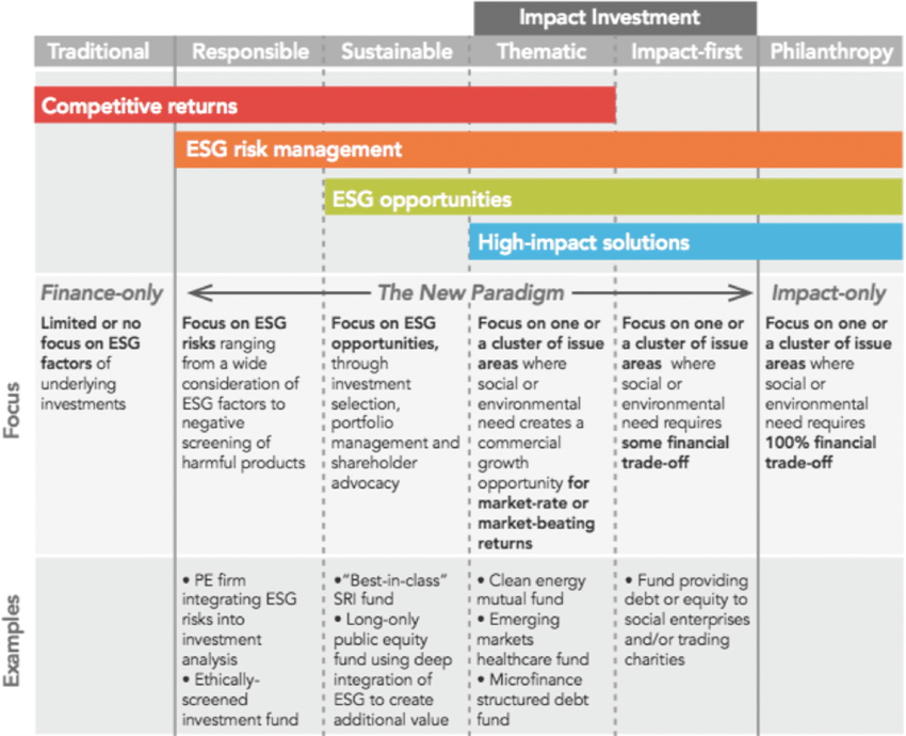
“Traditional investment”, when we put our savings into a bank with no ethical policies, is literally funding loans for expanding oil and gas infrastructure, among other things we might not want to support, like weapons, gambling, deforestation, livestock and so on.
If we consider environmental, social and governance (ESG) concerns, we can see which companies and industries our financial providers invest in and then move our money to those providers whose investment strategies align with our own ethical values.
“Ethical investing” involves real costs and risks but, once we’ve seen what traditional financial institutions do with our money, we’re unlikely to be happy with the status quo.
“Impact investment” is a further step, with higher risk and little promise of financial returns, where we choose to invest in social enterprises or businesses that exist to deliver changes that we believe in. As examples, these could be local community assets like pubs and clubs or nature restoration ventures promoting community land ownership for social and ecological reasons, like Common Nature Ltd: https://commonnature.uk
“Philanthropy”, which literally means love of humanity, is the far end of this spectrum. This is where we choose to give money to causes that matter to us, with no ownership and no possibility of financial return. When these causes are charities registered in Britain, the Treasury (HMRC) will donate an extra 25% of gifts received from taxpayers who complete Gift Aid forms in respect of their donations.
Higher rate taxpayers can offset charitable giving against their higher rate tax liability. Charitable giving can also be part of estate planning because these bequests are not subject to inheritance tax and, if the deceased leaves more than 10% of their estate to charity, the rate of IHT payable on the residual estate is reduced from 40% to 36%.
4 Use your voice
Community and political actions can have a greater impact than our lifestyle choices. Who we vote for and the organisations and activities we engage with can multiply the beneficial impacts of our personal changes. There are groups of concerned citizens in every town who want to connect with like-minded people, to discuss their hopes and fears and to act together, to make the changes that we so desperately need.
This might involve lobbying local authorities to support climate and nature, championing conservation opportunities or protesting environmentally damaging developments — just to name a few responses.
Nationally and internationally, it’s incredibly hard to change the economic system that prevents meaningful action to limit manmade global warming. What we can do is support non-governmental organisations (NGOs) whose campaigns we really believe in. They can’t do anything without public engagement and funding.
Prominent NGOs in the climate change space include:
https://www.theclimatecoalition.org
We can also lobby our political representatives to act decisively against the industries responsible for global warming. There have been some incredible legal successes in the Netherlands and elsewhere, holding polluters responsible for the consequences of their actions and opening the way to further lawsuits to compensate people who have been injured by their emissions. https://uitspraken.rechtspraak.nl/details?id=ECLI:NL:RBDHA:2021:5339
There is currently a climate justice campaign to hold the British Government to its legal commitments in the Climate Change Act: https://glanlaw.org/cases/climate-justice-case-with-good-law-project
Similarly, the mayors of capital cities including Paris and London have greatly improved the health and wellbeing of their citizens by eliminating most of the pollution from domestic transport, as beautifully depicted in this video from the Grantham Institute: https://www.youtube.com/watch?v=Adb5VgEW5UQ
5 Learn more about it
My awareness of climate change began with the publication of Al Gore’s remarkable book, “An Inconvenient Truth”, in 2006.
The contemporary bible for this all-encompassing topic is “The Climate Book” (2022), edited by Greta Thunberg. Do not let the images and stories of this young campaigner stop you from picking up this book, it’s been written by some of the most eminent scientists, economists, philosophers and distinguished authors of our time.
To cut through the complexities of climate science, watch this series of videos with comedians translating the messages of academics like Professor Mark Maslin, Professor Joanna Haigh and others. Some of the language is not suitable for work but it’s highly appropriate to getting the magnitude of the challenges across to us. https://www.climatesciencebreakthrough.com
A slim volume in the style of Sun Tzu’s “The Art of War” was published in 2021 by Mark Maslin, called “How to Save our Planet — The Facts”. It’s full of pithy prescriptions and sets out multiple paths for progress so it’s a must read for all who care about the habitable climate we are destroying.
The latest title to have touched my heart is “Human Nature” (2026), a truly poignant read by Kate Marvel, the leading climate scientist who resigned in March from NASA’s Goddard Institute for Space Sciences (GISS).
I’m currently reading geologist Bill McGuire’s “The Fate of the World” (2026), which sets out the climate history and future of Earth. It’s not the best news — the supercharged climate we’re living through now is the mildest climate we will ever experience in future.
6 Never give up
Professor Katharine Hayhoe is an unusual and inspirational character, a leading climate scientist and an evangelical Christian. This gives her voice unique access to religious communities around the world and also to all those who seek to inspire others to recognise and act to minimise the causes of climate change. Katharine says that dropping more bad news upon people who don’t know how to deal with it just reinforces their avoidance of the issue. Instead, we have to spread hope by sharing positive stories and demonstrating that solutions exist — we simply need the political will to use them.
Regius Professor of meteorology and climate science at Reading University, Hannah Cloke OBE, describes this as “imagination infrastructure”. Re-imagining small things in our lives, like clean air and school streets where children can walk safely to and from school, allow us to see a liveable future. The Climate Stripes, developed by Ed Hawkins (another Professor of meteorology at Reading University) have become an instantly recognisable shorthand for global warming: https://showyourstripes.info

It’s tempting to try and draw simple conclusions from this incredibly broad subject but the truth is that climate change is an existential threat to humanity, multiplying all the other risks (drought, floods, starvation, disease) and fomenting wars for the diminishing resources left to us.
The best we can do now is to minimise our personal contributions to global warming, divest our money from the principal sources of manmade greenhouse gas emissions — which are fossil fuels and the livestock industry — and demand social and political action to cut global emissions of greenhouse gases to zero with maximum urgency.
Every Tonne of carbon that we leave in the ground is a blessing for future generations, who will avoid the additional global warming that burning it would inflict upon them.
The last word goes to Professor Hugh Montgomery, OBE, who leads a British campaign group called Real Zero that focuses on the health sector and has a superb team of medical doctors, academics, humanitarians and artists. Real Zero proposes seven actions we can each take to reduce global warming: https://www.realzero.earth/7-acts-1

메타데이터
- post_id
- 6bf0dd6fe41b
- slug
- a-climate-response-6bf0dd6fe41b
- url
- https://medium.com/@cutyourcarbon/a-climate-response-6bf0dd6fe41b
- canonical_url
- https://medium.com/@cutyourcarbon/a-climate-response-6bf0dd6fe41b
- author_url
- https://medium.com/@cutyourcarbon
- status
- ok
- fetched_at
- 2026-07-15 10:15:25