The Brilliance of AEW’s Entrance Tunnels
All the stage is a stage.
The Brilliance of AEW’s Entrance Tunnels
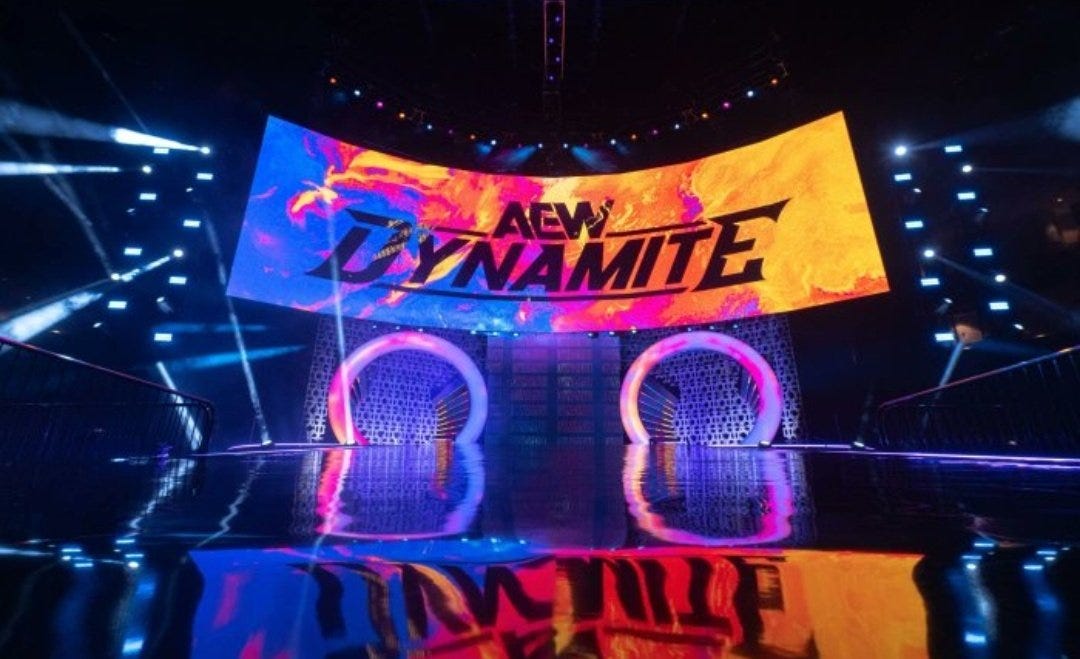
Pro wrestling is famous for many things that are not wrestling — cocaine, soap opera silliness, large men yelling very loudly — but perhaps the most enduring and iconic are the entrances. The sting of theme music, the burst of pyrotechnics, the emergence of a larger-than-life star; plenty of sports give their athletes “walk-out songs,” but wrestling elevates it to another level, providing the audience with a rhythm and melody that becomes synonymous with their favorite performers.
For many years, this was enough. The wrestling entrance served to herald the arrival of a new character onto the stage, get the crowd engaged, and keep the show moving. But subtly and slowly, one company has turned the very act of walking out on stage into a narrative device. Building on ideas established back in the old days of kayfabe — the illusion and performance of reality maintained by wrestlers at all times — All Elite Wrestling has been able to give performers one more tool in their arsenal to develop a distinct personality and communicate it to the viewers.
Before the scripted nature of pro wrestling was common knowledge (or, at least, openly discussed) wrestlers were expected to adhere to their characters both on and off the clock. If they were spotted in public, they should answer to their ring names and behave in line with how they were seen by the general public. Many villainous characters were given face paint, masks, and elaborate gimmicks in part to allow the performers to live normal lives without dealing with hostility or aggression from “marks:” the fans who bought into the story and, consciously or not, treated everything they saw on-screen and in the ring as real.
As such, rule number one was that babyfaces (good guys) and heels (bad guys) were not to be seen hanging out with each other. Most famously, all-American “Hacksaw” Jim Duggan and foreign menace The Iron Sheik were busted for drug possession while driving to a show together in 1987; for many, that was enough to shatter the illusion, but if asked, WWF and its superstars would still assert that faces and heels had separate locker rooms and did not associate with one another.
As the realities of pro wrestling became widely understood by the fans, it became harder and harder to get people to buy into the clear-cut, Saturday morning cartoon-style Upstanding Noble Hero and Wretched Cowardly Villain characters in wrestling. The entertainment world was moving on — hair metal was out, grunge was in, and if wrestling wanted to keep with the times, it would have to change. Different companies took different approaches to keep people engaged; WCW introduced the New World Order, a group of former WWF stars who were presented as “renegades” trying to take over the company. This storyline also introduced backstage cameras and “behind-the-scenes” fights — elements of wrestling that are commonplace today, but at the time genuinely blurred the line of fiction and reality in an attempt to get viewers to question how much of what they were seeing was truly scripted.
WWF, meanwhile, focused on the model that had made them successful: building top stars and getting fans to pay to see them. But instead of your Hulk Hogans and Jake “The Snake” Roberts, you had characters that dealt more in shades of grey. Stone Cold Steve Austin is probably the best example of this; he didn’t act like a “good guy” was supposed to, he drank, swore, brawled, and made his opinions known regardless of who was around. But when push came to shove and the villains were getting a bit too villainous, Stone Cold would always be there to lay an ass whooping in the name of justice — and this endeared him to the fans. He felt less like a caricature and more like a real person, someone with a thorny side who might rub people the wrong way, but with a good heart underneath.
This became the model that WWE continued past their name change and into the modern era. If you ask WWE executives today, they give you an answer like “we don’t have good guys and bad guys, we just have wrestlers.” But internally, they still keep everyone on a list of Face or Heel to organize writing and booking of matches, and for 99% of on-screen personae, it’s pretty clear whether you’re supposed to cheer or boo. Many wrestlers in the modern day also stay in character online or when meeting fans, trying to bring back the spirit of kayfabe and convince people that what they’re seeing is real — at least, convince them for long enough that they can buy into what you’re selling.
All Elite Wrestling, though, takes a slightly different approach.
To a casual observer, things are mostly the same. Wrestlers can largely be sorted into hero and villain roles, which are immediately evident to viewers and are maintained in the performers’ presence outside of the ring. Where they differ, though, is in one crucial element: how (or to be more precise, where) they come out on-stage.

The two tunnels that flank the entrance ramp for the majority of AEW events represent the two “locker rooms” that exist in kayfabe, and anyone who watches to see who enters where will quickly catch on to this fact, even though it’s rarely mentioned outright. To our right (stage left), the babyface tunnel, which we can see in occasional backstage glimpses is directly in front of the producer position where CEO/Head of Creative Tony Khan and company are posted up. On the opposite side, emerging from the left tunnel (stage right) are the heels, with their locker room away from leadership.
Not only does this follow in the tradition of old wrestling kayfabe, with antagonistic wrestlers separated until the moment they get in front of the cameras, it also gives wrestlers a small but important choice to make. There is the choice that the real-life performer has to make, obviously, but more interestingly, within the world of wrestling, each wrestler actively chooses how they come out. They’re not assigned a tunnel, they make the decision within kayfabe to let the audience know how they define themselves. Sometimes, performers will vary which tunnel they enter through depending on who they’re with; Bryan Danielson, for much of his early AEW run, entered by himself through the heel tunnel, but would join Wheeler Yuta at the face tunnel when teaming with his young, pure-hearted protege. Some wrestlers, like Jon Moxley, choose to forgo the binary choice of the stage altogether and enter through the crowd, calling back to the shades of grey of his predecessors like Stone Cold. Others might view themselves as “above” the normal entrance tunnels and enter via a fancy elevator in the center of the stage instead, as The Elite currently do. Often, after a dramatic betrayal of a fan favorite friend, a wrestler who had entered to our right will pause and decide to exit through the tunnel on the left. Regardless, the small and otherwise thoughtless act of stepping out on stage becomes part of the narrative.
But when it comes to using the tunnels to help further a story, there is no better example than that of Hangman Adam Page.

After being kayfabe suspended by The Young Bucks four months prior, Hangman Page made his return to AEW in July as the mystery participant in the Owen Hart Cup Tournament. He did so with a new entrance theme and video, and dramatic low lighting that obscured his face… but he did so through the babyface tunnel. Even though the last time we saw him, he was assaulting referees and tapping out to deny his arch-rival Swerve Strickland the World Championship.
In the following match against Jeff Jarrett, Hangman maintains a furious, crazed expression from bell to bell. Jarrett, formerly a heel, is extremely sympathetic in this match, having expounded upon his personal history with Owen and desire to win the tournament in his late friend’s honor. Hangman, meanwhile, is vicious and unrelenting, going overboard with his offense even after he has the match won. The crowd chants for Swerve and he fumes, brow ever-furrowed. The crowd boos as he gets the pinfall victory. He is, as far as wrestling psychology is concerned, definitely a heel. He exits through the face tunnel.
As we learn more about Hangman’s motives in the following weeks, we get an insight into how deeply Swerve’s past actions have affected him, and how desperately he feels he needs to avenge the injustices enacted upon him and his family (for the uninitiated, this includes a home invasion and threatening of an infant child). The fans, in his eyes, betrayed him when they chose to cheer for Swerve as their World Champ. But he hasn’t done anything wrong. He’s still the good guy.
After two months of entering through the face tunnel, despite boos and jeers following him wherever he goes, Hangman has decided that enough is enough, and with his enemy having crossed a line into his personal life, he will do the same. Only much worse.
Hangman torches Swerve Strickland’s childhood home. In the words of the AEW commentary team, “Adam Page can no longer tell himself that he walks a righteous path.”

Three days later, Hangman has allowed his anger to fully consume him. He no longer has any interest in convincing the audience that he’s in the right, he just wants to hurt those who have wronged him. He enters through the heel tunnel.
메타데이터
- post_id
- 6c005bd3cb89
- slug
- the-brilliance-of-aews-entrance-tunnels-6c005bd3cb89
- url
- https://medium.com/@ianjwhitsitt/the-brilliance-of-aews-entrance-tunnels-6c005bd3cb89
- canonical_url
- https://medium.com/@ianjwhitsitt/the-brilliance-of-aews-entrance-tunnels-6c005bd3cb89
- author_url
- https://medium.com/@ianjwhitsitt
- status
- ok
- fetched_at
- 2026-06-21 20:33:08