Advanced Laparoscopic Fertility Treatment
Punya Hospital
Advanced Laparoscopic Fertility Treatment
Punya Hospital
For a lot of couples, the idea of becoming parents is really one of life’s most cherished hopes. But when fertility challenges show up, the whole path can become emotionally, and physically, pretty heavy . Still, medical science keeps moving forward, and fertility care has changed a lot. Today there are safer, more effective, and generally minimally invasive options, that feel less disruptive than people expect. One such advancement is **Advanced Laparoscopic Fertility Treatment**, and it has slowly become the go to method for identifying and managing many kinds of conditions linked to fertility.
At Punya Hospital, we recognize how infertility can weigh on someone, sometimes quietly but intensely. Because of that, we focus on empathetic and evidence-based care, shaped around each patient’s own situation. Our experienced gynecologists and fertility specialists use Advanced Laparoscopic Fertility Treatment to get a clearer, more accurate diagnosis, while also supporting better odds for natural conception or, if needed, assisted reproductive success.
In this blog, we’ll walk through how Advanced Laparoscopic Fertility Treatment works , who may benefit from it, and why it has become such an important piece of modern fertility care.
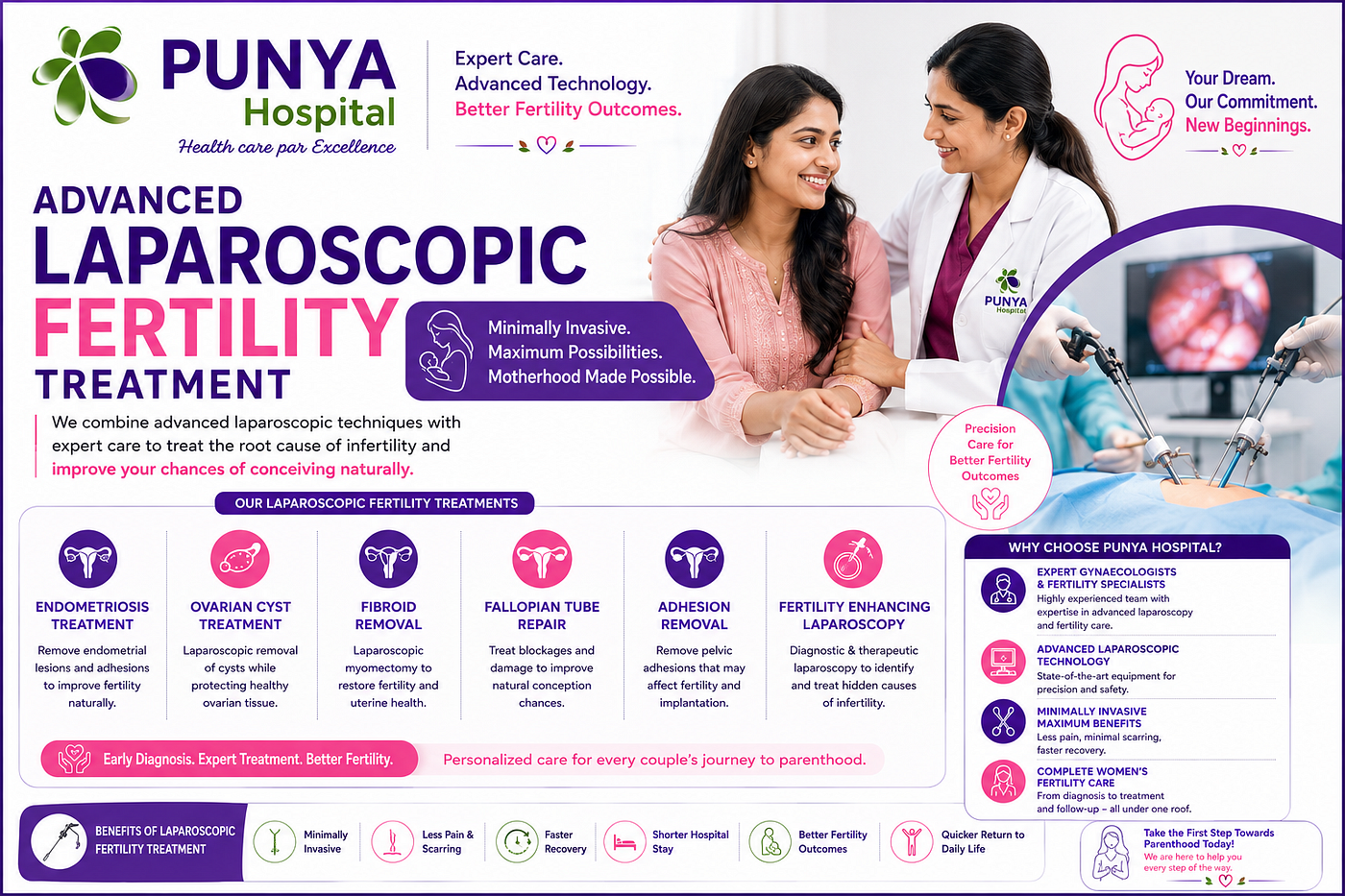
Advanced Laparoscopic Fertility Treatment
What is Advanced Laparoscopic Fertility Treatment?
Advanced Laparoscopic Fertility Treatment is a low impact surgical approach , sort of minimally invasive , that lets fertility experts check and fix issues tied to the female reproductive organs. They do this through small incisions, then use specialized instruments, so everything stays more controlled than in older methods.
Unlike traditional open surgery, laparoscopy works by putting in a tiny camera through a small cut near the navel. With that setup doctors get a magnified look at the uterus , ovaries, fallopian tubes and other pelvic tissues around them. So it becomes easier to spot what s causing infertility, and then correct fertility related problems with more accuracy.
Since it is minimally invasive, most patients usually notice things like:
- smaller incisions
- less pain after surgery
- reduced blood loss
- faster recovery
- minimal scarring
- and a quicker back to regular day to day life
At Punya Hospital, Advanced Laparoscopic Fertility Treatment is carried out with modern equipment and advanced surgical techniques, aimed at maximizing safety and improving reproductive outcomes overall.
Why is Laparoscopy Important in Fertility Care?
A lot of reproductive problems can’t be completely worked out using ultrasound, or just normal imaging stuff alone. Laparoscopy gives a direct view of the pelvic organs, so clinicians can spot those less obvious abnormalities, that might mess with conception, even when scans look okay.
In the Advanced Laparoscopic Fertility Treatment category, some frequent fertility challenges are diagnosed and treated like this:
Endometriosis
Endometriosis happens when lining-like tissue, similar to what normally grows inside the uterus, starts growing outside the uterus. It may lead to:
- Chronic pelvic discomfort
- Very painful periods
- Sharp pain during sex
- Trouble becoming pregnant
With laparoscopic surgery, endometriotic lesions can be removed, while healthy reproductive tissue is kept intact as much as possible.
Blocked Fallopian Tubes
Healthy fallopian tubes are, like really important for fertilization. But scar tissue can form, infections can happen, or someone may have had prior surgeries and then these tubes get blocked, kind of stopping everything.
With Advanced Laparoscopic Fertility Treatment, surgeons sometimes can repair the blocked tubes, or carefully take away scar tissue so fertility has a better chance again.
Ovarian Cysts
Some ovarian cysts, especially endometriomas, may mess with ovulation and fertility. It’s not just “a cyst” and done, it can be more… tricky.
By removing problematic cysts using a minimally invasive approach, ovarian function is usually preserved while reproductive health improves.
Pelvic Adhesions
Adhesions are bands of scar tissue that can appear after infections , surgeries, or endometriosis. They can be kind of sneaky because they don’t always cause pain right away.
These adhesions may limit how reproductive organs move, and that makes conception harder, or at least less likely.
Laparoscopic surgery can safely remove the adhesions and bring pelvic anatomy back toward normal.
Fibroids
Some uterine fibroids can change the shape of the uterine cavity, or make embryo implantation more difficult.
Depending on where they sit and how large they are, laparoscopic removal may lead to noticeably better fertility outcomes.
Who Can Benefit from Advanced Laparoscopic Fertility Treatment?
Your fertility specialist could suggest Advanced Laparoscopic Fertility Treatment if you have some of the following, for example infertility that has no clear cause, persistent pelvic discomfort, or suspected endometriosis and things like that. It might also be an option when there’s recurrent miscarriage, ovarian cysts, blocked fallopian tubes, pelvic adhesions, or uterine abnormalities. Even when ovulation seems regular, some people still experience difficulty conceiving , so this kind of approach may come up as well.
At Punya Hospital, each patient gets a thorough fertility assessment first, before any surgery is advised. The treatment pathway is always customized to suit your personal medical situation as well as your reproductive objectives.
How is the Procedure Performed?
The procedure is usually done under general anesthesia
Step 1: Small Incisions A tiny cut is made close to the navel, along with one or two more small incisions down in the lower abdomen.
Step 2: Camera Insertion A laparoscope, with a high-definition camera attached, is put in so it can show clear images of the reproductive organs, in real time.
Step 3: Diagnosis The surgeon looks very carefully at the whole area, including:
- Uterus
- Ovaries
- Fallopian tubes
- Pelvic cavity
This kind of viewing can help spot problems that might not show up on routine scans.
Step 4: Treatment If something is found, it can often be addressed right away using specialized laparoscopic tools
This may involve:
- Removing endometriosis
- Opening blocked tubes
- Taking out cysts
- Reducing adhesions
- Removing selected fibroids
Being able to both diagnose and treat problems within the same session is what makes **Advanced Laparoscopic Fertility Treatment** highly effective.
Benefits of Advanced Laparoscopic Fertility Treatment
Compared to conventional surgery, laparoscopic fertility procedures can give a few real advantages , in a sort of more clear way.
Greater Diagnostic accuracy Surgeons get a direct, close up view of the reproductive organs, so the doctors can pinpoint fertility related problems more precisely . That helps the evaluation feel less guessy.
Simultaneous Diagnosis and treatment Often the diagnosis and treatment happen during the same visit, or same procedure, which cuts down those annoying delays in fertility care .
Faster Recovery Most patients bounce back much quicker than after open surgery , and they usually feel more steady sooner .
Minimal scarring Because they use small incisions, the cosmetic outcome tends to look better, and the visible marks are generally reduced .
Reduced chance of Infection Smaller wounds mean there’s usually less exposure, so postoperative complications related to infection can be lower .
Better Fertility results When the root reproductive issue is handled , the chances for natural conception may improve, or fertility treatment success can be boosted, like with IVF.
Recovery After Surgery
Recovery is usually smooth, and yes pretty quick too.
Most folks can:
- Go back home within 24 hours,
- Start light activities in a few days ,
- Go back to work within a week,
- And feel fully recovered in about two to four weeks
Doctors often advise pausing intense training for a short while while everything is still repairing itself.
At Punya Hospital, our team offers full post-op guidance and steady check-ins so recovery stays on track, and also to help optimize fertility outcomes .
Can Pregnancy Occur Naturally After Laparoscopy?
Yeah, I mean sometimes women end up conceiving naturally after those older fertility problems are actually addressed and, well corrected. But of course, it’s not a simple or totally predictable story, because success tends to hinge on a mix of things like, Age, and the ovarian reserve, plus how intense the underlying reproductive conditions are, also overall reproductive health in general. And don’t forget male partner fertility, since that part matters too.
In some couples, a laparoscopy might remove the necessity for more advanced fertility treatments, while in other cases they still go ahead with IVF but with better odds, and honestly that can feel like a huge shift.
Why Choose Punya Hospital?
Choosing the right fertility center is , kind of , a big decision:
At Punya Hospital, patients get thorough fertility care from seasoned specialists who blend modern technology with caring guidance. And yes it can feel a little overwhelming at first , but you don’t have to handle it alone.
Some of our strong points are pretty clear, like:
- Experienced gynecologists and laparoscopic surgeons
- Personalized plans for fertility treatment
- Advanced minimally invasive surgical approaches
- Complete reproductive health assessment
- Up-to-date operation theatres
- Care that stays focused on the patient
- Ongoing follow-up and counseling
We truly believe every fertility journey should be met with individual attention, plus evidence based treatment, so the odds of a successful pregnancy are as high as possible.
When Should You Consult a Fertility Specialist?
You may want to seek medical advice if, say, you’re under 35 and you just haven’t conceived after 1 year of trying, without it happening naturally. If you’re 35 or older and you’ve been trying for 6 months and still nothing, it’s also a good time to talk with a professional. Another sign is when your menstrual cycles are irregular or they feel more scattered than usual. Also consider getting checked if you have severe periods pain, like pain that really interrupts daily life, not just mild discomfort.
If you’ve had recurrent pregnancy loss, or if you already know you have endometriosis, or pelvic infections, then don’t wait too long. The same goes if you’ve had previous pelvic surgery, because sometimes it can affect fertility later on. Overall, an earlier diagnosis usually means there’s a better chance for more effective care and improved reproductive outcomes.
Conclusion
Infertility can feel very hard, but nowadays medicine gives a real chance , especially with minimally invasive surgical methods. In a lot of cases, **advanced laparoscopic fertility treatment** has changed how people handle fertility care, because it helps with precise diagnosis , better treatment options, quicker healing and often stronger pregnancy results.
At Punya Hospital, our focused specialists are ready to support couples who face these difficulties with empathetic attention and sharp medical skill. So whether you’re looking for clarity in unexplained infertility , or you need help with a known reproductive issue, our team will stay beside you as you move through each step, with the goal of reaching your dream of parenthood.
메타데이터
- post_id
- 6c2f463cc130
- slug
- advanced-laparoscopic-fertility-treatment-6c2f463cc130
- url
- https://medium.com/@pratyushkumar.sahoo1999/advanced-laparoscopic-fertility-treatment-6c2f463cc130
- canonical_url
- https://medium.com/@pratyushkumar.sahoo1999/advanced-laparoscopic-fertility-treatment-6c2f463cc130
- author_url
- https://medium.com/@pratyushkumar.sahoo1999
- status
- ok
- fetched_at
- 2026-08-11 17:20:30