Enterprise Access Control System for Secure UAE Facilities
Every enterprise facility in the UAE-whether a multi-tower corporate campus in Dubai’s Central Business District, a sovereign wealth fund…
Enterprise Access Control System for Secure UAE Facilities
Every enterprise facility in the UAE-whether a multi-tower corporate campus in Dubai’s Central Business District, a sovereign wealth fund headquarters in Abu Dhabi, or a critical utility substation on the outskirts of Sharjah-shares one foundational security requirement: a reliable, scalable **Access Control System that enforces the right of entry for the right people, at the right time, with an auditable record of every decision. As the UAE’s digital economy, free zone ecosystem, and government services infrastructure continue their rapid expansion, the complexity of managing physical access across hundreds of doors, dozens of buildings, and thousands of enrolled users demands enterprise-grade platforms-not commodity readers and basic controllers. Tektronix LLC, a SIRA-licensed, ISO-certified integrator with over 500 deployments since 2009, engineers and delivers Access Control Solutions** that grow with your organisation, satisfy UAE regulatory requirements, and integrate with the broader security and building intelligence ecosystem your facility depends on.
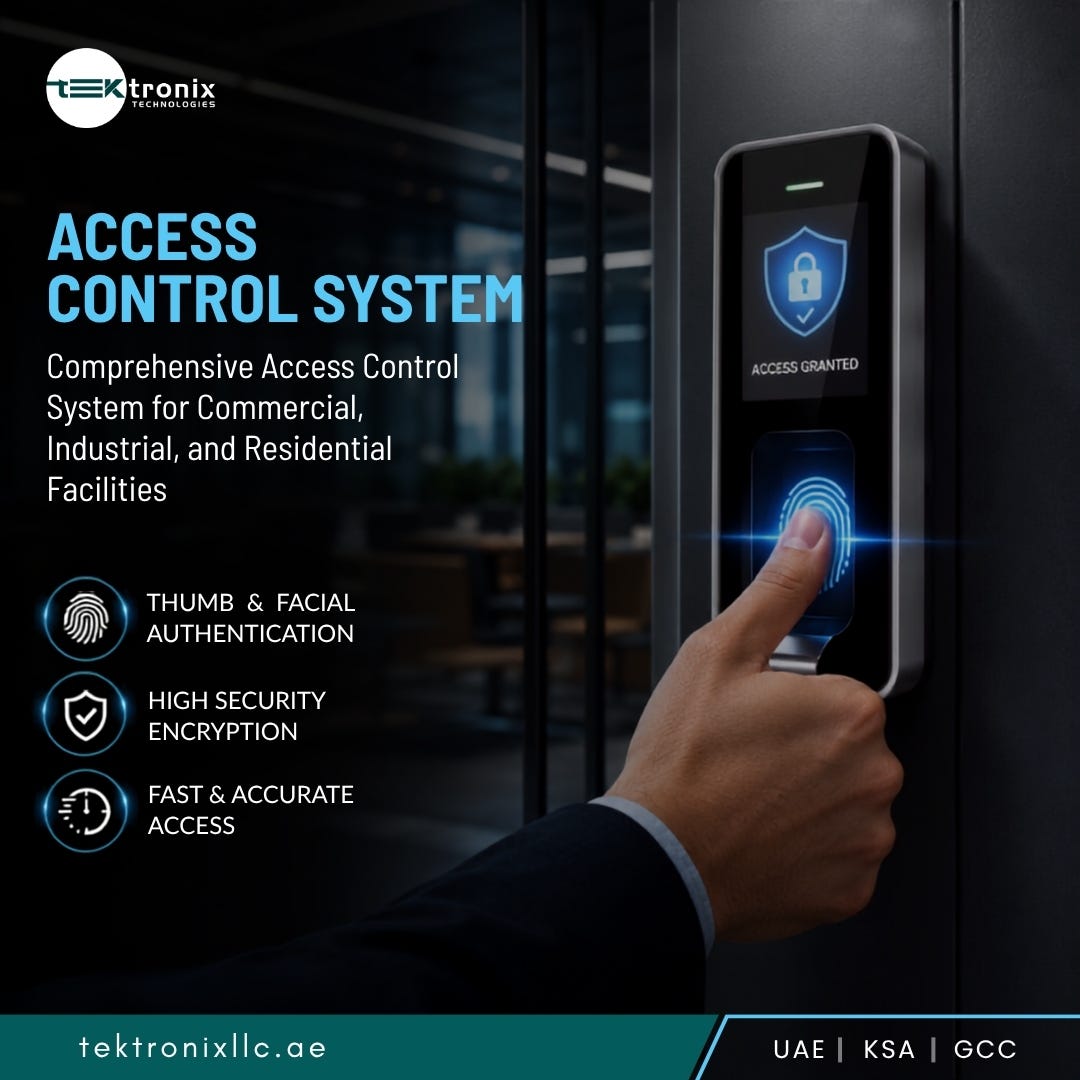
This article takes an enterprise architecture perspective on access control-examining how large, multi-site organisations in the UAE should approach system design, platform selection, identity lifecycle management, cybersecurity hardening, and long-term operational governance to derive maximum security, compliance, and operational value from their investment.
Enterprise vs. SME Access Control: Why Architecture Decisions Matter
The distinctions between a departmental access control deployment and a true enterprise Advanced Access Control System go far beyond the number of doors. Enterprise deployments must address identity federation-synchronising enrolled user records with Active Directory, SAP HR, or Workday so that access rights are provisioned automatically on day one and revoked the moment an employee exits the organisation. They must support multi-tenancy-partitioning a shared platform so that a free zone landlord can manage building-level access while individual tenants manage their own floor-level policies independently, without either party seeing the other’s data. They must enforce geographic separation-ensuring that an access credential issued for a Dubai office cannot be used in an Abu Dhabi facility unless explicit cross-site permissions have been granted. And they must deliver forensic-grade audit trails-producing the timestamped, tamper-evident access logs that SIRA, NESA, and CBUAE auditors expect to see during compliance inspections.
Tektronix LLC’s enterprise access control engagements begin with an architecture workshop that maps the client’s organisational structure, HR lifecycle workflows, building topology, and regulatory obligations onto a platform design that addresses all these dimensions from day one-preventing the costly retrofits that result from deploying an SME product to serve enterprise requirements.
Biometric Access Control Dubai: Eliminating Credential Sharing in High-Value Environments
In any access control deployment, the weakest link is the credential itself. A proximity card can be borrowed, cloned, or lost without the badge holder reporting it. A PIN can be observed, shared between colleagues, or written on a notepad. The only authentication factor that is genuinely non-transferable is biometric-and this is precisely why Biometric Access Control Dubai deployments have become the standard for enterprise-grade installations across banking, healthcare, legal, and government sectors in the emirate.
Fingerprint Recognition
Suprema’s BioStation series-deployed by Tektronix LLC as a Suprema Certified Installer-delivers 1:N fingerprint identification across databases of up to 500,000 templates in under one second, using a fake finger detection algorithm that rejects silicone, gelatin, and 2D paper spoofing attempts. For environments where hand contamination from industrial or clinical work may affect fingerprint capture quality, Tektronix LLC configures multi-sample enrollment that averages across ten captured images per finger, improving matching reliability under challenging skin conditions.
Facial Recognition
HID Amico and Suprema FaceStation deployments provide contactless, hygienic authentication at sub-second speed-enabling high-throughput entry at corporate lobby turnstiles, data centre mantrap airlocks, and hospital restricted zone doors where card or fingerprint contact would introduce hygiene concerns. Liveness detection prevents photograph and mask spoofing, and the wide-angle capture zone accommodates varying user heights and natural walking posture without requiring users to stop and reposition at the reader.
Multi-Factor Authentication Configurations
For the highest-security zones-executive floors, server rooms, treasury vaults, and pharmaceutical storage-Tektronix LLC configures three-factor authentication combining smart card (something you have), fingerprint or facial recognition (something you are), and PIN (something you know). The controller enforces all three factors simultaneously before the door release signal is issued, and any single factor failure prevents access regardless of the other two succeeding-eliminating partial-authentication bypass vulnerabilities.
Security Access Control System: Hardening the Platform Against Cyber and Physical Attack
An enterprise Security Access Control System is itself a networked computing infrastructure -comprising IP-connected readers, panel controllers, management servers, and database platforms-and must therefore be secured against cyber-attack with the same rigour applied to any other critical business system. Tektronix LLC’s cybersecurity hardening methodology for access control deployments covers every layer of the platform stack:
• Network Segmentation: Access control devices are placed on a dedicated VLAN isolated from corporate LAN traffic, with firewall policies permitting only the specific management ports required for controller-to-server communication and reader-to-controller signalling
• OSDP v2 Encrypted Reader Communication: Open Supervised Device Protocol version 2 replaces legacy Wiegand connections between readers and controllers with an encrypted, bidirectional channel that detects tampering, prevents signal replay attacks, and alerts the management platform when a reader is physically removed or substituted
• TLS-Encrypted Management Traffic: All communication between access control controllers and the management server is encrypted using TLS 1.3, preventing credential data and access policy configurations from being intercepted on the network
• Role-Based Administrative Access: Management platform accounts are provisioned with least-privilege roles-receptionists can register visitors, security officers can view logs, and only designated system administrators can modify access policies or enroll new credentials
• Tamper Detection and Audit Logging: Every controller and reader generates a tamper alert event when its housing is opened, and all administrative actions on the management platform are logged with operator identity, timestamp, and the specific configuration change made-creating an immutable audit trail for ISO/IEC 27001:2022 internal audit purposes
Door Access Control System: Hardware Selection and Installation Standards
The physical enforcement point of every access policy is the door-and the quality, specification, and installation standard of the **Door Access Control System** hardware at that door determines whether the policy is enforced reliably or circumvented by mechanical failure, power outage, or deliberate attack. Tektronix LLC’s hardware selection and installation methodology addresses the full door assembly:
Electric Locking Hardware
Electromagnetic locks (mag-locks) rated at 600 lbs for standard interior doors and 1,200 lbs for security perimeter doors provide the holding force required to resist forced entry attempts. Fail-safe configurations-where the lock releases on power loss-are applied to fire egress paths in compliance with UAE Civil Defence requirements. Fail-secure configurations — where the lock remains engaged on power loss-are applied to security perimeter doors and vault entries where maintaining containment during a power outage is the priority. Every installation includes a request-to-exit (REX) sensor on the secure side, a door position sensor for the management platform’s real-time door status display, and a break-glass emergency release unit compliant with UAE Civil Defence evacuation requirements.
Reader and Controller Mounting
Reader mounting height, backbox depth, and conduit routing are specified per manufacturer installation guidelines and SIRA performance standards, ensuring consistent read range performance and tamper resistance. Controller panels are installed in locked, ventilated enclosures in secure IDF rooms, with battery backup providing a minimum four-hour standalone operation duration during mains power interruption-aligning with SIRA’s business continuity requirements for security system installations in Dubai.
Access Control Device: Selecting the Right Reader for Every Application
The Access Control Device at the door-the reader that captures and transmits the credential for controller-side authentication-must be specified for the specific environmental, security, and throughput demands of its location. Tektronix LLC’s product portfolio spans the full spectrum of enterprise reader requirements:
• HID iCLASS SE and SEOS Readers: Smart card readers supporting AES-encrypted credentials for corporate office and government deployments requiring FIPS 201 or equivalent credential security standards
• Suprema BioStation 3: Multimodal biometric reader supporting fingerprint, face, QR code, and mobile credential simultaneously-ideal for enterprise lobbies where diverse authentication methods must be accommodated without deploying multiple reader types
• ZKTeco SpeedFace Series: High-throughput facial recognition reader supporting up to 50,000 face templates with mask detection capability-suited to large manufacturing and logistics facilities with high daily headcount
• Outdoor Ruggedized Readers: IP66-rated, IK10 vandal-resistant readers for perimeter gates, car park barriers, and external building entry points in UAE environments where temperature, humidity, and physical abuse resistance are primary selection criteria
• Long-Range UHF Readers: Vehicle credential readers with 6 to 10 metre read range for hands-free car park and logistics yard access-integrated with ANPR cameras for dual-verification of vehicle identity and driver credential simultaneously
Access Control System UAE: Multi-Site Management and Scalability
Managing an Access Control System UAE-wide estate-spanning facilities in Dubai, Abu Dhabi, Sharjah, and potentially GCC regional offices-from a single management platform is both an operational efficiency requirement and a security governance necessity. Tektronix LLC architects multi-site deployments on platforms that provide true centralised management with distributed controller intelligence:
Centralised Policy with Edge Autonomy
Access policies-which credentials are authorised at which doors during which time windows-are defined centrally and pushed to local controllers at each site. Should the WAN link between a remote facility and the central management server fail, the local controller continues enforcing the last-received policy autonomously, logs all access events locally, and synchronises the event log to the central server when connectivity is restored. This architecture eliminates the single-point-of-failure risk of server-dependent access control deployments and ensures security continuity during network outages.
Unified Credential Lifecycle Management
A single credential enrollment event-capturing biometric template, smart card UID, and personal identity data-provisions access rights across all sites simultaneously based on the employee’s role and organisational unit. When an employee is terminated, a single deactivation action in the management platform revokes their access rights at every door on every site in real time, eliminating the manual revocation delays that create credential overhang-one of the most common findings in SIRA and ISO 27001 access control audits.
Access Control System Dubai: Enterprise Deployments in the Commercial Capital
Dubai’s concentration of financial services, professional services, and technology enterprises creates access control demand characterised by high user volumes, frequent credential changes driven by project-based staffing models, and the need for seamless visitor integration with corporate reception workflows. An enterprise Access Control System Dubai deployment by Tektronix LLC for a typical DIFC or Business Bay corporate headquarters encompasses multi-floor tenant segmentation via the Genetec Security Center platform, turnstile integration at lobby level for tailgating prevention, visitor management system integration for pre-registered guest access, and Genetec Synergis cloud-link architecture for organisations whose IT governance requires SaaS-delivered access control management without on-premise server infrastructure.
Tektronix LLC’s status as a Genetec Gold Certified Partner is particularly valued by Dubai enterprise clients: Genetec Security Center’s open architecture supports over 300 access control hardware partners, protecting hardware investment when panel or reader technology is upgraded, and its unified video-plus-access interface eliminates the separate VMS and ACS operator consoles that fragment security operations in multi-vendor deployments.
Access Control System Abu Dhabi: Securing the Capital’s Institutional Infrastructure
Abu Dhabi’s institutional character-dominated by sovereign funds, federal ministries, energy sector headquarters, and major financial institutions -creates access control requirements defined by classified zone separation, mandatory ADGICT-compliant procurement documentation, and security clearance-linked access policy management. An enterprise Access Control System Abu Dhabi deployment by Tektronix LLC for a federal ministry or ADNOC affiliate typically incorporates security clearance level encoding in smart card credentials, so that a door controller can independently verify both the individual’s identity and their clearance level against the zone’s minimum clearance requirement-without requiring a server lookup for every authentication event.
Tektronix LLC’s engineering team holds Dahua Certified Engineer credentials and maintains active relationships with Abu Dhabi’s major system integrators and project management consultancies, enabling seamless coordination on main contractor-led infrastructure projects where the access control scope is part of a broader MEP or security systems package.
Conclusion: Build an Enterprise Security Foundation That Scales
An enterprise facility deserves an enterprise security foundation-one where the Access Control System is not a collection of independently managed door readers but a unified, policy-driven, identity-aware platform that integrates with HR systems, enforces compliance automatically, and delivers the forensic audit data that regulators and internal governance teams require. From **Biometric Access Control Dubai deployments eliminating credential sharing in high-value commercial environments to Advanced Access Control System** architectures protecting Abu Dhabi’s most sensitive institutional infrastructure, the difference between an adequate installation and a genuinely secure one lies in the architecture decisions made before a single cable is pulled.
Whether your requirement is a hardened Security Access Control System for a regulated financial environment, a scalable Door Access Control System spanning a multi-building campus, a precisely specified Access Control Device estate serving thousands of daily users, or a fully managed multi-site Access Control System UAE programme with 24/7 AMC support, Tektronix LLC brings the certified expertise, regulatory authority, and proven track record to deliver it.
Speak to Tektronix LLC’s enterprise security team today-explore our Access Control System Dubai and Abu Dhabi capabilities, and let us design the architecture your facilities deserve.
FAQs
Q1. How does Tektronix LLC handle access control integration with HR and identity management systems?
Tektronix LLC configures bidirectional integration between the access control management platform and the client’s HR or Identity and Access Management (IAM) system using REST API, LDAP, or SCIM protocol connections depending on the platform capabilities of both systems. When a new employee is created in the HR system, an automated provisioning workflow enrols them in the access control platform with access rights mapped to their role, department, and site-typically completing within 15 minutes of the HR record being activated. Termination events trigger immediate credential deactivation across all sites simultaneously. Tektronix LLC has successfully integrated with SAP SuccessFactors, Oracle HCM, Microsoft Azure Active Directory, and several UAE government HR platforms on enterprise deployments.
Q2. What is the difference between fail-safe and fail-secure door configurations, and how does UAE Civil Defence regulation affect this choice?
Fail-safe locks release (unlock) when power is lost, ensuring that occupants can always exit the building freely during a power failure or fire alarm event — a mandatory requirement for any door on a designated fire egress path under UAE Civil Defence regulations and the UAE Fire and Life Safety Code of Practice. Fail-secure locks remain engaged (locked) when power is lost, maintaining containment for security perimeter doors, server rooms, vault entries, and other locations where maintaining access restriction during an outage is the priority. Tektronix LLC’s design engineers specify locking mode based on both the security policy requirement and the fire egress designation of each door, documented in an as-built fire strategy matrix submitted to the relevant Civil Defence authority as part of the commissioning package.
Q3. Can the access control system generate reports for ISO 27001 and SIRA compliance audits automatically?
Yes. Tektronix LLC configures scheduled automated report packages for each client’s specific compliance reporting requirements. For ISO/IEC 27001:2022 Annex A control A.7.2 (physical entry controls), the system generates monthly access log summaries, dormant credential reports, access policy change logs with operator attribution, and failed authentication attempt reports by door and time window. For SIRA compliance, access event logs are retained for a minimum of 90 days in tamper-evident storage with export capability in formats accepted by SIRA’s inspection documentation requirements. Custom report templates are built during commissioning based on the client’s audit calendar and regulatory reporting obligations.
Q4. How does the system perform during internet or WAN outages in a multi-site UAE deployment?
Tektronix LLC architects multi-site deployments on distributed controller platforms where each site’s local controllers hold a full copy of the access policy database relevant to that site’s doors. During a WAN outage, local controllers continue authenticating credentials, enforcing time-schedule policies, and logging access events entirely independently of the central management server. When connectivity is restored, event logs are automatically synchronised to the central database and any policy updates made centrally during the outage are pushed to the local controllers. This architecture ensures that a network disruption-whether caused by an ISP fault, a cyber incident, or infrastructure maintenance-does not create an open-door condition at any secured entry point.
Q5. What ongoing services does Tektronix LLC provide to keep the access control system performing and compliant over time?
Tektronix LLC’s Annual Maintenance Contract for enterprise access control deployments includes quarterly preventive maintenance visits covering reader cleaning and optical calibration, controller battery and power supply testing, door hardware mechanical inspection, and firmware update management. Remote monitoring services provide 24/7 visibility into system health metrics-controller connectivity, reader tamper status, door fault conditions-with automated alerting to Tektronix LLC’s NOC and the client’s security team. Annual compliance reviews assess the access control configuration against current SIRA requirements, ISO/IEC 27001:2022 controls, and any updates to NESA or DESC frameworks applicable to the client’s sector. All services are backed by a guaranteed 4-hour on-site response SLA.
메타데이터
- post_id
- 6c3fa2ae75bb
- slug
- enterprise-access-control-system-for-secure-uae-facilities-6c3fa2ae75bb
- url
- https://medium.com/@tekmuzammil/enterprise-access-control-system-for-secure-uae-facilities-6c3fa2ae75bb
- canonical_url
- https://medium.com/@tekmuzammil/enterprise-access-control-system-for-secure-uae-facilities-6c3fa2ae75bb
- author_url
- https://medium.com/@tekmuzammil
- status
- ok
- fetched_at
- 2026-06-29 22:44:20

