Can We Stop the American Schism? Do We Want To?
Unbelievable as it sounds, we may be on the verge of a complete split between two different versions of what America should be
Can We Stop the American Schism? Do We Even Want To?
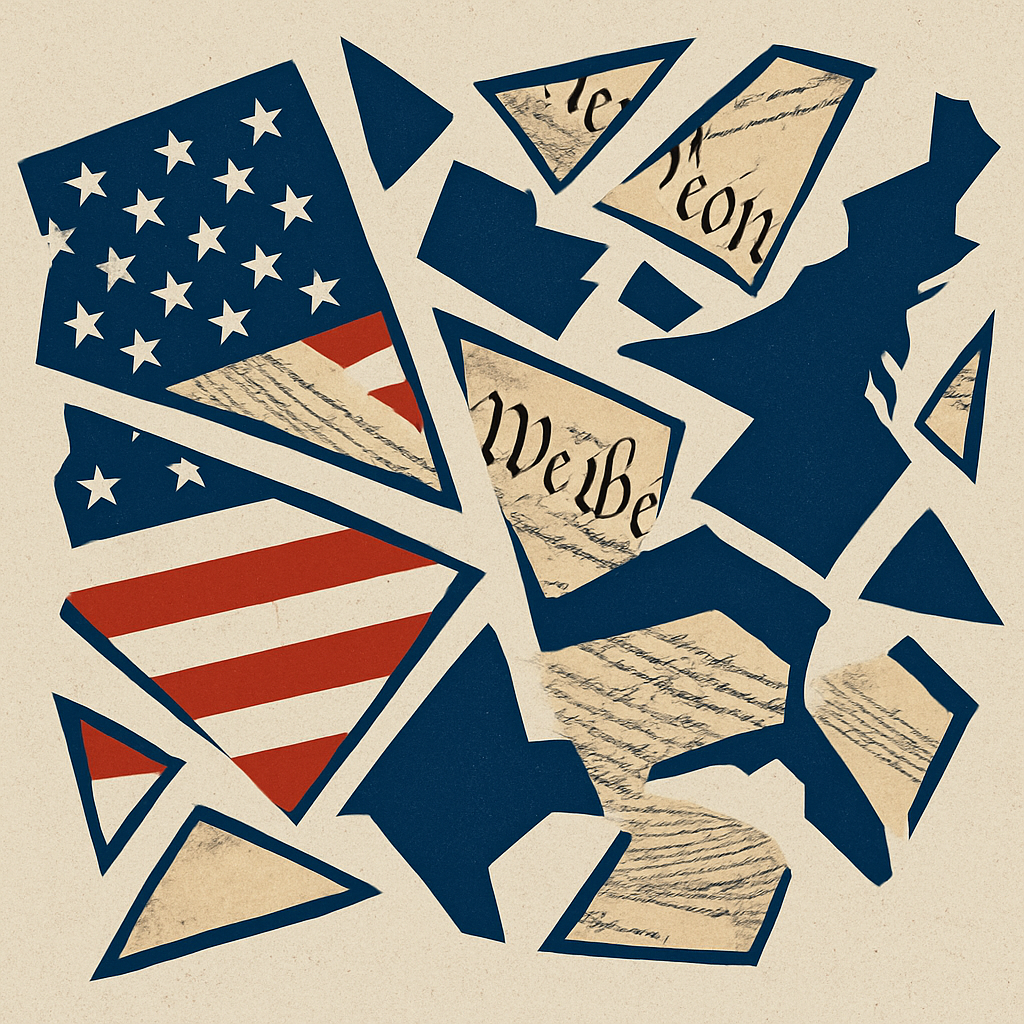
Image generated by ChatGPT
C’mon. We’re not really going to split up, are we?
Sure, we argue like hell. The shouting never stops. But haven’t Americans always argued? Red vs. blue, North vs. South, progressive vs. conservative, urban vs. rural — none of that is new. We’ve been calling each other idiots since Jefferson and Hamilton. We survived Watergate, Vietnam, even the Civil War (though that one got a little messy), and still came out waving the same flag.
So surely, we’re not actually going to break apart. Not for real. Right?
But… what if this time is different? What if a true American schism is coming — not all at once, but in fits and fractures, the way a glacier seems frozen until suddenly it isn’t? What if we’re already pulling away from each other — not just politically, but legally, culturally, morally? What if the quiet question isn’t “Will we split?” but “How far along are we already?”
It’s not as crazy as it sounds. And it wouldn’t be the first time the nation fractured under the weight of its own contradictions. When the United States split in 1861, it was after decades of moral and economic divergence. Slavery wasn’t just an issue — it was an identity, embedded in the Southern economy and psyche, but increasingly intolerable to the North. The political compromises that once papered over our differences stopped working. Both sides stopped believing they could be governed by the same laws — or even the same truths. And so the break came, in blood and cannon fire.
Other countries have parted ways more quietly. When Czechoslovakia dissolved in 1992, it wasn’t because of war — it was because the Czech and Slovak peoples, finally free of the Iron Curtain, realized they no longer wanted to share a government. No troops marched. No shots were fired. Just two nations, calmly going their separate ways. History now calls it “The Velvet Divorce.”
Then there are the messy splits — India and Pakistan, Yugoslavia, the Soviet Union. Separations born of trauma and fear, of people who no longer agreed on who they were or who they wanted to be. When identity and ideology collide, borders aren’t just lines — they’re lifeboats.
And now here we are. America, 2025.
One side wants a strongman; the other, a democracy. One sees immigrants as a threat; the other, as the future. In some states, abortion is a felony; in others, it’s a protected right. A woman driving across state lines may pass through multiple different legal realities governing her own body. A teacher in Florida can be jailed for discussing gender identity; in California, they might be required to. The courts no longer appear impartial. Entire states are ignoring federal directives — or threatening to.
Cable news once gave us different opinions. Now it gives us different realities. We don’t just disagree — we live in different worlds. Different truths. Different definitions of patriotism. Of freedom. Of America itself.
So maybe this really is happening. Not by secession, but by disassociation. Communities rewriting rules. Governors defying Washington. Cities shielding their residents from federal law. Churches acting like legislatures. States erecting border walls — not of steel, but of statute and ideology.
Let’s say, just for the sake of a thought piece, that the United States is beginning to divide — not into neat Civil War-style battle lines, but into something subtler and more insidious. Two incompatible visions of the same country, occupying the same geography but sharing little more than currency and airspace. If America splits — not with a bang, but with a shrug — what does that look like on the ground?
It might not mean redrawing borders, but redrawing loyalties. Republican-controlled states could become de facto autonomous zones, rejecting federal authority. Democratic states might form their own coalitions, coordinating on climate, health care, immigration, even defense. Governors could become national leaders in all but name. Or the split could play out in culture and code — in parallel school systems, media ecosystems, digital currencies, even internet platforms. Instead of secession, we get soft partition: a country still called the United States, but one where the experience of living in it varies so wildly that the name no longer means much at all.
And if you believe in the idea of America, this is where it starts to hurt. Because for all our faults, we’ve always been something together. Something imperfect, yes — but shared. A patchwork. A mess worth fixing.
But what if we’re not fixable?
What if this is the part in the story where the center stops holding — not because we failed, but because this is how empires evolve? Maybe we were never meant to last forever as one. Maybe the American experiment has multiple endings, and we’re about to write a new one.
Or maybe — just maybe — we still have time. Time to listen. To rebuild trust. To tell a better story than the one we’re currently trapped in. Maybe this isn’t the beginning of the end, but the last warning before the turning point.
Either way, something is happening.
We don’t need to agree on the cause to recognize the symptoms. And we don’t need to declare a split to feel it unfolding — in our courts, in our schools, at our borders, and in our hearts.
We’re not broken yet. But if we want to remain united, we’d better start tending to the fractures.
메타데이터
- post_id
- 6c52df889ced
- slug
- can-we-stop-the-american-schism-do-we-want-to-6c52df889ced
- url
- https://medium.com/@michaeltemlin/can-we-stop-the-american-schism-do-we-want-to-6c52df889ced
- canonical_url
- https://medium.com/@michaeltemlin/can-we-stop-the-american-schism-do-we-want-to-6c52df889ced
- author_url
- https://medium.com/@michaeltemlin
- status
- ok
- fetched_at
- 2026-07-19 00:51:08
