The Hidden Failure Modes of Modern GCCs
An Enterprise Architecture Blueprint for Banking GCCs

pic courtesy: times of india
The Hidden Failure Modes of Modern GCCs
An Enterprise Architecture Blueprint for Banking GCCs

Hyderabad is witnessing an unprecedented influx of financial giants establishing their Global Capability Centers(GCC). While these will enable them to capitalize on the local talent pool, however they are silently falling prey to failure modes directly impacting their progress.
The following factors broadly create a paradox of GCCs which instead of enhancing the capabilities, it cripples the entire system.
- Rapid Hiring
- Early Wins
- Expensive realization
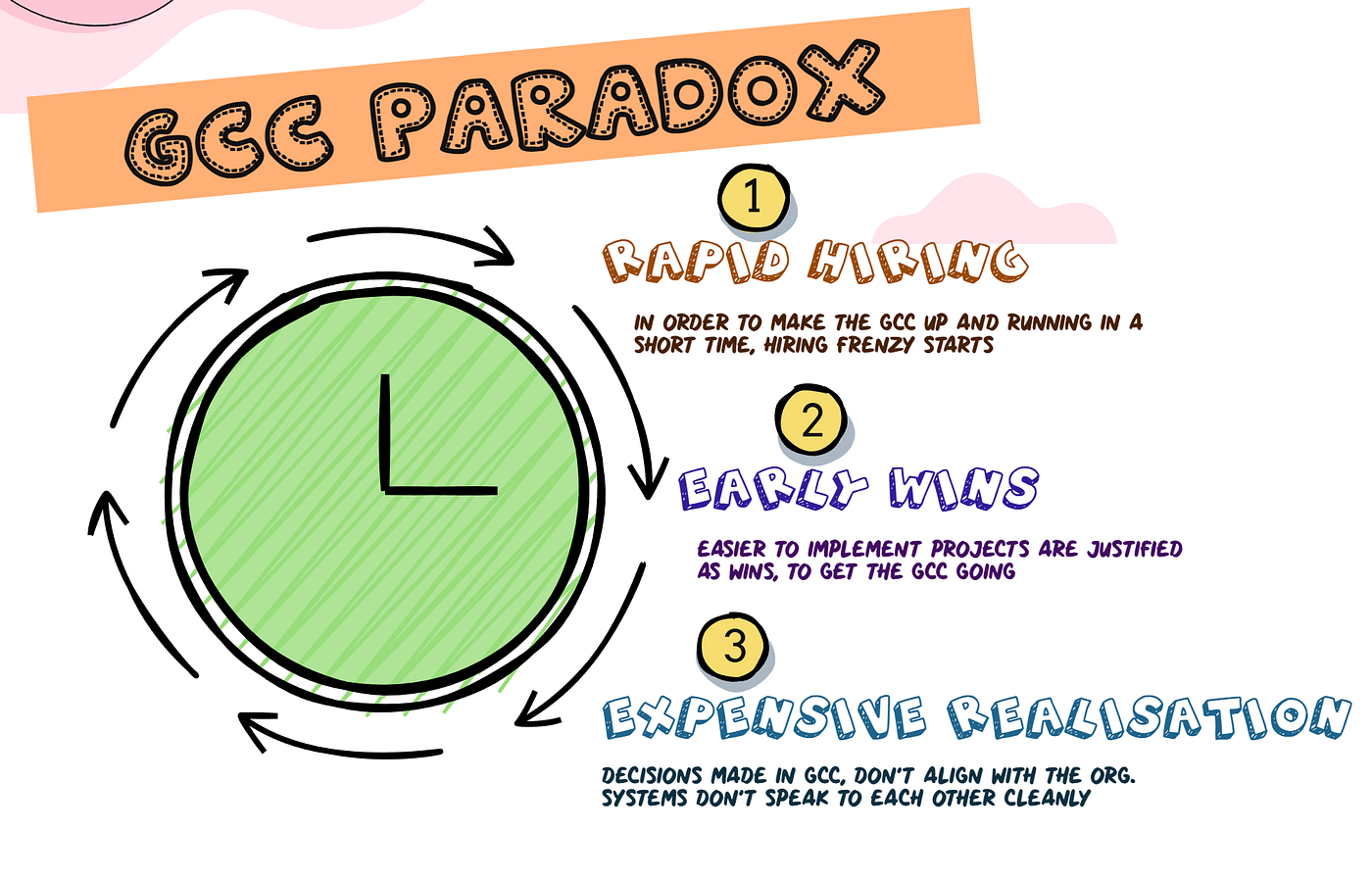
Many organizations fail to maximize their potential because GCCs are treated as a standalone tech-delivery units rather than an extension of the bank’s core operating model.
This is fundamentally an enterprise architecture problem. A GCC changes how a bank sets priorities, manages data, enforces security and executes strategy.

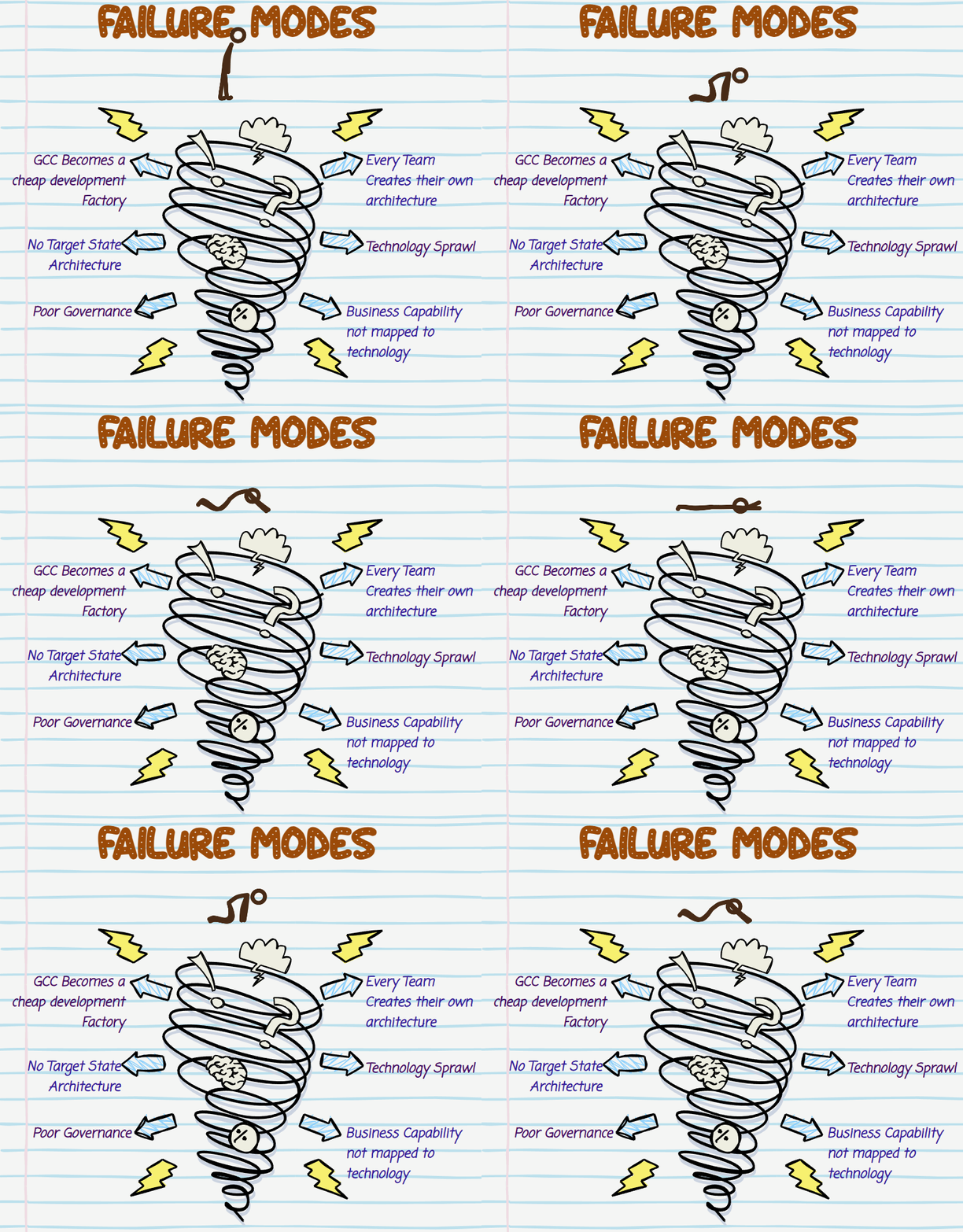
Pitfall 1:
GCC becomes a cheap development factory
Leadership says: “Let’s move development to Hyderabad.”
After 2 years: — No product ownership — No Architecture ownership — No Innovation
Result: GCC becomes merely a coding center
Pitfall 2:
Every team creates their own architecture
Impact: — 15 APIs are built by different teams to do the same thing — Multiple databases for a single customer — Different cloud patterns
Result: Redundant work and loss of productive time
Pitfall 3:
No target state architecture
Impact: — Each team delivers projects independently — After a few years, there will be over 500 applications to deal with — Huge Technical Debt
Result: Every strategy at the enterprise level hits a massive roadblock
Pitfall 4:
Technology sprawl
Impact: — Each team implements their own choice of technology, integration inconsistencies creep in. — Similar workloads are implemented using differing technologies — Increases cost and complexity
Result: Application level technology choices leads to Domain level technology sprawl
Pitfall 5:
Poor governance
Impact: — No Architectural review — All projects get approved — No Guardrails in place — Teams introduce new frameworks, new databases or new deployment patterns
Result: Increased risk of non-compliance and introduction of vulnerabilities
Pitfall 6:
Business capabilities are not mapped to technology
Impact: — IT roadmaps become application-centric — Business roadmaps are not taken beyond capabilities — Difficulty demonstrating business value — No correlation of Business Capability with the choice of technology
Result: Executives struggle to understand the technology investment

Why These Problems Exist
One of the most important realizations for the organization is that none of these issues are fundamentally technology problems
They are the symptoms of an organizational growth.
As a GCC expands — from 100 engineers to 500, then 2000 and eventually 10,000 — autonomy naturally increases
Without an architectural framework, that autonomy leads to fragmentation. Teams optimize locally, while the enterprise becomes harder to manage globally.
The Enterprise Architect’s responsibility is not to control every technical decision. It is to provide guardrails that enable teams to innovate while preserving enterprise coherence.
The Enterprise Architect ensures that independent teams can move quickly without increasing the complexity, cost and by decreasing the evolvability of an organization.

The Enterprise Architecture is the connecting tissue between the GCC level deliveries and the enterprise level coherence.
Enterprise Architecture Frameworks such as TOGAF proves invaluable when an architecture needs to be evolved into GCCs. And if done right, it will easily overcome all the pitfalls in a seamless and efficient manner.
TOGAF Actually Earns Its Keep
TOGAF gets dismissed in fast-moving organizations as a ceremony It is wrong when TOGAF is applied as a decision discipline or a documentation theater.
The Architecture Development Method (ADM)
At the heart of TOGAF framework, is the process called as ADM. This well-defined process, brings in a sense of clarity and purpose while evolving the architecture to GCCs.
ADM has phases A till H, which provides a structured way of aligning GCC to Organizational architecture.
A GCC’s hardest organizational problem is translating org architecture into locally executable decisions. TOGAF provides the much needed discipline at every decision point to achieve the transition of the architecture.
Evolution of ADM
The below diagram illustrates the relationship between the following three architectures:
- Strategic Architecture (Enterprise level)
- Segment Architecture (GCC level)
- Capability Architecture (Team level at GCC)
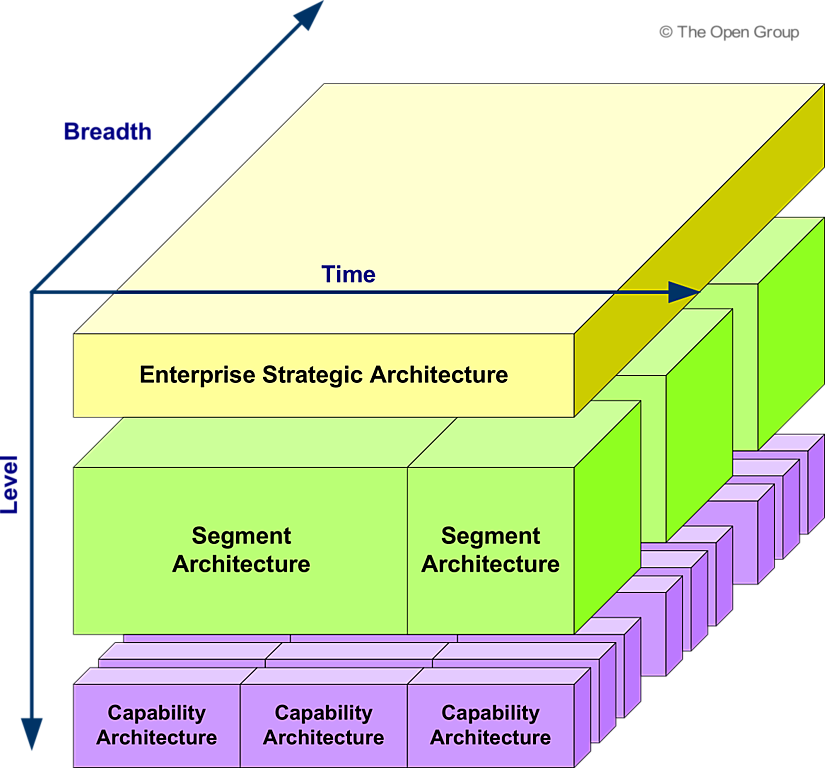
ADM Phases in the three architecture
The following diagram shows how the strategic architecture’s ADM cycle supports in evolution of GCC architecture’s ADM cycle.
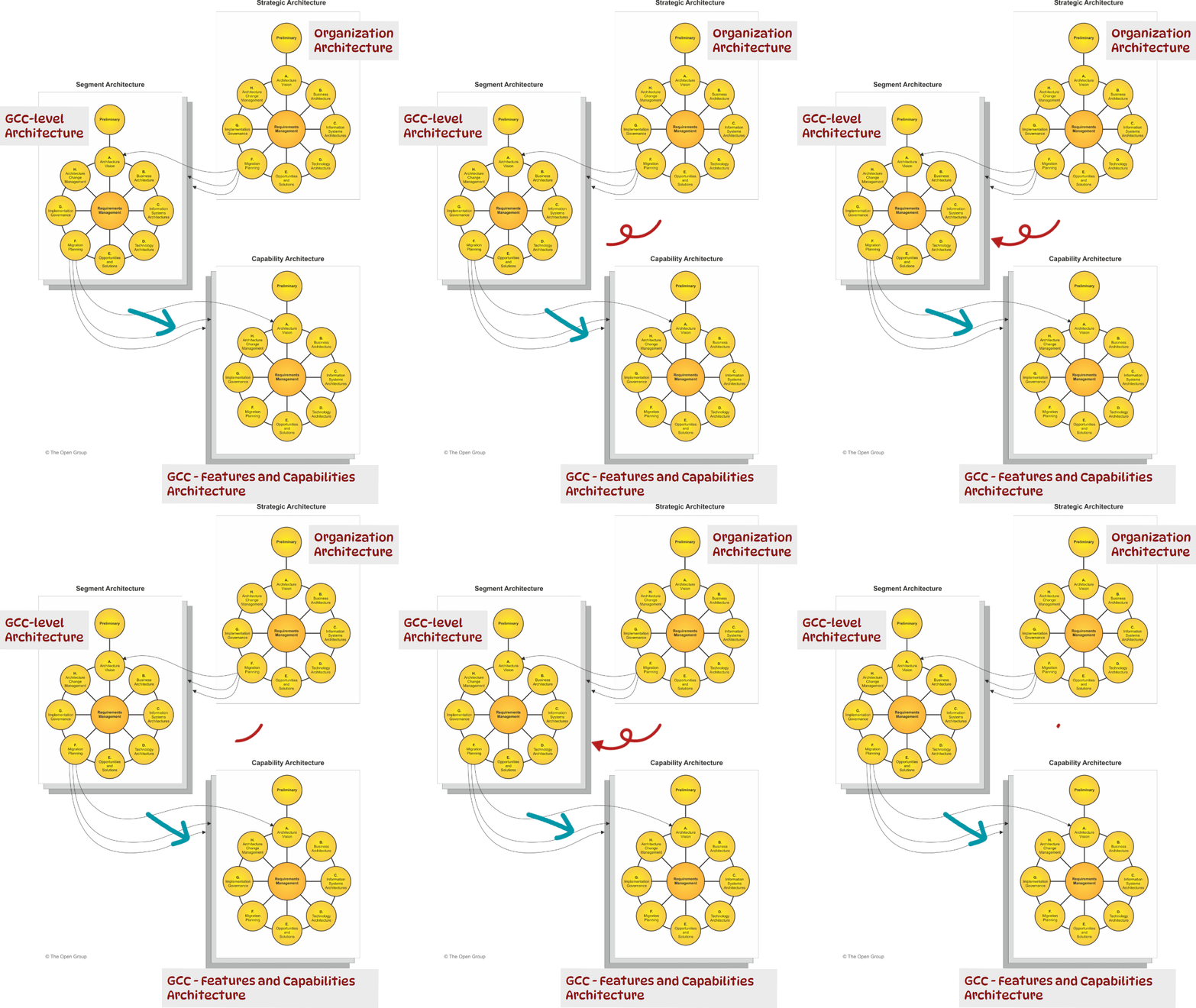

TOGAF provides a mature framework which helps in identifying and resolving the common pitfalls that we discussed earlier.
The following are the few methodologies which help in resolving them:
- Business Capability Map
- Capability Ownership Matrix
- Architecture Principles
- Application Portfolio assessments
- Target State Architecture
- Technology Standards Catalog
- Architecture Governance Framework

What Success Actually Looks Like
The GCCs that get this right share a pattern: Enterprise Architecture introduced as a discipline to enable faster delivery and not as a documentation hub.
Big Architecture Decisions such as: — Data residency — Integration patterns — Platform choices are made only once. And reused throughout the organization reducing independent deviations from the teams.
TOGAF offers a disciplined, repeatable way to make architectural decisions and thus enabling applications to scale cleanly.
“A GCC doesn’t become strategic because it hires great engineers. It becomes strategic because it makes great architectural decisions.”
Need a Thought Partner for your GCC Journey?
Planning to establish or transform a GCC?
If you’re exploring how TOGAF and Enterprise Architecture can help define governance, capability ownership, architecture standards, and long-term transformation roadmaps, I’d be glad to help.
Feel free to reach out to me on LinkedIn. Whether it’s a discussion, an architecture review, or guidance on implementing an Enterprise Architecture practice for your GCC, I’m always happy to connect with technology leaders and fellow architects. LinkedIn profile: https://www.linkedin.com/in/raj-arcot/
메타데이터
- post_id
- 6c536d48c907
- slug
- the-hidden-failure-modes-of-modern-gccs-6c536d48c907
- url
- https://medium.com/@arcot-rajanikanth/the-hidden-failure-modes-of-modern-gccs-6c536d48c907
- canonical_url
- https://medium.com/@arcot-rajanikanth/the-hidden-failure-modes-of-modern-gccs-6c536d48c907
- author_url
- https://medium.com/@arcot-rajanikanth
- status
- ok
- fetched_at
- 2026-06-28 10:39:35





