Why GPS Gets Weird During Storms: The Ionosphere Story Without Jargon
Your location dot is wrong, and it is not the app.
Why GPS Gets Weird During Storms: The Ionosphere Story Without Jargon
Your location dot is wrong, and it is not the app.
On some days your phone shows you drifting across a street you are standing on. A survey grade receiver that usually holds centimeter level precision starts to wander. Timing systems that rely on satellite clocks report higher uncertainty.
Those failures do not start in the software. They start in the medium the signal travels through.
The ionosphere is part of the path
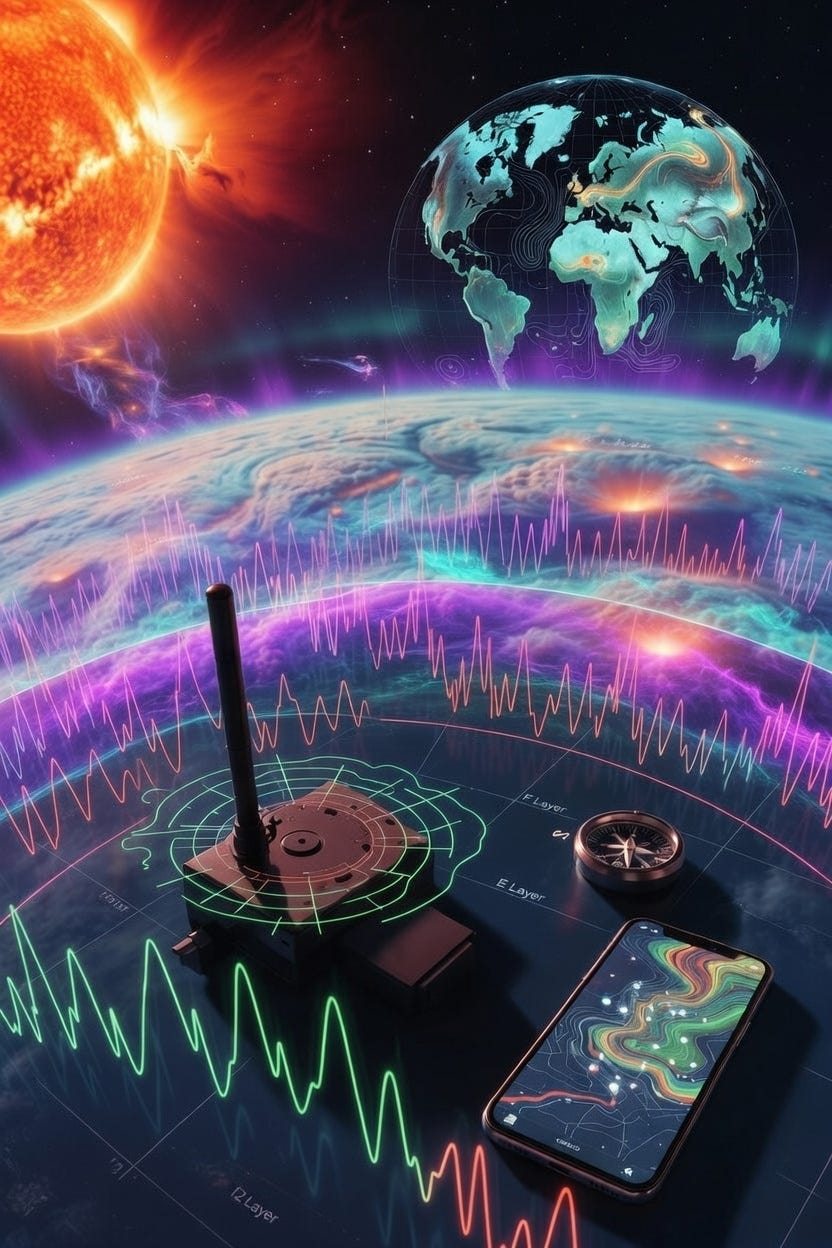
GNSS signals are radio waves. Between the satellite and your receiver they pass through the ionosphere, a region of the upper atmosphere filled with free electrons and ions created mainly by solar radiation.
A useful mental model is this.
The ionosphere acts like a changing lens. It delays the signal, and that delay changes with electron density along the path. On quiet days the delay can be modeled and removed well enough for most uses. On disturbed days the lens becomes patchy and fast changing.
Geomagnetic storms are one of the main ways the lens becomes patchy.
What storms do to the ionosphere
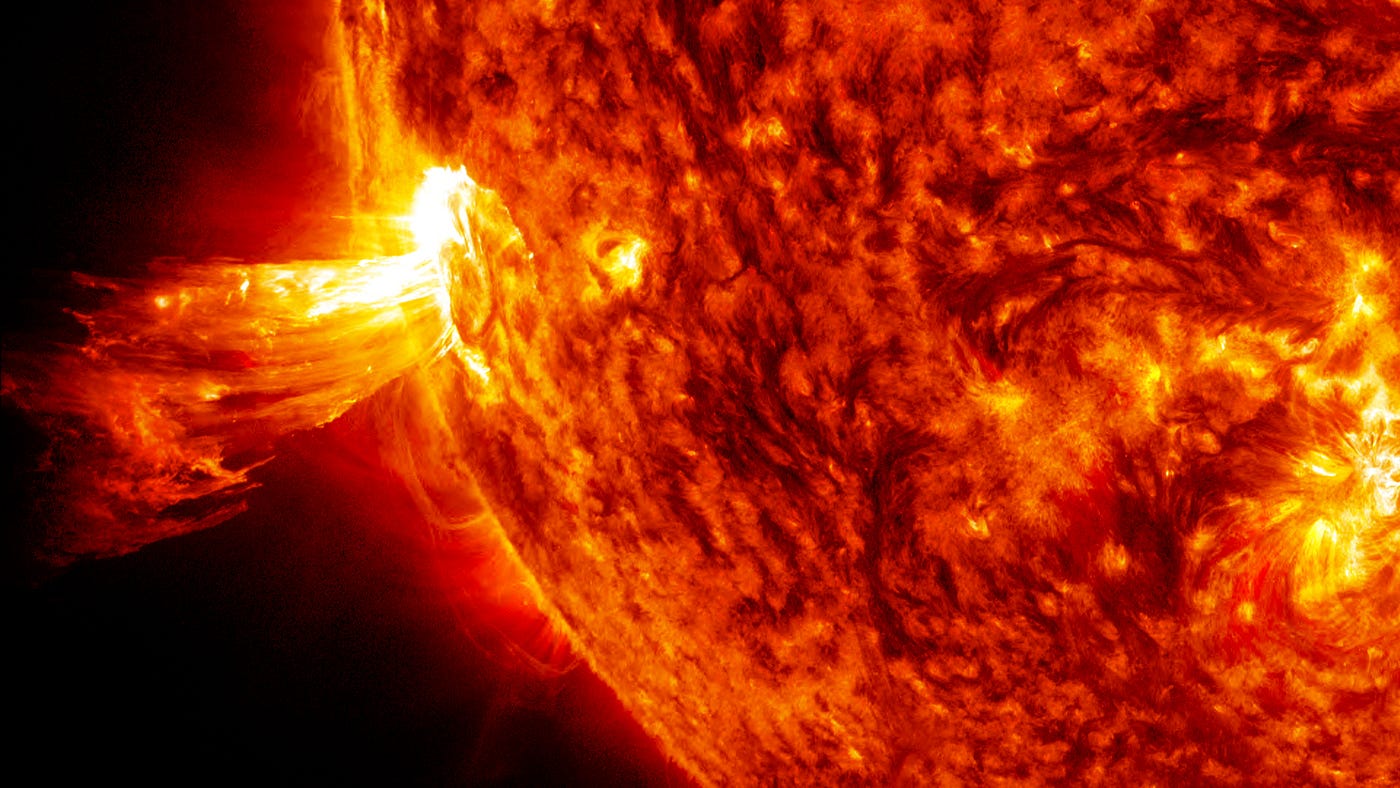
A geomagnetic storm is energy transfer from the solar wind into the Earth system. That energy shows up as electric fields, currents, heating, and winds in the upper atmosphere. Those changes reshape ionospheric electron density.
The important point for navigation is not just a bigger error term. It is that the error becomes structured.
Instead of a smooth delay that can be estimated, the ionosphere develops irregularities on multiple spatial scales. Receivers can track through some of it. At times they cannot.
Irregularities lead to scintillation
When ionospheric structure becomes irregular, the radio signal can fluctuate in amplitude and phase while it propagates. That phenomenon is scintillation.
Phase scintillation is the one that stresses tracking loops.
A receiver estimates the carrier phase and keeps lock by continuously updating a local oscillator and a tracking model. Rapid phase fluctuations force the tracking loops to work harder. If they cannot follow, the receiver loses lock.
Loss of lock appears as cycle slips, sudden discontinuities in the tracked phase. Cycle slips do not only reduce accuracy. They can break ambiguity resolution and degrade solutions for minutes after the event.
Why PPP is sensitive
Precise point positioning is powerful because it squeezes accuracy from small residuals.
PPP relies on precise satellite orbit and clock products, models the troposphere, and estimates remaining biases and states from the data stream. It succeeds when the remaining errors behave like noise that is well approximated by the stochastic model.
During storms, the ionospheric term is neither small nor well behaved.
Even dual frequency combinations that remove the first order ionospheric delay can be challenged by rapid fluctuations, higher order effects, and tracking interruptions. The practical result is larger positioning errors and more frequent solution instability.
This is not a hypothetical. Recent work in Space Weather developed storm responsive stochastic modeling that uses ionospheric disturbance proxies to improve PPP performance during severe geomagnetic storm activity (Luo et al., 2022).
Which space weather signals relate
Two layers matter.
The first is the scoreboard you see reported.
Indices such as Kp, Dst, and AE summarize storm time geomagnetic disturbance. They are useful context because they correlate with the conditions under which ionospheric structure is more likely to be disturbed.
The second layer is upstream driving.
The solar wind and interplanetary magnetic field set the boundary conditions. Southward IMF Bz increases coupling efficiency, and associated convective electric fields are often expressed in terms such as Ey. These drivers do not guarantee a specific local ionospheric outcome, but they are closer to the physical cause of storm time electrodynamics.
There is also a methodological caution.
Coupling functions and derived drivers can be informative, but their construction and use have pitfalls. Sampling, data gaps, and event selection can create misleading performance if the coupling proxy is treated as a universal knob rather than a context dependent summary (Lockwood, 2022).
Why effects vary so much
People notice GNSS problems in clusters because impacts are not uniform.
Latitude matters.
High latitude regions are directly connected to magnetospheric forcing through auroral electrodynamics. Low latitude regions can be dominated by different irregularity mechanisms and storm time electric field penetration. Mid latitude behavior can be quiet or chaotic depending on storm phase and local time.
Local time matters.
A storm can produce different ionospheric structures on the dayside versus the nightside. The same global index value can coincide with distinct regional impacts.
Storm phase matters.
The main phase is often associated with strong driving and rapid change. The recovery phase can still host structured ionospheric conditions that continue to stress GNSS, even when headline indices start to improve.
The practical takeaway is narrow.
When the ionosphere becomes irregular, receivers are asked to do more than correct a smooth delay. They must keep lock through a changing medium. That is where accuracy degrades and why it sometimes looks like your device is failing.
A simple way to read a GNSS space weather day
Start with the symptom.
If you see intermittent loss of lock, jumps in position, or degraded precision, you are often dealing with tracking stress rather than a constant bias.
Then look at context.
Geomagnetic disturbance indices provide a coarse indicator of storm time conditions. Upstream solar wind drivers provide a clue about coupling strength, but they are summaries with known limitations.
Finally, keep the boundary clear.
Space weather does not produce one universal GNSS failure mode. It changes the ionosphere, and the ionosphere changes how signals propagate. Local time, latitude, and storm phase decide how that story plays out at your receiver.
References
Lockwood, M. (2022). Solar wind magnetosphere coupling functions: Pitfalls, limitations, and applications. Space Weather, 20, e2021SW002989. https://doi.org/10.1029/2021SW002989
Luo, X., Li, X., Zhang, K., & colleagues. (2022). ROTI based stochastic model to improve GNSS precise point positioning under severe geomagnetic storm activity. Space Weather, 20, e2022SW003114. https://doi.org/10.1029/2022SW003114
메타데이터
- post_id
- 6c75927a7104
- slug
- why-gps-gets-weird-during-storms-the-ionosphere-story-without-jargon-6c75927a7104
- url
- https://medium.com/@chaerus/why-gps-gets-weird-during-storms-the-ionosphere-story-without-jargon-6c75927a7104
- canonical_url
- https://medium.com/@chaerus/why-gps-gets-weird-during-storms-the-ionosphere-story-without-jargon-6c75927a7104
- author_url
- https://medium.com/@chaerus
- status
- ok
- fetched_at
- 2026-08-08 04:14:00