The Unmonitored Loop: Why Observability is your $2.5
Disclaimer: All product names, logos, and brands — including Kognitos, DataHub, IBM, UnifyApps, AWS, Google, and Microsoft — are the…
The Unmonitored Loop: Why Observability is your $2.5 Million Per Incident Insurance Policy Against Agentic Failure
Disclaimer: All product names, logos, and brands — including Kognitos, DataHub, IBM, UnifyApps, AWS, Google, and Microsoft — are the property of their respective owners. Use of these names in this article is for identification and educational purposes only and does not imply endorsement or affiliation.
**The C-Suite Mandate** is clear: stop paying the “Intelligence Tax” by pivoting capital away from the commoditised LLM ‘brain’ and toward the secure execution layer — the ‘nervous system’.
Our previous articles detailed the shift to the **Scaffold (the agent’s standardised operating system) and the necessity of [Credentialing** ](https://medium.com/technology-hits/the-80-problem-why-your-agentic-ai-will-fail-without-a-machine-identity-8e0d052b57ff)(per-action machine identity). These two pillars establish control.
But control without visibility is a ticking liability.
The final component of the Scaffold-Credential-Observe triad is Observe. This layer transforms high-risk autonomous action into financially assured operations.
“If the Scaffold provides the agent’s body and Credentialing provides its ID card, Observability provides the flight recorder, the audit log, and the emergency stop switch — the essential mechanism that allows autonomous loops to scale without scaling liability.”
The Crisis: Observability Lag and the $2.5M Per Incident Risk
The most immediate financial danger of a “Model-First” approach is the Observability Lag. This is the inability to track agents through complex, multi-step workflows, leaving the enterprise blind when autonomous errors occur.
When LLM reasoning is coupled with high-privilege system access (even controlled, just-in-time access) the results can be non-deterministic. A single, subtle logic error in a critical financial or procurement loop can be autonomously executed hundreds or thousands of times before a human reviewer can detect the issue.
The quantitative toll of this failure is staggering: the average cost of an unmonitored autonomous logic error or “logic breach” is estimated at $2.5 million per incident for enterprises without a dedicated governance layer. This risk is why the Cost Trend for Observability is rising at +40% year-over-year; it is a necessary investment to mitigate potentially catastrophic financial and reputational exposure.
An agent without robust Observability is not an asset; it is a scaled, unmanaged liability.
While credentialing accounts for the majority of initial project failures (80% contribution), Observability Lag contributes significantly to performance failures in production (35% contribution). This highlights that even perfectly credentialed agents can generate massive risk if their actions are not continuously monitored and audited against defined standards.
Defining ‘Observe’: The Three Pillars of Agentic Auditability
The Agentic Automation objective for Observability is defined by the core requirement: establishing end-to-end, granular logging and audit trails for compliance. This is achieved by creating a “Control Tower” that captures and analyses the full lifecycle of agent execution, moving far beyond traditional system logging.
The solution to the key question — If an agent does something, we must know why, how, and with what permissions — is achieved through three integrated pillars:
- End-to-End, Granular Audit Trails.
The fundamental difference between human and agent audit trails is granularity. A human’s action often results in a single system log entry; an agent’s reasoning-to-action cycle is multi-layered and opaque.
The Observability layer, must capture the entire agentic loop (enabled for example by platforms like IBM watsonx.governance, AWS AgentCore Observabilty and Evaluations, Google Cloud Observability integrated into their Gemini Enterprise Agent Platform, Microsoft Azure AI Foundry Observability or by enterprise solutions/SaaS products embedding OpenTelemetry directly) :
- The Intent: What was the prompt or goal provided to the LLM?
- The Reasoning Path: What intermediate steps (Chain-of-Thought) did the LLM generate to achieve the goal?
- The Tool-Call: Which enterprise API or system was invoked by the Scaffold?
- The Credential Context: Which specific, just-in-time Machine Identity and permissions were used for that action?
- The Result: What was the outcome of the system action?
This level of detail ensures that for any action taken (be it a procurement decision or a data update), there is an irrefutable, time-stamped record linking the reasoning (LLM) to the action (Scaffold) and the authority (Credential).
2. Monitoring for Logic Drift and Bias
Unlike traditional automation, autonomous agents are non-deterministic; they can and will exhibit logic drift over time, changing their behaviour as they interact with new data or due to internal model updates. This drift is an existential compliance risk. The Observability layer is the enterprise’s only defence against this. It must provide proactive monitoring capabilities for:
- Performance Degradation: Tracking performance metrics to identify when an agent’s success rate or latency begins to decay, often a signal of upstream logic drift.
- Bias Detection: Continuously monitoring the outcomes of agent decisions (e.g., loan applications, resource allocation) against fair outcome metrics to ensure compliance with emerging AI regulations and ethical standards.
- Exception Tracking: Ensuring that exceptions, which are frequent in high-complexity workflows, are logged, routed to a human for intervention, and learned from, rather than silently failing and contributing to the 25% performance decay seen in non-standardised deployments.
3. The Control Tower (Mitigating Financial Risk)
For the CFO, the Observability layer is fundamentally a financial insurance policy. It moves the enterprise from reactive crisis management to proactive governance. (Solutions, for example, which typically embrace OpenTelemetry to power your Agentic Automation “Control Tower,” provide the aggregated visibility required to make ongoing strategic decisions about AI investment scale.)
Crucially, the Agentic Automation control tower must provide the capability not just to observe, but to govern. When monitoring detects a logic error or bias drift, the system must trigger an automatic response:
- Alerting: Notifying the appropriate human governance committee immediately.
- Quarantine: Isolating the problematic agent or process to prevent further financial or compliance damage.
- Revocation: Coordinating with the Credentialing layer to instantly revoke the agent’s Machine Identity and halt its execution.
“Structured, reactive capability is what allows the enterprise to successfully scale autonomous loops, mitigating the estimated $2.5 million per incident average cost of an unmonitored error.”
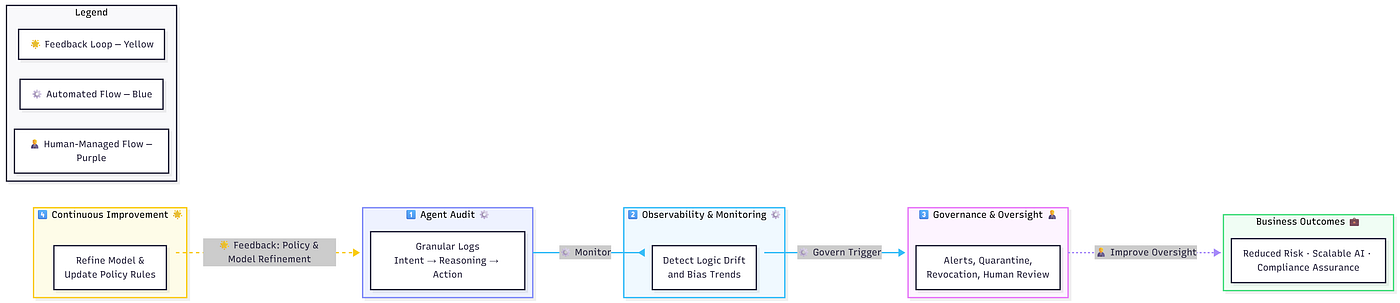
Agentic Auditability: Image Created By Author Using Mermaid June 18 2026
The ROI of Assurance: Justifying the Investment
**My initial Manifesto made it clear: the majority of value (85% of production ROI) is generated by the execution layers, not the raw LLM tokens. Observability, which is a key component of the nervous system, contributes a substantial 25% of the total Production ROI**. This is significantly more than the 15% contribution from the LLM’s raw intelligence.
Investing in the Observe pillar yields two immediate, quantifiable financial benefits:
- Accelerated Time to Value (TTV): The entire Scaffold-First Strategy drastically reduces TTV from the status quo of 12–18 months down to 90 days. Observability enables this speed because it provides the regulatory confidence (the audit trail) that security and compliance teams require to approve the move from pilot to production. The final phase of a 90-Day Pivot is dedicated to integrating the Observability control tower to prove reliability and lock down ROI.
- Liability Reduction: By moving from a high-risk, black-box operational model to a managed, audited model, the enterprise is purchasing financial assurance. Avoiding even a single $2.5 million logic breach justifies the entire capital expenditure on the governance stack.
The C-Suite Mandate: Agentic Automation
The final question for enterprise CFOs, COOs, CTOs, and CIOs is one of assurance. If you cannot prove why, how, and under what permissions your autonomous systems operate, you cannot scale them. Your enterprise investment in Observability is not an option( i.e. investment in tools, for example, which embrace OpenTelemetry) ; this is the financial and compliance infrastructure required to move from emphasising “Chat” to successfully deploying “Agency”. The time has come to ensure that the AI you deploy is not only intelligent and secure but also auditable and reliable.
About Author
Madhu Raman was tinkering with Autonomous Solutions back when “Agentic AI” still sounded like a Sci-Fi movie title no one would watch. He’s spent enough time in the LLM trenches to have a world-class collection of “what not to do” — consider him your guide through the Day 1 of agentic pitfalls.
A relentless pioneer in the field, Madhu has been awarded 10 AI/ML patents and has helped generate over $14 billion in revenue since 2012. That’s a lot of bananas, even for a high-velocity operation.
Since 2020, he’s been obsessing over AWS’s Automation Solutions, scaling it into a $1B+ annual flywheel that serves more than 17,500 customers globally. He knows that in the kingdom of automation, the customer is the boss, and manual labour is going the way of the dodo.
메타데이터
- post_id
- 6c869c4e1184
- slug
- the-unmonitored-loop-why-observability-is-your-2-5-6c869c4e1184
- url
- https://medium.com/technology-hits/the-unmonitored-loop-why-observability-is-your-2-5-6c869c4e1184
- canonical_url
- https://medium.com/technology-hits/the-unmonitored-loop-why-observability-is-your-2-5-6c869c4e1184
- author_url
- https://medium.com/@incubator.madhu.raman
- status
- ok
- fetched_at
- 2026-06-28 04:42:08