AI Agent Evidence Ledger for SaaS: How Builders Make Answers Auditable
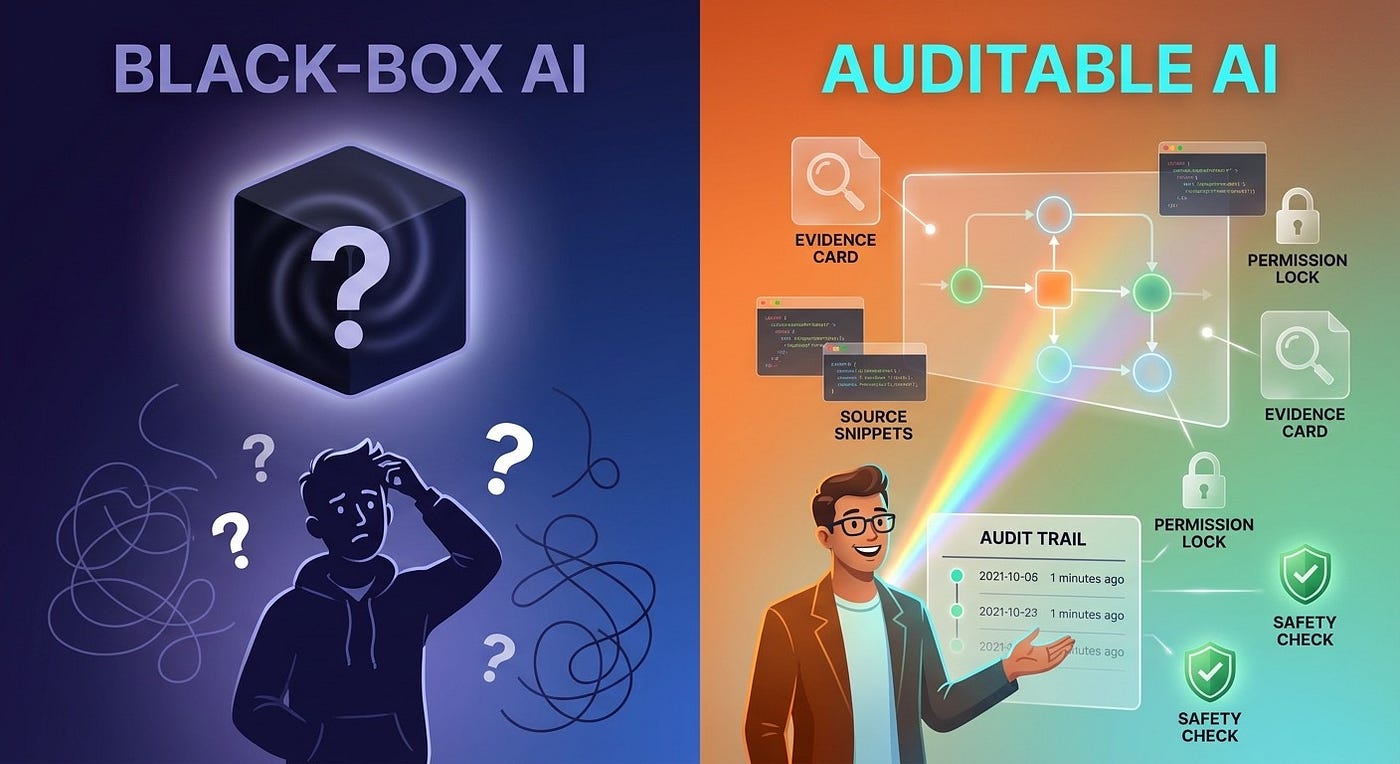
If an AI agent cannot show what it used, what it skipped, and why it acted, users do not have an AI feature. They have a confident black…
AI Agent Evidence Ledger for SaaS: How Builders Make Answers Auditable
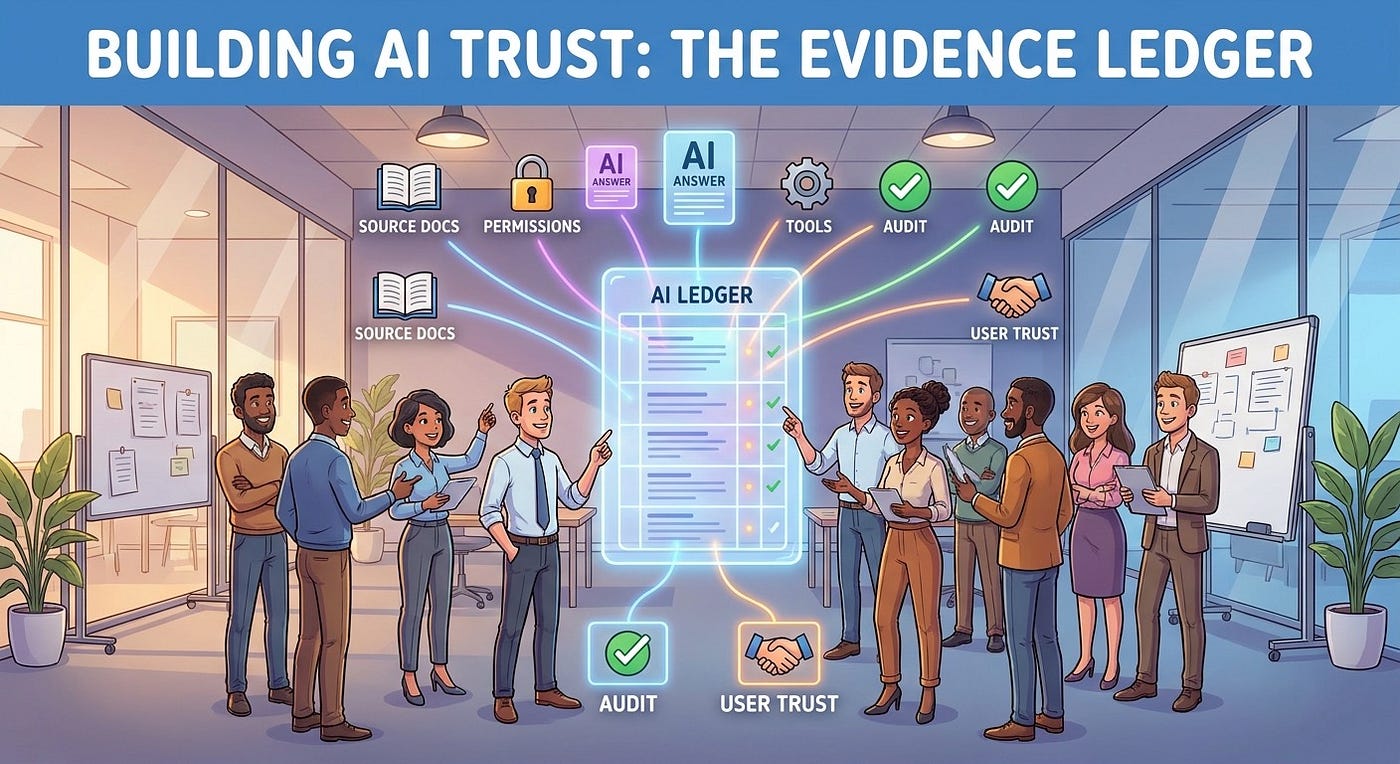
AI Agent Evidence Ledger for SaaS
If an AI agent cannot show what it used, what it skipped, and why it acted, users do not have an AI feature. They have a confident black box.
The next hard problem in AI SaaS is not making agents sound smart. That part is already easy enough to be dangerous. The hard problem is making their work inspectable after the moment has passed. A customer asks, “Why did the agent recommend this refund?” A manager asks, “Which documents were used?” A developer asks, “Why did it call this API three times?” If the only answer is a chat transcript and a pile of logs, the product is not ready for serious workflows.
This is where an AI agent evidence ledger becomes useful. It is a structured record of the facts, sources, permissions, tool calls, model decisions, confidence signals, and human approvals behind an AI output. Think of it as a receipt for agent work. Not a full replay of every token. Not a surveillance dump. A practical, compact, auditable trail that helps users trust the result and helps builders debug the workflow.
The idea is timely because AI SaaS teams are moving from chat demos into agentic workflows: data analysts, support copilots, browser agents, sales assistants, document processors, compliance helpers, and internal automation agents. Recent AI news and developer discussions keep circling the same pain points: autonomy without supervision, context loss, token cost, tool reliability, security, and explainability. Yet a lot of content still stops at “add citations” or “log everything.” That is not enough.
An evidence ledger answers the uncomfortable production question: “Can we prove this AI result was grounded, permitted, and safe enough for the action it took?”
What Is an AI Agent Evidence Ledger?
An AI agent evidence ledger is a product-level record that connects an agent’s answer or action to the evidence behind it. It can include retrieved documents, database rows, customer permissions, policy checks, tool-call inputs and outputs, model routing decisions, cost data, confidence estimates, human approvals, and final user-facing reasoning.
The word “ledger” matters. A normal log records events for engineers. A ledger records evidence for accountability. Logs are often noisy, technical, and scattered across providers. Evidence ledgers are structured around the user-visible outcome: the answer, recommendation, draft, decision, or action your SaaS product delivered.
For example, a support AI agent might generate a refund recommendation. The evidence ledger would not just store the final text. It would capture the customer’s plan, refund policy version, conversation snippets used, payment status, risk score, tool calls, whether the agent had permission to draft or execute the refund, and whether a human approved it.

Why This Topic Matters for AI SaaS Builders
Builders are learning that users do not only judge AI by answer quality. They judge it by recoverability. When the answer is wrong, can the team find out why? When the agent is right, can the user see enough evidence to trust it? When a customer complains, can support explain what happened without reading raw prompts or leaking another user’s data?
Search and community demand is shifting toward long-tail implementation questions such as:
- How do I make AI agent answers auditable?
- How should SaaS products store AI citations and tool calls?
- How do I debug RAG answers without exposing private data?
- How can an AI agent prove it had permission to use a source?
- What should be logged for production AI workflows?
These are not broad “AI trends” questions. They are builder questions. They come from teams trying to ship AI features into real accounts, real data, and real customer expectations.
The Problem With “Just Add Citations”
Citations help, but they are a thin slice of the truth. A citation says, “This source was referenced.” It does not prove the agent was allowed to use the source, that the source was current, that conflicting evidence was considered, that the tool call succeeded, or that the final answer stayed faithful to the evidence.
In AI SaaS workflows, weak citations create a false sense of safety. A model can cite a document while still misreading it. A retrieval system can return the right file but the wrong section. A user can see a link without knowing whether it came from their tenant, another tenant, stale cache, or a public fallback. For sensitive workflows, that is a serious trust gap.
An evidence ledger goes deeper by recording the chain around the citation:
- Which query retrieved the source?
- Which permission filter allowed it?
- Which version of the source was used?
- Which extracted facts were passed to the model?
- Which facts appeared in the final answer?
- Which facts were ignored or contradicted?
The Core Components of an Evidence Ledger
A useful AI agent evidence ledger does not need to be complex on day one. Start with a few stable components and expand as the workflow becomes more important.
1. The outcome record
Every ledger starts with the outcome. This may be an answer, a recommended action, a generated report, a drafted email, a database update, or a completed workflow. Store a stable outcome ID, tenant ID, user ID, workflow name, timestamp, model route, and status.
2. The source packet
The source packet stores the evidence the agent was allowed to use. This can include document IDs, chunk IDs, row IDs, transcript ranges, API response hashes, timestamps, source version numbers, and short extracted snippets. Avoid storing full sensitive documents unless the product genuinely needs them. A reference plus a safe excerpt is usually better.
3. The permission proof
Permission proof is the part many teams forget. It records why the agent was allowed to see or act on a piece of data. That might include role-based access checks, tenant boundaries, customer consent flags, data residency rules, and workflow-specific scopes. If a user later asks why an agent used a file, this record should answer clearly.
4. The tool-call trail
Agents often fail at the edges: APIs, browser actions, database queries, webhooks, file parsers, and background jobs. Your ledger should record tool name, input summary, output summary, latency, retry count, error state, and whether the response was used in the final answer. Do not store raw secrets or full payloads by default. Redact first, then store.
5. The reasoning summary
You do not need to expose chain-of-thought. In fact, you usually should not. Instead, store a short, user-safe reasoning summary: “The agent compared the latest invoice, the plan’s refund window, and the support conversation. It recommended a partial refund because the user was inside the policy window but had consumed part of the usage quota.”
6. The human review record
For higher-risk actions, record who approved, rejected, edited, or escalated the agent’s output. Include the version they reviewed. If the human changed the output, store the diff or a short change summary. This creates a feedback loop for evals and improves accountability.
A Practical Ledger Schema for SaaS Teams
You can implement the first version with ordinary application tables or event storage. The schema below is simplified, but it shows the shape.
{
  "outcome_id": "out_7K9",
  "tenant_id": "tenant_42",
  "workflow": "support_refund_recommendation",
  "user_request": "Can this customer get a refund?",
  "model_route": "fast_reasoning_model_with_policy_context",
  "status": "approved_with_edits",
  "sources": [
    {
      "source_id": "policy_refunds_v14",
      "type": "knowledge_base_article",
      "version": "14",
      "permission_check": "tenant_policy_public_to_support",
      "excerpt_hash": "sha256:9a4...",
      "used_in_answer": true
    }
  ],
  "tools": [
    {
      "tool": "get_customer_invoice_status",
      "input_summary": "invoice_id and tenant-scoped customer_id",
      "output_summary": "paid invoice, 12 days old",
      "latency_ms": 430,
      "retries": 0,
      "used_in_answer": true
    }
  ],
  "risk": {
    "risk_level": "medium",
    "required_approval": true,
    "reason": "financial action above draft-only threshold"
  },
  "review": {
    "reviewer_role": "support_manager",
    "decision": "approved_with_edits",
    "edit_summary": "Changed full refund to partial refund"
  }
}
This is not a vendor-specific pattern. You can use it with any model provider, RAG stack, workflow engine, database, or application framework. The point is to make evidence a first-class product object instead of an accidental byproduct of logs.
How to Design the Ledger Around User Trust
The best evidence ledger has two views: an internal debug view and a user-facing trust view. Engineers need tool details, latency, retries, and raw-ish traces with redaction. Users need plain-language evidence: “The answer used these three sources, all from your workspace, updated today, and no external web data.”
Do not dump everything into the UI. That creates anxiety rather than trust. Instead, use progressive disclosure:
- Show a short “Why this answer?” summary near the AI output.
- Let users expand to see sources and timestamps.
- Show permission notes only when relevant.
- Flag missing, stale, or low-confidence evidence clearly.
- Let users report “wrong source,” “outdated,” or “missing context.”
This turns trust into an interaction, not a decoration.
Common Workflows That Need Evidence Ledgers
Evidence ledgers are most useful when an agent touches important data or produces a decision people may challenge later.
AI data analysts
When an agent answers “Why did churn increase?” it should show which metric definition, filters, date range, SQL query, dashboard, and segment it used. Without this, two users can get different answers and nobody knows whether the issue is data, retrieval, or reasoning.
Support and success agents
Support agents need clear evidence for refunds, plan limits, SLA claims, account status, and escalation recommendations. The ledger helps managers review decisions quickly and improves future playbooks.
Document intelligence workflows
Contract review, invoice extraction, compliance checks, and research summaries all need source spans. The ledger should connect each conclusion to document pages, sections, parser confidence, and human corrections.
Browser and API agents
Agents that click, submit, sync, or update systems need tool receipts. Store what page or API state they saw, what they attempted, whether the action succeeded, and what guardrail allowed it.
Security and Privacy Rules You Should Not Skip
An evidence ledger can become dangerous if it stores too much. Treat it as sensitive infrastructure. The ledger may contain customer data, internal logic, snippets from private documents, policy decisions, and security-relevant traces.
Use these rules early:
- Redact before writing: remove secrets, tokens, personal data, and unnecessary payload fields before storage.
- Store references when possible: prefer source IDs, hashes, and safe excerpts over full raw documents.
- Separate tenant data: never let audit views cross tenant boundaries.
- Apply retention policies: keep high-risk traces only as long as needed for support, compliance, or product improvement.
- Protect internal instructions: do not expose private prompts, hidden policies, or system-level controls in user-facing views.
How Evidence Ledgers Improve Evals
Many teams struggle with AI evals because they only compare final answers. That misses the workflow. The final answer may look fine while retrieval used the wrong document, a tool failed silently, or the model ignored a required policy.
Evidence ledgers give you richer eval data. You can test whether the right source was retrieved, whether the permission filter worked, whether the tool output was used correctly, whether stale evidence was rejected, and whether high-risk cases entered human review. This is much closer to how production AI SaaS actually fails.
Over time, your ledger becomes a dataset for regression testing. Every corrected answer, rejected recommendation, and escalated workflow can become a future test case. This is how an AI SaaS product compounds quality without relying only on better models.
Metrics to Track
A ledger should help you make product decisions, not just satisfy audits. Track a small set of useful metrics:
- Evidence coverage: percentage of AI outputs with at least one valid source packet.
- Source freshness: how often answers rely on stale or unknown-version evidence.
- Permission failures caught before generation.
- Tool-call success rate and retry rate by workflow.
- Human approval rate, edit rate, and rejection reason.
- Cost per accepted outcome, not just cost per model call.
- User trust actions, such as expanding sources or reporting wrong evidence.
These metrics connect technical reliability to user trust. They also help builders decide whether to refresh knowledge bases, improve permissions, add approval gates, or simplify a workflow.
A Simple Implementation Roadmap
If you are a solo SaaS founder or small team, do not build a giant audit platform first. Start with the smallest ledger that answers real user and developer questions.
Phase 1: Record outcome receipts
For every AI output, store the outcome ID, workflow name, model route, source IDs, tool-call summaries, and user-safe reasoning summary. Add a hidden internal debug page.
Phase 2: Add permission and source versioning
Record why the agent could use each source and which version it used. This is critical for SaaS teams with teams, roles, workspaces, and changing knowledge bases.
Phase 3: Add review workflows
Connect ledger records to human approval, rejection, and edit events. Use this data to build eval cases and improve prompts, retrieval, and tool policies.
Phase 4: Expose a trust view
Show users a clean explanation: sources used, freshness, confidence limits, and whether the action was automated or reviewed. Keep it simple enough for non-technical users.
Common Mistakes
The first mistake is storing raw everything. That feels safe until the ledger becomes a privacy and security liability. The second mistake is storing only final answers, which makes debugging almost impossible. The third mistake is showing users technical traces instead of plain-language evidence. The fourth mistake is treating evidence as a backend-only concern. Trust is part of the product experience.
The most subtle mistake is building the ledger after users complain. By then, the team has lost the evidence needed to understand the complaint. Add the receipt before the workflow becomes business-critical.
Content Map for Builders
This topic fits inside the broader pillar of production AI SaaS implementation. It connects naturally to supporting topics such as AI-ready knowledge bases, agent evals, trace redaction, permission design, human review workflows, AI data analyst UX, browser agent security, and cost-per-outcome monitoring. The search intent is practical and middle-of-funnel: builders are not asking what AI is; they are asking how to ship it responsibly.
The strongest long-tail keyword cluster includes “AI agent evidence ledger,” “auditable AI agent answers,” “AI SaaS audit trail,” “RAG evidence tracking,” “AI agent source grounding,” “AI workflow receipts,” and “production AI agent logging.” These terms are more specific than broad agentic AI keywords and match urgent implementation pain.
Final Takeaway
AI SaaS products will not earn trust just by sounding confident. They will earn trust by showing their work in a way users, developers, and reviewers can understand. An evidence ledger gives every important AI output a receipt: what the agent used, what it did, what it was allowed to access, what it cost, and who approved it when risk was high.
That may sound less exciting than a fully autonomous demo. Good. Production AI should be a little less magical and a lot more accountable. The builders who make agent work auditable will have a real advantage: fewer mystery failures, faster debugging, better evals, safer automation, and users who can trust the system without blindly trusting the model.
FAQ
What is an AI agent evidence ledger?
An AI agent evidence ledger is a structured record of the sources, permissions, tool calls, model route, risk checks, and review events behind an AI answer or action. It acts like a receipt for agent work.
How is an evidence ledger different from normal logging?
Normal logs are usually event streams for engineers. An evidence ledger is organized around a user-visible outcome and explains what evidence supported that outcome, what permissions allowed it, and what actions happened.
Do AI SaaS products need to show the full prompt to users?
No. In most cases, showing full prompts is unnecessary and risky. A better approach is a user-safe reasoning summary, source list, freshness notes, and permission context without exposing hidden instructions or sensitive traces.
What should be stored in a RAG evidence ledger?
Store source IDs, chunk IDs, document versions, retrieval query metadata, permission checks, safe excerpts or hashes, whether each source was used in the final answer, and user feedback on source quality.
Can evidence ledgers reduce hallucinations?
They do not eliminate hallucinations by themselves, but they make grounding failures visible. That helps teams improve retrieval, prompts, evals, permissions, and human review rules.
What is the biggest risk of building an evidence ledger?
The biggest risk is storing too much sensitive data. Redact before storage, prefer references over full payloads, enforce tenant isolation, and apply retention policies from the start.
메타데이터
- post_id
- 6c8fd9f60ca3
- slug
- ai-agent-evidence-ledger-for-saas-how-builders-make-answers-auditable-6c8fd9f60ca3
- url
- https://medium.com/@saaslyra/ai-agent-evidence-ledger-for-saas-how-builders-make-answers-auditable-6c8fd9f60ca3
- canonical_url
- https://medium.com/@saaslyra/ai-agent-evidence-ledger-for-saas-how-builders-make-answers-auditable-6c8fd9f60ca3
- author_url
- https://medium.com/@saaslyra
- status
- ok
- fetched_at
- 2026-07-09 08:02:55