The Loudest and Most Devastating Recorded Sound In History
Two noises that will wreck your world. One you can still hear today.
The Loudest and Most Devastating Recorded Sound In History
Two noises that will wreck your world. One you can still hear today.
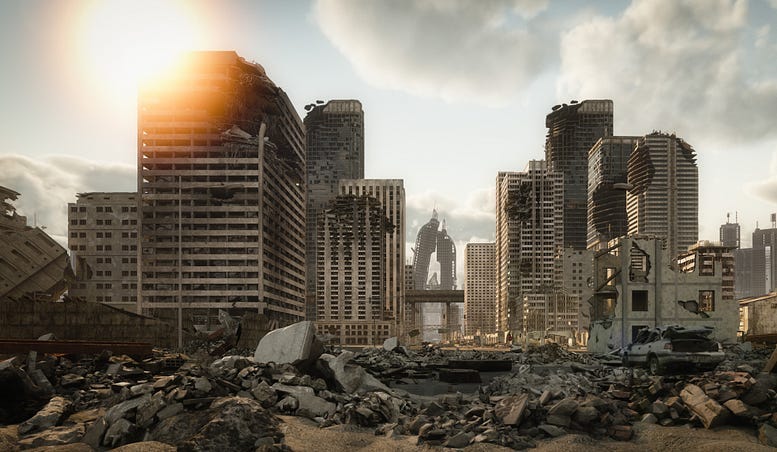
Author via iStock Photos
There are two insanely powerful sounds you should know about. The first is active every day in our world. It’s produced by a magnificent sea animal that was once brought to the brink of extinction.
The second happened in 1883 and was loud to the point that it will be difficult for me to properly articulate. I’ll do my best.
Organic sound weapon
In my five years of writing about science and animals, one animal fact stands above them all: the clicks of a sperm whale. Their deadly power is on par with a superhero’s.
In a marvelous act of bioengineering, their body has evolved a means of bouncing sound waves through their skull, magnifying the waves in a way that the military would struggle to replicate:
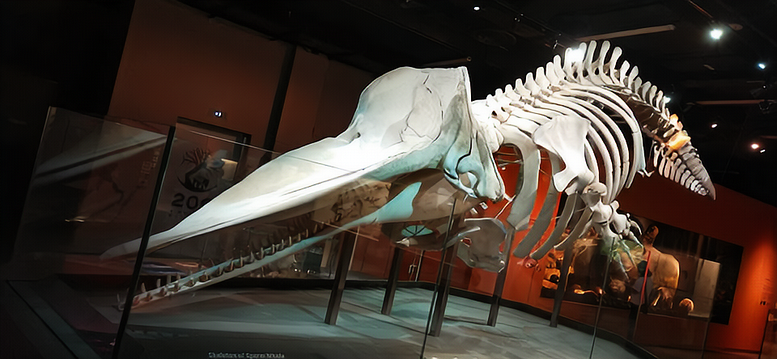
The entire skull is a giant noise machine. (Author via Metropolitan Museum of Art)
Note the flat part on the back skull that looks like a satellite dish. Sperm whales send a sound at the front of the mouth to that flat part. Then bounces it back outward, concentrating it in a cone that funnels out through a hole above its nose in a clicking sound.
When a large sperm whale is trying to talk to his buddy on the other side of the Pacific, or stun a giant squid, this click goes as high as 230 decibels. For context, a jackhammer is 100 decibels. The loudest noise ever produced by NASA was 194 decibels during the Saturn V takeoff, right near the launch pad.
Your eardrums rupture around 150 decibels. And you begin having a risk of heart attack and stroke around 180 decibels.
Sounds are vibrating waves that create a vacuum between them. The louder the sound, the bigger the vacuum, and the possibility of an air pocket inside your veins, which becomes an air embolism that travels to critical organs.
However, in water, the sound waves hit even harder. If a large male sperm whale clicked as loud as he could, it is akin to a car crash in your lungs as the sound is forced to slow down suddenly in your organs. Females select for males with the loudest clicks. Consequently, the species has gotten progressively louder over time.
Don’t fear, sperm whales are friendly and curious. If you swim near them, they will absolutely scan you with their clickers. They do it at lower intensities to get a three-dimensional view of your body (including your inner organs).
Diver, James Nestor, experienced this and said it was painfully loud even with their calm clicks. He felt his body heating up as the sound waves hit him.
And as a quick aside, one of the coolest things about sperm whales is that they sleep vertically in groups. This is a real photo:
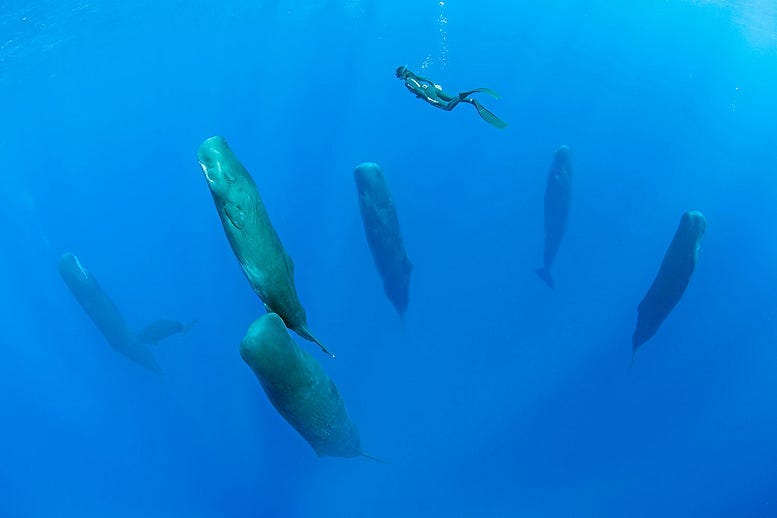
(Author via Wikimedia Commons)
The actual loudest sound recorded
In 1883, residents in Perth Australia heard a loud explosion that sounded nearby but none could see any smoke.
It stemmed from the Krakatoa volcanic eruption in Indonesia, more than 3000 miles away:
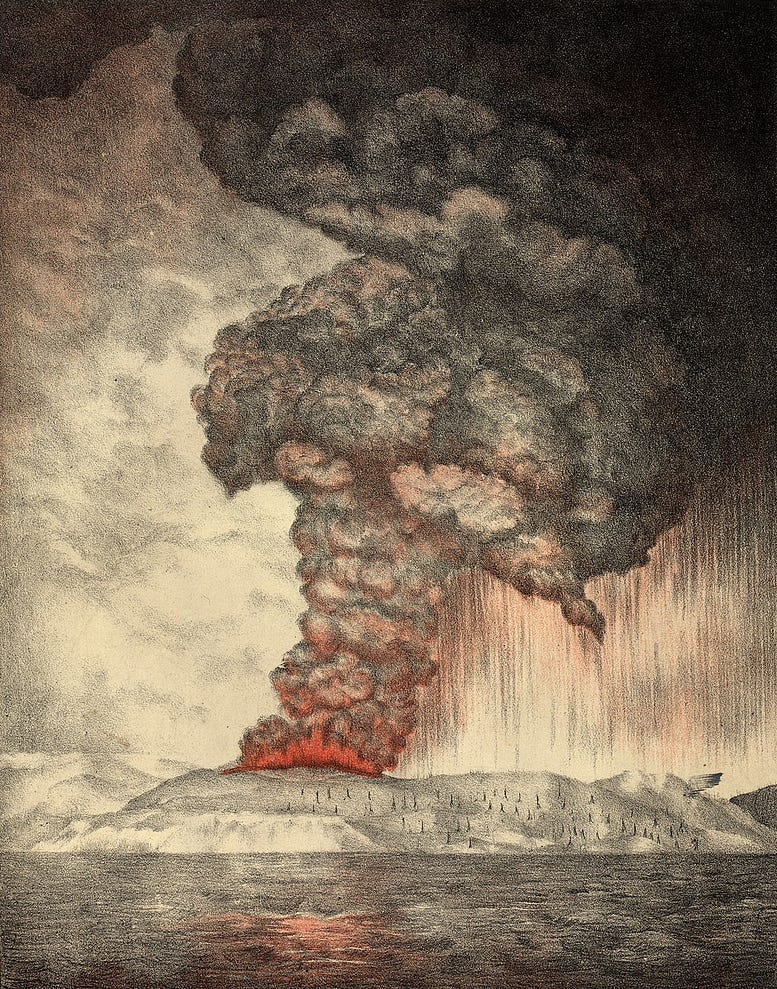
Author via Wikimedia commons.
The sound wave traveled the globe seven times over. It was the equivalent of Earth burping loudly — and sending 100-foot tsunamis outward, which killed 36,000 people in the region. Those that weren’t killed by the tsunami were killed by the poison gas that fell from the sky in the surrounding radius.
Seven barographs were running at the time and one registered 172 decibels 100 miles from the source. They calculated Krakatoa’s originating sound wave at 310 dB, which pushes the limits on the possibilities of sound.
It’s actually not technically possible to reach 310 dB, because sound waves turn into shock waves at that point. But because it was volcanic activity, the earth itself was helping the sound cheat science, shaking the area like a vibrating cell phone.
The noise blew out the eardrums of sailors 40 miles away, leaving several of them deaf. The eruption wiped out entire populations in Indonesia, including 160 villages, many of which never recovered. Those regions are now wilderness.
The thing that’s crazy is that many people had just lost their hearing minutes before the tidal waves came. The scene was written straight out of the depths of hell.
The volcanic explosion was so powerful that the volcano completely wiped itself out, falling 50 meters below sea level as a dent in the earth. The volcano is still growing today and just rose back above the shoreline, growing at 5 inches a week. And yes, I just had the same fear you did — I hope we don’t have a repeat eruption.
You need not worry: it takes thousands of years, but typically tens of thousands of years before explosions like this happen again.
Krakatoa was the disaster movie you wanted no part of.
메타데이터
- post_id
- 6c917ce4458d
- slug
- the-loudest-and-most-devastating-recorded-sound-in-history-6c917ce4458d
- url
- https://medium.com/@seanjkernan/the-loudest-and-most-devastating-recorded-sound-in-history-6c917ce4458d
- canonical_url
- https://medium.com/@seanjkernan/the-loudest-and-most-devastating-recorded-sound-in-history-6c917ce4458d
- author_url
- https://medium.com/@seanjkernan
- status
- ok
- fetched_at
- 2026-06-14 11:28:49