From Cloud Commands to Systems Thinking: What AWS Fundamentals Really Taught Me
Over the last several weeks, I completed Modules 5 & 6 of the Cloud Engineer Academy, covering core AWS infrastructure concepts including:
From Cloud Commands to Systems Thinking: What AWS Fundamentals Really Taught Me

Over the last several weeks, I completed Modules 5 & 6 of the Cloud Engineer Academy, covering core AWS infrastructure concepts including:
- VPC architecture
- Public and private subnet design
- Bastion hosts
- Route tables
- IAM
- EC2
- Load Balancers
- Auto Scaling
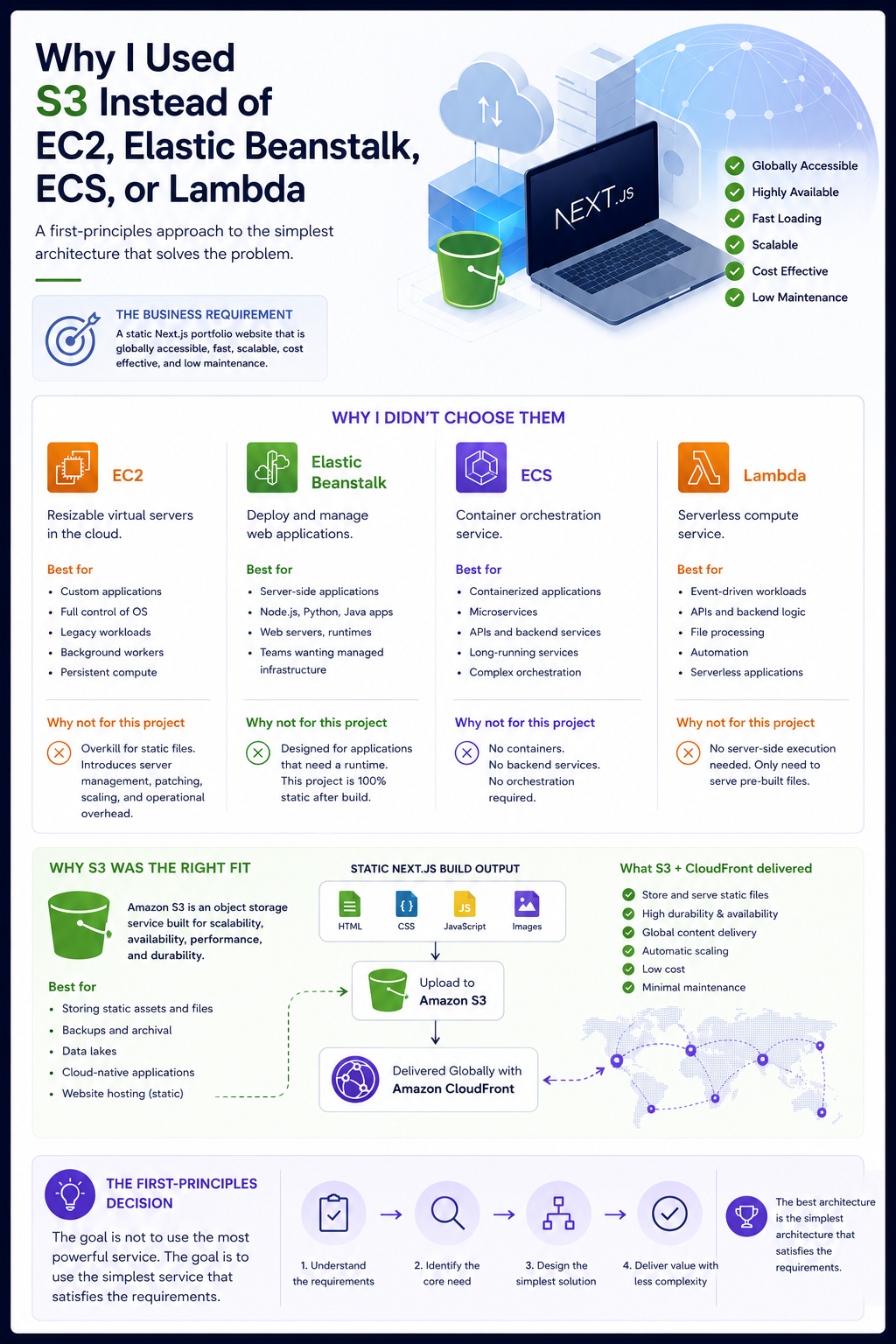
- S3
- RDS
- CloudFormation
On paper, these are “fundamentals.”
In practice, they represent the beginning of systems thinking.
The Difference Between Memorizing Services and Understanding Systems
Early cloud learning can create a dangerous illusion: that engineering is mostly about memorizing commands, clicking through consoles, and deploying services.
But these modules exposed something deeper.
Every deployment became an exercise in understanding relationships:
- Why can one EC2 instance communicate with another?
- Why does a route table determine reachability?
- Why can a machine have network access but still fail AWS API calls?
- Why can a tiny YAML indentation issue cascade into full stack rollback?
- Why does changing a logical resource ID in CloudFormation effectively create a new resource?
These are not “AWS problems.”
They are systems problems.
And systems thinking is what separates operators from architects.
First Principles Engineering
One of the most valuable lessons from the Cloud Engineer Academy has been the emphasis on first principles engineering.
Instead of asking: “What command fixes this?”
I’ve been learning to ask:
- What system is actually executing this?
- What trust boundary exists here?
- What identity is being assumed?
- What dependency failed?
- What layer is responsible for this behavior?
- Is this a networking issue, a permissions issue, or a deployment orchestration issue?
That shift changes everything.
Because once you understand the underlying principles, the tools become interchangeable.
CloudFormation Taught Me More Than Automation
CloudFormation was especially transformative.
At first, it felt like writing YAML.
But over time, it became clear that Infrastructure as Code is really about expressing system relationships:
- dependency chains
- network topology
- identity models
- scaling behavior
- deployment orchestration
- rollback recovery
- immutable infrastructure patterns
The debugging process became the real classroom.
Every failure message forced deeper understanding:
- malformed CIDR notation
- invalid IAM policy ARNs
- route table associations
- stack rollback states
- launch configuration deprecations
- security group logic
- YAML structure failures
- credential boundary confusion
Those failures weren’t setbacks.
They were architecture lessons.
Applying These Lessons in the Real World
What makes this journey especially meaningful is that I’m not learning cloud engineering in isolation.
Alongside this program, I’ve been helping drive strategic systems architecture discussions for Sawa X — a compliance-first platform connecting real-world energy assets with blockchain-enabled investment infrastructure.
That work has forced me to think beyond isolated cloud services and into:
- trust architecture
- permission models
- distributed systems
- investor-grade infrastructure
- compliance-aware design
- operational resilience
- system scalability
The cloud engineering journey is strengthening my ability to reason about these systems from the infrastructure layer upward.
And increasingly, I’m realizing that the future belongs to engineers who can bridge:
- business strategy
- cloud infrastructure
- systems architecture
- and AI-assisted execution
The Bigger Realization
The biggest takeaway from these modules is this:
Cloud engineering is not about learning AWS services.
It’s about learning how complex systems behave.
The services will evolve. The interfaces will change. The tooling will improve.
But the underlying principles:
- networking
- identity
- scalability
- fault tolerance
- orchestration
- automation
- observability
- dependency management
…those remain foundational.
And that’s the layer I’m trying to master now.
메타데이터
- post_id
- 6cb87246ecf8
- slug
- from-cloud-commands-to-systems-thinking-what-aws-fundamentals-really-taught-me-6cb87246ecf8
- url
- https://medium.com/@ismail.abdur.rahmanmba/from-cloud-commands-to-systems-thinking-what-aws-fundamentals-really-taught-me-6cb87246ecf8
- canonical_url
- https://medium.com/@ismail.abdur.rahmanmba/from-cloud-commands-to-systems-thinking-what-aws-fundamentals-really-taught-me-6cb87246ecf8
- author_url
- https://medium.com/@ismail.abdur.rahmanmba
- status
- ok
- fetched_at
- 2026-06-09 15:37:30