MQTT vs WebSocket vs HTTP: Understanding Real-Time Communication in Modern Applications
“How do apps deliver live updates instantly without constantly refreshing?”
MQTT vs WebSocket vs HTTP: Understanding Real-Time Communication in Modern Applications
“How do apps deliver live updates instantly without constantly refreshing?”
That question shows up sooner or later for almost every developer building modern applications. Whether it’s a chat app, a live dashboard, an IoT device, or a tracking system users expect one thing today: instant updates. No refresh. No delay. Just live data. But once you start building these systems, you quickly run into an important architectural decision:
Should you use HTTP, WebSockets, or MQTT?
At first, they may feel interchangeable. But in reality, they solve very different problems. Let’s break it down in a practical way.
Why HTTP struggles with real-time systems
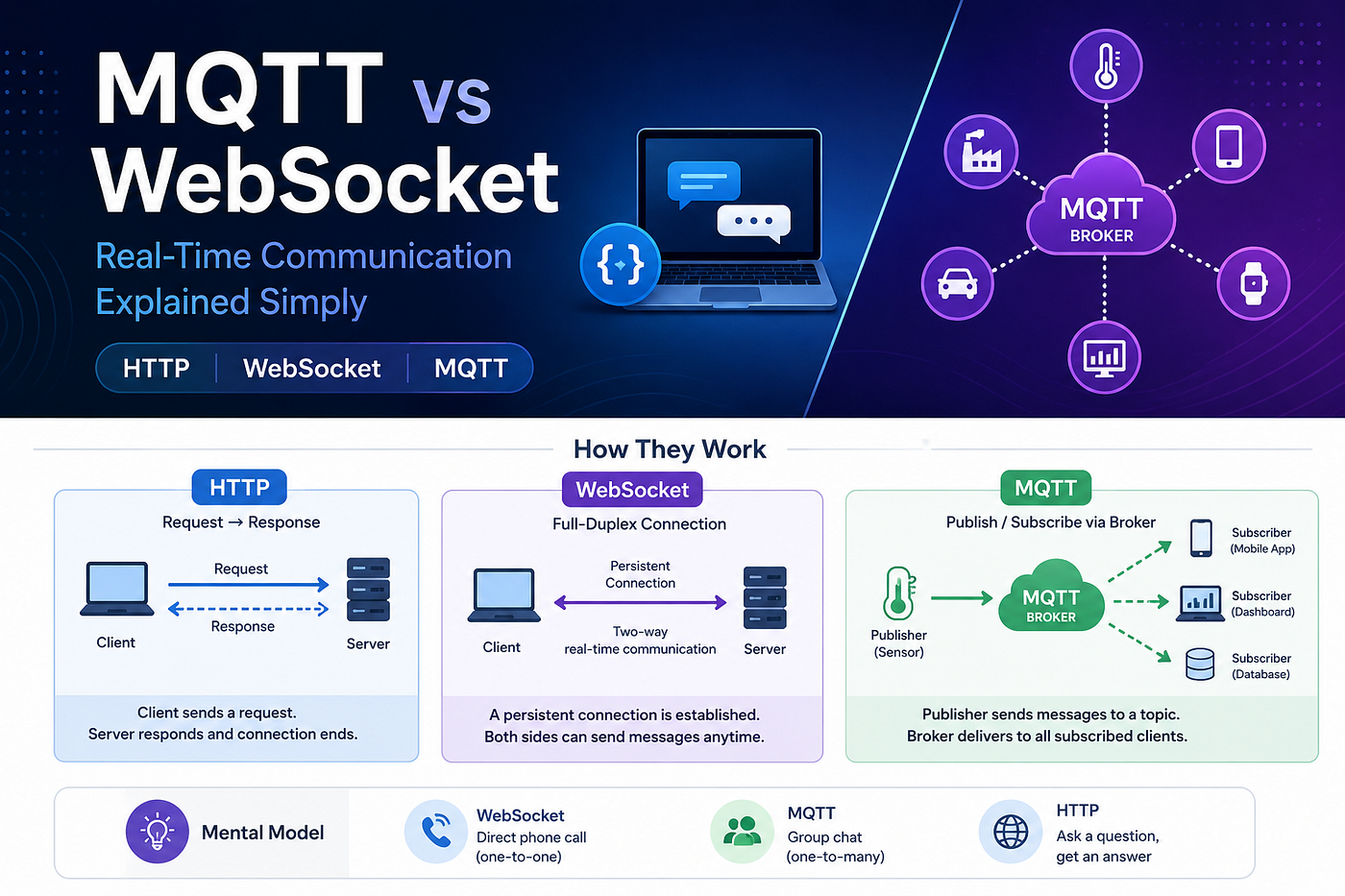
HTTP is where most developers start. It’s simple, reliable, and powers the entire web. But it was not designed for real-time communication. It works like this:
- the client asks
- the server responds
- connection ends
If you want updated data, you have to ask again… and again… and again. That leads to a few problems:
- too many repeated requests
- unnecessary network usage
- delayed updates
- inefficient communication for fast-changing data
This is why HTTP starts to feel “wrong” when you build things like:
- chat apps
- live tracking
- IoT sensors
- real-time dashboards
So developers needed something better.
WebSocket: the first step into real-time communication
WebSocket was introduced to fix one major limitation of HTTP: constant re-requesting. Instead of opening and closing connections every time, WebSocket creates a persistent connection between client and server.
Once the connection is open:
- both sides can send messages instantly
- no repeated requests needed
- data flows in real time
This makes WebSocket a great fit for:
- chat applications
- live dashboards
- collaborative tools
- real-time notifications
It feels like upgrading from messaging letters (HTTP) to a live phone call. But there’s something important to understand: WebSocket is still just a direct connection between two endpoints. And that becomes a limitation when systems grow.
MQTT: built for lightweight, scalable messaging
Now we move to MQTT , and this is where things change. MQTT is not just another real-time protocol.
It is designed for a different world:
- lightweight devices
- unstable networks
- massive scale systems
Instead of connecting clients directly, MQTT introduces a broker in the middle.
Here’s the simple idea:
- a device publishes a message
- it sends it to a topic
- the broker receives it
- all subscribed clients get it instantly
So instead of: client ↔ server we get: publisher → broker → subscribers
The key difference? Clients don’t need to know about each other at all.
They are completely decoupled.
A simple example
Imagine a temperature sensor in a building:
- it sends updates to a topic like
sensor/temperature - hundreds of apps or systems subscribe to that topic
- everyone gets updates instantly
No direct connections. No complexity.
Just a simple flow of messages.
That’s why MQTT is widely used in:
- IoT systems
- mobile apps with weak networks
- real-time data pipelines
- distributed systems
It is designed to be lightweight, efficient, and scalable.
WebSocket vs MQTT (the real difference)
At first glance, WebSocket and MQTT seem similar because both support real-time communication. But they are built for completely different purposes.
WebSocket
WebSocket creates a direct connection between a client and a server.
- one connection
- two endpoints
- real-time data flow
Think of it like a phone call between two people.
MQTT
MQTT does not connect clients directly. Instead, it uses a broker in the middle.
- publish → broker → subscribe
- one message → many receivers
- fully decoupled system
Think of it like a group chat where a moderator distributes messages to everyone who is interested.
Quick mental model
- HTTP → request & response
- WebSocket → direct real-time connection
- MQTT → scalable message distribution system
Final thoughts
There is no “best” protocol. Each one solves a different problem.
The real skill is not choosing the most advanced tool, it’s choosing the right one for your system.
Once you start seeing these protocols as design choices instead of just technologies, building real-time systems becomes much clearer:
- HTTP for simple APIs
- WebSocket for direct live communication
- MQTT for scalable, distributed messaging
A message from our Founder
Hey, Sunil here. I wanted to take a moment to thank you for reading until the end and for being a part of this community. Did you know that our team run these publications as a volunteer effort to over 3.5m monthly readers? We don’t receive any funding, we do this to support the community.
If you want to show some love, please take a moment to follow me on LinkedIn, TikTok, Instagram. You can also subscribe to our weekly newsletter. And before you go, don’t forget to clap and follow the writer️!
메타데이터
- post_id
- 6cbbcdeec679
- slug
- mqtt-vs-websocket-vs-http-understanding-real-time-communication-in-modern-applications-6cbbcdeec679
- url
- https://blog.stackademic.com/mqtt-vs-websocket-vs-http-understanding-real-time-communication-in-modern-applications-6cbbcdeec679
- canonical_url
- https://blog.stackademic.com/mqtt-vs-websocket-vs-http-understanding-real-time-communication-in-modern-applications-6cbbcdeec679
- author_url
- https://medium.com/@ana.hedjazi68
- status
- ok
- fetched_at
- 2026-06-09 15:37:30