Butter Over Guns: Syria’s Fuel Crisis in the Shadow of Civil War
INTRODUCTION:
Butter Over Guns: Syria’s Fuel Crisis in the Shadow of Civil War
INTRODUCTION:
Since 2011, Syria has constantly made headlines for one humanitarian crisis or another. The fundamental problem is the leadership in Syria, wherein many rebel groups are fighting to end the supposedly unjust rule of the President. The war has also been popularlydubbed as a proxy war in which many powerful international players like the USA and Russia are involved. (Alrefaai N., 2013)
Damascus, the capital of Syria, lost many of its oil fields due to the war in 2013, because of which Syria was forced to become a country almost entirely dependent on oil and other fuels. (Daher J., 2021) This policy brief will look at how this civil war in Syria has managed to substantially impact the availability of fuel in the country and its other consequences.
PROBLEM:
Syria, before the conflict, was a leading oil and natural gas producer in the Eastern Mediterranean. This fuel, which isused to provide electricity and other resources from industries to basic life supports like hospitals, home heaters, gas stoves to cook, and even cell phone towers, has been affected by the Syrian war.
The cost of cooking gas was about 250 SYP in 2010 and in 2021 cost around 9,700 SYP, which is an increase of 3,780 per cent. (WFP, Syria Country Office, 2021)
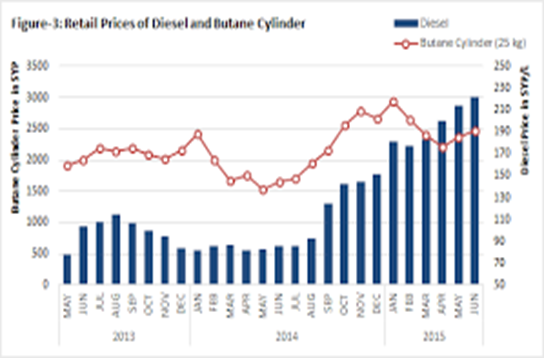
The above graph gives a clear picture of the gradual yet tremendous increase in butane cylinders and petroleum from 2013 to 2015, that is from 500 SYP to 3000 SYP, which is a 600% increase in just 3 years.
Due to the high price, almost half of the population is unable to eat proper meals. According to the World Food Programme, a Syrian population of 12.1 million suffers from food insecurity (WFP, Syria Country Office, 2021)
In winter, due to rising fuel costs, it’s impossible for people living in poverty. A researcher at the London School of Economics, Myriam Youssef, says that like many other winters, they wait for hours on end for vehicles distributing fuel to pass their neighborhood to buy a few litres of fuel that will only be enough to warm the house for a couple of hours. (Lund A., 2019) Electricity lasts for less than four hours a day. There are reports of children freezing to death. This becomes especially true when huge-scale displacement takes place, and the people are forced to flee with only the clothes that they are wearing.
Due to higher fuel prices, transportation costs proportionally increased. It is reported that 400–600 SYP is paid for one day of transportation so most of the salary goes there. (Leigh K., Dighli W., 2014) Increases in fuel prices have also resulted in huge-scale protests by automobile drivers, further disrupting the economy.
Daily labour has become costly as well due to which farmers are forced to pay more just for irrigation than what it costs for planting. (Action Against Hunger USA, 2022)
Many private sector industries were granted holidays for more than ten days to save up on fuel (Nofal W., 2023)
Solutions
The government tried to ration its fuel by cutting 40% of fuel given to government officials and also cutting down official travel for anything other than emergency purposes. (Sanadiki.O., 2019)
Black marketing of fuel was on the rise and it sold fuel at three times the cost, as can be seen from the graph above. Counter-intuitively, to curb this, the government further increased the price of fuel. State subsidies for fuel have fallen for this reason. So, there is a lingering fear among the people about the future implications of the same. Thus, it is imperative for the government not togo down the same path again because even though this might be meaningful in fiscal terms, it acts as a tremendous blow for the consumers there. (Cuyler Z., 2015) So, the priority during a national financial crisis must be to provide subsidised fuel to its citizens. Drawing from the lessons, it can be said that fuel prices became the trade-off here to curb unfair practices.
In 2021, out of 3,51,000 registered citizens for heating oil, only 35,000 people received it (Daher J., 2021) and those who don’t need subsidised fuel also are required to wait in extremely long queues for long hours. So, the rationing of fuel is not done efficiently and so steps must be taken to distribute fuel most effectively and efficiently.
This level of unprecedented shortage of fuel calls for large-scale international humanitarian help and considerations and negotiations on the President’s part concerning Western sanctions.
The UNHCR does its part by providing humanitarian aid for Syrian refugees by providing them with stoves and fuel for heaters. The Regional Refugee and Resilience Plan is also being headed by UNHCR which provides basic amenities and needs for the Syrian refugees.
The most logical solution to the fuel crisis would be a combination of pacification and negotiation by the Syrian government to international bodies, and more humanitarian aid through creating increasing awareness of the dire situation in Syria. Subsidies must be provided at an effective rate and the distribution and rationing of these subsidies must also be done efficiently.
CONCLUSION
Fuel prices affected by the Syrian war are quite a complicated affair due to the mixed aspects involved. With the people’s interest in mind, if the above-mentioned solutions, especially those of negotiation and subsidies are carried out more efficiently, there is a scope for improvement. In brief, the Syrian economy can improve if butter is favoured over guns, because, unfortunately, in Syria’s case, war has not ‘made up’ a state but only deteriorated it, maybe because all the players involved internally are on the losing end.
메타데이터
- post_id
- 6ccdc8bf8d21
- slug
- butter-over-guns-syrias-fuel-crisis-in-the-shadow-of-civil-war-6ccdc8bf8d21
- url
- https://medium.com/@subasreesaminathan/butter-over-guns-syrias-fuel-crisis-in-the-shadow-of-civil-war-6ccdc8bf8d21
- canonical_url
- https://medium.com/@subasreesaminathan/butter-over-guns-syrias-fuel-crisis-in-the-shadow-of-civil-war-6ccdc8bf8d21
- author_url
- https://medium.com/@subasreesaminathan
- status
- ok
- fetched_at
- 2026-06-09 15:37:30



