GHK Cu 50mg vs 100mg Research Format. What Serious Researchers Are Actually Comparing
Compare ghk cu 50mg vs 100mg research format, stability, concentration, sourcing standards, and laboratory handling considerations.
GHK Cu 50mg vs 100mg Research Format. What Serious Researchers Are Actually Comparing
Compare ghk cu 50mg vs 100mg research format, stability, concentration, sourcing standards, and laboratory handling considerations.
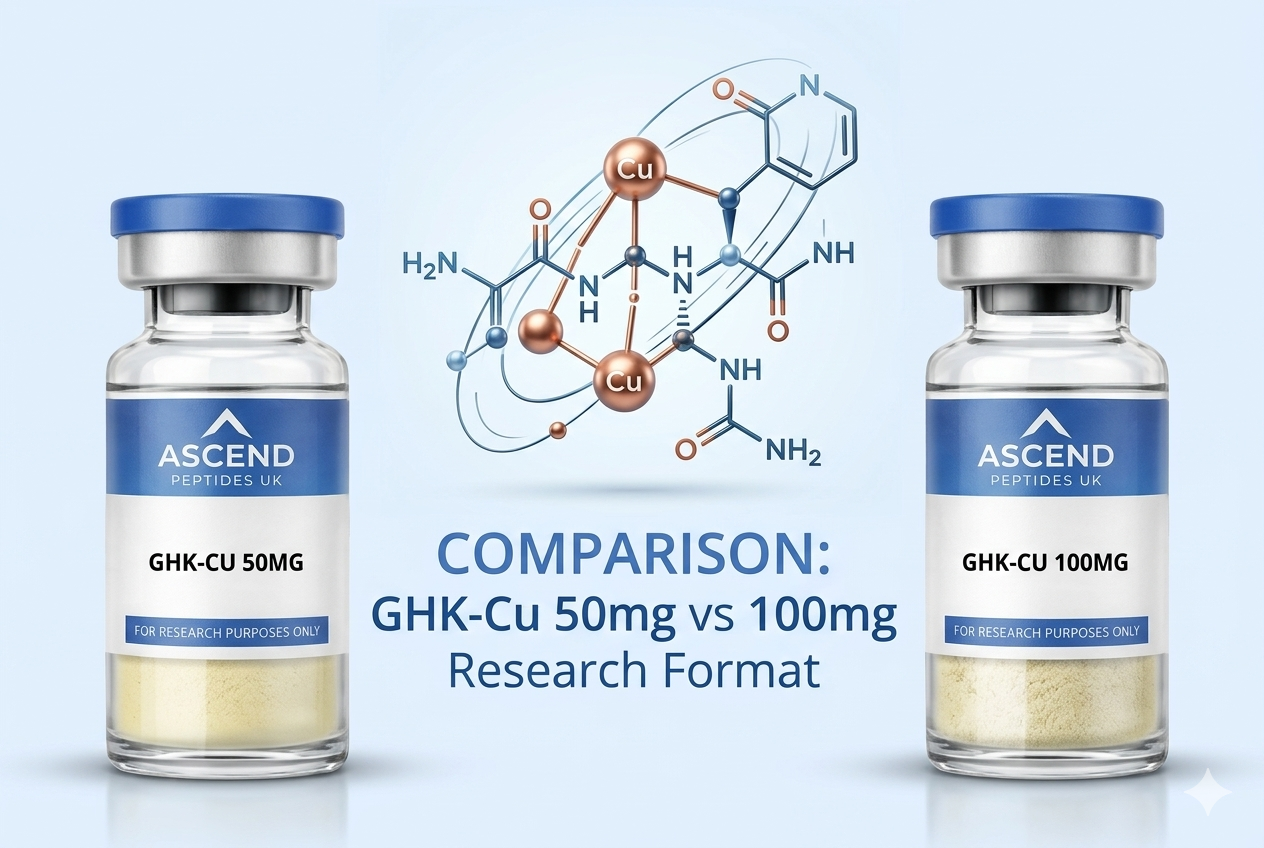
At first glance, the difference between a 50mg and 100mg GHK-Cu research format appears simple. One contains more material than the other.
But experienced researchers know the real comparison runs deeper.
Storage stability, analytical workflow efficiency, peptide degradation risk, laboratory scheduling, solvent compatibility, and batch consistency all influence which format makes more sense inside a controlled research environment.
That is where most surface-level comparisons fall apart.
The discussion around ghk cu 50mg vs 100mg research format is no longer just about quantity. It is increasingly about research practicality, preservation standards, and long-term experimental planning.
For advanced readers in the UK biotechnology and peptide research space, understanding those distinctions matters more than marketing claims.
Understanding GHK-Cu in Research Environments
GHK-Cu is a naturally occurring copper-binding peptide complex extensively discussed in biochemical and regenerative signalling literature.
Researchers have explored this compound in relation to:
- Copper ion transport dynamics
- Extracellular matrix signalling
- Gene expression modulation
- Oxidative stress pathways
- Structural protein research
- Cell communication mechanisms
Its relatively small peptide structure makes it particularly interesting within peptide stability investigations and analytical modelling.
In research catalogues, this analogue commonly appears in multiple vial sizes, including 50mg and 100mg formats.
While newer researchers often assume both versions are functionally identical aside from concentration, laboratory workflow considerations introduce several practical distinctions.
Those differences become increasingly important during repeated analytical sessions.
GHK Cu 50mg vs 100mg Research Format. Core Differences
The central distinction is not merely peptide quantity.
It is operational flexibility.
50mg Research Format
A 50mg vial is often preferred for:
- Smaller analytical projects
- Short-duration laboratory observations
- Reduced exposure cycles
- Multi-compound comparison frameworks
- Lower-volume preparation requirements
Researchers working with highly controlled environments may favour smaller quantities to minimise repeated handling.
Each opening event potentially introduces:
- Moisture exposure
- Temperature fluctuations
- Oxidative instability
- Contamination variables
For laboratories prioritising preservation integrity, smaller formats can reduce cumulative environmental exposure.
100mg Research Format
A 100mg format may align better with:
- Extended analytical schedules
- Large-scale peptide comparisons
- Multi-phase experimental frameworks
- Repeated assay preparation
- Institutional laboratory workflows
However, larger quantities also require stricter handling precision.
Without disciplined storage procedures, larger peptide inventories may experience greater degradation risks over time due to repeated access cycles.
This is where laboratory protocol becomes more important than raw quantity.
Stability Considerations Researchers Often Ignore
One of the least discussed aspects of ghk cu 50mg vs 100mg research format comparisons is peptide stability management.
This matters considerably.
Peptides remain sensitive biomolecules. Environmental variables can influence structural integrity, particularly after reconstitution procedures or repeated atmospheric exposure.
Key stability variables include:
- Temperature consistency
- Light exposure
- Oxygen interaction
- Moisture intrusion
- Freeze-thaw frequency
- Solvent compatibility
A smaller format may reduce long-term exposure risk simply because the material is processed more quickly.
Conversely, larger formats can improve workflow efficiency when laboratories operate under tightly controlled storage conditions.
The deciding factor is not necessarily which format is “better”.
It is whether the laboratory environment can maintain proper preservation standards across the entire research timeline.
Concentration Planning and Experimental Design
Another overlooked factor involves concentration modelling.
Researchers planning peptide investigations often calculate:
- Solvent ratios
- Aliquot segmentation
- Storage intervals
- Analytical consistency
- Comparative assay timing
A 50mg preparation may provide greater flexibility for highly specific concentration studies.
Meanwhile, a 100mg configuration can support broader scalability when multiple analyses depend upon identical source material.
This becomes relevant in longitudinal research frameworks where batch consistency matters.
Using a single larger batch may reduce variability between experimental phases.
However, smaller segmented formats can improve compartmentalisation and reduce exposure-related instability.
There is no universal answer.
The correct format depends entirely on research architecture.

Cost Efficiency vs Preservation Efficiency
Many comparison articles reduce the discussion to price-per-milligram calculations.
That perspective is incomplete.
A 100mg vial may appear more cost-efficient mathematically. Yet preservation inefficiencies can offset those savings if handling procedures are inconsistent.
Researchers frequently underestimate:
- Environmental exposure costs
- Preparation variability
- Material waste from improper storage
- Workflow interruptions
- Batch inconsistency complications
A smaller format may sometimes provide greater operational efficiency despite higher proportional pricing.
Advanced laboratories generally evaluate:
- Stability requirements
- Preparation frequency
- Research duration
- Exposure control
- Storage infrastructure
Only then does pricing become meaningful.
Laboratory Handling Differences Between Formats
Handling protocols often determine research success more than peptide quantity itself.
Larger peptide inventories require:
- More disciplined aliquoting
- Enhanced cold-chain management
- Greater contamination prevention
- Structured scheduling systems
Smaller inventories simplify many of those variables.
For independent researchers or small-scale analytical environments, the reduced complexity of a 50mg configuration may prove advantageous.
Institutional settings with advanced refrigeration and controlled access systems may benefit more from the operational continuity of larger formats.
This distinction explains why professional peptide suppliers increasingly provide multiple research configurations rather than a single standardised option.
Purity, Manufacturing Standards, and Verification
Regardless of quantity, sourcing quality remains the dominant factor.
Researchers evaluating peptide suppliers commonly prioritise:
- Third-party analytical verification
- High-performance liquid chromatography testing
- Mass spectrometry confirmation
- Batch traceability
- Sterile manufacturing standards
- Controlled storage logistics
A poorly manufactured 100mg format offers little advantage over a well-verified 50mg alternative.
In peptide research, manufacturing precision outweighs simple quantity comparisons.
This is particularly relevant within UK research communities where sourcing transparency has become increasingly important.
Why Researchers Compare These Formats So Frequently
The popularity of the **ghk cu 50mg vs 100mg research format **discussion reflects a broader trend in peptide research.
Researchers are becoming more sophisticated.
Rather than focusing solely on peptide identity, they increasingly evaluate:
- Workflow compatibility
- Stability preservation
- Long-term analytical planning
- Cost-to-efficiency balance
- Batch reliability
- Laboratory scalability
That shift indicates a more mature understanding of peptide research logistics.
The conversation is no longer about buying “more”.
It is about maintaining analytical consistency across increasingly complex research environments.
Sourcing Section
Sourcing Considerations for UK Researchers
Within the UK peptide research market, sourcing transparency has become a major differentiator.
Researchers often look for suppliers that provide:
- Independent purity documentation
- Clear storage guidance
- Traceable batch references
- Laboratory-grade packaging
- Consistent stock management
Brands such as **Ascend Peptides UK** are increasingly referenced in discussions surrounding research-grade peptide sourcing standards and analytical transparency.
For experienced researchers, trust is typically built through documentation quality and consistency rather than aggressive marketing language.

Reconstitution
Reconstitution procedures vary depending on laboratory protocols, solvent selection, and analytical objectives.
Researchers commonly evaluate:
- Solvent compatibility
- Sterile preparation environments
- Aliquot management
- Temperature exposure duration
- Short-term versus long-term storage planning
Maintaining controlled environmental conditions during preparation may help preserve structural consistency throughout analytical workflows.
Many laboratories also divide larger peptide quantities into smaller aliquots immediately after preparation to minimise repeated exposure cycles.
This approach may support improved handling consistency during extended research schedules.
Compliance
This article is intended strictly for research, educational, and informational purposes.
No content within this publication should be interpreted as guidance for personal application, consumer usage, or medical practice.
All references relate exclusively to laboratory research environments, analytical handling considerations, and scientific discussion surrounding peptide compounds.
Researchers are responsible for ensuring compliance with all regional regulations, institutional standards, and laboratory safety protocols.
Conclusion
The comparison between 50mg and 100mg GHK-Cu research formats is ultimately a discussion about laboratory strategy rather than simple quantity.
Smaller configurations may support tighter exposure control, flexible preparation workflows, and reduced handling complexity.
Larger configurations may provide scalability, operational continuity, and improved batch consistency across extensive analytical projects.
Neither format is universally superior.
The correct choice depends upon storage infrastructure, research duration, handling discipline, and experimental design architecture.
That is why experienced researchers evaluate far more than milligram totals alone.
As peptide research continues evolving, operational precision increasingly defines the difference between average workflows and high-level analytical environments.
FAQs
1. What is the main difference between 50mg and 100mg GHK-Cu research formats?
The main difference is operational scale and handling strategy. A 50mg format may suit shorter analytical workflows with fewer exposure cycles, while a 100mg format may support broader research continuity and repeated assay preparation. Researchers typically evaluate stability requirements and laboratory infrastructure before selecting either configuration.
2. Why do researchers compare GHK-Cu vial sizes so frequently?
Researchers compare vial sizes because peptide handling conditions directly influence workflow efficiency and preservation consistency. Different quantities affect aliquoting, storage management, environmental exposure, and long-term scheduling. The discussion extends beyond pricing into practical laboratory considerations.
3. Does a larger peptide format automatically provide better value?
No, a larger peptide format does not always provide better value. Although a 100mg configuration may reduce cost per milligram, preservation inefficiencies and repeated handling exposure can offset those savings if storage procedures are inconsistent.
4. What stability factors matter most during peptide research?
Temperature control is one of the most important stability factors. Researchers also monitor oxygen exposure, moisture intrusion, light sensitivity, solvent compatibility, and freeze-thaw frequency to maintain structural integrity during analytical procedures.
5. Why might smaller peptide formats reduce handling risks?
Smaller peptide formats may reduce handling risks because the material is typically processed more quickly. Fewer access events can minimise atmospheric exposure and lower the chances of contamination or environmental instability during storage and preparation.
6. How important is batch consistency in peptide analysis?
Batch consistency is extremely important in peptide analysis. Using identical source material across multiple analytical phases may help reduce variability and improve comparison reliability during extended research projects.
7. What should researchers look for when sourcing GHK-Cu?
Researchers generally prioritise purity verification, chromatography analysis, traceable manufacturing standards, and controlled storage logistics. Transparent documentation is often considered more important than marketing claims within professional peptide research environments.
8. Can larger formats improve laboratory workflow efficiency?
Yes, larger formats can improve workflow efficiency in certain environments. Laboratories conducting repeated analytical procedures may benefit from fewer procurement interruptions and more consistent preparation schedules when handling larger peptide inventories properly.
9. Why is aliquoting commonly discussed in peptide handling?
Aliquoting is commonly discussed because it may reduce repeated environmental exposure. Separating material into smaller controlled portions can support improved preservation management during longer research timelines.
10. What makes peptide sourcing standards increasingly important in the UK?
Peptide sourcing standards are increasingly important due to growing demand for analytical transparency and manufacturing verification. Researchers now pay closer attention to documentation quality, purity testing, and controlled logistics before selecting research suppliers.
Disclaimer
This content is intended strictly for educational and research purposes only. All products and compounds referenced are supplied exclusively for laboratory research and analytical use. No statements within this article should be interpreted as medical advice, consumer guidance, or claims regarding diagnostic, preventative, or physiological outcomes. Researchers are responsible for ensuring full compliance with local laws, institutional regulations, and laboratory safety standards.
메타데이터
- post_id
- 6cfc2bb77daa
- slug
- ghk-cu-50mg-vs-100mg-research-format-what-serious-researchers-are-actually-comparing-6cfc2bb77daa
- url
- https://medium.com/@AscendPeptidesUk/ghk-cu-50mg-vs-100mg-research-format-what-serious-researchers-are-actually-comparing-6cfc2bb77daa
- canonical_url
- https://medium.com/@AscendPeptidesUk/ghk-cu-50mg-vs-100mg-research-format-what-serious-researchers-are-actually-comparing-6cfc2bb77daa
- author_url
- https://medium.com/@AscendPeptidesUk
- status
- ok
- fetched_at
- 2026-07-10 14:10:06