Why the Healthiest Homes Look Like They’re Half Outside
Biophilic design isn’t about adding a plant to your desk. It’s about reconnecting interior spaces with the natural patterns that our…
Why the Healthiest Homes Look Like They’re Half Outside
Biophilic design isn’t about adding a plant to your desk. It’s about reconnecting interior spaces with the natural patterns that our nervous systems are wired to respond to — and the health benefits are measurable.
There’s a hospital in Singapore where patients heal faster.
It’s not because of better doctors or advanced treatment protocols. It’s because of the building itself. Khoo Teck Puat Hospital was designed around a central courtyard filled with native plants, water features, and natural ventilation. Patients have views of greenery from nearly every room. Healing gardens are integrated throughout. The building doesn’t just sit in nature — it brings nature inside.
The results are documented: lower stress hormones, reduced pain medication use, faster recovery times, better patient satisfaction scores. The building itself is therapeutic.
This is not feng shui or wellness marketing. This is biophilic design — the practice of incorporating natural elements into built environments in ways that tap into deep, evolutionarily wired human responses to nature. And the science behind it is surprisingly robust.
Humans spent 99.9% of our evolutionary history in natural environments. Our nervous systems are calibrated to the patterns, rhythms, and sensory inputs of the natural world. Modern interiors — sealed from the outdoors, lit artificially, climate-controlled, filled with synthetic materials — are profound departures from the environments we’re adapted to.
The question biophilic design asks is simple: what happens when we bring those natural patterns back?
What Your Nervous System Is Looking For (And Not Finding)
Your body is constantly scanning its environment for cues about safety, resource availability, and well-being. In nature, these cues are abundant and legible.
Variability and complexity signal health. A landscape with varied terrain, diverse plant life, and changing light is a landscape that can support life. A landscape that is monotonous — featureless, uniform, unchanging — is potentially dangerous.
Modern interiors tend toward monotony. Flat walls. Uniform lighting. Smooth surfaces. Identical rooms. Your nervous system registers this as a low-information environment, which creates a subtle, chronic stress response.
Natural patterns and fractals occur throughout nature — the branching of trees, the spiral of a shell, the ripple of water. Research has found that viewing fractal patterns reduces stress and promotes cognitive restoration. Humans find them inherently pleasing without knowing why.
Modern architecture tends toward geometric simplicity — right angles, flat planes, repetitive grids. These patterns are legible and efficient, but they lack the visual richness that the brain finds restorative.
Dynamic light and shadow change throughout the day in natural environments. Morning light is cool and low. Midday light is bright and overhead. Evening light is warm and diffuse. This variation regulates circadian rhythms, mood, and energy.
Modern interiors often have static lighting — the same fluorescent or LED wash from morning to night. This confuses circadian signaling and contributes to sleep problems, mood disorders, and fatigue.
Connection to living systems — plants, water, animals — signals abundance and vitality. Being near life reinforces that you are in a life-supporting environment.
Modern interiors are often entirely inorganic. Concrete, glass, steel, plastic, drywall. Nothing grows, nothing moves, nothing changes. The space is dead, and your nervous system knows it.
The cumulative effect of these absences is a kind of environmental poverty. Not acute. Not dramatic. But real, measurable, and compounding over time.
The Six Elements of Biophilic Design That Actually Work
Biophilic design is not a single intervention. It’s a set of principles that, when layered, create environments that support human health in ways conventional design does not.
1. Direct Contact with Nature: Bring the Outside In
The most obvious form of biophilic design is also the most effective: actual living plants.
The benefits are well-documented. Plants improve air quality by filtering toxins and producing oxygen. They increase humidity, which is especially valuable in dry climates or during winter heating. They reduce stress — one study found that simply having a plant within view reduces cortisol levels by 15%.
But not all plants work equally well in interiors.
Low-light tolerance is essential unless you have abundant natural light. Pothos, snake plants, ZZ plants, and philodendrons thrive in low light. Fiddle leaf figs and rubber plants need bright indirect light.
Maintenance must match your lifestyle. A plant that requires daily care will die if you travel frequently or forget to water. Choose plants that fit your reality, not your aspirations.
Scale matters. A single small plant on a desk is better than nothing, but it’s not enough to shift the character of a room. Larger plants — floor plants in 10"+ pots — create presence. Multiple plants create an ecosystem feel.
Groupings are more effective than scattered singles. Three plants clustered in a corner have more impact than three plants spread across different rooms.
2. Natural Light: The Non-Negotiable Element
No amount of artificial light can fully replace natural light.
Sunlight contains the full spectrum of wavelengths. It shifts in color temperature throughout the day. It provides cues that regulate circadian rhythm, vitamin D production, and mood stabilization. Exposure to natural light in the morning improves sleep quality at night. Lack of natural light is associated with depression, especially in winter.
Maximize what you have. If you have windows, don’t block them with heavy curtains during the day. Use sheer or translucent window treatments that allow light in while managing glare.
Position workspaces near windows. The closer you are to a window, the more light you receive. Even a few feet makes a measurable difference.
Reflect light with mirrors and light surfaces. A mirror opposite a window doubles the effective light in a room. Light-colored walls and ceilings bounce light deeper into the space.
Supplement with full-spectrum bulbs. If natural light is limited, use bulbs rated at 5000K–6500K during the day. They won’t replace sunlight, but they’re far better than warm-white bulbs that make interiors feel artificial and dim.
3. Natural Materials: Texture and Warmth
Materials matter.
Wood, stone, clay, linen, cotton, leather — natural materials have visual and tactile properties that synthetic materials struggle to replicate. They age gracefully. They have inherent variation. They feel warm to the touch.
Wood is the most versatile. Flooring, furniture, cutting boards, bowls, frames — wood introduces warmth and organic texture into almost any space. Light woods (oak, ash, maple) feel clean and Scandinavian. Dark woods (walnut, teak) feel rich and grounding.
Stone and clay add weight and permanence. Marble countertops, slate tiles, ceramic vases, stone bowls — these materials have a density and coolness that contrasts beautifully with wood and fabric.
Natural textiles soften and absorb. Linen curtains, cotton throws, wool rugs — they add softness, warmth, and acoustic dampening. A room with only hard surfaces feels cold. A room with textiles feels inhabited.
Avoid excessive plastic and synthetic finishes. They don’t age well, they feel cheap to the touch, and they contribute to the sense of a space being disconnected from natural systems.
4. Views and Vistas: What You See Matters
What you look at while you’re indoors affects your psychological state.
A view of a natural scene — trees, sky, water, distant hills — reduces stress and improves cognitive performance. A view of a parking lot or a brick wall does the opposite.
If you have a good view, orient your furniture to take advantage of it. Position your desk, reading chair, or dining table so that the view is accessible.
If you don’t have a good view, you can create visual depth in other ways. Mirrors expand the sense of space. Artwork depicting natural scenes provides a surrogate for an actual view. Interior windows — glass between rooms — create sightlines that make spaces feel more connected and less closed off.
5. Water: Sound and Movement
The sound of water is one of the most universally calming natural sounds.
A small tabletop fountain, an aquarium, or even a recording of water sounds can reduce anxiety and improve focus. Water introduces movement — something most interiors lack entirely. A room where nothing moves feels static. A room with water, plants swaying slightly in airflow, or visible outdoor elements through a window feels alive.
6. Natural Patterns and Biomorphic Forms
This is the subtlest element but potentially the most powerful.
Biomorphic design uses shapes, curves, and patterns inspired by nature rather than pure geometry. Curved furniture instead of all right angles. Organic forms in lighting fixtures. Wallpaper or textiles with leaf patterns, waves, or fractals.
Avoid rigidity. A room where every surface is flat and every line is straight feels harsh. Introducing curves — a round table, an arched doorway, a curved sofa — softens the space.
Use natural patterns sparingly. A feature wall with botanical wallpaper, a rug with an organic pattern, or curtains with a subtle leaf print can introduce biophilic cues without overwhelming the space.
The Smallest Changes That Make the Biggest Difference
You don’t need to renovate to introduce biophilic design. Small interventions compound.
Add one large plant. Not a tiny succulent. A substantial floor plant in a 10"+ pot. Put it somewhere you see it daily — near your desk, next to the couch, in the entryway.
Open your blinds. If you have windows and you’re keeping them covered during the day, you’re blocking one of the most powerful biophilic elements available.
Replace one synthetic object with a natural one. Swap the plastic cutting board for wood. Replace the polyester throw with linen. Trade the acrylic picture frame for wood. One substitution won’t transform a room, but it shifts the material balance.
Introduce one element of movement. A fish tank. A fountain. A window that opens. Something that moves, changes, or responds.
Change your screen savers and wallpapers to natural images. If you spend hours a day looking at screens, what’s on them when they’re idle matters. A forest, ocean, or mountain scene is better than a logo or a solid color.
What Happens When You Get It Right
A biophilically designed space doesn’t feel like a normal interior.
It feels more alive. More comfortable. More restorative. People comment on it — “your place feels so calm” — without being able to articulate exactly why.
You sleep better. You focus more easily. You feel less anxious when you’re home. Guests stay longer. Kids play more calmly. The space doesn’t just shelter you from the world — it actively supports your well-being.
This is not mysticism. This is your nervous system responding to environmental cues it was designed to respond to. Cues that have been largely absent from your life, and that you didn’t realize you were missing until they return.
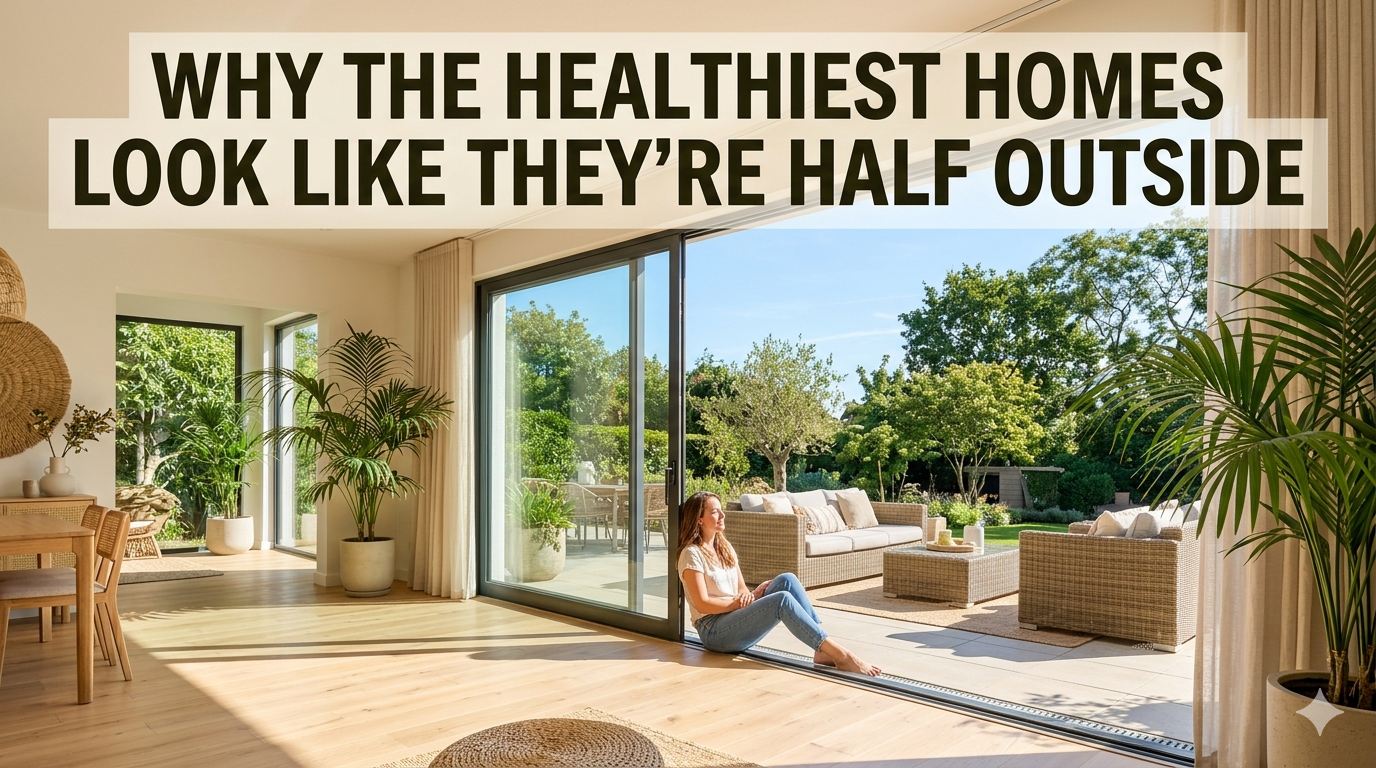
The healthiest homes don’t look like sealed boxes. They look like transitions between inside and outside. They blur the boundary. They bring in light, life, texture, and change.
They feel, in the deepest sense, like places where humans can actually thrive.
Follow for more on biophilic design, healthy interiors, and creating spaces that support human well-being.
메타데이터
- post_id
- 6cfe956c18cb
- slug
- why-the-healthiest-homes-look-like-theyre-half-outside-6cfe956c18cb
- url
- https://medium.com/arch-lab/why-the-healthiest-homes-look-like-theyre-half-outside-6cfe956c18cb
- canonical_url
- https://medium.com/arch-lab/why-the-healthiest-homes-look-like-theyre-half-outside-6cfe956c18cb
- author_url
- https://medium.com/@idenvion
- status
- ok
- fetched_at
- 2026-06-21 09:28:28