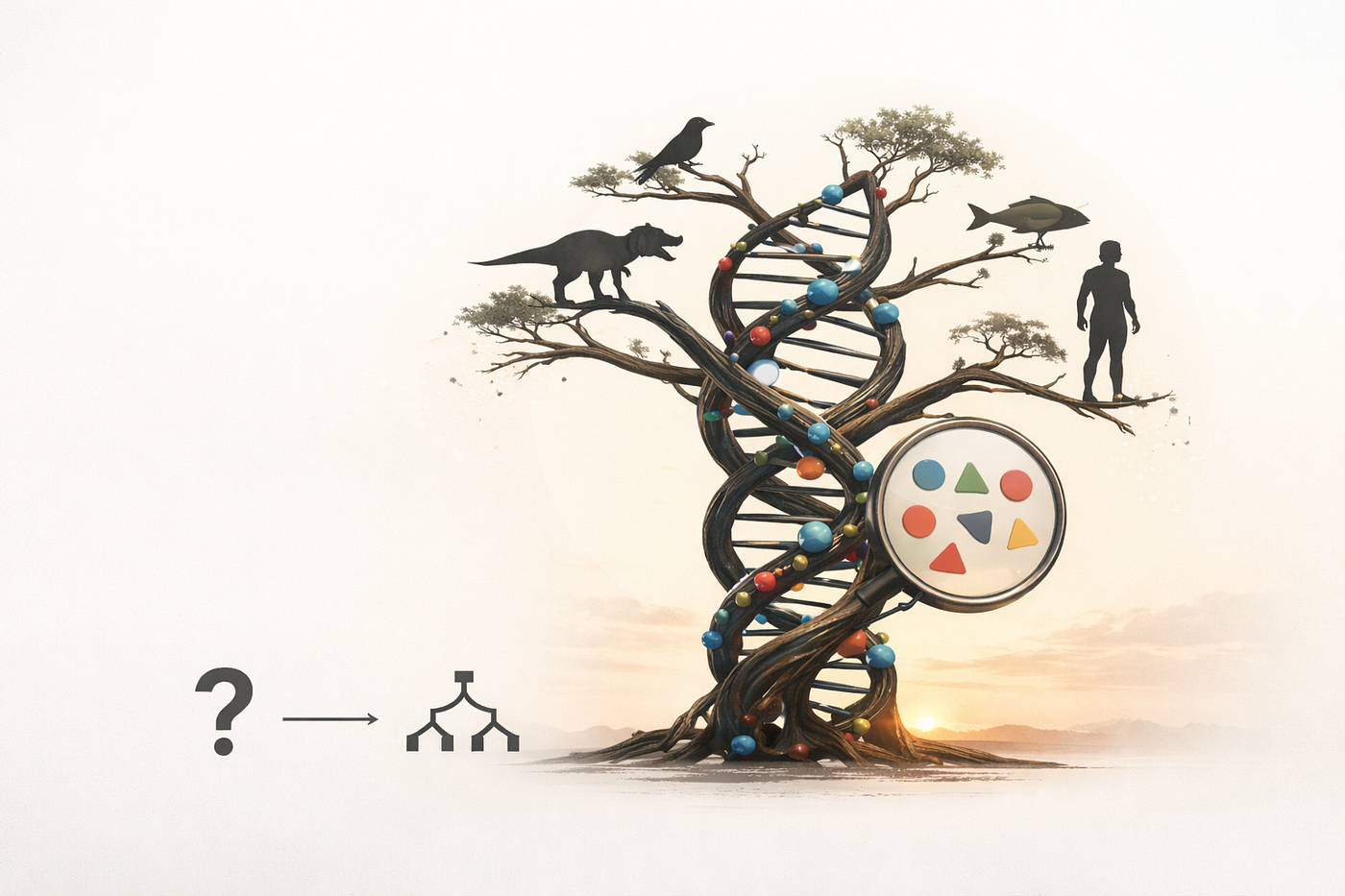
Genes Before Gods: Reconstructing Ancient India Through Genetics Part 2
How Chromosomes Learned to Tell Time
Genes Before Gods: Reconstructing Ancient India Through Genetics Part 2
How Chromosomes Learned to Tell Time
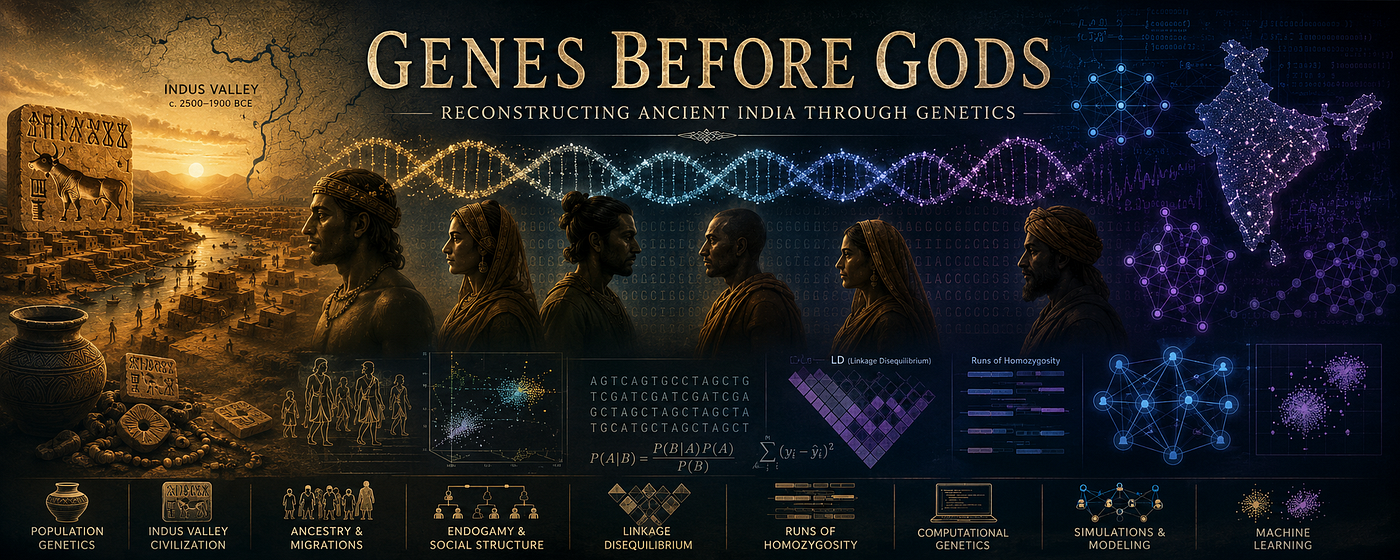
“Every mystery becomes less mysterious once you know what evidence to look for.”
By now, we have established two remarkable facts.
First, DNA is much more than the biological instruction manual that builds every living human being. It is also an accidental archive of ancestry, quietly preserving the record of who inherited genetic material from whom.
Second, unlike stone inscriptions or ancient manuscripts, DNA has been copied continuously from one generation to the next. Every one of us carries inside our cells a document that has never stopped being edited since long before the first cities were built.
That alone is extraordinary. But the real miracle of modern genetics lies elsewhere.
Remembering history is impressive. Remembering time is astonishing.
Because that is precisely what population geneticists claim to do. They do not merely say that two ancient populations mixed. They often estimate when they mixed. Not to the exact year, of course. Biology is not a wristwatch. But often within a few centuries. If that sounds almost unbelievable, it should. It certainly did to scientists when these ideas were first proposed.
So the obvious question is this. How can a molecule tell time?
The Coffee Cup Thought Experiment
Imagine I place two cups in front of you. One contains black coffee. The other contains milk. I pour the milk into the coffee and stir. Then I leave the room. An hour later I return and ask,
“When did I add the milk?”
You laugh. “Impossible.”
The coffee looks exactly the same whether the milk was added one minute ago or one hour ago.
Now imagine a different experiment.
Instead of coffee and milk, imagine two enormous piles of coloured sand. One pile is bright red. The other deep blue. You mix them together. Not perfectly. Just enough that large clumps of red and blue remain visible. Then every day someone comes along with a shovel and mixes the sand a little more. After one day, the coloured patches are still fairly large. After one hundred days, they are much smaller. After one thousand days, the colours are almost uniformly blended.
Now the question suddenly becomes answerable. The size of the remaining coloured patches tells you something about how long the mixing has been taking place.
Notice what changed. We are no longer measuring time directly. We are measuring the consequences of time.
That simple shift in thinking is the key to understanding admixture dating.
Imagine Someone Hands You Two Decks of Cards
Suppose I hand you two decks of playing cards. One deck has a red back. The other has a blue back. I shuffle them together. Then I ask you a seemingly impossible question.
How many times have I shuffled these decks?
At first glance, the question appears absurd. Surely there is no way to know. Then you begin looking more carefully. If the cards are still arranged in large blocks of red followed by large blocks of blue, you might reasonably conclude that only a few shuffles have occurred. If, however, the red and blue cards are hopelessly interwoven into tiny fragments throughout the deck, you would conclude that the deck has been shuffled many more times.
You haven’t watched the shuffling. You haven’t measured the passage of time. Instead, you have examined the size of the remaining blocks. That, remarkably, is exactly what chromosomes do.
Time Leaves Scars
When we think about history, we usually imagine dates.
330 BCE., 1206 CE., 1947
But biology does not record dates. Biology records processes. Time itself is invisible. Only its consequences are visible.
- We cannot see ageing. We see wrinkles.
- We cannot see erosion. We see valleys.
- We cannot see evolution. We see fossils.
Likewise, chromosomes do not contain little timestamps saying,
“Population A mixed with Population B in 175 BCE.”
Instead, they carry the scars left behind by thousands of generations of recombination. Those scars are measurable. That is all science needs.
🔬 Inside the Lab — Admixture
One of the most important words in population genetics is admixture.
It simply means that two previously separated populations began having children together.
Nothing more. Nothing less. The word carries no political meaning. No moral judgement. It simply describes genetic mixing.
Every modern human population is the product of numerous admixture events.
The Great Genetic Shuffle
In the previous installment we introduced recombination, the process by which chromosomes exchange pieces before being passed to the next generation. Now let us see why this matters so profoundly.
Imagine that one chromosome came from Population A and another from Population B. When those two populations first intermarry, their child inherits enormous uninterrupted stretches of DNA from each ancestral population. The chromosomes still retain large “blocks” of ancestry. But nature never stops shuffling. The next generation recombines those chromosomes again.
And again. And again.
Every generation slices those ancestral blocks into progressively smaller fragments. The longer two populations have been mixing, the smaller and more fragmented those original blocks become. Suddenly the impossible becomes possible.
If scientists can measure the average size of those ancestry blocks, they can estimate roughly how many generations have passed since the original mixing occurred.
Time has left fingerprints.
🔬 Inside the Lab — The Recombination Clock
Unlike a mechanical clock, which measures seconds by counting oscillations, the recombination clock measures generations by counting how much ancestral DNA has been broken into smaller pieces.
Large uninterrupted DNA segments generally indicate relatively recent admixture. Small fragmented segments indicate much older admixture. Nature performs the cutting. Geneticists simply measure the fragments.
Notice something beautiful about this idea. The clock was never designed. No biological process evolved to help historians reconstruct ancient migrations. The recombination clock is an accidental consequence of ordinary reproduction.
Every child slightly reshuffles the cards. Generation after generation. Century after century. Millennium after millennium. History quietly writes itself into our chromosomes.
When Randomness Becomes Predictable
At this point you may object.
“Surely recombination is random. If it is random, how can it produce reliable dates?”
That is an excellent question. Individual recombination events are indeed unpredictable. No scientist can tell you exactly where your father’s chromosome exchanged material with your grandmother’s chromosome. But random events become remarkably predictable when they occur millions of times.
Suppose I wanted to estimate the average height of Indians. Would measuring one person be sufficient? Obviously not. That individual might simply happen to be unusually tall. Or unusually short. Now suppose I measure ten million people. Suddenly random variation becomes much less important. The average stabilises.
Think about tossing a coin. One toss tells you almost nothing. A million tosses almost always produce very close to fifty percent heads and fifty percent tails. The randomness hasn’t disappeared. It has become statistically predictable.
Population genetics works in exactly the same way. One person’s genome tells a fascinating family story. Ten thousand genomes begin telling the story of civilizations. This is why modern studies increasingly analyse enormous numbers of individuals. The larger the sample, the more clearly the historical signal emerges from the biological noise.
Scientists do not analyse one chromosome. They analyse thousands. Often millions of recombination events spread across thousands of individuals. Patterns emerge that no single family could ever reveal.
This is why the sequencing of approximately 2,700 Indian genomes in the 2025 Cell study represents such a major milestone. It is not merely a larger dataset. It is a sharper historical lens. It was equivalent to increasing the resolution of a blurry historical photograph. Previously invisible details suddenly became visible.
The First Witness: The Size of the Fragments
We have already met the first witness. Every generation cuts ancestral chromosomes into progressively smaller pieces. Large blocks usually indicate recent mixing. Small fragmented blocks suggest much older admixture. This alone is already a remarkable historical clock.
But any good scientist immediately asks another question.
“What if the clock is wrong?”
Excellent. Let’s call another witness.
The Second Witness: Linkage Disequilibrium
The name sounds intimidating. The idea is not. Scientists have a habit of giving beautiful ideas intimidating names.
One of the most frightening-sounding phrases in population genetics is Linkage Disequilibrium. Do not let the terminology intimidate you. The underlying idea is wonderfully simple.
Imagine two friends who always arrive at work together. Every single morning. Every single evening. You naturally assume they travelled together. Genes behave similarly.
If two neighbouring genetic markers remain associated more often than chance would predict, geneticists say they are in linkage disequilibrium, often abbreviated simply as LD.
Over many generations, recombination gradually separates them. The stronger the recombination, the weaker the linkage. The weaker the linkage, the older the admixture event is likely to be.
In other words, linkage disequilibrium measures how much yesterday’s genetic neighbourhood has been broken apart by today’s biological shuffling.
Imagine walking into your office every morning and noticing that Alice and Bob always arrive together.
Always.
You naturally conclude that they probably travelled together.
Now suppose that, over the years, you notice Alice gradually arriving with different people. The original association has weakened. Genes behave in much the same way.
Neighbouring pieces of DNA tend to be inherited together because they physically sit next to one another on the chromosome.
Scientists call this linkage.
Every generation, recombination gently separates some of those neighbours. Over many generations the original associations gradually dissolve. This gradual breakdown is called the decay of linkage disequilibrium, or simply LD decay.
That intimidating phrase really means something beautifully ordinary.
Neighbours slowly stop travelling together. By measuring how quickly those neighbourhoods have broken apart, geneticists obtain another independent estimate of how long ago different populations mixed.
Notice what has happened. We have not invented a new clock. We have merely asked another witness the same question.
And remarkably… the answer agrees.
🔬 Inside the Lab — Linkage Disequilibrium (LD)
Neighbouring genetic variants are often inherited together because they physically sit close to one another on a chromosome. Recombination slowly separates these neighbours over successive generations. By measuring how strongly nearby genetic markers remain associated, scientists can estimate how long ago different populations mixed.
LD is therefore one of the principal tools used in admixture dating.
Another Independent Witness: Identity by Descent
Now imagine two complete strangers discover that they possess an unusual handwritten family recipe.
Not merely similar. Identical. Every ingredient. Every spelling mistake. Every coffee stain. The most reasonable explanation is that both inherited it from the same ancestor.
DNA works similarly. Sometimes two people share an unusually long stretch of chromosome that is virtually identical. Scientists call these shared stretches Identity by Descent, or IBD.
Long shared segments usually indicate a relatively recent common ancestor. Tiny shared fragments generally point to a much more ancient relationship. Once again, chromosomes reveal history without recording a single historical event. No king’s name. No battle. No inscription. Just inheritance.
Three Witnesses Enter the Courtroom
By now you may have noticed something.
Scientists are not relying on one clock. They are consulting several independent witnesses.
- Recombination fragment sizes.
- Linkage disequilibrium.
- Identity-by-descent segments.
Each approaches the same historical question differently. When all three point toward approximately the same period, confidence grows dramatically. This is exactly how science becomes robust. Not because one clever technique appears convincing. But because independent methods converge on the same answer.
Population genetics is, in many ways, a courtroom where multiple biological witnesses testify independently.
Two Family Diaries
At this point another fascinating question naturally arises. Everything we have discussed so far concerns the twenty-two ordinary chromosome pairs, collectively called autosomal DNA.
But humans possess two other remarkable genetic records. One belongs almost exclusively to fathers. The other almost exclusively to mothers. Unlike ordinary chromosomes, these two diaries tell unusually simple stories.
The Y chromosome passes almost unchanged from father to son. A father receives it from his father. Who received it from his father. And so on.
Meanwhile, tiny structures inside our cells called mitochondria contain their own small genome. Many readers have probably heard about mitochondrial DNA, often abbreviated as mtDNA. Does it also function as this remarkable historical clock?
The answer is both yes and no.
Mitochondrial DNA is inherited almost exclusively from one’s mother. Unlike ordinary chromosomes, it does not undergo recombination. That makes it extremely valuable for reconstructing maternal lineages extending deep into the past. Similarly, the Y chromosome, passed almost exclusively from father to son, allows scientists to reconstruct paternal lineages. These two genetic witnesses answer questions very different from those answered by autosomal chromosomes.

Together, these form one of the most powerful historical toolkits ever developed allowing scientists to follow one paternal line and one maternal line across astonishing spans of time.Sometimes they even reveal details no historian could have guessed.
They do not reconstruct overall ancestry nearly as well as autosomal DNA. But they answer different questions. Sometimes more interesting questions. Suppose autosomal DNA shows that two populations mixed extensively. The Y chromosome reveals that many paternal lineages arrived from Population A.
Meanwhile, mitochondrial DNA remains overwhelmingly local. Suddenly an entirely new historical picture emerges. Perhaps the migration involved predominantly men marrying local women. No ancient historian recorded that. Chromosomes did.
For example, autosomal DNA can reveal that two populations mixed extensively. The Y chromosome may simultaneously show that many of the incoming paternal lineages came from one population, while mitochondrial DNA indicates that most maternal lineages remained local.
Together, these observations suggest a pattern of male-mediated migration — a conclusion supported not by stories, but by independent genetic evidence.

Ancient Bones Begin to Speak
Everything we have discussed so far relies upon living people. But what if we could question the ancient people themselves? Until recently, that belonged entirely to science fiction. Today it belongs to archaeology.
Scientists now routinely extract DNA from ancient skeletons — sometimes four thousand or five thousand years old. Perhaps the most astonishing development in the last decade has been the sequencing of ancient DNA.
For most of scientific history, geneticists had to infer ancient populations indirectly by studying living people. Now they can often sequence DNA extracted directly from ancient skeletons.
Imagine excavating a burial in Kazakhstan. Another in the Indus region. Another in Central Asia. None of these individuals knew one another. None imagined that four thousand years later, tiny fragments of their DNA would be compared in laboratories around the world. Yet that is exactly what happens.
Ancient bones have become historical witnesses. Not because they speak. But because their chromosomes do.
When the Witnesses Agree
“Extraordinary claims require extraordinary evidence.” — Carl Sagan
If this were a courtroom, the defence attorney would by now be smiling.
“So,” she says, pacing slowly before the jury, “your entire theory about ancient history depends upon a single biological clock?”
The geneticist smiles back.
“No.” “It depends on several.”
That distinction is the reason population genetics has become one of the most powerful historical sciences of the twenty-first century. Science is never at its strongest when one clever experiment appears to support a dramatic conclusion. Science becomes powerful when independent methods, developed for entirely different reasons, quietly arrive at the same answer.
Imagine five strangers independently describing the same person. One remembers the face. Another remembers the voice. A third remembers the clothes. A fourth remembers the accent. A fifth remembers the car. None of them possesses the complete story. But when every description points toward the same individual, your confidence increases dramatically.
Modern genetics works in almost exactly the same way. Recombination is only one witness. There are several others waiting outside the courtroom. Each has seen the same historical events from a different angle. And remarkably, they all begin telling the same story.
🔬 Inside the Lab — Why Scientists Love Independent Witnesses
Suppose one thermometer says today’s temperature is 36°C. Would you immediately trust it?
Perhaps.
Now suppose five completely different thermometers — all manufactured by different companies — each read almost exactly the same value. Your confidence increases enormously.
Population genetics works the same way.
Scientists rarely trust one statistical method in isolation. They compare many independent methods. Agreement is more convincing than complexity.
The Clock Is Built.
The Witnesses Have Testified. The Method Has Been Tested. For thousands of years humanity asked ancient books where we came from. For the first time, we can also ask ancient chromosomes. And sometimes the answers agree.
Sometimes they challenge long-held assumptions. Sometimes they raise entirely new questions.
Now that we understand how geneticists built this remarkable biological clock, we are finally ready to point it toward one of the oldest continuous civilizations on Earth.
What exactly does this clock reveal about the making of India?
That is where our investigation turns next.

(To be continued in Part 3: Can We Really Date Ancient Mixing? There, we will examine how all these independent witnesses are combined using statistical models, why geneticists speak in confidence intervals rather than exact years, how Bayesian modelling helps reconstruct population history, and why the often-quoted “300 CE” is not a magical date but the centre of a much richer and more nuanced historical story.)
메타데이터
- post_id
- 6d0b1165ee6f
- slug
- genes-before-gods-reconstructing-ancient-india-through-genetics-part-2-6d0b1165ee6f
- url
- https://medium.com/@datavector/genes-before-gods-reconstructing-ancient-india-through-genetics-part-2-6d0b1165ee6f
- canonical_url
- https://medium.com/@datavector/genes-before-gods-reconstructing-ancient-india-through-genetics-part-2-6d0b1165ee6f
- author_url
- https://medium.com/@datavector
- status
- ok
- fetched_at
- 2026-07-09 22:34:41