The Girl From Nowhere — Chapter Five
Connections
The Girl From Nowhere — Chapter Five
Connections
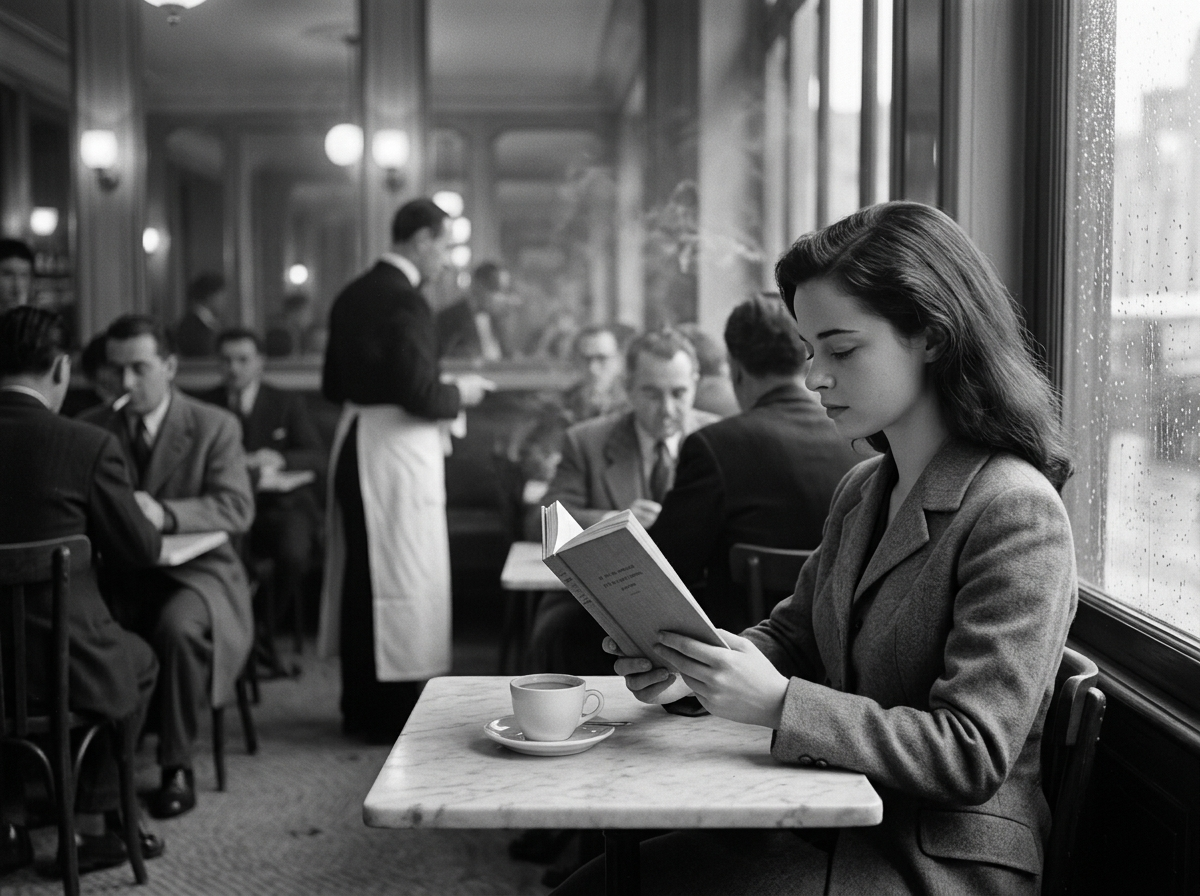
Monique reading Poésies complètes in the cafe (AI; author’s creation)
The Girl From Nowhere was serialised here on Medium from October to April, concluding with Chapter Four on 9 April. The pause since then has been intentional.
The complete novel — twenty-three chapters, an Opening Frame, an Epilogue, and a historical Afterword on Article 331 and the realities the book draws from — will be published on Amazon in eighteen days, on Sunday 28 June.
Chapter Five now resumes the serial. It is also available on Substack from yesterday, alongside the wider Trevelver Chronicles.
The chapter returns, as the earlier instalments do, to the Institut Alpin Montfleur in Rougemont, Vaud, Switzerland, in late November 1956, where Monique reads her Paris journal — edited from her diaries — aloud to Sylvia.
What follows is what she read that evening, and what followed from it.
⸻
Chapter Five: Connections
The following evening, Sylvia brought extra blankets from the linen cupboard. The heating in their room had failed again; it was cold enough to see their breath.
‘More Paris, please,’ she said, settling onto the joined bed. ‘I want to know how you survived.’
Monique looked at her, the particular stillness Sylvia wore when something mattered more than she intended to show.
‘This is when I learned.’ And she began to read.
⸻
November 1954
It was Céleste who taught me something more important than strategy or survival: how to be seen without being diminished.
The casting at her studio took place in November, four months after I arrived in Paris. My portfolio was modest: a few magazine spreads, some catalogue work, enough to be considered. Not enough, on its own, to explain what followed. The Circle opened doors quickly, but only once trust had been won.
Margot arranged it.
‘Céleste Moreau,’ she said one afternoon in Isadora’s kitchen, handing me a card with a printed address. ‘She photographs women. Not what men want to see when they look at women. She’s particular about who she works with. Don’t perform for her. She’ll see through it.’
‘What should I do instead?’
‘Let her see what you usually hide.’ Margot lit a cigarette, exhaled towards the window where November rain streaked the glass. ‘If she likes what she sees, she’ll teach you things that will help more than just your career.’
I studied the card. The address was near the Luxembourg Gardens, expensive, which meant Céleste was established. Selective.
‘Why are you sending me to her?’
Margot regarded me through tobacco smoke. ‘Because you need someone who sees you as more than a pretty surface.’ She paused. ‘And because Céleste is safe.’
⸻
The studio occupied the third floor of a building near the Luxembourg Gardens. I climbed the stairs on a grey autumn afternoon — Thursday the eleventh; Armistice Day, and the city was unusually quiet — my portfolio under my arm, my heart hammering with nerves I could not yet name.
North-facing windows filled the space with clean, even light: the kind that showed everything without flattery. The walls were lined with photographs: not fashion, but art. Women caught mid-gesture. Street scenes. Ordinary objects rendered extraordinary through attention.
Céleste herself was perhaps thirty. Her dark hair was cropped short, a style suggesting either politics or practicality, probably both. She wore men’s trousers, a white shirt with sleeves rolled to the forearms, no makeup, and a man’s watch, her only adornment. There was no clock in the studio, and the time was hers to keep. She moved with the authority of someone long accustomed to ignoring expectations.
Three other girls waited when I arrived. All beautiful. All composed.
I suddenly felt inadequate.
Céleste looked at each of us in turn, her gaze clinical but not unkind, assessing not only faces but something beneath.
She dismissed two immediately.
‘You’re performing,’ she said to a striking blonde holding a perfect three-quarter pose. Then, turning to a brunette with patrician features, ‘And you’re not interested in being photographed. You’re interested in becoming famous. Neither is what I need.’
To the remaining girl and me, she said, ‘Stay.’
For the next hour, she had us move through the studio while she observed. Not posing. Just moving: walking, sitting, reaching, turning towards the light.
The other girl was ballet-trained, clearly — every gesture precise and placed.
I moved as I had learned to move in Paris. Aware of my body, but not displaying it. Letting fabric fall as it wished, weight shift as it needed to. Allowing my attention to rest elsewhere: on the photographs, the afternoon light on the floor, the muted traffic below.
Céleste watched without speaking, without lifting a camera.
At last, she dismissed the other girl, kindly, firmly. ‘You’re very skilled. You’ll do well in fashion. But I need someone who can forget the camera exists. This isn’t the right project for you.’
The girl left with professional grace.
Céleste turned back to me.
‘You understand your body,’ she said. ‘How to move. How fabric falls. Where the light is. Most girls must be taught that.’
‘I’ve studied.’ Élise’s lessons, Margot’s observations, four months of moving through Paris with intention.
‘It’s more than study.’ She circled me slowly, not appraising but observing. ‘You move like someone who knows she’s being watched and doesn’t care. That’s rare.’
‘Is that what you need?’
‘It’s what I want to photograph.’ She paused. ‘How old are you?’
‘Sixteen. Nearly seventeen.’
Something crossed her face and settled. ‘You’re very young.’
‘Old enough to work. Old enough to understand what’s being asked.’
‘Are you?’ Her gaze sharpened. ‘Because what I photograph isn’t fashion. It’s women: their strength, their vulnerability. That requires trust. Complete trust. I need to know you can tell me no.’
Something in her voice made me listen. Not threat. Its absence.
‘I understand,’ I said. Though I didn’t. Not yet.
She nodded. ‘We’ll start with a test session next week. If it works, we continue. If it doesn’t, we’ll have lost nothing.’ She wrote on a card and slid it across the desk.
‘But Monique –’ She used my name for the first time. ‘This isn’t about selling clothes or building a career. It’s about truth. Can you bear to be seen that completely?’
I thought of my uncle’s gaze. Its weight. How being seen had meant being used.
But Céleste’s attention was different. No hunger. If she calculated, it was never against me.
Just attention.
‘I’d like to try,’ I said.
She handed me the card. ‘Thursday. Three o’clock. Don’t bring makeup. Don’t bring expectations.’
⸻
Margot told me about François a week after I met Céleste.
‘One of Cartier-Bresson’s assistants,’ she said one afternoon in Isadora’s kitchen. ‘He wants credit, not flesh. Thursday mornings at the Flore. Take this.’ She handed me a card with an address. ‘The 1895 Vanier edition of the Poésies complètes. Jean-Claude will lend it. Read Verlaine’s preface. François thinks it explains everything.’
She stubbed out her cigarette. ‘Don’t chase. Let him believe he’s discovered you.’
⸻
Margot brought the Vanier edition the next morning.
I was still in bed. The shared room was quieter than the kitchen, though cooler; Zsófia’s body heat lingered in the sheets even after she’d left for her typing job. Margot knocked once and entered, carrying a parcel wrapped in paper.
‘The Vanier,’ she said, setting it on the bed. ‘Be careful. It belongs to Jean-Claude. He’ll want it back exactly as it is.’
I unwrapped it slowly. Dark green cloth, faded at the spine. The pages bore the yellowing of nineteenth-century paper, and the book fell open of its own accord to certain poems, the ones Jean-Claude must have returned to.
Verlaine’s preface was dated 1895, written four years after Rimbaud died. His words touched on Rimbaud with the quiet grief of a love that had ended in ruin.
I spent the day reading. Not only Illuminations, which I already knew, but the early poems, the raw ones, before Rimbaud had broken everything open. Le Bateau ivre. Voyelles. Ma Bohème.
My uncle had made me read Rimbaud aloud for months, his voice behind me, correcting my pronunciation, explaining what each image meant. I had absorbed those meanings without question.
Verlaine offered something else.
By evening, my hands ached from holding the book. I lit a candle, expensive but necessary, and kept reading.
Zsófia returned near midnight. ‘Still preparing?’ Her smile was knowing. ‘You’ll do well.’
After she fell asleep, I read Verlaine’s preface once more by candlelight and absorbed its sense.
He was sixteen when I met him. Already he knew everything and nothing. Already he was leaving.
Thursday. Ten o’clock. François at the Flore.
I would be ready.
⸻
I arrived at half past nine, the Vanier edition wrapped in brown paper against the damp. I wore a simple grey dress, wool, not expensive but clean and well-fitted. No makeup beyond a trace at the eyes.
The café was already alive with morning noise. At a corner table, three men argued communist doctrine with the vehemence of people who had never missed a meal for their politics. Students smoked and pretended to read Sartre. An American couple studied their Michelin guide, trying to locate themselves on the map of what they believed was Paris.
I took a table two removed from the corner window: close enough to be seen, far enough to seem accidental.
I ordered coffee I didn’t want and couldn’t afford. Forty francs for a café crème. I counted them from the small purse Isadora had lent me, aware of their weight. Finite.
The Vanier edition sat before me. I unwrapped it slowly, then opened to ‘Aube’, not the first poem, not the most famous.
At ten o’clock precisely, François entered.
He stepped into the café, thin and dark-haired, wire-rimmed spectacles catching the light. His too-long wool scarf was looped just so, a Gauloise poised between elegant fingers, a worn leather satchel at his side. He ordered without looking at the menu, then settled into the corner with the ease of someone who had claimed the space long ago, his hair arranged with that careful nonchalance that takes twenty minutes in the mirror.
I didn’t look up. Not at once.
I read. Actually read. ‘Aube’ was short enough that I’d memorised it without meaning to, letting my eyes move across the page while my attention remained oblique.
Then, for the space of a breath, I let my eyes rise from the page.
His gaze lifted. Swept the café.
Stopped on the book.
I felt it immediately: the shift from casual observation to interest.
I turned a page. Read three more lines. Then, as if caught by a thought, I looked up, eyes unfocused.
Our eyes met.
I allowed a flicker of surprise, slight, genuine, and returned to the page.
He stood.
I didn’t look up again until his shadow crossed my table.
‘Pardon,’ he said. His voice was educated, careful. ‘I could not help noticing — you are reading Rimbaud.’
‘I am.’
‘The Vanier edition. Not easily found.’
‘A good friend’s.’ I marked my place with one finger.
‘May I?’ He gestured to the empty chair.
I hesitated, counted to three, then nodded.
He sat. Adjusted his spectacles. Looked at the book rather than at me.
‘Which poem?’
‘‘Aube’.’
‘J’ai embrassé l’aube d’été. I embraced the summer dawn. One of his finest. Do you know the collection well?’
‘I’m learning.’ I met his eyes. ‘Someone told me that if I wanted to understand Paris, I should begin with how Rimbaud saw beneath its surface.’
Recognition sharpened his expression.
‘Most people read him for the scandal: Verlaine, the violence, Africa. They miss the discipline.’
‘I wonder whether Africa was an escape at all,’ I said. ‘Or just the hope that distance might resolve what was internal.’
He leaned forward. ‘You think he was running?’
‘I think he was searching for what didn’t exist. When poetry failed him, and Paris failed him, he tried geography.’
I touched the book’s cover. ‘Verlaine understood that. You can hear it in the preface, how he knew Rimbaud was already leaving.’
‘That’s not the usual interpretation.’
‘Most interpretations exist to comfort the reader.’
He smiled. ‘You are not most readers.’
‘I’m practical.’ I closed the book. ‘Poetry is beautiful. But it doesn’t pay the rent.’
‘What does?’
‘I’m trying to find out.’ I held his gaze. ‘I model. Or I intend to. I’m new to Paris.’
He studied me differently now.
‘You are serious.’
For a breath, the performance slipped; his attention had weight, and under it I felt the other girl, the one who counted coins on the Métro, lay awake doing sums, and needed this badly to work. I waited until my voice would hold.
‘I’m sixteen and living in Montmartre. Seriousness is unavoidable.’
A pause. Laughter burst too loudly from the next table. The espresso machine hissed.
‘I work with photographers,’ he said. ‘Editorial. Some commercial. I could make an introduction.’
‘To whom?’
‘A colleague. Discreet. Professional.’
‘And what would you want in return?’
The question startled him. Then he laughed. Brief, genuine. ‘Credit. The pleasure of saying, in five years, that I met you reading Rimbaud at the Flore and recognised what I was seeing.’
‘That’s all?’
‘That’s enough.’ He extended his hand. ‘François Garnier.’
‘Monique Gournay.’
He produced a card, wrote an address on the back. ‘Tomorrow. Two o’clock. Ask for Bernard. Tell him I sent you.’
I took it. Heavy stock. The address was near Place de la République.
‘Don’t come unless you’re serious,’ he said, standing. ‘But if you are, then perhaps I’ll have an interesting story to tell.’
He left his coffee half finished, seventy-five francs on the table.
I stayed another twenty minutes, the book open before me, the card tucked between its pages.
Every word I had given François had been my uncle’s first. The discipline beneath the scandal, the searching for what did not exist, the grief in the preface, all of it learned in a locked study, recited until it was correct. I had taken the thing that had been done to me and made it useful, and it had worked, and a man I would never see again had taken me for the real thing.
I told myself this was strength. Mostly, I believed it. I did not look too closely at the part of me that had enjoyed it: the being seen, the being exactly right. The old reward. I finished my coffee and did not think about it again.
The waiter brought my bill, forty-six francs, service included.
I counted out the notes and coins. Enough left for the Métro to Céleste’s studio, where I was expected at three.
I wrapped the book carefully and stood.
⸻
Sylvia drew the blanket higher.
‘You make it sound like a game you already knew how to win,’ she said. ‘The book. The pause before you looked up. As though you’d rehearsed it in a mirror.’
Monique turned a page that did not need turning. ‘I had rehearsed it. That was the point.’
‘That isn’t what I meant.’ Sylvia’s voice went careful, the way it did when she had found the soft place and was deciding whether to press. ‘I meant, were you ever frightened? Reading it now, you never are. Everything goes the way you want it to.’
‘Everything I am telling you went the way I wanted it to.’ Monique heard the shape of her own sentence only after she had said it, and did not take it back.
Sylvia said nothing. Outside, the snow kept on.
‘Read,’ she said at last. ‘I want to hear the rest.’
⸻
I arrived at Céleste’s studio at three o’clock, still carrying the Vanier edition, still feeling the morning’s performance like a physical weight.
She opened the door before I could knock.
‘You look exhausted,’ she said, taking my coat. ‘Come. Sit. Tea first. Then we’ll work.’
The studio was warm after the cold outside. Tea waited on the table: biscuits, cups already laid out, the small rituals that marked this space as separate from the rest of Paris.
I sat heavily by the window. My hands were still cold despite the gloves Isadora had lent me. I wrapped them around the cup Céleste placed in front of me.
‘Tell me about your morning.’
So, I did. François. The fear that he had seen through me, that the intelligence I had offered was borrowed, rehearsed, not truly mine.
‘And now you’re afraid you’re a fraud,’ she said when I finished.
‘Oui.’
‘Because the knowledge came from your uncle.’
I nodded.
She set down her cup. ‘Monique. Where knowledge comes from matters less than what you do with it. Your uncle forced you to read Rimbaud. That was control. But you absorbed it. You understood it. Today, you used that understanding to build something that may help you survive.’
‘It feels like lying.’
‘It isn’t. Once knowledge is yours, it’s yours.’ She leaned forward. ‘Your education was abusive. François’s was privileged. The difference matters. The knowledge does not.’
Something loosened in my chest.
‘You’re not a fraud,’ she said. ‘You learned under pressure. And you learned well.’
My eyes burned. I pressed my palms against them.
‘Now,’ she said, standing. ‘Let’s work. I don’t want the performance from this morning. I want what’s here.’ She tapped two fingers against my sternum. ‘This.’
⸻
She positioned me by the window, where grey light fell across my face. ‘Don’t pose,’ she said, adjusting her camera. ‘Sit how you like. Let me see.’
I sat.
The exhaustion returned: the fear that everything I had done was mimicry, that beneath it there was nothing solid.
The shutter clicked.
‘Good,’ Céleste murmured. ‘Hold that.’
I did not hide. I let my face hold the doubt, the tiredness, the quiet panic of someone who had been performing survival for too long.
Click. Click.
‘Now look at me,’ she said. ‘As if you’re deciding whether to trust me.’
I looked. At the steadiness of her gaze. At the way she held the camera, careful, patient. At the woman who wanted nothing from me but presence.
The shutter clicked.
‘Oui,’ she said softly.
⸻
We worked for an hour. She photographed what I usually concealed: fatigue, uncertainty, the moments when it slipped entirely.
By the end, I felt wrung out, but lighter.
‘That’s enough,’ she said. ‘You did beautifully.’
‘I don’t feel like I did anything.’
‘You let yourself be seen.’ She rested a hand on my shoulder. ‘What you did this morning was necessary. What you did here is necessary too.’
‘What if I forget which is which?’
‘Then you come back.’ Her hand squeezed once. ‘You make spaces where the armour can come off.’
I nodded.
‘Next Thursday,’ she said. ‘Same time.’
⸻
Bernard’s studio occupied the top floor of a narrow building near Place de la République, four flights of stairs, no lift. I climbed them on Friday afternoon, pausing only once to steady my breath before knocking.
The door stood ajar. I knocked anyway.
‘Enter.’
Daylight poured through skylights cut into the sloped roof, flooding the space with cold, flat light: the kind that shows everything and flatters nothing. The studio smelled of coffee gone bitter on a hotplate and of chemicals I did not yet know the names for.
Worktables lined one wall, contact sheets and prints weighted with smooth stones. Near the window, a large-format camera stood on a heavy wooden tripod, its brass fittings catching the light.
Bernard sat bent over a contact sheet, a loupe pressed to his eye. He was older than I had expected, perhaps fifty, with a weathered face and fingers darkened at the tips from years in the darkroom. His shirt was stained with chemicals. His hands were steady.
He looked up when I entered. Studied me for three seconds. Then returned to his work.
‘François sent you.’ Not a question. That alone meant something.
‘Oui. Monique Gournay.’
‘Sit.’
I sat on a worn velvet chair near the window.
I waited.
The silence stretched. He finished marking the contact sheet with a grease pencil, set it aside with deliberate care, then looked at me properly.
His gaze moved over me with the same detachment he had given the prints: professional, exacting, without heat.
‘Stand.’
I stood.
‘Walk to that mark.’ He pointed to a strip of white tape on the floor.
I walked, conscious of my posture.
‘Turn. Slowly.’
I turned.
He made a sound in his throat. ‘You’ve modelled before.’
‘No.’
‘You move like you have.’
‘I was taught to move well.’
‘By whom?’
‘A dancer. A woman who understands how the body occupies space.’
He rose and circled me once. ‘Most girls your age move like they’re apologising for existing. You move like you own the floor beneath you.’
‘Should I not?’
‘On the contrary.’ He gestured to another mark, closer to the light. ‘Stand there. Look at me.’
I did.
He tilted my chin with impersonal fingers. His touch was cool, smelling faintly of fixer.
‘Your face is good,’ he said. ‘Strong bones. Balanced. The eyes, remarkable.’ He paused. ‘But that’s not what makes you interesting.’
‘What does?’
‘You’re present. Most girls vanish in front of a camera, miming what they think I want.’ He studied me. ‘You’re simply here. Watching. Deciding.’
‘And am I?’
He smiled, quick, surprised. ‘François was right.’
I had been closer to getting it wrong than I had realised.
He moved to the camera. ‘Sinar Norma, Swiss-made. Large format. Long exposures. You’ll need to hold still.’
‘I can.’
‘We’ll see.’
He positioned me by the window. ‘Chin up. No — too much. There. Hold.’
He slid the monorail forward, fine-tuned the focus, and pulled the dark cloth over his head to study the image on the ground glass. The shutter clicked, solid and mechanical.
‘Don’t smile. Good. Now look past me, as though remembering something you’d rather forget.’
Click.
‘Relax your shoulders. Breathe.’
I breathed.
‘Better. Now boredom. Pretend I’m the least interesting thing here.’
I let my attention drift to the pigeons clustered on the ledge outside.
Click. Click. Click.
An hour passed. Window light, then wall. A velvet backdrop lowered. Angles corrected by millimetres. Hands adjusted. Weight shifted.
Stillness was harder than movement. My neck ached. My calves burned.
‘Enough.’
He disappeared into the darkroom.
I waited.
Twenty minutes later, he returned with wet prints and pinned them to a cork board.
‘Come.’
The woman in the photographs looked older than sixteen, contained, self-possessed.
I did not recognise myself.
‘You photograph well,’ Bernard said. ‘The camera likes you.’
The praise reached me before I could stop it, a small and absurd warmth. Then I put it away, the way I was learning to put everything away.
‘Is that enough?’
‘For fashion? Oui. For editorial? More than.’ He consulted his calendar. ‘I can use you. Four thousand francs per session to start. Nothing improper.’
‘I know.’
‘Good.’ He pencilled a note. ‘Tuesday. One thirty. Elle. Background work. Wear something simple.’
No gratitude required. Only competence.
‘One thirty,’ I said.
‘Don’t be late. The client pays by the hour.’
⸻
I descended the four flights of stairs, my legs still shaking. Not from the session. From the morning. I had been one wrong answer from François seeing through me entirely.
Three teachers in two days.
François, who taught me how intelligence could be used strategically.
Céleste, who taught me that the person beneath the performance deserved witness.
Bernard, who taught me discipline.
The stairwell was dark. Someone had burned dinner on the third floor. Outside, night was falling fast.
I had four thousand francs promised for Tuesday. Enough for a week’s rent. Enough to buy coal.
I walked towards the Métro, my hands deep in my coat pockets. My neck still ached. My calves would ache tomorrow.
But I had work now.
All of it necessary.
⸻
Monique closed the journal. Sylvia had been quiet throughout, her expression thoughtful in the firelight.
‘François,’ Sylvia said. ‘He wanted credit, not flesh. That’s a real distinction.’
‘It is.’ Monique set the journal aside. ‘Some men want to be part of a story, not to own the person in it. That’s how you tell them apart.’
‘Three teachers in two days,’ Sylvia said. ‘Céleste, François, Bernard. You make it sound very clean.’
‘It wasn’t,’ Monique said.
‘No,’ Sylvia said. ‘I didn’t think so.’
She reached across and turned down the lamp.
‘Tomorrow,’ she said.
⸻
© 2026 Chris Shallow. All rights reserved.
The Girl From Nowhere — a literary historical novel of Paris, 1954–1956 — twenty-three chapters, an Opening Frame, an Epilogue, and a historical Afterword on Article 331 and the realities the book draws from — arrives on Amazon in Kindle and paperback, at $4.99 in September 2026. It stands alone, but belongs to the wider Trevelver Chronicles.
Remembered by Water, Volume One, the first novel in the Chronicles, is available on Amazon now: amazon.co.uk/Remembered-Water-One-Trevelver-Chronicles/dp/B0GMS9QVSZ
The ongoing serialisation of the Chronicles — including The Life She Made (Mariana de la Rosa, Salamanca and Paris, 1948–49) and Věra’s Story (Cheb to Paris, 1945–46) — lives at trevelverchronicles.substack.com.
Chapter Six — Becoming — follows here next week.
— Chris Shallow
“Věra’s Story” is a work of fiction. Any resemblance to actual persons, living or dead, is purely coincidental.
No part of this book may be reproduced, stored in a retrieval system, or transmitted in any form or by any means, electronic, mechanical, photocopying, recording, or otherwise, without prior written permission from the author, except for the use of brief quotations in a review.
Historical Fiction
Chris Shallow writes the Trevelver Chronicles, a sequence of interconnected literary novels set across Cornwall, Paris, Geneva, London, Madrid and Salamanca from the 1930s to the 1970s.
Entirely human-written, this story contains no AI-generated text content.
Checked by QuillBot Premium: v7.1.0: AI-generated: 0%, Human-written & AI-refined: 0%, Human-written: 100%.
메타데이터
- post_id
- 6d25b4b77e67
- slug
- the-girl-from-nowhere-chapter-five-6d25b4b77e67
- url
- https://medium.com/@cshallow/the-girl-from-nowhere-chapter-five-6d25b4b77e67
- canonical_url
- https://medium.com/@cshallow/the-girl-from-nowhere-chapter-five-6d25b4b77e67
- author_url
- https://medium.com/@cshallow
- status
- ok
- fetched_at
- 2026-06-18 00:10:23