The Anatomy of a Healthcare Data Model
Healthcare organizations are not short on data. They are surrounded by it.
The Anatomy of a Healthcare Data Model
Healthcare organizations are not short on data. They are surrounded by it.
Claims, clinical records, eligibility files, pharmacy data, provider information, care gaps, risk adjustment outputs, utilization trends, quality measures, and operational reports all generate enormous amounts of information every day.
The real challenge is not collecting more data. The challenge is organizing it in a way that healthcare leaders, analysts, providers, risk teams, and operations teams can actually use.
That is where the healthcare data model becomes critical.
A healthcare data model is the structure that connects fragmented data into a trusted foundation for analytics, decision-making, and value-based care execution.
Why the Data Model Matters
Without a strong healthcare data model, organizations often end up with disconnected reports, inconsistent definitions, duplicate records, and dashboards that require too much explanation.
One team may define a member one way. Another team may define attribution differently. Claims data may not align with clinical data. Care gap reports may not match outreach activity. Risk adjustment insights may not connect to provider documentation.
This creates confusion across the organization.
A strong healthcare data model creates a common language. It helps teams understand how members, providers, claims, clinical activity, risk adjustment, quality, utilization, and contract performance relate to each other.
In healthcare, that connection matters because decisions are rarely made from one data source alone.
The Core Components of a Healthcare Data Model
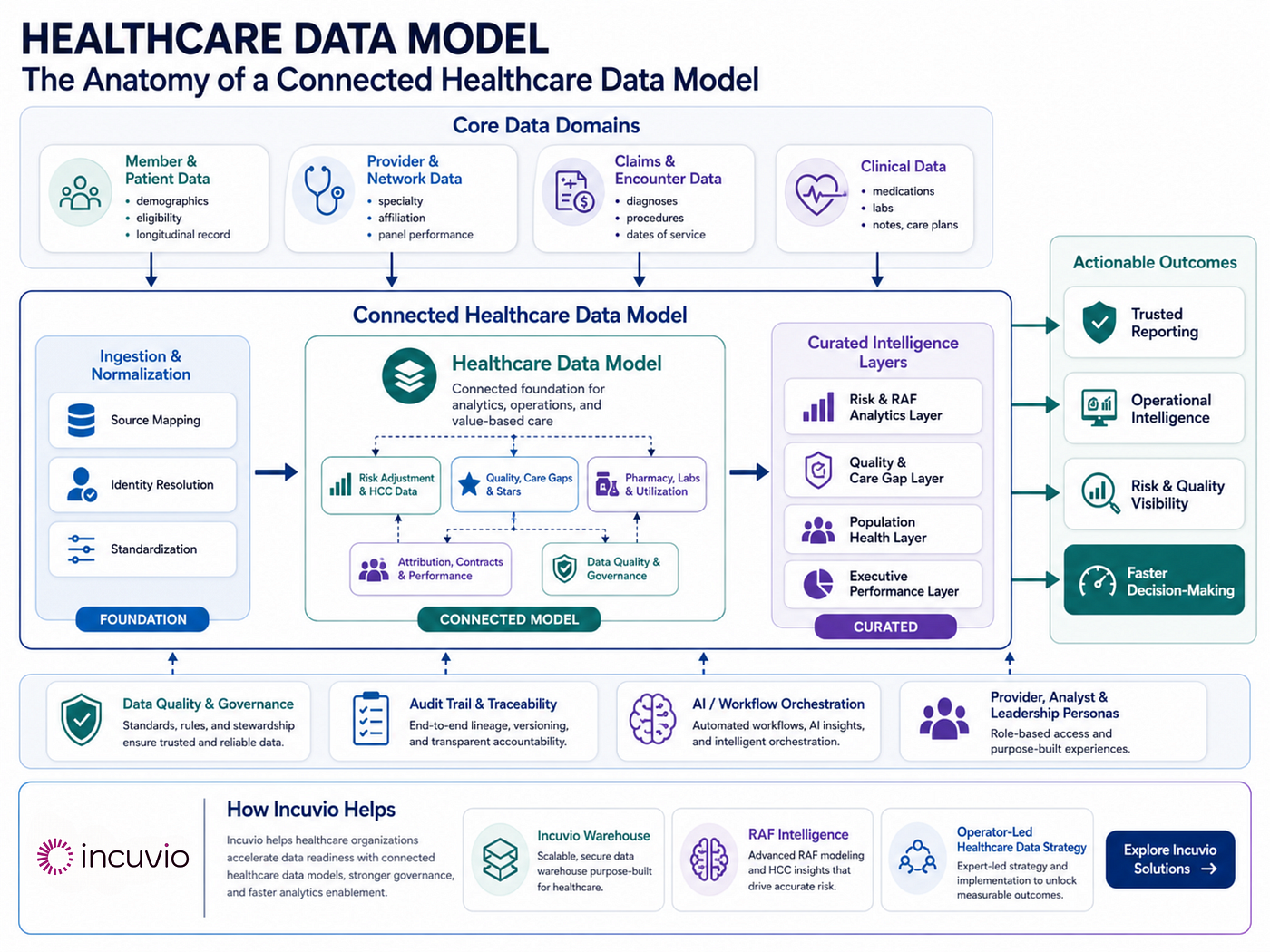
A strong healthcare data model should reflect how healthcare actually operates. It should not only organize tables for reporting. It should connect the data domains that influence care, cost, quality, risk, and performance.
The most important components include:
- Member and patient data
- Provider and network data
- Claims and encounter data
- Clinical data
- Risk adjustment and HCC data
- Quality, care gaps, and Stars data
- Pharmacy, labs, and utilization data
- Attribution, contracts, and performance data
- Data quality and governance rules
When these components are connected, organizations can move from fragmented reporting to operational intelligence.
1. Member and Patient Data
The member or patient record is the center of the healthcare data model.
This layer includes demographics, eligibility, enrollment history, coverage details, attribution, contact information, risk profile, and longitudinal activity over time.
When this layer is strong, teams can better understand who the member is, what care history exists, what risks are present, what gaps remain open, and what actions may be needed next.
When this layer is weak, every downstream report becomes harder to trust.
2. Provider and Network Data
Provider data helps healthcare organizations understand who is delivering care and how performance varies across the network.
This includes provider identity, specialty, location, group affiliation, panel size, network status, documentation behavior, and performance trends.
For MSOs, ACOs, payers, and risk-bearing provider groups, provider data is essential. It helps teams identify where care gaps are concentrated, where documentation gaps exist, where utilization patterns are changing, and where provider support may be needed.
A strong model connects providers to members, encounters, risk opportunities, quality performance, and operational workflows.
3. Claims, Encounters, and Clinical Data
Claims and encounter data help explain what happened from a billing, utilization, and service perspective. This includes diagnoses, procedures, dates of service, care setting, provider involvement, and cost patterns.
Clinical data adds the context behind the claim. It may include problems, medications, labs, notes, assessments, vitals, procedures, and care plans.
Both are important, but neither is complete on its own.
Claims data may be structured and useful for reporting, but it often arrives after the fact. Clinical data may be more timely and context-rich, but it can be messy, inconsistent, or unstructured.
A strong healthcare data model connects both, giving organizations a more complete view of the member, provider, condition, and care journey.
4. Risk Adjustment, Quality, and Care Gaps
Risk adjustment and quality are two areas where connected data becomes especially important.
Risk adjustment teams need visibility into diagnoses, HCC mappings, model versions, suspect conditions, submitted conditions, dropped conditions, chart review outputs, and provider documentation.
Quality teams need to understand open gaps, closure status, measure performance, outreach activity, clinical evidence, and provider accountability.
When these areas operate separately, teams lose visibility. A provider may have quality gaps, documentation gaps, and risk opportunities connected to the same member, but those signals may appear in different reports.
A strong data model helps bring those signals together.
This is what allows healthcare organizations to move from measuring performance to managing performance.
Attribution, Contracts, and Performance
Value-based care depends heavily on attribution and accountability.
Organizations need to know which members are assigned to which provider, group, contract, program, or population. They also need to understand how performance is changing across cost, utilization, quality, risk, and outcomes.
Without this layer, leadership may see performance numbers but not understand what is driving them or where action is needed.
A connected data model links attribution, contracts, financial performance, provider accountability, care gaps, utilization trends, and member-level risk.
This creates a clearer operating view for healthcare leadership.
Data Quality and Governance
A healthcare data model is only as valuable as the trust behind it.
That is why data quality and governance are not optional. They are core parts of the model.
Governance should define how member identity is resolved, how provider records are matched, which source system takes priority, how data is validated, how often data is refreshed, and how changes are tracked over time.
Strong governance helps teams answer important questions:
- Which source is trusted when systems conflict?
- How are duplicate records handled?
- How do we know whether the data is complete?
- Can we trace where this number came from?
- Can we defend this insight if it is questioned?
In healthcare, trust is not a technical feature. It is an operational requirement.
What a Strong Healthcare Data Model Enables
A strong healthcare data model helps organizations answer better questions faster.
It can support trusted reporting, executive dashboards, risk adjustment workflows, care gap closure, provider performance management, utilization monitoring, population health analytics, and AI readiness.
More importantly, it helps teams act with confidence.
Instead of asking whether the numbers are right, teams can focus on what needs to happen next.
How Incuvio Helps
At Incuvio Health Inc, we help healthcare organizations build stronger data foundations for analytics, value-based care, risk adjustment, quality performance, and operational execution.
With Incuvio Warehouse, teams can accelerate analytics readiness using pre-built healthcare data models compatible with Microsoft SQL, Snowflake, and AWS Redshift. This helps reduce the time-intensive burden of custom healthcare data modeling while supporting trusted reporting, stronger governance, and faster time-to-value.
Incuvio also helps organizations connect data strategy with real-world healthcare operations, so data models do not remain technical assets. They become operating foundations.
Because in healthcare, a data model is not just how information is stored.
It is how the organization learns to see, decide, and act.
메타데이터
- post_id
- 6d2adcdce2be
- slug
- the-anatomy-of-a-healthcare-data-model-6d2adcdce2be
- url
- https://medium.com/@incuvio/the-anatomy-of-a-healthcare-data-model-6d2adcdce2be
- canonical_url
- https://medium.com/@incuvio/the-anatomy-of-a-healthcare-data-model-6d2adcdce2be
- author_url
- https://medium.com/@incuvio
- status
- ok
- fetched_at
- 2026-06-27 23:56:40