How Does HashMap Handle Collisions Internally After Java 8.
1. Introduction
How Does HashMap Handle Collisions Internally After Java 8.
1. Introduction
HashMap is one of the most commonly used data structures in Java for storing key value pairs. One important concept in HashMap is handling collisions, which occur when multiple keys map to the same index. After Java 8, the internal mechanism of handling collisions was improved for better performance.
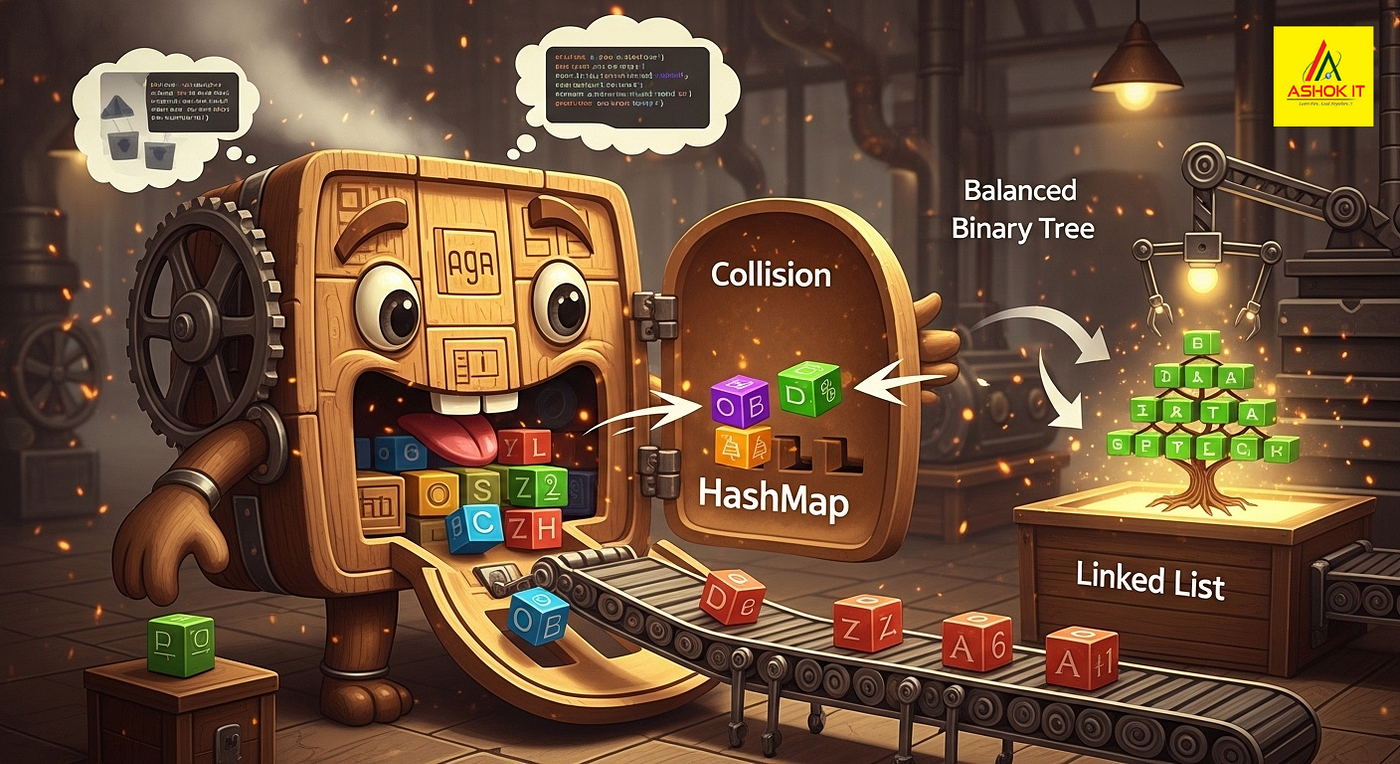
2. What is Collision in HashMap
A collision happens when two different keys produce the same hash code and are stored in the same bucket of the HashMap.
Summary
Occurs when keys share same index. Common in hash-based structures. Needs efficient handling.
3. Collision Handling Before Java 8
Before Java 8, HashMap handled collisions using a linked list. All elements that mapped to the same bucket were stored in a linked list.
Summary
Uses linked list. Slower for large data. Time complexity can become O n.
4. Collision Handling After Java 8
After Java 8, HashMap uses a combination of linked list and balanced tree (Red Black Tree) to handle collisions.
When the number of elements in a bucket exceeds a certain threshold, the linked list is converted into a balanced tree.
Threshold Conditions
If bucket size is greater than 8, it converts to a tree. If bucket size goes below 6, it converts back to linked list.
Summary
Uses linked list initially. Converts to tree for better performance. Improves efficiency.
5. Internal Working After Java 8
When a key is inserted Hash is calculated Index is determined If bucket is empty, value is inserted If collision occurs, elements are added If bucket size exceeds threshold, structure changes to tree
Summary
Dynamic structure. Optimized performance.
6. Performance Improvement
Before Java 8, worst case time complexity was O n due to linked list traversal. After Java 8, it improves to O log n because of tree structure.
Summary
Better worst-case performance. Faster data retrieval.
7. Real Time Example
In applications like caching systems or user sessions, multiple keys may map to the same bucket. With tree-based handling, performance remains efficient even with large data.
Summary
Handles large data efficiently. Improves scalability.
8. Common Mistakes to Avoid
Assuming HashMap always provides constant time. Ignoring hashCode and equals methods. Not understanding internal structure changes.
9. Key Takeaways
Collisions occur when keys share same index. Java 8 introduced tree-based handling. Performance improved from O n to O log n. Threshold values control structure conversion.
10. Useful Resources
Learn more from the AI powered Core JAVA Online Training in Hyderabad. https://www.ashokit.in/courses/core-java-online-training
Follow the Java Full Stack Developer Roadmap to become job ready. https://www.ashokit.in/java-full-stack-developer-roadmap
11. FAQ Section
11.1 What is collision in HashMap
Collision occurs when two different keys map to the same bucket index in a HashMap.
11.2 How does HashMap handle collisions after Java 8
It uses a linked list initially and converts it into a balanced tree when the number of elements exceeds a threshold.
11.3 What is the threshold for tree conversion
When the number of elements in a bucket exceeds 8, it is converted into a tree.
11.4 Why is Red Black Tree used in HashMap
It provides better performance with O log n time complexity for search operations.
11.5 What happens when elements decrease in bucket
If the number of elements falls below 6, the structure converts back to a linked list.
12. Conclusion
HashMap collision handling was significantly improved in Java 8 by introducing tree-based structures. This enhancement ensures better performance and scalability, especially for large datasets.
13. Promotional Content
Start learning today with the AI powered Core JAVA Online Training in Hyderabad.
메타데이터
- post_id
- 6d45f5afabfc
- slug
- how-does-hashmap-handle-collisions-internally-after-java-8-6d45f5afabfc
- url
- https://medium.com/@sarathkumar52356/how-does-hashmap-handle-collisions-internally-after-java-8-6d45f5afabfc
- canonical_url
- https://medium.com/@sarathkumar52356/how-does-hashmap-handle-collisions-internally-after-java-8-6d45f5afabfc
- author_url
- https://medium.com/@sarathkumar52356
- status
- ok
- fetched_at
- 2026-08-03 17:15:07