April 14th, 1935
It’s April 14th, 1935. You live in the Oklahoma panhandle on a cotton farm. Except, you haven’t been able to plant cotton in years. For the…
April 14th, 1935
It’s April 14th, 1935. You live in the Oklahoma panhandle on a cotton farm. Except, you haven’t been able to plant cotton in years. For the past five years, a drastic drought has taken place across the southern United States. You have been trying your best to find ways to feed your family of five, but the struggle is so difficult that at most times, you’re not even sure you’ll make it to the next morning.
At night, you tell your children of times in which the sun was shining, the sky was clear, and the harvests were magically full. You tell stories of when food was not scarce, catching pneumonia from the dust never happened, and dust ceased to exist. A time in which your children don’t remember, if they were even alive to see it.
But it’s April 14th, 1935. Today is different. You rise out of bed, expecting the same view you have had for the past five years (the same dark sky, dusty fields, and cold weather). However, as your eyes open, you are shocked at the sight of a clear sky. The color blue is blended across the horizon, and as you inhale the morning air, it smells fresh and appetizing.
You jump out of bed, hardly able to comprehend what you’re seeing. “Kids, kids, look outside!” you yell. “The sky- it’s remarkable!” Your children stare at the sight that has become foreign to them. Your family goes to stand on the porch and take in the miracle of April 14th.
It’s hard to believe a day like this would be possible. After a long silence on the porch staring in awe, one of your kids pipes in and says, “We should go for a picnic!” Enthusiasm is exchanged throughout the group, and it is decided. The family will take a walk and enjoy the countryside!
The windows are opened, the clothes are hung outside, and a basket is prepared for a small picnic. Excited chatter fills the room. As you hang clothes along the clothesline, you acknowledge the change in temperature. Where it had typically been around one-hundred degrees, it feels as though it couldn’t be over seventy. It feels as though it is the first day in a long time you are able to take a deep breath. Maybe it’s changing. Maybe the worst is over.
Now that the windows are open and the chores are done, it is time to go on your picnic. “We should walk farther than usual,” one of your children suggests. “I mean, today is the first day in a long time we don’t have to worry about getting stuck in the dust. Why not enjoy it and walk deeper into our fields?” As the others agree excitedly, you can’t help but feel weary. Is it really over? Is it safe to walk beyond one’s house?
As you and your family begin to walk your fields, you can’t help but imagine what life would be like if the dust had never swept the south. What would the fields look like if they were filled with cotton on this very day? The time in which there was cotton swaying in the fields was now only distant memories. Perhaps soon it would return to reality.
Trying to emerge yourself back into the moment, you notice your children have selected a spot to sit. During the picnic, you cheeringly tease each other. Everyone is extremely chipper, talking about the miracle. “I cannot wait for church,” you say. “God has blessed us with a sacred day and we should give thanks.” Everyone agrees that the afternoon service will be extra special.
The morning is filled with laughter, enjoyment, and anticipation for what the weather may be in the days to come. While preparing for church, it seems that for the first time in a long time, all will be well.
You are now at church. Your family has spread out to visit with friends. Everyone is talking about the weather. “Can you believe the clear skies?” someone asks you. “God has saved us once again!” another says. Everyone prays for another clear day and the possibility of farming sometime in the near future.
Many years ago your church was not dusty. However, dust has filled its cracks, which turned the floors to dirt. Most overlook these changes, but you cannot help but reflect on all that has changed since the 20s.
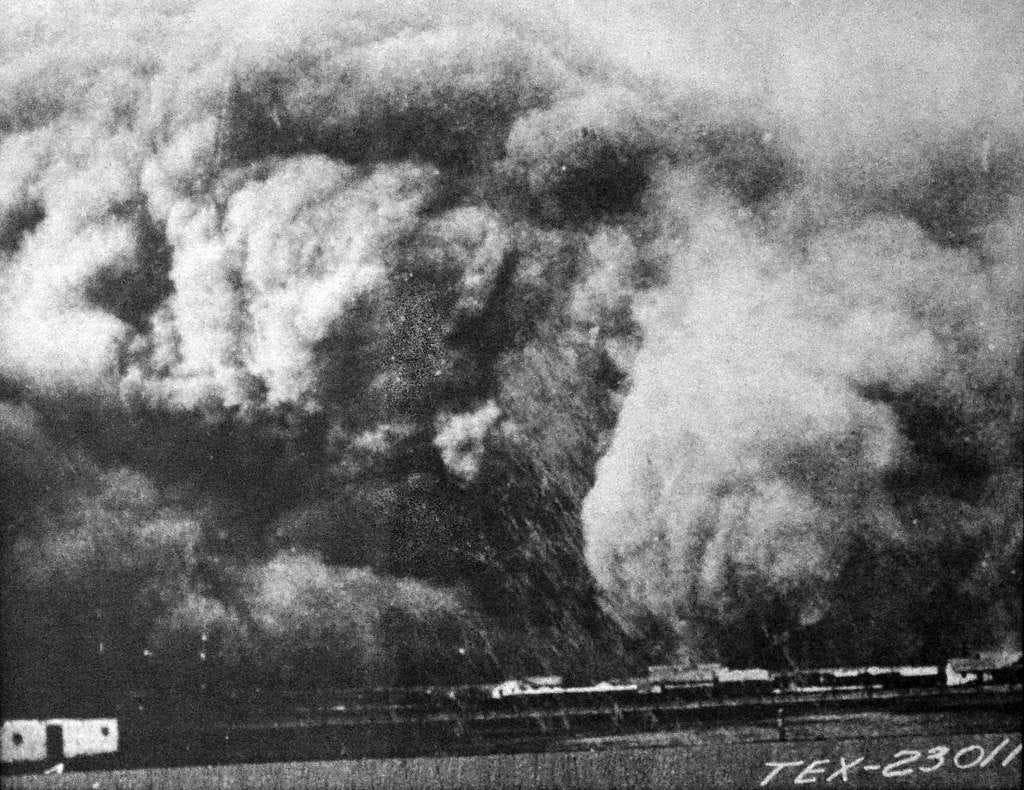
About a half hour into the sermon, the doors to the church fly open. A panicked man screams, ruining the peaceful moment. “A cloud! A cloud! A giant, black cloud is headed in our direction! Run to your homes! Get home as quickly as you can! It will not be long before dust swarms around us once again!”
“Our windows are open!” you hear someone yell. “My clothes are outside!” another shouts. Panic spreads across the room. As quickly as possible, everyone rushes out of the church. As your family steps out of the church’s doors, you see the black cloud for the first time. It’s moving at an incredibly fast speed. Wind blows ragingly as dust swarms around you. “Hang onto each other!” you yell. “We must get home!”
As you begin to walk home you realize that at no speed you walk will you ever get home before the cloud reaches you. You must think fast- or the dust will melt the lines between your family and the earth.
“Over here!” you hear someone call. The voice is faint, but you are able to identify the direction the person yelled it in. As you make your way towards them, you notice that the cloud is only a few feet away. “In the cellar!” the voice yells. But it is too late. There is no space between you and the cloud. The winds force you away, making you fall on the ground. You look for your hands, hoping to use them to stand up, but you can barely see your hand. There is only one thing your eyes show you: blackness. “Help!” you hear one of your children call. You reach for your children in the darkness, finding them, and clutching on for dear life. Your family lays together on the ground, silently praying. There’s nothing you can do besides wait for the storm to end, once again.
This day would go on to be known as Black Sunday. Where the day had started out as a beautiful, hopeful Sunday, it quickly turned out to be the most disastrous day within the Dust Bowl. Twenty deaths would later be reported: three from dust suffocation and seventeen from pneumonia. Those who did not make it to a cellar witnessed their whole world turning black. And those who did prayed that their houses would still be in place when the storm was over. The Dust Bowl would go on for another five years, leaving the ’30s with the nickname of “The Dirty Thirties.” Clear skies were scarce, as was food. When the sky grew clearer, those who had food brought it upon themselves to celebrate with a picnic. The population in Oklahoma was 2.3 million (a decrease of 20%). The farmers who decided to abandon their farms would move to California, in hopes of finding better luck there (though they would discover they were no better off). April 14th, 1935 was the midway mark of the Dust Bowl, a memorable tragedy for all.
메타데이터
- post_id
- 6d4a4ac656c4
- slug
- april-14th-1935-6d4a4ac656c4
- url
- https://medium.com/@madelineriker2018/april-14th-1935-6d4a4ac656c4
- canonical_url
- https://medium.com/@madelineriker2018/april-14th-1935-6d4a4ac656c4
- author_url
- https://medium.com/@madelineriker2018
- status
- ok
- fetched_at
- 2026-07-23 19:09:44