Batch Processing & KV Cache: Supercharging On-Device AI Inference
Running large language models (LLMs) or multimodal models directly on mobile and edge devices is becoming increasingly important…
Batch Processing & KV Cache: Supercharging On-Device AI Inference
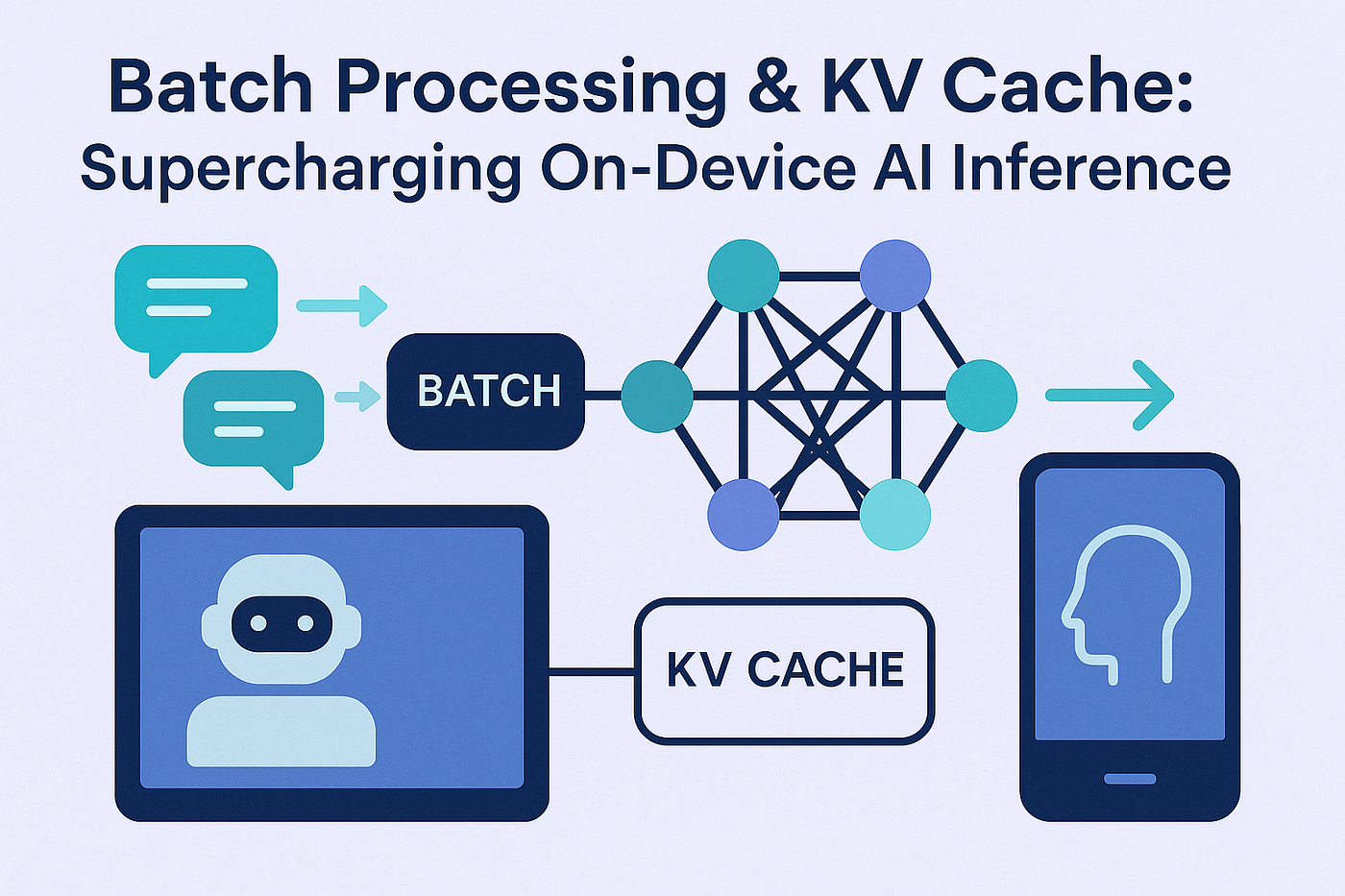
Running large language models (LLMs) or multimodal models directly on mobile and edge devices is becoming increasingly important. Applications like offline AI assistants, AR/VR glasses, translation apps, and embedded systems demand low-latency inference while working under strict memory and compute constraints.
Two important techniques that dramatically improve speed and efficiency in such scenarios are Batch Processing and KV (Key-Value) Caching. Let’s break them down and see how they help.
1. The Challenge of On-Device Inference
When models like Qwen, LLaMA, or GPT variants are deployed on devices (phones, tablets, wearables), the inference pipeline faces:
• Limited RAM & storage (e.g., 8 – 16 GB vs hundreds on servers).
• Slower CPU/GPU/NPU performance compared to datacenter GPUs.
• Strict latency budgets (a mobile user won’t wait 5 – 10 seconds for a response).
• Energy efficiency needs (battery-sensitive workloads).
Optimizations are not just nice-to-have – they are survival strategies for real-time, usable AI on devices.
2. Batch Processing
Batching means grouping multiple inference requests together into a single forward pass through the model. Instead of processing tokens or queries one at a time, the model processes several in parallel.

How It Works
• In a naive setup, if a model needs to process 10 queries, it runs the forward pass 10 times.
• With batching, all 10 queries are stacked into a single tensor and passed once, leveraging matrix multiplications that modern hardware accelerators (CPU SIMD, GPU CUDA cores, NPUs) are optimized for.
Benefits
• Throughput increase: Significantly reduces repeated overhead per request.
• Hardware utilization: Keeps GPUs/NPUs fully loaded rather than idle.
• Reduced latency per token: Each token generation amortizes cost across multiple requests.
On-Device Adaptation
• In mobile apps, batching often occurs at the token level: multiple tokens (or user sessions) are processed in one step.
• Frameworks like llama.cpp and MLC-LLM already support configurable batch sizes.
• Trade-off: larger batches improve speed but may increase RAM usage. Developers tune batch size depending on available memory (e.g., 4 – 8 on 12 GB RAM devices).
3. KV (Key-Value) Cache
Transformers rely on attention mechanisms, where each new token attends to all previously generated tokens. Naively, this requires recomputing attention for the full sequence every time – a quadratic nightmare.

How It Works
• At each step, the model generates Key (K) and Value (V) tensors for the tokens.
• Instead of recalculating them every time, these are stored in memory (the KV cache).
• When generating the next token, the model reuses the cached K and V, only computing attention against the new token.
Benefits
• Drastic speedup: Turns computation from O(n²) per step into near O(n).
• Lower energy use: Reduces redundant matrix multiplications.
• Better responsiveness: Especially critical for streaming responses (chat, voice AI).
On-Device Adaptation
• KV cache is typically stored in RAM, so memory management is crucial.
• Some optimizations:
• Quantized KV cache: Store in INT8/FP16 instead of FP32.
• Sliding Window Attention: Keep only the latest N tokens in cache (useful for long conversations).
• Paged KV caching: Swap chunks in/out of memory efficiently.
4. Combining Batch Processing + KV Cache
Together, these techniques enable practical, real-time inference on devices:
• Batching ensures the hardware is fully utilized.
• KV caching ensures each new token is generated with minimal re-computation.
• For applications like voice assistants, AR glasses, and offline translators, the combination delivers both throughput and low latency, while staying within RAM constraints.
Example:
• Without KV cache, generating 100 tokens might take 10 seconds.
• With KV cache, the same could drop to ~2 – 3 seconds.
• Adding batch processing (say, 4 requests in parallel) can further reduce per-request latency to near real-time levels.
5. Final Thoughts
On-device AI is shifting from research to mainstream adoption. Batch processing and KV cache are no longer optional – they are core strategies for making inference practical on constrained hardware.
• Batching maximizes throughput by parallelizing requests.
• KV cache minimizes re-computation by remembering past context.
• Together, they unlock responsive, energy-efficient, and scalable AI experiences – whether it’s a phone answering queries offline, AR glasses translating speech on the fly, or a health-monitoring wearable running medical inference in real time.
As models get larger, but hardware constraints remain, these optimizations will define the future of edge AI inference.
Follow Arpit Kulsreshtha
Facebook | Twitter(X) | Medium | LinkedIn Newsletter | Quora | Topmate | Amazon Author
BatchProcessing #KVCaching #OnDeviceAI #InferenceOptimization #EdgeAI
메타데이터
- post_id
- 6d55295ce4e5
- slug
- batch-processing-kv-cache-supercharging-on-device-ai-inference-6d55295ce4e5
- url
- https://medium.com/@arpitkulsh/batch-processing-kv-cache-supercharging-on-device-ai-inference-6d55295ce4e5
- canonical_url
- https://medium.com/@arpitkulsh/batch-processing-kv-cache-supercharging-on-device-ai-inference-6d55295ce4e5
- author_url
- https://medium.com/@arpitkulsh
- status
- ok
- fetched_at
- 2026-08-19 17:45:21





