Agentic AIOps: From Observability to Autonomous Operations
Why traditional monitoring is failing modern enterprises — and how AIOps is evolving into the autonomous operating system for digital…
Agentic AIOps: From Observability to Autonomous Operations
Why traditional monitoring is failing modern enterprises — and how AIOps is evolving into the autonomous operating system for digital businesses.
How Context Engineering, Enterprise Ontologies, Knowledge Graphs, and AI Agents Are Transforming IT Operations into Autonomous Digital Systems

Agentic AIOps

Ontologies & Knowledge Graph
Introduction
Enterprise IT environments have become exponentially more complex.
Organizations now manage:
- Multi-cloud infrastructure
- Kubernetes clusters
- SaaS ecosystems
- APIs and microservices
- AI workloads
- Distributed applications
- Edge computing environments
The result?
A single business transaction can traverse hundreds of systems before reaching the customer.
Traditional monitoring tools generate millions of alerts, terabytes of telemetry data, and endless dashboards. Yet despite all this visibility, enterprises still struggle to answer fundamental questions:
- Why did the outage occur?
- Which business service is impacted?
- What is the root cause?
- What should be done next?
This is where AIOps (Artificial Intelligence for IT Operations) enters the picture.
But modern AIOps is no longer just about anomaly detection.
The next generation of AIOps combines:
- Observability
- Context Engineering
- Enterprise Ontologies
- Knowledge Graphs
- Agentic AI
- Autonomous Remediation
Together, they create self-healing digital operations.
The Evolution of IT Operations
For decades, IT operations evolved through distinct phases.
EraFocusLimitationInfrastructure MonitoringServers, CPU, MemorySiloed visibilityLogs + Metrics + TracesBetter diagnosticsToo much dataDistributed ObservabilityEnd-to-end visibilityNo understandingAIOpsCorrelation and predictionLimited contextAgentic AIOpsAutonomous operationsEmerging capability
The challenge isn’t lack of data.
The challenge is lack of understanding.
Observability Without Context Is Just Expensive Data Collection
One of the biggest misconceptions in modern IT is believing that more telemetry automatically creates better operations.
Organizations collect:
- Petabytes of logs
- Millions of metrics
- Billions of traces
- Events from thousands of systems
Yet major incidents still require war rooms.
Why?
Because telemetry only answers:
Logs
What happened?
Metrics
How much happened?
Traces
Where did it happen?
But operations teams need answers to:
- Which business capability is affected?
- Which customer journey is impacted?
- Which application owns this service?
- Who should respond?
- What is the business risk?
Telemetry alone cannot answer these questions.
This is why many enterprises are experiencing what can be called:
“Observability Fatigue”
More dashboards. More alerts. More costs.
But not necessarily more intelligence.
The Missing Layer: Context Engineering
Modern AIOps requires a new capability:
Context Engineering
Context transforms raw telemetry into business understanding.
Think of it as the translation layer between machines and humans.
Instead of:
CPU > 95%Context says:
Checkout Service latency increasedPotential impact:
- Cart abandonment
- Revenue loss
- Customer dissatisfactionAffected Region:
North AmericaBusiness Criticality:
HighContext combines:
Telemetry Signals
- Logs
- Metrics
- Traces
- Events
Business Knowledge
- Applications
- Services
- Owners
- Dependencies
- Customer journeys
Operational Intelligence
- Runbooks
- Incident history
- Known failure patterns
- Change records
This transforms data into actionable intelligence.
Enterprise Ontologies: The Foundation of Intelligent Operations
To create context at scale, organizations need a common language.
This is where Enterprise Ontologies become critical.
What Is an Ontology?
An ontology defines:
- Entities
- Relationships
- Properties
- Business meaning
For example:
Entities
- Customer
- Order
- Application
- Service
- Database
Relationships
- Customer places Order
- Application depends on Service
- Service connects to Database
Properties
- Criticality
- Ownership
- SLA
- Compliance Level
Without ontology:
Database ErrorWith ontology:
Checkout Application
depends on
Payment Service
depends onCustomer DatabaseImpact:
Revenue Processing RiskThe ontology provides meaning.
Ontologies vs Knowledge Graphs
These concepts are often confused.
Ontology
The blueprint.
Defines rules and relationships.
Knowledge Graph
The actual implementation.
Stores connected enterprise knowledge.
Think of it like:
OntologyKnowledge GraphCity BlueprintActual CityData ModelConnected DataRulesRealityDesignExecution
In AIOps:
The ontology defines how systems relate.
The knowledge graph stores the live enterprise relationships.
The Modern AIOps Architecture
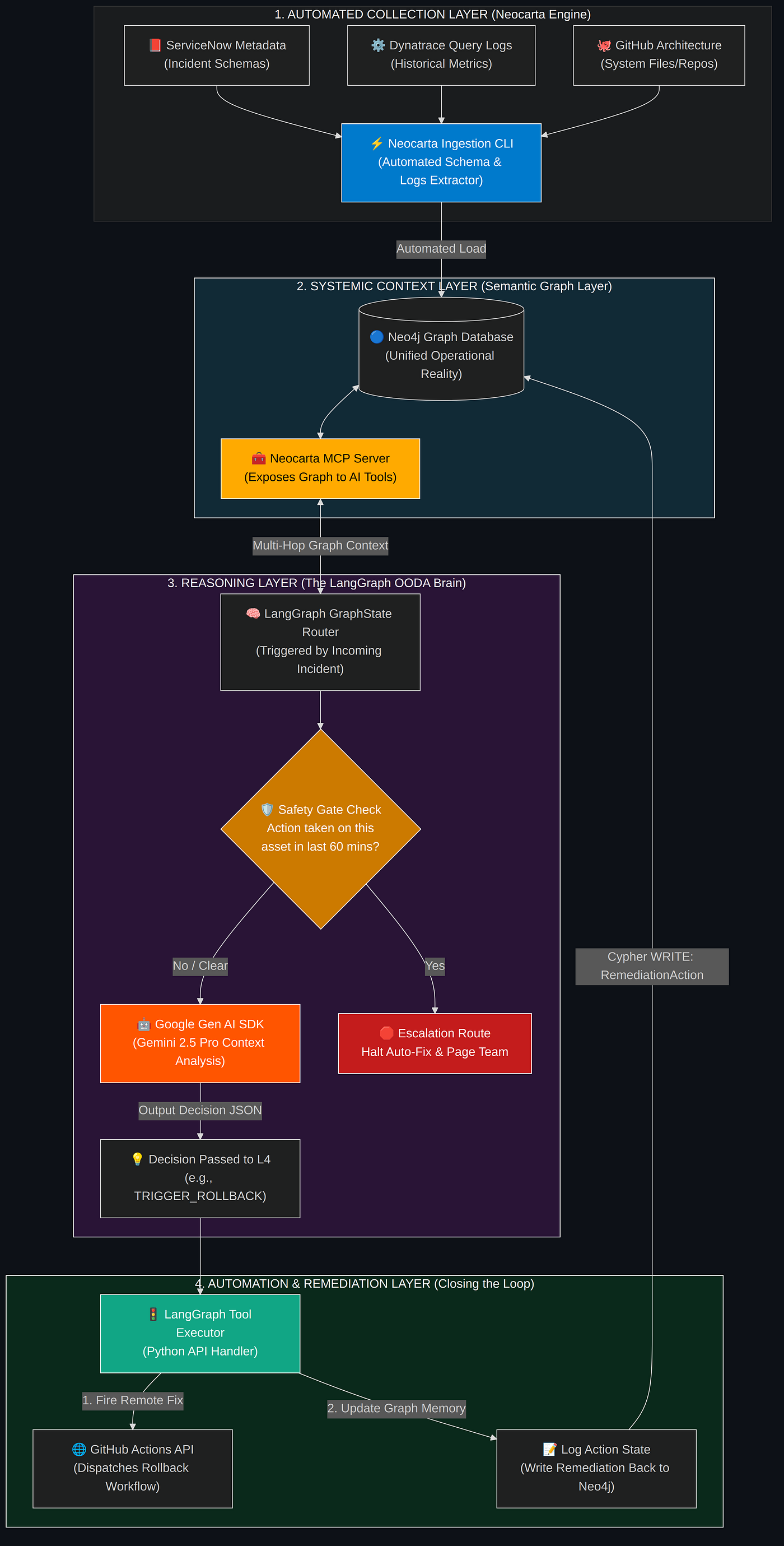
The next-generation AIOps platform consists of six major layers.
Layer 1: Telemetry Fabric
Collects operational signals from across the enterprise.
Sources include:
- Logs
- Metrics
- Traces
- Events
- APIs
- Infrastructure
- Applications
- Security Systems
Examples:
- OpenTelemetry
- Datadog
- Splunk
- Dynatrace
- Elastic
Output:
Unified telemetry stream.
Layer 2: Observability Intelligence
Raw signals are enriched using context.
Capabilities:
- Topology mapping
- Service dependency discovery
- Context enrichment
- Behavioral baselines
Output:
Contextualized operational insights.
Layer 3: AIOps Intelligence Engine
AI models process enriched signals.
Functions include:
Event Correlation
Reduce alert storms.
Pattern Recognition
Identify recurring failures.
Anomaly Detection
Detect unusual behavior.
Predictive Analytics
Forecast incidents before they occur.
Output:
Actionable insights.
Layer 4: Agentic Decision Layer
This is where traditional AIOps becomes Agentic AIOps.
AI Agents:
- Analyze incidents
- Evaluate remediation options
- Validate risk
- Coordinate workflows
Examples:
Incident Agent
Investigates outages.
Reliability Agent
Assesses service health.
Change Risk Agent
Evaluates deployment risks.
Capacity Agent
Predicts scaling needs.
Output:
Decision recommendations.
Layer 5: Automation Execution Layer
Once decisions are approved, automation takes over.
Integrations include:
- ServiceNow
- Jira
- Kubernetes
- Terraform
- Ansible
- Cloud Platforms
Typical actions:
- Restart services
- Scale infrastructure
- Rollback deployments
- Open incidents
- Update CMDBs
Output:
Automated remediation.
Layer 6: Closed-Loop Assurance Layer
The final step validates outcomes.
Questions asked:
- Did remediation work?
- Did KPIs improve?
- Was SLA restored?
- Was customer impact reduced?
Feedback is returned to the AI system.
This creates continuous learning.
Closed-Loop AIOps: The Autonomous Operations Model
Traditional Operations:
Detect
→ Alert
→ Investigate
→ Escalate
→ Fix
→ Validate
Modern AIOps:
Detect
→ Correlate
→ Diagnose
→ Recommend
→ Automate
→ Validate
→ Learn
Future Agentic AIOps:
Observe
→ Understand
→ Decide
→ Act
→ Learn
No human intervention required for routine incidents.
The Role of AI Agents in Operations
AI Agents are rapidly becoming the operational workforce of digital enterprises.
Instead of static workflows, agents can:
Observe
Monitor environments continuously.
Reason
Understand dependencies and impacts.
Plan
Determine remediation strategies.
Act
Execute approved actions.
Learn
Improve from previous outcomes.
This enables:
- Self-healing systems
- Autonomous incident management
- Intelligent capacity planning
- Predictive operations
Real Business Benefits
Organizations implementing mature AIOps capabilities typically achieve:
MetricImprovementMTTR50–80% reductionAlert Volume60–90% reductionIncident Escalations40–70% reductionOperational Costs20–40% reductionSLA ComplianceSignificant improvementCustomer ExperienceImproved reliability
Most importantly:
Operations teams move from firefighting to engineering.
The Future: Autonomous Digital Operations
The future evolution path is becoming clear:
Today
Monitoring Systems
↓
Tomorrow
Observability Platforms
↓
Next
Context-Aware AIOps
↓
Emerging
Agentic Operations
↓
Future
Autonomous Digital Enterprises
The differentiator will not be who collects the most telemetry.
It will be who creates the most intelligence from telemetry.
Key Takeaways
Modern AIOps is no longer just anomaly detection.
Successful AIOps requires five foundational pillars:
1. Observability
Comprehensive telemetry collection.
2. Context Engineering
Business meaning attached to operational data.
3. Enterprise Ontologies
A common language for systems, services, and business processes.
4. Knowledge Graphs
Connected enterprise intelligence.
5. Agentic AI
Autonomous decision-making and remediation.
Together, these capabilities transform IT operations from reactive monitoring into autonomous business operations.
The future of operations is not collecting more signals.
It is understanding them, reasoning about them, and acting on them autonomously.
메타데이터
- post_id
- 6d5dcf88d5dd
- slug
- agentic-aiops-from-observability-to-autonomous-operations-6d5dcf88d5dd
- url
- https://medium.com/@vimal-dwarampudi/agentic-aiops-from-observability-to-autonomous-operations-6d5dcf88d5dd
- canonical_url
- https://medium.com/@vimal-dwarampudi/agentic-aiops-from-observability-to-autonomous-operations-6d5dcf88d5dd
- author_url
- https://medium.com/@vimal-dwarampudi
- status
- ok
- fetched_at
- 2026-06-20 20:29:01