Google’s Latest GA4 Update Signals the Future of Marketing Analytics
Digital marketing is changing rapidly, and data has become the foundation of nearly every marketing decision. Businesses today rely on…
Google’s Latest GA4 Update Signals the Future of Marketing Analytics
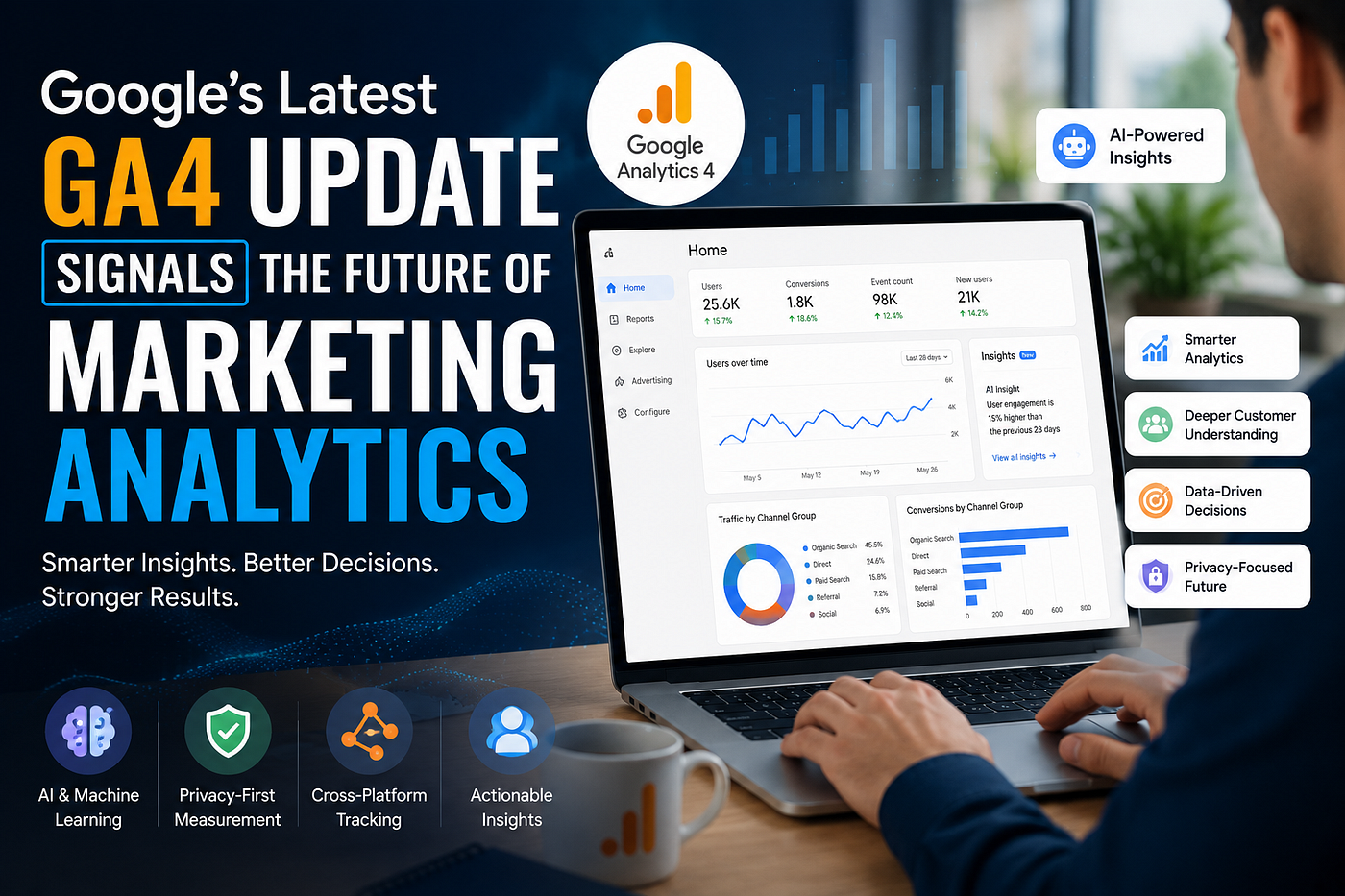
Digital marketing is changing rapidly, and data has become the foundation of nearly every marketing decision. Businesses today rely on analytics not only to measure traffic but also to understand customer behavior, improve campaigns, and increase conversions. That’s why every update to Google Analytics attracts attention across the marketing industry.
Recently, Google introduced another important update to GA4, further expanding the platform’s AI-driven capabilities and reporting features. While the update may seem technical at first glance, it actually reflects something much bigger:
The future of marketing analytics is becoming smarter, more predictive, and increasingly AI-powered.
For marketers, agencies, and business owners, this shift is more than just another software update — it’s a signal about where digital marketing is heading next.
Why GA4 Matters More Than Ever
When Google replaced Universal Analytics with GA4, many marketers struggled with the transition. The new interface, event-based tracking model, and reporting system felt very different from the traditional analytics setup people were used to.
But Google’s long-term vision was clear from the beginning:
- Better cross-platform tracking
- Deeper user behavior insights
- Privacy-focused measurement
- AI-powered data analysis
GA4 was designed not just for current marketing needs, but for the future of digital analytics.
The latest update continues pushing the platform further in that direction.
AI Is Becoming a Bigger Part of Analytics
One of the most noticeable trends in recent GA4 updates is the growing role of artificial intelligence.
Google is integrating more AI-assisted features into analytics reporting to help marketers:
- Understand trends faster
- Identify opportunities
- Predict customer behavior
- Simplify complex data analysis
Instead of manually searching through reports for insights, AI can now help surface patterns automatically.
For example, GA4 may highlight:
- Sudden traffic changes
- Unusual conversion trends
- Audience behavior shifts
- Emerging marketing opportunities
This allows businesses to react more quickly and make better decisions based on real-time insights.
The Rise of Predictive Analytics
Traditional analytics mainly focused on historical data:
- What happened yesterday?
- Which campaign performed best last month?
- How many visitors came from search?
Modern analytics is moving beyond that.
GA4 increasingly focuses on predictive analytics, meaning the platform can estimate:
- Purchase probability
- Churn likelihood
- Potential revenue trends
- User behavior patterns
This shift is important because marketers no longer want only reports — they want actionable predictions.
Businesses can now use analytics not just to understand past performance, but also to plan future strategies more effectively.
Privacy Changes Are Reshaping Analytics
Another major reason Google is evolving GA4 is the changing digital privacy landscape.
Third-party cookies are disappearing, and users are becoming more concerned about how their data is collected online. Governments and browsers are also introducing stricter privacy regulations.
As a result, analytics platforms need to adapt.
GA4 was built with privacy-focused tracking in mind:
- Event-based measurement
- Reduced reliance on cookies
- Machine learning-powered data modeling
- Flexible consent management
Google is preparing marketers for a future where traditional tracking methods may become less reliable.
The latest updates show that AI and machine learning will play a larger role in filling data gaps while still respecting privacy standards.
Cross-Platform Tracking Is Now Essential
Modern customers interact with brands across multiple devices and platforms:
- Mobile apps
- Websites
- Tablets
- Desktop browsers
- Social platforms
Older analytics systems often struggled to connect these user journeys accurately.
GA4 was specifically designed to provide a more unified view of customer behavior across platforms.
This matters because businesses today need to understand:
- How users move between devices
- Which channels influence conversions
- What customer journeys look like in real life
The latest GA4 improvements continue strengthening this cross-platform visibility.
Data Interpretation Is Becoming Easier
One challenge many marketers face is understanding complex analytics reports. Large amounts of data can quickly become overwhelming.
Google appears to be simplifying this process through AI-assisted reporting features.
Instead of requiring advanced technical expertise, GA4 is moving toward:
- Easier insight generation
- Automated recommendations
- Simplified trend analysis
- More accessible reporting
This makes analytics more useful for:
- Small businesses
- Content creators
- Marketing teams
- Non-technical users
In the future, marketers may spend less time building reports and more time acting on insights.
What This Means for Marketers
The latest GA4 update sends a clear message:
Marketing analytics is becoming smarter, faster, and more automated.
To stay competitive, businesses should:
- Learn GA4 more deeply
- Focus on first-party data strategies
- Embrace AI-assisted insights
- Improve conversion tracking
- Understand customer journeys across channels
Marketers who adapt early will likely gain a stronger advantage as analytics tools continue evolving.
Challenges Still Exist
Despite improvements, GA4 still presents challenges for many users.
Common concerns include:
- Complex setup process
- Different reporting structure compared to Universal Analytics
- Learning curve for new users
- Data interpretation difficulties
Some businesses are still adjusting to the platform, especially smaller teams without dedicated analytics specialists.
However, Google’s ongoing updates suggest the company is actively trying to make GA4 more user-friendly and intelligent over time.
Final Thoughts
Google’s latest GA4 update is more than just another feature release — it reflects the future direction of marketing analytics itself.
The industry is shifting toward:
- AI-powered insights
- Predictive analytics
- Privacy-focused measurement
- Smarter reporting systems
- Cross-platform understanding
For marketers, this means analytics is no longer just about collecting numbers. It’s about understanding customer behavior more intelligently and making faster, data-driven decisions.
As digital marketing becomes increasingly competitive, businesses that learn to use modern analytics tools effectively will be in a much stronger position moving forward.
The future of marketing analytics is not just about more data — it’s about better insights.
메타데이터
- post_id
- 6d63afe5f43b
- slug
- googles-latest-ga4-update-signals-the-future-of-marketing-analytics-6d63afe5f43b
- url
- https://medium.com/@sumiece98/googles-latest-ga4-update-signals-the-future-of-marketing-analytics-6d63afe5f43b
- canonical_url
- https://medium.com/@sumiece98/googles-latest-ga4-update-signals-the-future-of-marketing-analytics-6d63afe5f43b
- author_url
- https://medium.com/@sumiece98
- status
- ok
- fetched_at
- 2026-06-23 03:48:11