Between Liver and Kidney
Between Liver and Kidney
The Innocent Accomplice
In the quiet corners of a gastroenterology ward in Taiwan, worry hangs in the air like a low mist. Mr. Chen sits there, sixty-something, once a foreman whose word could stop a production line. After retirement, hepatitis B kept chasing him until he crossed the finish line into cirrhosis.
For years he lived alongside the stubborn “inland sea” of his abdomen. Diuretics were clockwork. Then the tide turned. His belly stretched tight as a drum, his legs rose like over-proofed dough, and the urine that had always trickled through his days simply stopped. The lab called. His creatinine had shot up as if strapped to a roller coaster.
“Nephrology consult.” The call went out. A young kidney doctor arrived, scanned with ultrasound, sifted the urine, read the numbers, and finally pushed up his glasses with a puzzled look. “Strange. Mr. Chen’s kidneys look good. Structure is fine, vessels are open, no stones, no inflammation. They are healthy.”
A stone into still water. Ripples of questions spread across the room. Why would a healthy organ walk off the job? That is the central riddle of hepatorenal syndrome. The kidneys are like innocent accomplices, dragged into the downfall planned by a failing liver. They did not commit a crime, yet they suffer the sentence.
Who is the real culprit? To answer, we have to play medical detective, step into a time machine, and go back a century and more. From the glow of candles in London, to microscopes in Germany, to a swimming pool in Miami, and then back to a bedside on our island.
Under the Shadow of Edema
Early nineteenth-century London had no precise instruments and few clean lines between diseases. Doctors faced a blur of symptoms. Among them, one loomed like a specter: dropsy, the old word for edema.
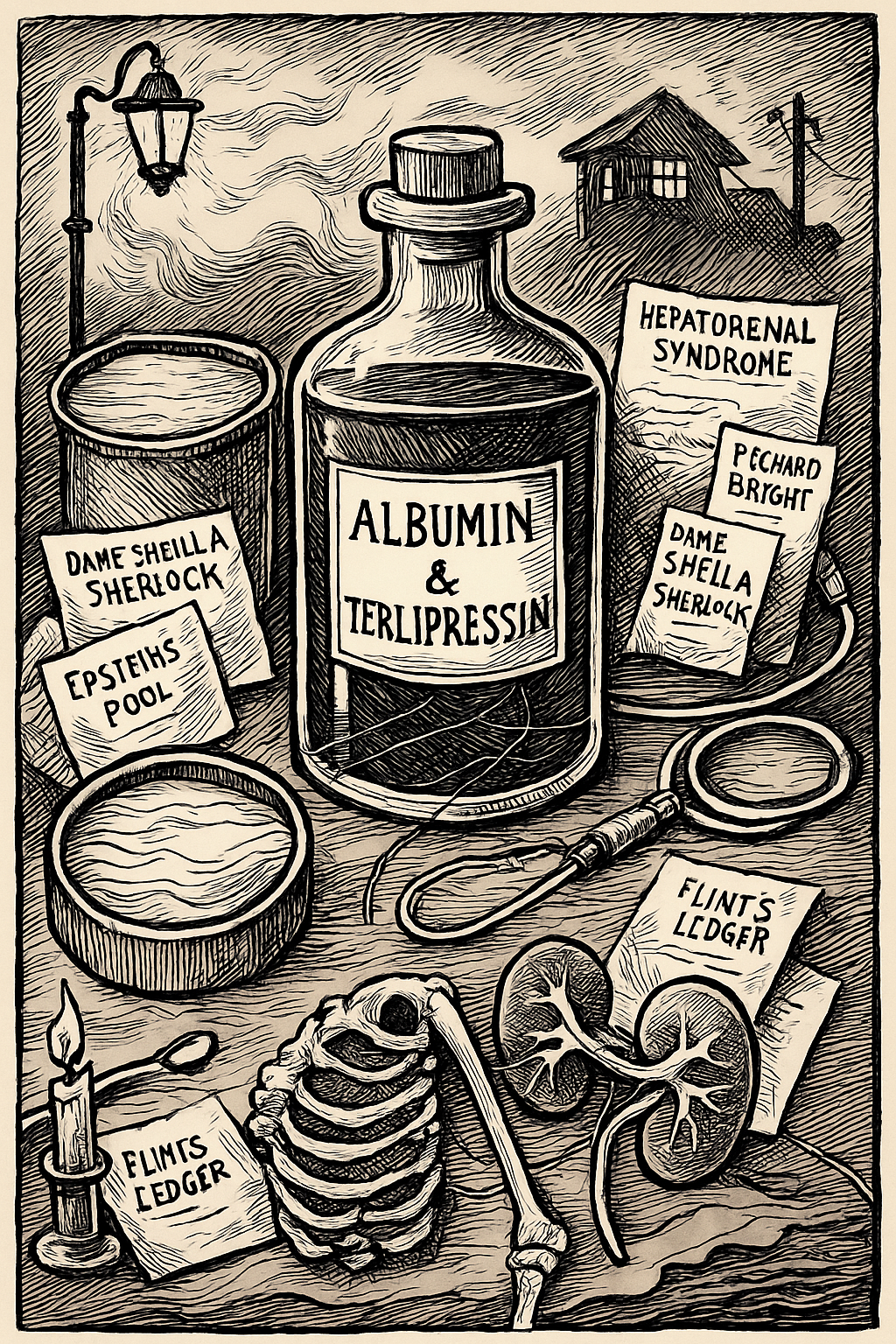
Bodies swelled from face to foot. Bellies pooled with fluid, breathing grew tight, and many died gasping. Explanations were vague. Bad air, trapped sweat, mysterious humors. Then a careful observer appeared: Richard Bright at Guy’s Hospital. His tools were humble, a spoon and a candle. He heated urine from edematous patients and watched it set like egg white. Protein in the urine.
More importantly, Bright linked three clues that seemed unrelated. Patients with edema and heat-coagulating urine had distinctive changes in their kidneys at autopsy. Clinical swelling, laboratory proteinuria, pathological kidney injury. Stitch those together and you have Bright’s triad. With that, nephrology found its first outline, and medicine learned a new way to think: marry bedside observation with lab evidence and postmortem truth. It was a baseline the field desperately needed. Without it, we might never have recognized the later paradox where a diseased liver makes healthy kidneys falter.
The German Titan and the American Watchman
Next the stage shifted. In 1861, Friedrich Theodor von Frerichs in Germany described “cholemic nephrosis.” He noted that patients with severe liver disease, often deeply jaundiced, developed plunging urine output and kidney failure. He connected liver catastrophe with kidney shutdown.
Two years later, across the Atlantic, Austin Flint compiled 46 cases of cirrhosis with heavy ascites. He found a common thread that worried him. Oliguria. The urine faded away even though the primary problem lived in the liver. Flint could not explain it, but he recorded it faithfully.
Two physicians, worlds apart in method and geography, glimpsed the same shadow. One peered through pathology and chemistry, the other through long hours at the bedside. Together they offered the first testimonies that the liver and the kidney were bound by an unseen wire.
The Ghost in the Machine
By the early twentieth century, surgery blossomed. Yet the mystery darkened. James Gordon Heyd noticed a chilling pattern. Some patients, after routine biliary surgery, went from normal kidney function to anuria in a day or two, then died within days. On autopsy their kidneys looked pristine. No inflammation. No necrosis. Nothing to justify failure.
So doctors began to say the words that felt strange in their mouths: functional renal failure. Imagine a gleaming factory with flawless machines but no raw materials. Production stops, not because the gears are broken, but because the supply line has been cut. In hepatorenal syndrome, the kidneys are the factory. The culprit is not a local lesion. It is a system problem that closes the spigot.
For decades the theory outpaced the proof. Then organ transplantation offered two elegant experiments. First, a kidney taken from someone who died with hepatorenal syndrome was transplanted into a patient with end-stage kidney disease. The “striking” result: the kidney woke up and worked. Second, a patient with hepatorenal syndrome received a healthy donor liver. Days later the patient’s original kidneys, once silent, began to flow again. The courtroom kind of evidence that changes minds. The kidneys were hostages, not villains.
The Queen of London and a Pool in Miami
Once innocence was established, we needed the mechanism. Enter Dame Sheila Sherlock, who built modern hepatology from a rooftop shack at the Royal Free Hospital. Her lab was makeshift and the stairs were steep, but her standards were sky-high. Through relentless hemodynamic measurements and liver biopsies, she and her trainees mapped the circulation chaos of cirrhosis.
From that work emerged the peripheral arterial vasodilation theory. Here is the story in plain language.
Cirrhosis raises resistance inside the liver and triggers portal hypertension. Blood searches for detours and the splanchnic, or gut, circulation releases powerful dilators like nitric oxide. Arteries dilate widely, not just in the gut but across the body. Total body water is up, yet the effective volume inside the arteries is down. The nervous system interprets this like blood loss.
The body hits the alarms. The renin–angiotensin–aldosterone system and the sympathetic nervous system surge. To protect blood flow to the brain and heart, they clamp down where they can. Renal arteries are sensitive to these orders. They constrict hard. Blood to the kidneys falls. Not because the kidneys are sick, but because the nation’s treasury has tightened all the wrong screws to keep the central government alive.
A brilliant experiment in Miami made the theory tangible. Murray Epstein sat cirrhotic patients with ascites in a warm pool with the water up to the neck. Hydrostatic pressure squeezed blood from the legs and abdomen back to the chest. Central volume rose. The body relaxed the alarms. Vasoconstriction eased. Urine flowed. No drug, just physics. An elegant proof that the system, not the kidney, is the lever.
From Club Rules to a Spanish Remedy
Knowing the trick is one thing. Catching it early is another. The International Club of Ascites gathered experts to standardize diagnosis. The earliest criteria in the 1990s set a creatinine threshold and required excluding other causes like shock, nephrotoxins, or true structural kidney disease. By 2007 they recognized two patterns. One was explosive and deadly within weeks. The other crept along with stubborn ascites.
Then came the crucial pivot. Waiting until creatinine rose above a fixed cutoff was costing lives. Nephrology had already embraced a more sensitive definition of acute kidney injury that looked at changes over days rather than static numbers. Hepatology followed suit. The term HRS-AKI replaced the old “type 1.” If creatinine rises by at least 0.3 mg/dL in 48 hours, or by at least 50 percent in seven days, and other causes are excluded, the diagnosis should be made and treatment started. Translation: do not wait for a body on the floor. Move when the weapon flashes.
Treatment logic followed the physiology. If the arteries are too relaxed and the central tank is empty, then constrict the right vessels and refill the tank. In Barcelona, Pere Ginès and colleagues tested terlipressin, a vasopressin analog, together with albumin. Across careful studies, a significant share of patients reversed their kidney failure. It is not a cure for cirrhosis. Liver transplantation remains definitive. But terlipressin plus albumin can buy time. In critical illness, time is a bridge to survival.
Back to Our Island
Return to Mr. Chen. We no longer stare into the fog. We can almost see the splanchnic vessels yawning open, siphoning off the effective blood volume. We can almost hear the RAAS and sympathetic system shouting at his renal arteries to slam shut.
We also see the line of detectives behind us. Bright’s candle over a spoon of urine. Flint’s ledger of forty-six swollen lives. Dame Sheila on a wet London roof, drawing a map of the circulation’s collapse. Epstein’s pool, the simplest demonstration you could imagine. Ginès’ trials that turned theory into therapy.
A long road from candlelight to vasoconstrictors. Each step a small victory of patience over confusion.
This history matters here. Taiwan has long carried a heavy burden of hepatitis B and C. Many families know the arc from chronic hepatitis to cirrhosis to cancer. Hepatorenal syndrome is the hard final chapter. Yet because of what we have learned, our hands are not empty. With the AKI-based criteria we can act when creatinine barely trembles. With albumin and terlipressin we can build a bridge toward transplant.
At Mr. Chen’s bedside, we hung the albumin and started terlipressin with care. A few days later the urine bag showed what we had been waiting for, that quiet gold. His road will still be long. But the clock has been nudged back in his favor.
This is what medicine does at its best. It is an endless investigation carried by many hands across time and oceans. And every hard-won insight has only one purpose. It is to bend over one ordinary, precious life and give it a little more time, a little more hope.
Keywords: cirrhosis; hepatorenal syndrome; albumin and terlipressin; medical history; kidney failure
References
- Flint A. Clinical report on hydro-peritoneum, based on an analysis of forty-six cases. Am J Med Sci. 1863;45(90):306–39.
- Papper S. The role of the kidney in Laennec’s cirrhosis of the liver. Medicine (Baltimore). 1958;37(4):299–316.
- Hecker R, Sherlock S. Electrolyte and circulatory changes in terminal liver failure. Lancet. 1956;271(6953):1121–5.
- Fagiuoli S, Angeli P, Gines P. Hepatorenal syndrome: a historical appraisal of its origins and conceptual evolution. J Hepatol. 2021;74(4):948–58.
- Martin PY, Gines P, Schrier RW. Nitric oxide as a mediator of hemodynamic abnormalities and sodium and water retention in cirrhosis. N Engl J Med. 1998;339(8):533–41.
- Epstein M. Renal effects of head-out water immersion in man: implications for an understanding of volume homeostasis. Physiol Rev. 1978;58(3):529–81.
- Arroyo V, Ginès P, Gerbes AL, Dudley FJ, Gentilini P, Laffi G, et al. Definition and diagnostic criteria of refractory ascites and hepatorenal syndrome in cirrhosis. Hepatology. 1996;23(1):164–76.
- Salerno F, Gerbes A, Ginès P, Wong F, Arroyo V. Diagnosis, prevention and treatment of hepatorenal syndrome in cirrhosis. Gut. 2007;56(9):1310–8.
- Angeli P, Gines P, Wong F, Bernardi M, Boyer TD, Gerbes A, et al. Diagnosis and management of acute kidney injury in patients with cirrhosis: revised consensus recommendations of the International Club of Ascites. J Hepatol. 2015;62(4):968–74.
- Ortega R, Ginès P, Uriz J, Cárdenas A, Calahorra B, De Las Heras D, et al. Terlipressin therapy with and without albumin for patients with hepatorenal syndrome: results of a prospective, nonrandomized study. Hepatology. 2002;36(4 Pt 1):941–8.
- Martín-Llahí M, Pépin MN, Guevara M, Díaz F, Torre A, Monescillo A, et al. Terlipressin and albumin vs albumin in patients with cirrhosis and hepatorenal syndrome: a randomized study. Gastroenterology. 2008;134(5):1352–9.
- Sanyal AJ, Boyer T, Garcia-Tsao G, Regenstein F, Rossaro L, Appenrodt B, et al. A randomized, prospective, double-blind, placebo-controlled trial of terlipressin for type 1 hepatorenal syndrome. Gastroenterology. 2008;134(5):1360–8.
- Boyer TD, Sanyal AJ, Wong F, Frederick RT, Lake JR, O’Leary JG, et al. Terlipressin plus albumin is more effective than albumin alone in improving renal function in patients with cirrhosis and hepatorenal syndrome type 1. Gastroenterology. 2016;150(7):1579–89.e2.
- Wong F, Pappas SC, Curry MP, Reddy KR, Sanyal AJ, Noureddin M, et al. Terlipressin plus albumin for the treatment of type 1 hepatorenal syndrome. N Engl J Med. 2021;384(9):818–28.
- \Ginès P, Schrier RW. Renal failure in cirrhosis. N Engl J Med. 2009;361(13):1279–90.
- Angeli P, Garcia-Tsao G, Nadim MK, Parikh CR. News in pathophysiology, definition and classification of hepatorenal syndrome: A step beyond the International Club of Ascites (ICA) consensus document. J Hepatol. 2019;71(4):811–22.
메타데이터
- post_id
- 6d8f8b82da4b
- slug
- between-liver-and-kidney-6d8f8b82da4b
- url
- https://medium.com/medical-stories/between-liver-and-kidney-6d8f8b82da4b
- canonical_url
- https://medium.com/medical-stories/between-liver-and-kidney-6d8f8b82da4b
- author_url
- https://medium.com/@critnephro
- status
- ok
- fetched_at
- 2026-06-09 15:37:30