DMCC vs IFZA vs Shams: Picking the Right UAE Free Zone Without Getting Sold the Wrong One
Beyond the advertised price: a practical comparison of DMCC, IFZA and Shams, including licensing, company structures, costs, and the…
DMCC vs IFZA vs Shams: Picking the Right UAE Free Zone Without Getting Sold the Wrong One
Beyond the advertised price: a practical comparison of DMCC, IFZA and Shams, including licensing, company structures, costs, and the trade-offs behind each option.
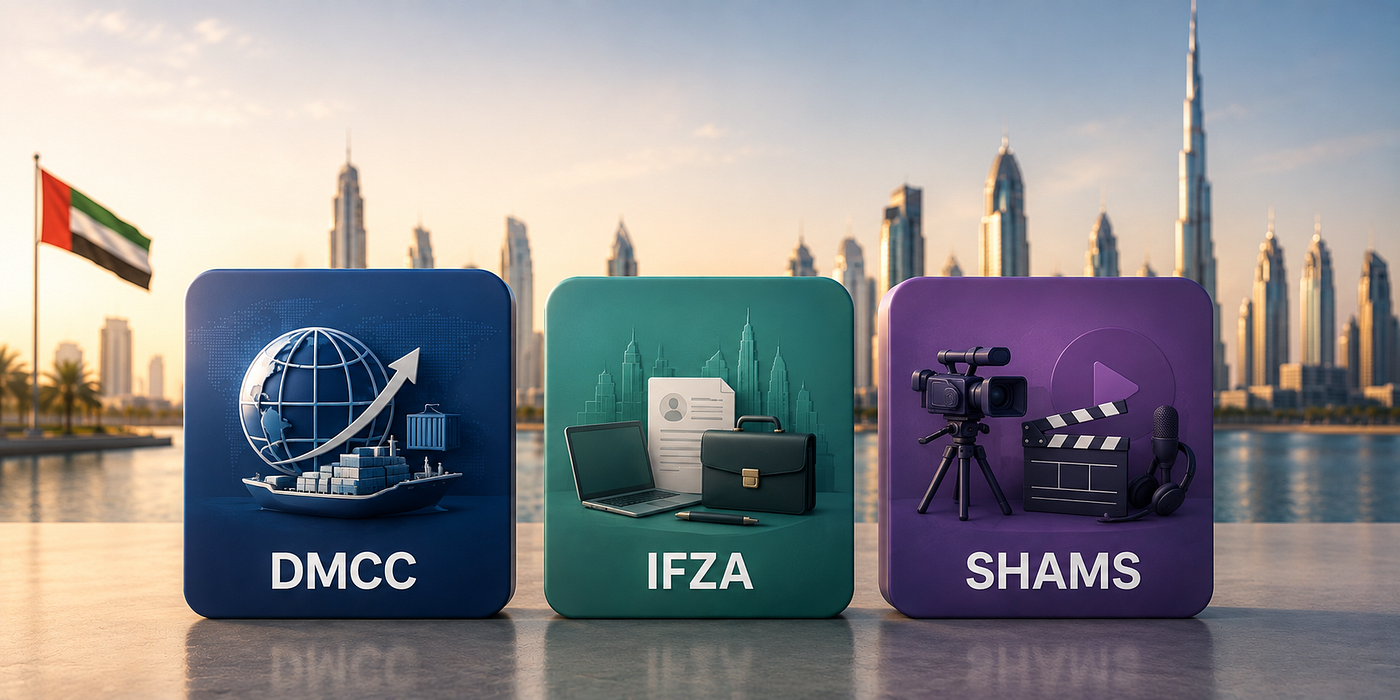
Starting a business in the UAE may seem easy at first glance. Pick a free zone, pick your license, pay the price, and you’re in business. But often, the difficulty begins before you even make an application — choosing which free zone is recommended to you matches the kind of business that you wish to start.
If you are presently researching UAE free zone business setup, it’s likely that you’ve already seen how the sales pitches can be very much alike. One consultant claims that a particular zone is “the best choice for startups,” another that it is “the most cost-effective,” yet another because of its “flexibility,” location, reputation or bundle pricing.
Unfortunately, however, any of those pitches, on their own, do not answer the question of best for what?
Different types of businesses, such as consultancy firms, multinational trading firms, tech startups, media houses and holding companies have different needs. The UAE government acknowledges that selecting a jurisdiction and a name for a free zone business is merely one step in starting a business, as different free zones vary in the services and areas of business they support.
Here is where the comparison between DMCC, IFZA and Shams comes in handy —but only if they go beyond headline prices and promotional claims.
The cheapest licence may not be the cheapest setup
A business owner must look at three proposals.
The first is priced at AED 6,000. The second costs AED 15,000. The third one has a price tag of AED 30,000.
The decision may seem easy at first sight. However, one should understand what is included in each of the quotations.
- What are the features that each quotation offers?
- Is the registration costs part of the price?
- Is the business license included for one year?
- What is the type of business office is included?
- How many activities can be done? Are visas included?
- What about renewal of the company?
- Does the activity need extra approvals?
- Is it necessary to have a physical office of business as it develops?
These things can change the whole picture when it comes to the price evaluation.
A practical example would be the price list of DMCC, which publishes separate company establishment fees rather than treating every business as one universal price. It has currently published a typical price list with such services as an application fee of AED 1,035, registration AED 9,020, AED 2,020 for the Articles of Association and AED 20,285 for an annual licence. There is also a set of additional costs as per the company and activities.
That is an important distinction: a package price and the underlying cost of maintaining a company are not necessarily the same thing.
The same idea applies to IFZA and Shams.
IFZA mentions that the fees for license issuance and renewal are determined by various factors such as company structure, number of shareholders, business activities and the validity period of the license, instead of having one universal fee for every company.
Meanwhile, Shams makes use of a special calculator that helps determine the rate due to the dependent nature of the cost on the chosen strategies for the company to be established.
Before thinking about finding the answer to the question “Which of the free zones is the cheapest?”, it is advisable to ask another question, which is:
“How much will it cost to set up and maintain this business in the chosen free zone?”
That is the main question this comparison will focus on.
DMCC, IFZA and Shams are not interchangeable
The three jurisdictions can all serve entrepreneurs establishing businesses in the UAE, but that does not make them identical.
A gist of 3 worlds:
DMCC has created a comprehensive business environment within the Emirate of Dubai, providing licensing facilities for trading, services and industrial operations. It also offers specialized business facilities such as holding company structure, ergo making it useful for entrepreneurs with needs that extend beyond an operating company.
IFZA grants Commercial and Professional licensing options and helps entrepreneurs and companies have different company structures established in Dubai. Its official documentation also emphasizes the 100% foreign ownership and flexible workplace facilities available to eligible free zone companies.
Shams has an identity in the field of media and creative industries while its licensing framework is more than just a media company model but instead provides various corporate structures. They are also able to provide tools that help entrepreneurs calculate costs via the official setup platform.
The differences become more important when you start asking what the company is actually being formed to do.
- The founder of a consulting business may be looking out for eligibility for certain activities, cost of acquiring licenses and having a viable working space to run the business.
- The owner of a trading firm may focus on authorised activities, warehousing and logistics instead.
- An entrepreneur dealing in technology may value professional activities as well as scalability more than other aspects.
- A media professional would probably feel that it is better to do business in a media-oriented jurisdiction right from the start.
- The choice of location when setting up a holding company in free zone must be on the basis of jurisdiction’s legal framework, permitted functions, ownership structure, property secured and compliance requirements.
What the consultant may not tell you

This does not imply that the consultants are always wrong when giving advice. What it implies is that what is good advice for one business may fail to provide any positive outcomes for another.
The free trade zone is perfect for small consultancy firms but sometimes does not work as expected for companies that require a specific trading environment. Similarly, it might provide the company with an appealing package but become unsuitable when the organization requires more office space, hires new employees, etc. The region might be famous for particular niches and still be quite versatile but that does not imply that it will be the most suitable solution either.
That is precisely why this comparison will not create the top three of Dubai Multi Commodities Centre, International Free Zone Authority and Sharjah Media City from the “best” to “worst.”
Instead, it will look at where each one makes sense, where it may not, what you are likely to pay for, what company structures and activities need closer attention and which assumptions entrepreneurs should challenge before signing up.
The goal is simple: choose the free zone based on the business you are actually building — not the package someone is trying to sell you.
DMCC: The Free Zone Everyone Recommends — But Should You Choose It?
Established in 2002 as a Government of Dubai initiative to strengthen commodity trade, the Dubai Multi Commodities Centre (DMCC) has grown into a major international business hub. Today, it is home to more than 26,000 registered companies from 180 countries, spanning businesses from startups to multinational corporations. DMCC was also recognised by Financial Times fDi Magazine as the Global Free Zone of the Year for nine consecutive years, reinforcing its position as one of Dubai’s most established free zone business destinations.
When a consultant suggests Dubai DMCC business setup merely because it is regarded as “one of the most respected free zones in Dubai,” this does not tell the entire story. DMCC can be a strong choice, but its value depends heavily on what you are actually building. For some companies, its ecosystem, business community and range of activities can justify the cost. For a small founder who only needs a basic professional licence, however, the additional cost and requirements may deserve closer scrutiny.
Different Types of Business Licenses Available in DMCC
DMCC offers its clients four main types of licenses and distinguishes their licensing categories in connection with different business operations:
1. Service License This license is designed for companies that provide professional services, consultancy in various areas and operational support, and includes companies offering IT and consulting services. 2. Trading License The license for any type of company involved in importing, exporting, distributing, storing goods and goods selling is available as well. 3. Commercial License This license allows companies to provide more complex commercial operations, including trading in other groups of products under existing legislation. 4. Industrial License This license is applicable to businesses engaged in the production of any goods or activities, working with any material or resource and permitting to convert goods into final or semi-finished items.
There are 1,000+ approved activities across 20 sectors, including trading, consulting, crypto, AI and commodities.
Common Business Activity Categories
DMCC covers a wide range of business activities across multiple sectors, including:
- Trading and General Commerce — textiles, consumer products, electronics and general trading.
- Commodities and Natural Resources — precious metals, diamonds, energy products and agricultural commodities.
- Professional and Consultancy Services — management consulting, marketing, advisory, and other professional services.
- Technology and Innovation — software development, IT services, AI, blockchain and cybersecurity.
- Crypto and Web3 — eligible virtual asset and blockchain-related activities subject to applicable regulatory approvals.
- Logistics and Transportation — freight, shipping, supply chain and related services.
- Food and Beverage — food trading, cafés, restaurants and related activities, where permitted.
- Healthcare and Medical — medical equipment trading and other healthcare-related activities subject to the relevant approvals.
The company’s structure may differ depending on how the business is owned. DMCC’s published materials on how to set up a company give examples for companies such as an Individual, Joint Venture or Subsidiary, and branches of companies incorporated in or outside DMCC can also be created. In 2025, DMCC also introduced dedicated SPV and Holding Company licences, expanding the options for businesses that need structures for investments, asset holding or overseeing subsidiaries.
DMCC also provides a Free Zone Mainland Operating Permit that eligible companies can obtain for performing certain activities with mainland clients, under certain conditions. This, however, does not eliminate the need for all mainland licensing and regulations.
What does DMCC actually cost?
This is where entrepreneurs should look beyond the advertised starting price.
Financial and compliance requirements are of importance here as well: for example, the standard company in DMCC must have a capital of at least AED 50,000. Companies must also comply with all accounting and auditing requirements that need to be satisfied in the context of their activity. To a great extent, the benefit of the UAE’s 0% Corporate Tax on income from the free-zone activities is also conditional and should not be regarded as a universally applicable rule for DMCC companies.
DMCC publishes both packaged company-setup options and individual standard charges, so entrepreneurs should understand the difference before comparing DMCC with another free zone. A package gives you a bundled option, while the standard schedule shows the individual charges involved in setting up and maintaining a company.
DMCC Company Setup Packages

These are the package prices currently displayed by DMCC. DMCC also states that its charges are subject to change and that the package terms and conditions apply.
DMCC Standard Company Setup / Registration Charges

DMCC specifically notes that the licence fee can vary when additional activities are selected. It also states that its charges are subject to AED 20 Knowledge & Innovation Dirhams, and that fees can change without prior notice.
Office Space in DMCC
The DMCC firms require a suitable business address within the free zone, where office spaces are available in different locations in Jumeirah Lakes Towers (JLT) and Uptown Dubai. Entrepreneurs can choose from flexible workspace solutions to dedicated offices based on their business size and requirements.
Small firms can start with flexi-desk or co-working solutions, while larger firms can go for dedicated and serviced offices. Currently, the published charges by DMCC have flexi-desk solutions costing about AED 16,000–19,000, while the costs of serviced offices vary from AED 35,000 to AED 140,000 depending on the chosen space. The choice of office space can also determine the visas allowed for the company. DMCC states that companies using a physical office in JLT are generally entitled to one visa for every 9 sq. m. of office space, while business-centre flexi-desk solutions might generally provide an allocation of 1–3 visas.
The workspace requirement will actually depend on the licensed activity. Activities like manufacturing, logistics and others can actually require a certain type of facility instead of an office. Therefore, the entrepreneur needs to ensure that the facility is capable of undertaking the licensed activity before considering the cost of the workspace
Where DMCC may not be the best fit
Here comes the part which is usually omitted from common free zones comparison.
DMCC is not always the best choice due to its popularity.
An individual consultant with a simple service function, minimum staff and modest space needs may discover that the cheaper free zone suits the company as good as DMCC.
Likewise, an entrepreneur who cares about setting up his company at the lowest initial cost needs to consider the full costs associated with DMCC relative to other jurisdictions. There are different fees charged by DMCC, and additional services like space rental, visas etc., will add to the total cost.
This does not mean DMCC is “too costly.” It just means that the features offered by DMCC have to be important to your business for you to incur that extra cost.
IFZA: Flexible Setup, With Several Details Worth Checking
IFZA business setup is built around a relatively flexible incorporation model for small businesses and international founders. Its current licence options include Professional, Commercial and Branch structures. A Professional Licence covers eligible consultancy and service activities, while a Commercial Licence covers trading, import and export of compliant goods. Foreign-incorporated companies can also establish a branch through IFZA.
Licence and Activity Choice
One of IFZA’s practical features is the ability to combine multiple eligible activities under one licence. These can include professional services such as technical consultancy, management consultancy, marketing and lifestyle services, as well as commercial activities covering the trading, import and export of compliant goods. IFZA states that the first three business activities are included under the standard licence, with additional activities charged separately. Activities are classified as either non-regulated or regulated; regulated activities may require approval from the relevant Dubai or UAE authority, and some activities can also have specific property requirements.
One of the particular advantages of IFZA is the possibility of having several eligible activities in one licence. These can include professional services such as technical consultancy, management consultancy, marketing and lifestyle services and commercial activities such as trading, import and export of compliant goods. The IFZA states that the first three business activities are included under the standard licence while the next activities require an additional charge. Activities are distinguished by two categories: between non-regulated activities and regulated activities requiring external approvals. Some activities can also have specific property requirements, so confirming the activity before choosing a package is important.
Office and Setup
The office requirements are relatively flexible: IFZA specifies that there is no mandatory provision of office for its basic licence package, while workspace can be added as per the company’s requirement. This may work well for the small service-oriented business, which does not require the provision of an office space right away. It is advised to look into the property requirements associated with the business activity in particular.
Approximate Cost
IFZA does not provide a single standard cost estimate for setting up a company on its business setup page. The estimated cost of a basic set-up is approximately AED 12,000–15,000+, and provision of visas, company setup services and office would raise the annual cost estimate to approximately AED 20,000–30,000+. This cost estimate is an indicative figure, which depends upon the actual activity, shareholders and office arrangement.
Where IFZA may not be the best fit
When your company relies on industry-specific ecosystems, extensive physical infrastructure, warehousing, production facilities, or highly regulated operations, there might be another jurisdiction where it would feel more at home.
Conversely, when the quote of your IFZA consulting firm appears to be much cheaper compared to DMCC, you need to make sure that both quotes relate to the same license, the same set of activities, the same office solution, the same number of visas, and the same corporate services. You may be comparing apples and oranges otherwise.
The IFZA takeaway is that its key strength lies in flexibility and a relatively easy setup process. It comes into play when your business requires an uncomplicated Dubai free zone setup and does not need the specific ecosystem of zones like DMCC. But the decision has to be based on the activity itself and the costs of operation.
Shams: Flexible Packages, Broad Activities, and a Low Entry Cost
Shams Free Zone has supported more than 75,000 business journeys since 2017, according to the free zone. While its name comes from Sharjah Media City, its current licensing framework extends beyond media into service, trading and light-industrial activities. Company formation in SHAMS offers 100% foreign ownership and fully digital setup.
One of its headline features is its “License Under 60 Minutes” service, designed to speed up licence issuance once the application and required checks are completed. Shams also offers an LLC suffix without “FZ” that means eligible companies can have a more mainland-like company name.
Licences and Activities
Shams provides over 120 business activities which includes three areas:
- Media
- Wholesale & Retail
- Services and Consultancy
Entrepreneurs can choose up to five activities through one licence, regardless of their sectors, in line with the activity criteria. This includes fields like management consultancy, marketing, information technology, e-commerce, trading, advertising and other professional and commercial activities. Some activities might need prior approval from another regulatory body; and so verification of the activity is recommended before applying.
Shams provides flexibility in terms of company structure, such as LLCs and branches, among other licensing and company formation services.
Packages and Approximate Cost
Shams provides two packages:
- Media Package, perfect for freelancers, creators and media companies
- Standard Package, suitable for service-based, trading, e-commerce and multi-sector businesses
Both are registered as LLCs and both have flexi-desk and lease agreement included. Up to 5 media activities shall be combined. According to Shams, all prices are inclusive of VAT, however, E-channel registration and the external approvals (as per the business activity) will be charged separately.

Shams Free Zone Package
Package terms and conditions apply. The actual cost can vary according to the selected business activities and additional requirements.
Its cost calculator allows applicants to estimate the setup cost before proceeding. The authority also highlights 100% digital setup and no NOC requirement for its business-formation process. You can also apply for up to 50 visas per license, depending on your business activity and office space allocation.
Documents, Company Structure and Timeline
LLC and Branch are the formats which Shams facilitates. Passport and ID or Emirates ID of UAE/visa of the country (wherever applicable) are generally submitted by individual applicants. Corporate shareholders owning 25% or more would be required to submit incorporation documents, constitutional documents, certificate of incumbency/good standing, ownership details, board resolution and ownership structure chart.
The company licence itself is currently listed by Shams at 1–2 working days from the formal processing stage. Visa-related stages take additional time. The entire application, payment and licence issuance process can be completed digitally and as said, this is one of Sham’s more practical advantages for overseas founders.
Where Shams may not be the best fit
Shams may not necessarily be the best option for companies which need specialized facilities such as warehousing, manufacturing facilities, or regulated operations. Though a variety of business activities can be licensed in Shams, there are some businesses that may require further approvals or facilities which are better provided in other free zones.
Takeaway ahead: Shams makes the most sense if you give importance to a straightforward UAE company structure that can support your business without requiring the deeper infrastructure of a specialised free zone. Its value is strongest for entrepreneurs whose operations can be handled with a relatively simple setup. But once the business needs more complex logistics, physical facilities or sector-specific infrastructure, the comparison should shift toward zones designed around those requirements.
DMCC vs IFZA vs Shams: What Actually Changes Your Decision?
At this juncture, the variations become more apparent.
- DMCC introduces a wide range of activities, developed trading and industry infrastructure and more choices for operations and workspaces.
- IFZA stands for flexibility in terms of registering a company, a combination of Professional and Commercial activities, remote operations and lighter requirements for a workspace for eligible basic packages.
- Shams merges a cheap and easy-to-set-up company (mostly catering to media and service-led), with a wide selection of operations and extremely flexible packages.
However, if one wants to name a “winner,” they need to comprehend what a company actually needs. A founder choosing a consultancy, an e-commerce business and a commodities trader should not be making the same decision.

Compaison: DMCC vs IFZA vs Shams
Comparison based on current information published by the three free zones. Costs and requirements can change, and regulated activities may require additional approvals.
So, Which One Should You Pick?
Opt for DMCC if your firm needs what is already available for DMCC. Its wide catalogue of activity, existing commodities and trading system, specialized communities within a certain sector and various kinds of workspaces can justify a higher setting cost. It is especially recommended for consideration if your firm is not only a small professional firm but has more substantial commercial and trading demands.
Consider IFZA if you are in need of a more flexible approach than a specialized ecosystem. Its capacity to include both Professional and Commercial activities under one license, remote incorporation and no mandatory office premises for basic setup with up to four visa allocations can come in handy for firms that are lean and whose founders come from overseas.
Move forward with Shams if your firm can capitalize on a flexible package approach without demanding much infrastructure. Presently, the Standard Package suits businesses like consultancy, trading and e-commerce businesses. Media Package suits creative and media firms. Both packages provide up to five eligible activities but require certain approvals from outside for particular activities.
The Questions to Ask Before You Sign Anything
Before accepting the advice of a consultant, insist on receiving a quotation based on the reality of your company profile, not a package.
Make sure that you find out in advance the specifics of the activities to be performed under the license, for how many shareholders your business is organized, its organizational structure, the required number of visas, how many offices your business is going to have, how much it will cost in its first year and how much the renewal of the license will be worth. Be sure to clarify if your business operation requires any regulatory approvals and whether the quotation includes the costs of these approvals.
This also highlights the common mistake of comparing two packages from different consulting companies that may be priced differently; a AED 25,000 package and a AED 6,000 package should not be compared before the contents of both packages are known. The least expensive package may be quite sufficient or it may simply exclude the office, visas, additional approvals or other services that your business needs.
Before You Choose the Free Zone, Choose the Business You Are Building
The most important lesson from the comparison between DMCC, IFZA and Shams is that choosing a free zone should follow rather than precede formulating a business model. The activity dictates the type of licence that you need; this, in turn, dictates the operating conditions, which will determine most of the cost of establishment.
A consulting firm can certainly help with this procedure, but it must be able to provide an explanation. You need to understand why a certain free zone has been chosen, what the price quote covers, which approvals you need and how the cost and conditions change when the firm hires people, engages in new activities or gets an additional office space.
This is how entrepreneurs will be saved from purchasing a package that may look impressive on paper but is completely unsuitable for their specific business. Good choice of free zones is about neither getting the cheapest option nor the most prestigious one. It is about buying exactly what your company requires and nothing more.
Have you been recommended DMCC, IFZA or Shams for your business? Share your experience or questions in the comments below.
메타데이터
- post_id
- 6d9aff7be4e0
- slug
- dmcc-vs-ifza-vs-shams-picking-the-right-uae-free-zone-without-getting-sold-the-wrong-one-6d9aff7be4e0
- url
- https://medium.com/@aziendmedia/dmcc-vs-ifza-vs-shams-picking-the-right-uae-free-zone-without-getting-sold-the-wrong-one-6d9aff7be4e0
- canonical_url
- https://medium.com/@aziendmedia/dmcc-vs-ifza-vs-shams-picking-the-right-uae-free-zone-without-getting-sold-the-wrong-one-6d9aff7be4e0
- author_url
- https://medium.com/@aziendmedia
- status
- ok
- fetched_at
- 2026-08-20 03:55:16