The Cycle
Every night it was the same. A joint, a thirty-milligram gummy, the vape going until she fell asleep. I didn’t dare say a word — I’d…
The Cycle
Every night it was the same. A joint, a thirty-milligram gummy, the vape going until she fell asleep. I didn’t dare say a word — I’d learned what saying a word cost. So I gave it a pass.
I gave a lot of things a pass.
She was upset when I went running with friends. Mad if I worked out more than once in a day. She’d ask if I even had a job, like the parts of my life that didn’t include her were an insult. One by one, the things that made me me — the miles, the friends, the work — got smaller, because keeping them wasn’t worth what it cost to defend them. I didn’t have a word for it then. The word is isolation. It’s not a side effect of that kind of relationship; it’s the point. The more of your own world you have, the harder you are to control. So the world gets taken apart, one reasonable-sounding objection at a time.
Then one day the text came: suck your moms tits, you are such a baby.
And I gave that a free pass too.
That’s how far in I was. That I could read that, about my own mother, and go quiet — because the quiet was survival, and I’d long since stopped being able to tell the difference between survival and love.
The first version of her was the best person I’d ever met. That’s how it starts — not with a warning, but with being chosen so completely it feels like proof of something. Love bombing has a clinical name now, but in the moment it just feels like being seen. Like finally. After a 2 year split. The timing for her was perfect. You don’t know yet that the intensity isn’t intimacy. It’s the setup.
I had the traits that she was going to take advantage of . It has an acronym. PHIL:
Protector, Helper, Integrity, Low-Self Esteem.
These are the traits they prey upon, and I took the bait.
I was always walking on eggshells wondering when she was going to blow. Sometimes I would leave a cabinet shelf open and that was it. That was the mistake. And for it I was discarded — blocked, erased, gone. No conversation, no proportion. Ten minutes against months of being told I was everything. I sat with a phone that wouldn’t deliver and tried to figure out what I’d done, because surely I’d done something. The math had to work. It never occurred to me that the math was the problem.
A couple of days later: Hey. How are you doing?
Like nothing had happened. And then the warmth again, all of it flooding back — and God help me, the relief was the sweetest thing I’d ever felt, because the punishment had been so total that its ending felt like love. I found a youtube channel that helped me to understand.\
https://www.youtube.com/watch?v=K4VRzdf5LVM
That’s what shattered my nervous system. Not the cruelty and not the affection, but the two of them wired into the same circuit. Discard, then reward. Silence, then how are you doing. You can’t brace for it because you never know which is coming, and the not-knowing is the whole mechanism. I’ve since learned it’s the most powerful conditioning that exists — the same pattern that keeps people at slot machines. I didn’t know that then. I just knew I couldn’t stop checking my phone.
The cognitive dissonance is a kind of madness. Two things that can’t both be true, held in the body at once: this person is destroying me and this person is the love of my life. You can’t resolve it, so you split the difference and blame yourself. If I could just be less — less late, less difficult, less me — the good version would stay. That’s the trap closing. You’re ashamed to stay and you’re the villain if you go.
All of this while I was trying to hold my family together — nine kids depending on me to keep standing. I don’t know how to explain what it does to a person to be broken down like that in private while showing up whole in public every single day. It broke me down further than I knew a person could go. The difficulty of this type of relationship is summed up perfect here. There was a day I didn’t think I’d survive it, and I came closer than I’ve ever told most people to not making it through.
I want to be careful and honest about that, because someone reading this might be exactly where I was. What I’ve learned since is that this wasn’t weakness, and it wasn’t a defect in me. Being held that long in a loop of punishment and relief — punished for existing, then flooded with warmth, never able to predict which was coming — does real damage to a person. What was happening to me was real, and the pain it caused was real. None of the shame it installed in me was the truth.
If you’re in that place right now, I need you to hear the part it took me too long to learn: the difficulty leaving is the design. It isn’t proof you’re weak. It’s proof it was working. You don’t owe the thing that hurt you a final word. And if you’ve reached the point I reached — where staying alive feels like too much to hold — please tell someone tonight. Not eventually. Tonight. You can call or text 988 in the US, any hour. I’m still here to write this because I made it past that day, and I need you to make it past yours.
It ended. Not the way I wanted it to — nothing clean, nothing that felt like closure.
A month later I reached out. I said I’m sorry — for what, I couldn’t have told you. It was reflex by then. Apologizing was just the shape my body had learned to make.
She answered with hate. The same threats she’d always made, word for word, right on schedule.
And this is where running comes in — except it couldn’t, not at first.
My calf had torn during all of it. The one thing that had always been mine, the thing no relationship could touch, and I couldn’t do it. I couldn’t run from any of it, literally. So I waited. Five weeks of letting it heal, five weeks of sitting still inside a body that had learned to survive by moving, wondering if the ground would feel the same when I finally got back to it.
Then one day it was ready. And I ran twelve miles.
I want to tell you it was profound, and it was, but not in the way I expected. It wasn’t dramatic. It was quiet. It was just me and the trail and the distance, and somewhere in those twelve miles I realized I could hear myself think again. My own judgment, my own read on things — the reference points that had been drowned out for so long I’d forgotten they were mine. They were still there. She hadn’t taken them. They’d just been waiting, like the calf, for the swelling to go down.
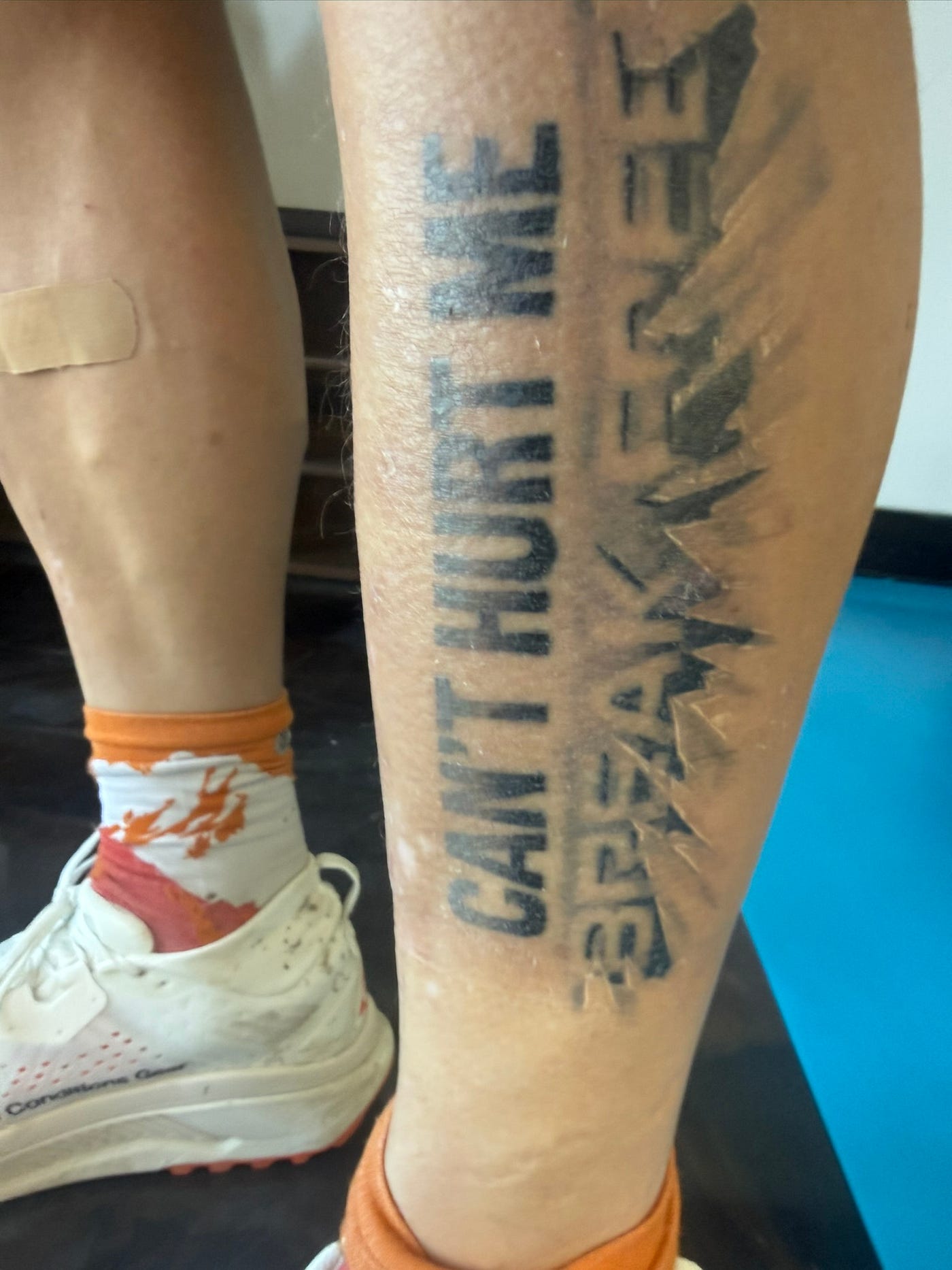
9.72 miles. And I finally broke free.

That’s what the phrase means to me now, and it’s why it’s stitched into everything I build. Break Free was never a victory cry. It’s not about the finish line or the buckle or the crowd. It’s about what you’re running from — the heartache, the hurt, the thing that put you on the trail in the first place. For me it was a cycle I couldn’t see while I was inside it. Discard and reward, punishment and relief, wired into the same circuit until I couldn’t tell them apart and it nearly cost me everything.
The trail is where I finally could tell them apart. Where the machine couldn’t follow. Twelve miles at a time, I got myself back.
That’s why I run ultramarathons. Not to escape what happened — to prove, over and over, mile after mile, that I made it out.
메타데이터
- post_id
- 6da4fabda437
- slug
- the-cycle-6da4fabda437
- url
- https://medium.com/@patrick.n.enger/the-cycle-6da4fabda437
- canonical_url
- https://medium.com/@patrick.n.enger/the-cycle-6da4fabda437
- author_url
- https://medium.com/@patrick.n.enger
- status
- ok
- fetched_at
- 2026-07-08 19:15:55