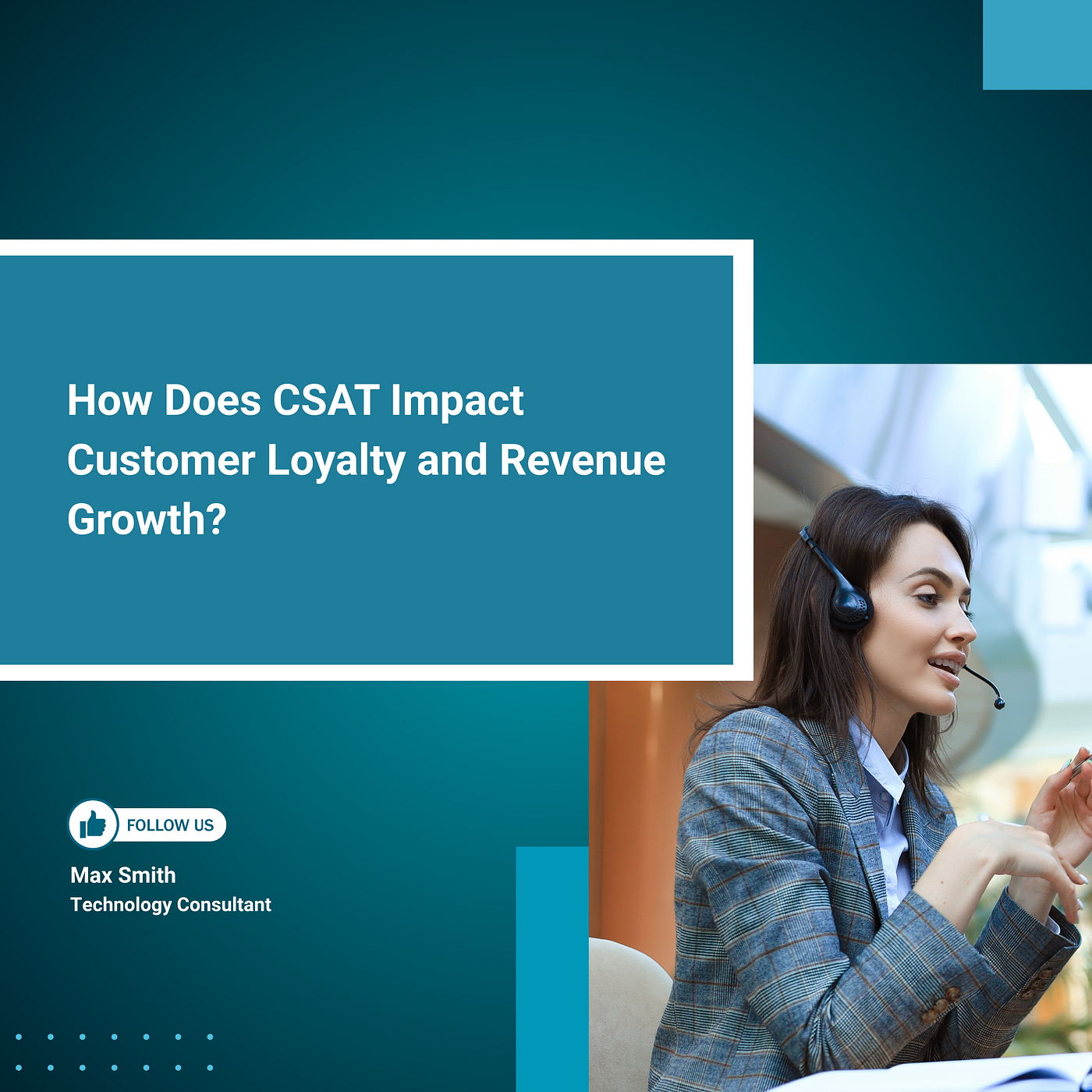
How Does CSAT Impact Customer Loyalty and Revenue Growth?
Customer expectations continue to rise across every industry. Buyers expect quick responses, accurate solutions, and consistent service…
How Does CSAT Impact Customer Loyalty and Revenue Growth?
Customer expectations continue to rise across every industry. Buyers expect quick responses, accurate solutions, and consistent service across every interaction. As a result, organizations are placing greater emphasis on customer experience metrics that directly influence business performance. One of the most important metrics is CSAT (Customer Satisfaction Score).
CSAT helps businesses measure customer satisfaction with a product, service, or support interaction. More importantly, it provides valuable insights into customer behavior, retention, and future purchasing decisions. Organizations that actively monitor and improve customer satisfaction often see stronger, greater retention rates and faster revenue growth.
As businesses increasingly turn to CSAT Analytics, they can transcend the limitations of mere survey scores and unlock deeper insights into customer sentiment, service quality, and business performance.
What is CSAT?
CSAT is a customer experience metric that measures satisfaction with a specific interaction, product, or service. The question customers are usually asked is:
How pleased were you with your experience?
Responses are collected on a rating scale, and the percentage of satisfied customers is the CSAT score.
The formula is simple:
The CSAT Score is calculated as follows: (Number of Satisfied Customers / Total Responses) × 100
A high CSAT score generally indicates positive customer experiences, while lower scores highlight areas that require improvement.
Why CSAT Matters for Modern Businesses
Customer satisfaction has a direct impact on customer retention, brand perception, and long-term profitability.
Bain & Company research indicates that a 5% rise in customer retention can lead to a 25% to 95% rise in profits. Likewise, research indicates that when customers have a positive experience, they are more likely to return and recommend the business to others.
CSAT is used in businesses because it aids:
Measure the quality of customer experience.
- Identify service gaps
- Improve support performance
- Reduce customer churn
- Increase customer loyalty
- Provide support for revenue growth strategies
By regularly tracking customer satisfaction, companies can make informed decisions to enhance their operations and performance.
There is a strong link between CSAT and customer loyalty. Customer satisfaction and customer loyalty are tightly coupled.
Customer loyalty is built through positive, consistent experiences. Repeat customers are more likely to stay loyal if they consistently get value from the company.
The Connection Between CSAT and Customer Loyalty
1. Improves Customer Retention
Happy customers do not have to look elsewhere for alternative solutions. A high CSAT score can indicate that service teams are meeting customer expectations.
Benefits include:
- Lower customer churn
- Longer customer relationships
- Reduced acquisition costs
- Stronger lifetime value
Customer satisfaction is a key metric for customer retention, which can be more cost-effective than acquiring new customers.
2. Builds Trust and Confidence
Trust is a key contributor to the buying decision. When customers are consistently well-informed and receive timely support, they become more confident in the company’s ability to satisfy their needs.
High satisfaction levels contribute to:
- Increased brand trust
- Stronger customer relationships
- Higher engagement rates
- Better customer advocacy
3. Encourages Repeat Purchases
If customers are happy with previous interactions, they are more likely to make repeat purchases.
Repeat customers are known to spend much more than first-time customers, as research from the industry has shown. Recurring revenue can be directly driven by consistent service quality as measured by CSAT.
4. Generates Positive Word-of-Mouth
Happy customers often tell their friends, co-workers, and social media about their positive experiences.
This can lead to:
- Increased referrals
- Improved brand reputation
- Higher conversion rates
- Reduced marketing costs
High CSAT scores can lead to a positive cycle of more business opportunities driven by positive customer experiences.
How CSAT Impacts Revenue Growth
Customer satisfaction is not just a customer experience measure; it’s also a business growth measure.
Businesses that enhance customer satisfaction tend to reap tangible economic rewards.
Better CSAT scores are associated with revenue growth. High CSAT scores are correlated with revenue growth.
1. Higher Customer Lifetime Value
Customer Lifetime Value (CLV) is the total value of a customer’s purchases from a company over time.
If the level of satisfaction is high:
- Customers stay longer
- Customers buy more often.
- Upselling opportunities increase
- Cross-selling becomes easier
The longer people stay, the more they will spend in their lifetimes.
2. Reduced Churn Costs
Losing customers can cost you money. Each lost customer represents lost revenue and additional costs to acquire new customers.
CSAT Analytics enables companies to detect customer dissatisfaction early and implement corrective measures before they turn away.
This preventive measure can help to lower:
- Revenue loss
- Service recovery expenses
- Customer acquisition costs
3. Increased Operational Efficiency
When customers don’t have a great experience, they’ll make contact again, complain, and escalate.
Companies with high CSAT scores typically see:
- Lower call volumes
- Faster issue resolution
- Reduced escalation rates
- Improved workforce productivity
There are ways of improving operations that can directly affect profitability.
4. Better Upsell and Cross-Sell Success
Customers who trust a business are more receptive to additional products and services.
High satisfaction leads to opportunities for:
- Product upgrades
- Service expansion
- Subscription renewals
- Additional purchases
As customers become more confident, so do the revenue opportunities.
The Role of CSAT Analytics in Business Growth
While traditional satisfaction surveys offer valuable feedback, modern businesses need more in-depth insights. This is where CSAT Analytics comes in handy.
CSAT Analytics enables companies to dissect customer feedback, uncover trends, and gain insights into what affects their satisfaction ratings.
The primary advantages of CSAT Analytics are as follows:
Real-Time Customer Insights
Businesses can detect problems before they occur, rather than waiting for quarterly reviews.
Trend Analysis
Businesses can monitor customer sentiment trends and gauge the effect of service enhancements.
Root Cause Identification
By identifying the root causes of customer dissatisfaction, CSAT Analytics allows businesses to make targeted improvements.
Agent Performance Evaluation
Customer feedback can be correlated with support interactions to help managers identify coaching opportunities.
Predictive Decision-Making
By identifying patterns that signal potential churn, businesses can take proactive measures to prevent it.
These features enable customers to provide feedback, which is then converted into business intelligence.
Best Practices for Improving CSAT
Organizations seeking stronger customer loyalty and revenue growth should focus on the following strategies:
- Respond quickly to customer inquiries.
- Reduce customer effort during interactions.
- Train agents regularly.
- Monitor service quality consistently.
- Act on customer feedback promptly.
- Use automation to improve response times.
- Track customer satisfaction across all channels.
- Utilize CSAT Analytics to identify improvement opportunities.
- Measure performance continuously.
- Create a customer-centric service culture.
Consistent improvement efforts help maintain high satisfaction levels while supporting long-term business objectives.
CSAT remains one of the most valuable indicators of customer experience success. High customer satisfaction contributes directly to stronger loyalty, improved retention, increased customer lifetime value, and sustainable revenue growth. Businesses that actively measure and improve satisfaction levels gain a competitive advantage by creating better customer experiences and stronger customer relationships.
Vanie’s CSAT Analytics solution helps organizations transform customer feedback into actionable insights. Through AI-powered analytics, automated quality monitoring, real-time customer sentiment tracking, and intelligent performance recommendations, Vanie enables businesses to identify service gaps, improve customer experiences, reduce churn, and strengthen customer loyalty. By providing a clearer understanding of customer satisfaction drivers, Vanie helps organizations achieve measurable revenue growth while continuously improving overall service performance.
메타데이터
- post_id
- 6dcd688fe7fd
- slug
- how-does-csat-impact-customer-loyalty-and-revenue-growth-6dcd688fe7fd
- url
- https://medium.com/@max.s_33396/how-does-csat-impact-customer-loyalty-and-revenue-growth-6dcd688fe7fd
- canonical_url
- https://medium.com/@max.s_33396/how-does-csat-impact-customer-loyalty-and-revenue-growth-6dcd688fe7fd
- author_url
- https://medium.com/@max.s_33396
- status
- ok
- fetched_at
- 2026-08-01 02:42:01