The Living Archive of Scent: How Ancient Chinese Medicine Engineered Wearable Fragrance
In the mainstream Western tradition, perfume is often treated as an olfactory decoration — a linear pyramid of chemical top, middle, and…
The Living Archive of Scent: How Ancient Chinese Medicine Engineered Wearable Fragrance
In the mainstream Western tradition, perfume is often treated as an olfactory decoration — a linear pyramid of chemical top, middle, and base notes designed purely for external sensory stimulation. However, thousands of years ago in China, the creation of cold-condensed incense (Leng Ning Xiang) was never approached as a simple aesthetic mixture.
It was born directly from the foundational lineage of Traditional Chinese Medicine (TCM), anchored in an absolute truth: fragrance and botanicals share a singular origin (Xiang Yao Tong Yuan). To understand this non-legacy art is to understand that a handcrafted incense amulet or bead is a wearable, solid formulation. It requires no burning or heat; instead, it relies entirely on the wearer’s natural body temperature to gently volatilize its active aromatic molecules.
As these botanical compounds are absorbed through the olfactory pathway, they interact directly with the body’s internal biological systems, mirroring the precise therapeutic logic of an internal herbal decoction. Under the framework of traditional Chinese wellness culture, aromatics are regarded as the “pure essence of vital energy,” capable of harmonizing internal equilibrium and supporting organic vitality.
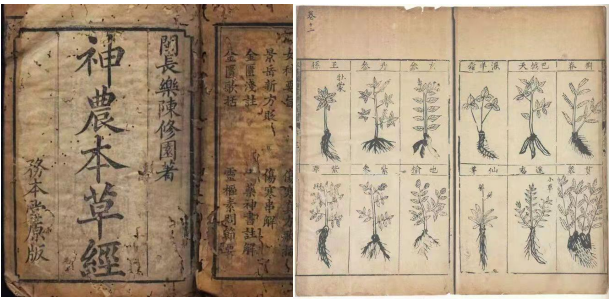
Cultural Provenance: The detailed botanical illustrations represent a pre-modern “Olfactory Pharmacopoeia” — a rigorous, multi-century research effort into the molecular defense systems of plants.
How Does a Fragrance Formula Function? The Ancient “Emperor-Minister” System
The core operational system of this botanical synthesis is an ancient framework known as Jun-Chen-Zuo-Shi (Emperor, Minister, Assistant, Envoy). In true non-legacy crafting, wild herbal ingredients are never selected by their superficial scent profiles alone. Instead, they are meticulously cataloged by their intrinsic medicinal properties: their temperature nature, flavors, and “meridian tropism” — their specific affinity for targeted internal organs and biological path networks.
· The Emperor (Jun): This is the core direction and soul of the formulation, possessing the strongest affinity for the primary meridian system the crafter aims to balance. For example, natural, high-grade agarwood (Chen Xiang) enters the kidney, spleen, and stomach meridians, serving as the Emperor to anchor unstable vital energy and calm the internal biological core.
· The Minister (Chen): These secondary botanicals are chosen to actively amplify and synergize with the Emperor. Ingredients like sandalwood (Tan Xiang) travel along complementary meridian paths — such as the liver and lung networks — to regulate organic balance and add deep, multi-layered resonance to the sensory matrix.
· The Assistant (Zuo): In their raw states, wild herbs often carry harsh, conflicting properties — such as intense “green” astringency or excessive dryness. Ingredients assigned as Assistants function as natural molecular stabilizers, neutralizing the material frictions and inherent sharpness of the primary herbs to ensure the formulation is perfectly rounded and smooth.
· The Envoy (Shi): The Envoy acts as the ultimate conductor and aromatic catalyst. It possesses the unique property of directing the entire botanical matrix toward its designated internal meridians and organs, ensuring that the compound’s essence is distributed target-specifically throughout the biological system.
What is the Archaeological Evidence for Chinese Aromatic Wellness?
This intricate integration of TCM and fragrance is not a contemporary marketing narrative; it is verified by thousands of years of imperial history and modern archaeological discoveries.
The Earliest Physical Proof: The Mawangdui Han Tomb №1 excavation unsealed the earliest physical evidence of Chinese botanical wellness culture. Among the artifacts belonging to Lady Xin Zhui were beautifully embroidered herbal pillows stuffed with Eupatorium (Pei Lan), alongside six delicate fragrance sachets (Xiang Nang) clutched in her hands and archived in storage chests. These ancient amulets were meticulously filled with raw, un-adulterated botanicals including lemongrass (Mao Xiang), Sichuan pepper (Hua Jiao), and magnolia flower (Xin Yi). This empirical discovery confirms that as early as the Han Dynasty, the Chinese aristocracy used precise herbal formulations for personal fragrance, environmental purification, and biological safeguarding.
Sophisticated Multi-Botanical Compounding: The Western Han tomb of the Nanyue King revealed an extraordinary “Four-Connected Bronze Censer.” This unique apparatus features four entirely independent, non-communicating burning chambers designed to burn four distinct botanical resins and herbs simultaneously. Coupled with the discovery of imported frankincense (Ru Xiang) from the Red Sea region within the same tomb, this artifact provides solid proof of early maritime trade and sophisticated compounding methods practiced over 2,000 years ago.
The Pinnacle of Imperial Aromatic Culture: By the time of the Tang Dynasty, imperial aromatic culture reached an apex of technical and structural brilliance, as documented by the historic discoveries at the Famen Temple Underground Palace. The excavation revealed massive ritual mountains of agarwood, sandalwood, clove, and frankincense painted with gold dust, alongside over twenty imperial gold and silver aromatic vessels — the highest status cluster ever discovered in Chinese history. Among them, the iconic “Gilded Silver Sachet with Double Moths and Floral Patterns” showcases an internal gimbal mechanism that perfectly mirrors the principles of the modern gyroscope, ensuring the herbal burning vessel remains perfectly level regardless of movement.
A Living Microcosm of Patience
We do not create rapid commercial consumer goods. We preserve these demanding steps because we believe that the tactile memory of the artisan and the raw honesty of the earth cannot be simulated by modern chemical substitutes.
When you hold an AromaMandala piece, you are not simply holding a fragrance. You are holding a physical archive of patience — a living tradition that has crossed thousands of years of traditional Chinese medicine culture to rest in your palm.
메타데이터
- post_id
- 6dd604af03b1
- slug
- the-living-archive-of-scent-how-ancient-chinese-medicine-engineered-wearable-fragrance-6dd604af03b1
- url
- https://medium.com/@yalanzhangsun/the-living-archive-of-scent-how-ancient-chinese-medicine-engineered-wearable-fragrance-6dd604af03b1
- canonical_url
- https://medium.com/@yalanzhangsun/the-living-archive-of-scent-how-ancient-chinese-medicine-engineered-wearable-fragrance-6dd604af03b1
- author_url
- https://medium.com/@yalanzhangsun
- status
- ok
- fetched_at
- 2026-06-27 08:09:27