My Graves’ Healing Journey
As is the case with many people diagnosed with Graves’ disease, when I got diagnosed with it in 2008 I was in complete shock. I was…
My Graves’ Healing Journey
As is the case with many people diagnosed with Graves’ disease, when I got diagnosed with it in 2008 I was in complete shock. I was initially diagnosed with hyperthyroidism, and then a few months later received the official Graves’ disease diagnosis from an endocrinologist.
Of course, I’m very grateful for the experience I went through. Since getting into remission in 2009 I’ve helped thousands of people with Graves’ disease restore their health through my books, podcast, and one-on-one work.
Even though I didn’t have any experience dealing with Graves’ disease back then, as a chiropractor I had always attended nutrition and functional medicine seminars as part of my continuing education. Thankfully I attended a couple of functional endocrinology seminars prior to my diagnosis.
How I Found Out I Had Hyperthyroidism
Before being diagnosed, I lost a lot of weight and had a voracious appetite, which I initially attributed to dieting. A few months prior to my diagnosis, I weighed 182 lbs., while my normal weight is between 165 and 170 lbs.
I went on a restrictive diet and exercised intensely. I started shedding pounds, but little did I know that some of the weight loss was due to developing hyperthyroidism. Ultimately, I lost 42 pounds and dropped down to 140 lbs.
I didn’t suspect anything was wrong until I was walking around a retail store (Sam’s Club) and noticed an automated blood pressure machine. My blood pressure was normal, but my resting heart rate was 90 bpm.
Over the next few days, my resting heart rate ranged between 90 and 110 bpm. I visited a primary care doctor, who ordered a TSH and free T4, confirming hyperthyroidism. A few months later, an endocrinologist confirmed the diagnosis of Graves’ disease.
My Symptoms
In addition to the weight loss, I also experienced an increased resting pulse rate, heart palpitations, and tremors. Other common symptoms of hyperthyroidism and Graves’ disease include hair loss, anxiety, and insomnia.
Here is a summary of some of the more common symptoms associated with hyperthyroidism:
➤ Increased resting pulse rate
➤ Heart palpitations
➤ Tremors
➤ Increased appetite
➤ Weight loss
➤ Anxiety
➤ Insomnia
➤ Hair loss
➤ Loose stools
Antithyroid Medication vs. Herbs
Those functional endocrinology seminars I attended focused more on hypothyroidism, but they did briefly discuss natural options for hyperthyroidism and Graves’ disease. This is where I first learned about the herbs bugleweed and motherwort as natural symptom management options for hyperthyroidism.
While many of the people I’ve worked with over the years have taken methimazole or PTU, I decided to try an herbal approach. I figured that if the herbs didn’t work, I could always take the medication. Thankfully, both bugleweed and motherwort did a great job of managing my symptoms.
My goal here isn’t to tell you what you should do. It’s to share what I did, what I learned, and what I’ve seen work for many others.
What Graves’ Disease Is (in Plain English)
I assume most people reading this know what Graves’ disease is, so I’m not going to go into great detail here. What’s important to understand is that Graves’ disease is more of an immune system condition than a thyroid condition.
With Graves’ disease, the immune system attacks the TSH receptors of the thyroid, which results in a state of hyperthyroidism. So Graves’ disease is an autoimmune condition, but unfortunately, most endocrinologists don’t do anything to improve the health of the person’s immune system.
This is important because someone with one autoimmune condition is more likely to develop other autoimmune conditions in the future, and this is also true with Graves’ disease. And so while there is a time and place for conventional treatment, ideally you want to address the root cause of the condition whenever possible.
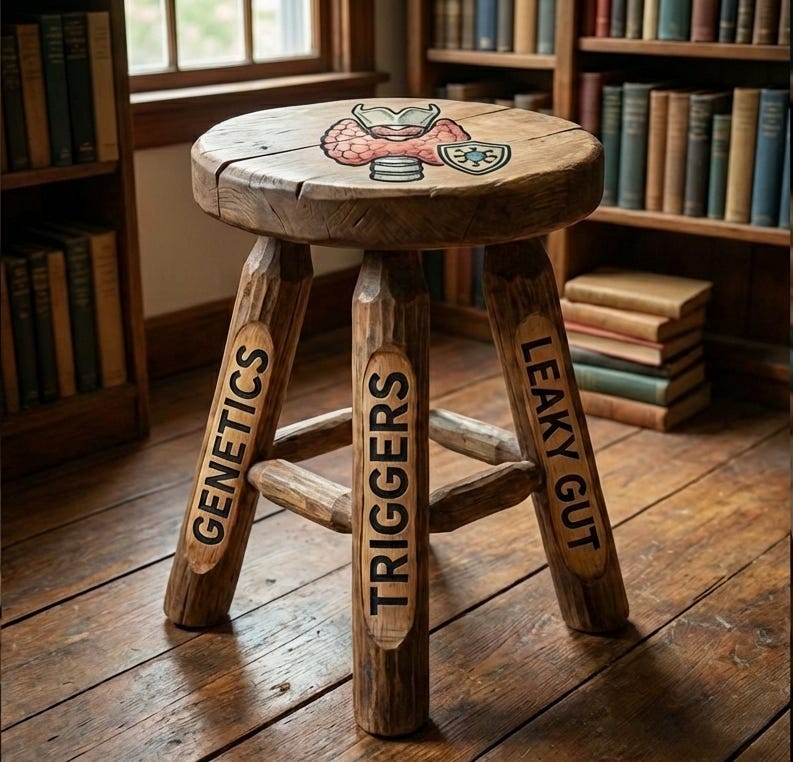
Why does Graves’ disease develop in the first place? This is explained by the “Triad of Autoimmunity,” also known as the three-legged stool:
-
Genetic predisposition
-
Exposure to environmental triggers
-
Increased intestinal permeability (leaky gut)
Not everyone with Graves’ disease has a strong family history. I don’t know anyone in my family who was diagnosed with Graves’, although some people do have a strong genetic link.
3 Treatment Options for Hyperthyroidism
Most endocrinologists will recommend one of three treatment options:
1. Antithyroid medication and/or beta blockers. Methimazole is the most commonly prescribed antithyroid medication, although some people are prescribed propylthiouracil (PTU). Beta blockers such as propranolol are often used to manage symptoms like elevated heart rate and also inhibit the conversion of T4 to T3. Other beta blockers sometimes used include atenolol and metoprolol.
2. Radioactive iodine (RAI). This treatment destroys thyroid cells, and most people who receive RAI eventually require thyroid hormone replacement. Some remain hyperthyroid and need additional treatment. While RAI is often labeled a “cure,” it does nothing to address the autoimmune component of Graves’ disease. And as I mentioned earlier, research clearly shows that having one autoimmune condition increases the risk of developing others.
3. Thyroid surgery. There is a time and place for thyroid surgery, but it should be a last resort. Once the thyroid is removed, lifelong thyroid hormone replacement is required. Like RAI, surgery does nothing to address the autoimmune component.
How I Learned About Natural Solutions
Prior to my diagnosis, I had attended functional endocrinology seminars as part of my continuing education. This exposure helped me understand natural approaches to thyroid and autoimmune conditions — knowledge I would eventually need for my own health.
Because of this background, I already knew I wanted to at least attempt to heal naturally. That said, at the time I didn’t know anyone who had Graves’ disease and reversed it through a natural approach.
When diagnosed, I chose not to take antithyroid medication and instead used the herbs bugleweed and motherwort, which worked extremely well for symptom management.
I’ll discuss natural symptom management options in more detail in future articles. Other options include lemon balm, L-carnitine, and lithium orotate. Most endocrinologists aren’t supportive of these approaches, but there is a time and place for both natural options and medication.
What Diet Did I Follow?
There is no single diet that works perfectly for everyone. Even in my book, ***The Hyperthyroid Healing Diet***, I discuss multiple approaches.
I often recommend the autoimmune Paleo (AIP) diet as an elimination diet, although it’s not a perfect fit for everyone. When I dealt with Graves’ disease, AIP didn’t exist, so I followed a modified Paleo diet.
In my book I discuss modifications of these diets which are referred to as a Level 3 diet (modified AIP), Level 2 diet (modified Paleo), and a Level 1 diet (modified Plant Paradox diet).
Anyway, I later realized that nuts and seeds seemed to stall my recovery. This doesn’t mean they’re problematic for everyone, but it was relevant for me.
Here are a few things I would recommend from a dietary standpoint:
· Focus on whole, healthy foods
· Avoid gluten, dairy, and corn
· Minimize refined foods and sugar
· Consider reading The Hyperthyroid Healing Diet
The Impact of Stress

Stress was a major factor in my Graves’ disease condition. While I knew stress played a role, I overestimated my ability to handle it. Adrenal saliva testing revealed low cortisol, low DHEA, and low secretory IgA — all of which improved over time.
It’s important to mention that it wasn’t just the emotional stressors that were a factor, but I was also overtraining at the time. I should have known better, but I didn’t listen to my body, and I’m certain this was also a factor in my poor adrenal health.
Many of the people I have worked with over the years have felt that chronic stress was a major factor in the development of their Graves’ disease condition. And so you definitely don’t want to overlook this as a potential trigger.
So from a stress management perspective I would recommend the following:
· Don’t underestimate stress
· Block out daily time for stress management
· Prioritize sleep
· Don’t overtrain
· Get your adrenals tested
What Supplements Did I Take?
Most people are interested in nutritional supplements and herbs, and while I’m definitely not shy about taking or recommending them, just keep in mind that 1) taking supplements aren’t a replacement for a healthy diet and lifestyle, and 2) not everyone requires the same supplements.
That said, here are the supplements I took when I dealt with Graves’ disease:
✅ Bugleweed
✅ Motherwort
✅ Probiotic
✅ Digestive enzyme
✅ Omega-3 fatty acid (fish oil)
✅ Selenium
✅ Vitamin D3 and K2
✅ Magnesium
✅ Licorice root
✅ B complex
There are a few other things I took, and it’s important to mention that I took licorice root because I had very low cortisol levels, but if someone has high blood pressure they’ll want to avoid taking this herb. I will definitely have future articles where I discuss supplementation more.
How Long Did It Take Me to Restore My Health?
I hesitate to use the word “cure,” although I feel like I’ve been cured. However, I realize that genetics still matter, and a relapse is always possible. If I relapsed tomorrow, I’d still be grateful for well over a decade of remission.
It took about nine months for my thyroid labs — including antibodies — to normalize, and for me to stop using herbs for symptom management. Many people heal within 6–12 months, although some take longer.
The Thyroid Eye Disease Connection
Many people with Graves’ disease develop thyroid eye disease (TED), also known as Graves’ ophthalmopathy. Common symptoms include eye bulging, swelling, pressure, and sometimes double vision.
Like Graves’ disease itself, TED is an autoimmune condition. In this case, thyroid-stimulating immunoglobulins attack the tissues of the eyes, which is why addressing immune system health is also essential.
I didn’t experience TED symptoms myself, but over the years I’ve worked with many Graves’ patients who have. Some cases are mild, while others are moderate to severe.
I’ll talk more about thyroid eye disease in a future article.
Finding Your Graves’ Disease Triggers
When it comes to healing Graves’ naturally, and even other types of hyperthyroidism (i.e., toxic multinodular goiter, subclinical hyperthyroidism), you want to find and remove your triggers. This is yet another topic I’ll discuss in future articles, but I do want to conclude this article with the following final thoughts:
✔️ It is possible to heal Graves’ disease naturally
✔️ Diet and lifestyle play an important role in this (no matter what your endocrinologist tells you)
✔️ You usually need to do other things to find and remove triggers
✔️ Having a healthy gut is also essential
✔️ While trying to restore your health you want to safely manage your hyperthyroidism
Before You Go…
If you enjoyed this article, click the clap button below… And share it with friends, so they can enjoy it too! I really appreciate you taking the time out of your busy schedule to read this, and I hope you found it to be valuable.
The views in this blog by Dr. Eric Osansky should never be used as a substitute for professional medical advice. Please work with a healthcare practitioner concerning any medical problem or concern. The information here is not intended to diagnose, treat, or prevent any disease or condition. Statements contained here have not been evaluated by the Food and Drug Administration.
*These statements have not been evaluated by the Food and Drug Administration. This product is not intended to diagnose, treat, cure, or prevent any disease.
Learn More About Natural Solutions for Hyperthyroidism and Graves’ Disease
To learn more about natural approaches for hyperthyroidism and Graves’ disease visit www.savemythyroid.com
Dr. Eric Osansky also has a Healing Graves’ Naturally community on the platform Skool. This includes access to a free Graves’ Survival Roadmap Training. To join visit www.savemythyroid.com/HealGravesDisease.
메타데이터
- post_id
- 6dd76d11cf4f
- slug
- my-graves-healing-journey-6dd76d11cf4f
- url
- https://medium.com/@osansky/my-graves-healing-journey-6dd76d11cf4f
- canonical_url
- https://medium.com/@osansky/my-graves-healing-journey-6dd76d11cf4f
- author_url
- https://medium.com/@osansky
- status
- ok
- fetched_at
- 2026-06-27 07:40:21