The Closest Thing We Have to a “Cognitive-Health” Vaccine
How the shingles shot is outperforming every expectation.
The Closest Thing We Have to a “Cognitive-Health” Vaccine
How the shingles shot is outperforming every expectation.

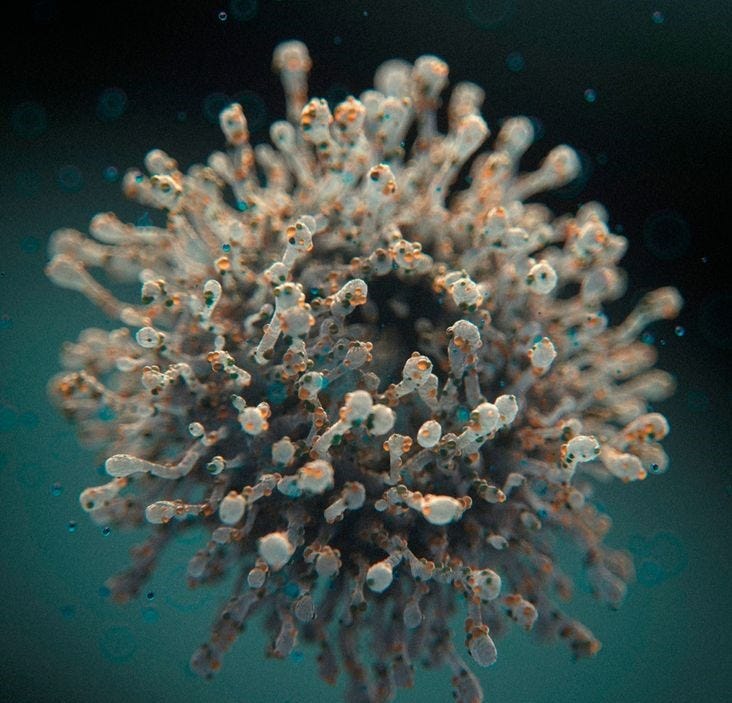
Image adapted from rawpixel.com
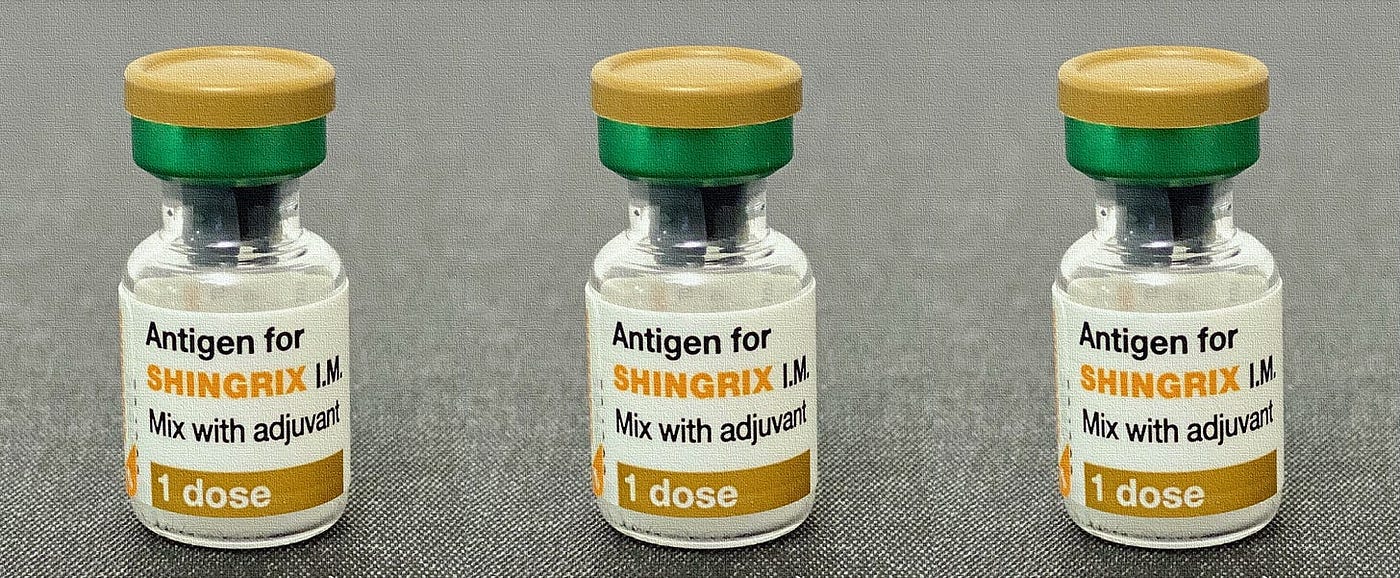
It sounds almost absurd that a vaccine, designed to train the immune system, could also protect the brain. That’s why a new robust study has drawn so much renewed attention: it shows that the shingles vaccine reduces the risk of mild cognitive impairment (MCI) and even benefits those who already have dementia. If this isn’t the closest thing we’ve ever had to a “cognitive-health” vaccine, I don’t know what is.
A Brief Backdrop
Over the past two years, elegant natural-experiment studies from the U.K., Australia, Canada, and the U.S. have transformed our understanding of how shingles vaccines affect brain health. These studies all show that shingles vaccination is causally associated with a lower dementia risk.
(I previously covered these studies in detail here: *Shingles Vaccine Protects Against Dementia, But How Strong is the Effect? and [The Reason Why Shingles Vaccine is Highly Protective Against Dementia](https://theinfectedneuron.substack.com/p/shingles-vaccine-neuroprotection-mechanism)*.)
Natural-experiment studies allow scientists to get as close to “randomization” as possible in the real world. In the U.K. and Australia, for example, eligibility for the shingles vaccine depends on the date of birth. This means that two people born just days apart were treated differently by policy, not by personal choice or health status. This creates a situation that mimics a randomized clinical trial: one group is offered the vaccine, the other isn’t, and everything else between them is nearly the same.
This approach overcomes the biggest problem in observational vaccine studies: the healthy-vaccinee effect, in which healthier, more proactive people are usually the ones who get vaccinated. As a result, these vaccinated individuals often have better outcomes even without the vaccine.
But an important gap remained.
Those studies focused on incident dementia. They did not tell us whether shingles vaccination also influences the earlier stages of decline, such as mild cognitive impairment (MCI), nor whether it continues to matter after dementia has already begun. Could the vaccine modify the disease course? Or does its protective effect end once symptoms appear?
Until now, we simply didn’t know.
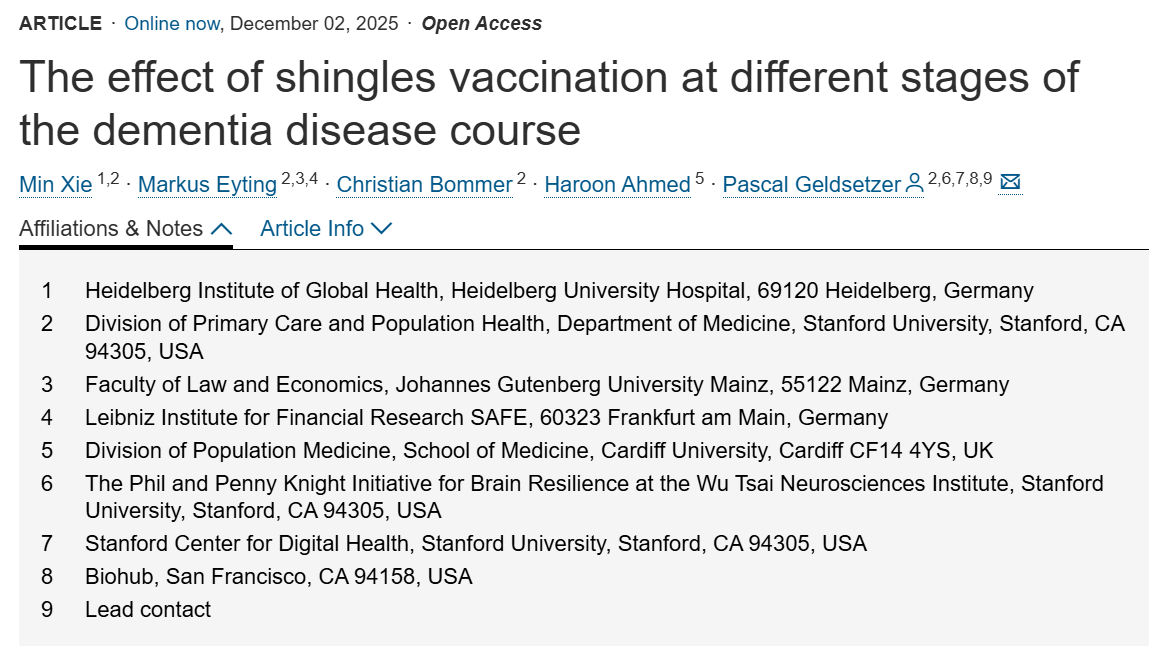
Figure 1. The new fourth natural-experiment study on shingles vaccine and dementia/cognitive function. Source: Xie et al. (2025), Cell.
The New Natural-Experiment Study
That’s why this new study matters. Newly published in Cell, the fourth natural-experiment study was conducted by Xie et al., an international collaboration between scientists from institutions across Germany, the UK, and the USA (Figure 1). Xie et al. (2025) is the first large analysis to examine shingles vaccination across both ends of the cognitive spectrum:
- Does vaccination reduce the risk of MCI, the earliest measurable sign of cognitive decline?
- Do vaccinated individuals with dementia experience fewer hospitalizations and better clinical outcomes?
Xie et al. accessed the Wales’ Secure Anonymised Information Linkage (SAIL) Databank, which contains health records and demographic data for over 300,000 older adults. As Wales implemented the date-of-birth eligibility for the shingles vaccine — where people born on or after 2 September 1933 were eligible, and those born before were not — it created two otherwise similar groups, forming a natural randomization (Figure 2).

Figure 2. People on either side of the vaccine eligibility cutoff were equally healthy before the shingles vaccine program began. They had similar rates of major diseases and similar use of preventive care. This means later differences in cognitive outcomes cannot be explained by pre-existing health differences. Source: Xie et al. (2025), Cell.
First, Xie et al. examined the risk of mild cognitive impairment (MCI).
Among individuals who were cognitively healthy at baseline, about 7% developed MCI during the 9-year follow-up. But those eligible for the shingles vaccine were 1.5 percentage points less likely to develop MCI over the next 9 years than those ineligible. When this effect is translated into the effect of actually receiving the vaccine (not just being eligible), the benefit rose to a 3.1 percentage-point reduction (Figure 3).
This doubling of the effect size makes sense once you consider vaccine uptake. Only about 46% of eligible people actually received the shingles vaccine. That means the initial 1.5-percentage-point reduction was driven by less than half of the eligible group. When you scale the effect to those who were actually vaccinated, the protective impact doubles.
Now, what does 3.1 percentage points mean?
In this cohort, about 7 out of every 100 cognitively healthy older adults went on to develop MCI over the next nine years. The shingles vaccine reduced that risk by about 3 percentage points. In practical terms, that’s roughly 3 fewer cases of MCI for every 100 people vaccinated. If we take 7% as a rough baseline, that’s on the order of a 40–45% relative reduction in early cognitive decline — a very strong effect size for a single adult vaccine.
Importantly, this finding wasn’t fragile. Xie et al. tried to break the result in every way they could: changing the age range around the cutoff, swapping statistical methods, excluding people who rapidly developed dementia, and even restricting the analysis to people who see their doctor often. None of it made the effect disappear. The protective signal held up every time.
In short, the shingles vaccine meaningfully reduced the risk of early cognitive decline. This matters because MCI marks the earliest clinically measurable stage at which cognitive decline becomes apparent. Intervening at this stage can delay or even prevent progression to dementia.
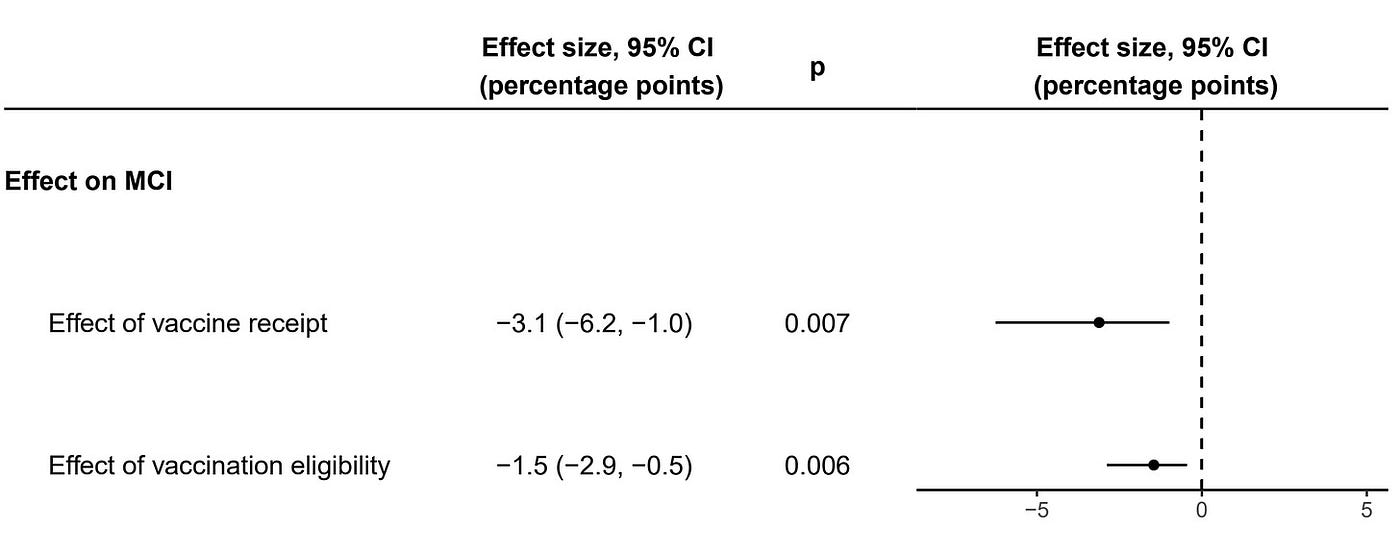
Figure 3. Effect of the shingles vaccine on new diagnoses of mild cognitive impairment (MCI). Receiving the vaccine reduced the risk of developing MCI by 3.1 percentage points, while eligibility alone reduced risk by 1.5 points. Confidence intervals do not cross zero, indicating statistically reliable protective effects. Source: Xie et al. (2025), Cell.
Second, Xie et al. looked at dementia-related deaths among those who already had dementia before the shingles vaccination program began.
Over the next 9 years, about half of them (49%) died with dementia as the main cause of death. But eligibility for the shingles vaccine made a meaningful difference, resulting in an 8.5 percentage-point reduction in dementia deaths over the follow-up period (Figure 4).
When Xie et al. translated this into the effect of actually receiving the vaccine (not just being eligible), the protective benefit became even stronger: nearly a 30-percentage-point reduction in deaths due to dementia. This is because only about 29% of those already living with dementia who are eligible for the shingles vaccine went to get it. As a result, the initial effect size, an 8.5 percentage-point reduction, more than tripled (Figure 4).
In other words, among people whose vaccination status was influenced by the policy cutoff, the chance of dying from dementia dropped from roughly half of patients to closer to one in five — a very strong effect size.
As with the MCI analysis, this result also held up under robustness checks, indicating that the result is real and not due to statistical artifacts.

Figure 4. Effect of the shingles vaccine on deaths due to dementia. Receiving the vaccine reduced the risk of dementia death by 29.5 percentage points, while eligibility alone reduced risk by 8.5 points. The orange lines show the same result using a different statistical method (difference-in-differences), and the estimates point in the same protective direction. Source: Xie et al. (2025), Cell.
Third, Xie et al. asked if the effects are stronger in women.
Similar to previous natural-experiment studies, women benefited more than men. This was true for both outcomes the researchers focused on: preventing new cases of MCI and reducing deaths due to dementia.
Among women with healthy cognition at the start of the study, being eligible for the vaccine lowered their chance of developing MCI by about 2.5 percentage points. For women who actually received the vaccine, the protective effect doubled to about 5 percentage points (Figure 5).
Similarly, for women who already had dementia, vaccine eligibility reduced deaths due to dementia by about 14 percentage points, and actual vaccination reduced it by more than 50 percentage points (Figure 5).
But because this effect is highly impressive (standard dementia drugs don’t even come close to that effect size), it needs to be treated with caution. The 95% confidence interval for this estimate ranges from a 9.2 to 97.9 percentage-point decrease, indicating that the true effect size lies within that range. Put simply, there’s very strong evidence that shingles vaccination reduces dementia-related mortality in women with dementia, but the precise effect size is “large but uncertain.”
Among men, however, none of these effects reached statistical significance. Part of this could be because both shingles and dementia affect women more often than men, or maybe the virus activity is more detrimental in women. Other immune, hormonal, and genetic factors could also be involved, but the current study was not designed to investigate this biological difference.
The reduction in dementia deaths also reduced all-cause mortality by about 6.5 percentage points for eligibility and 23 percentage points for vaccine receipt. We know this reduction in all-cause mortality stems from dementia deaths because the vaccine did not affect deaths not related to dementia. And the reduction in all-cause mortality was again driven by women.
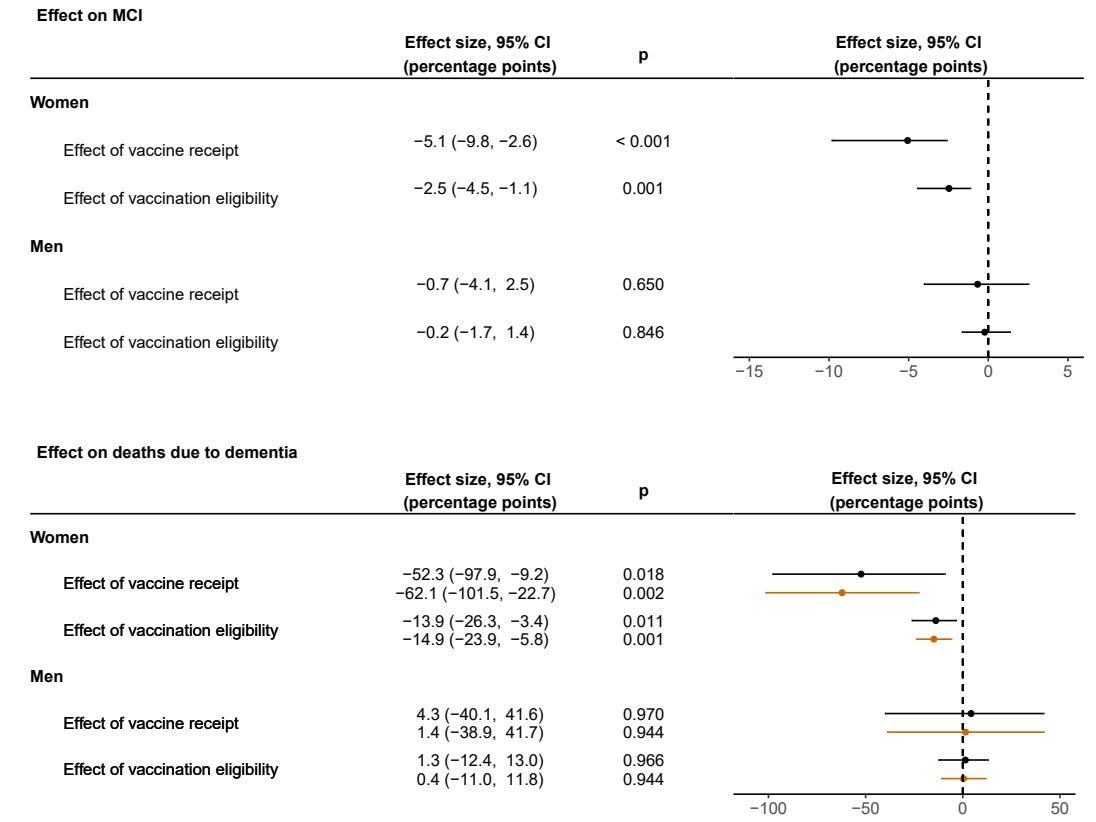
Figure 5. Effect of the shingles vaccine on MCI and dementia deaths, separated by sex. Among women, receiving the shingles vaccine reduced the risk of developing MCI by 5.1 percentage points, and simply being eligible reduced it by 2.5 points. Vaccinated women also had a dramatically lower risk of dying from dementia by 52 percentage points, while eligibility alone reduced risk by about 14 points. These effects were not observed in men. The orange lines show results from a different statistical approach (difference-in-differences), which point in the same protective direction for women. Source: Xie et al. (2025), Cell.
Did something else cause the results?
For this kind of natural experiment to be trustworthy, one key assumption must hold: nothing else important should change at the same birthdate cutoff (September 2, 1933). If another health program used the exact same eligibility rule, it could create the illusion that the shingles vaccine was protective when something else was actually responsible.
To test this, the researchers ran several checks:
- People on either side of the cutoff were equally healthy at the start. They had similar rates of major diseases (e.g., heart disease, stroke, COPD, diabetes, or common cancers) and similar healthcare use (e.g., influenza vaccination, statins, or cancer screening).
- The cutoff didn’t predict cognitive decline before the vaccine existed. When the 9-year analysis window was shifted backward, the birthdate cutoff did not yield differences in MCI incidence or dementia deaths. If the cutoff were somehow selecting healthier or sicker people, differences would have appeared even before the vaccine was introduced.
- The cutoff didn’t affect other diseases or health behaviors during the study. Across nine years of follow-up, the cutoff had no impact on diagnoses of the major causes of disability and death in older adults (aside from dementia) and no effect on health-service use. This rules out the possibility of another intervention driving the results.
So, these tests show that the only meaningful change occurring at the September 2, 1933, cutoff was eligibility for the shingles vaccine. This provides concrete evidence that the lower rates of MCI and dementia-related deaths seen in the study were a result of the vaccine, not a hidden confounder.
The Biological Context
To understand why shingles vaccination can protect cognition, we should begin with the virus the vaccine targets. Varicella-zoster virus (VZV) causes chickenpox in childhood and remains dormant in the nervous system for life. Later in life, as immunity wanes, VZV can reactivate. Sometimes this produces shingles rash, but many reactivations occur subclinically, without any skin symptoms at all. These subclinical flare-ups can still trigger inflammation in nerves, blood vessels, and brain tissue.
Epidemiological studies have consistently shown that repeated VZV reactivations are linked to higher dementia risk. For instance, one of the most extensive longitudinal analyses was conducted by Polisky et al. (2025) — an international collaboration between scientists in Germany, Switzerland, the UK, Canada, and the USA — who reported a series of compelling findings that were recently published in Nature Medicine:
- People who received the shingles vaccine had a lower risk of dementia than those who received the pneumococcal vaccine (used as an active control).
- People who received two doses of the newer recombinant shingles vaccine benefited more than those who received just one dose.
- People who received the older live-attenuated vaccine showed a gradual loss of dementia protection as immunity waned over about ten years. In other words, the strength of dementia protection tracks closely with the strength of VZV suppression.
A previous natural-experiment study by Eyting et al. (2025) supports the same interpretation. Individuals who experienced multiple shingles episodes — a sign of frequent VZV reactivation — had a higher risk of dementia, while those who received antiviral treatment during a shingles episode had a lower risk. Of course, those who were eligible for the shingles vaccine in this study also benefited from a reduced risk of dementia.
These findings agree that the more often VZV reactivates, the more neuronal damage accumulates; the more effectively we suppress it with antivirals or vaccinations, the greater the neuroprotection.
Laboratory studies help explain why. When VZV reactivates, even silently, it can trigger many of the biological changes seen in dementia, including neuroinflammation, blood-vessel injury, and amyloid buildup. VZV can even trigger the reactivation of HSV-1, another herpesvirus involved in dementia, thus amplifying the neurodegenerative cascade.
So, by suppressing VZV reactivation, shingles vaccination can reduce long-term inflammation and neural stress that contribute to cognitive decline and dementia over time. What makes this remarkable is that the benefit appears at both stages of disease: preventing MCI and improving survival in people with dementia (Figure 6). Few interventions touch both.
As Xie et al. concluded, “Our finding that HZ [herpes zoster] vaccination had a beneficial effect on two different dementia-related outcomes in two different patient samples — and at two opposing ends of the disease course of dementia — thus provides promising evidence that HZ vaccination may prevent or slow the dementia disease process in a substantial proportion of individuals.”
While the shingles vaccine is not a cure for dementia, nor a perfect shield, it is the closest thing we currently have to a cognitive-health vaccine.
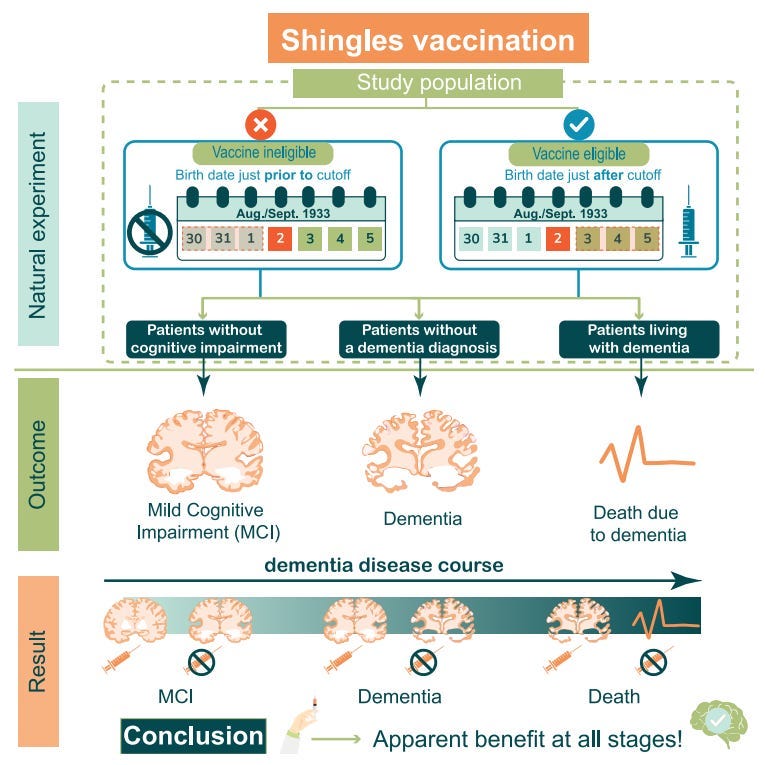
Figure 6. How the shingles vaccine affects the brain across the entire spectrum of dementia. Because eligibility for the vaccine in Wales was determined by date of birth, researchers could compare people born just before and just after the cutoff in a naturally randomized experiment. They then followed three groups: people with healthy cognition, people without a dementia diagnosis, and people with dementia. Across all groups, shingles vaccination was linked to better outcomes — fewer cases of mild cognitive impairment (MCI), fewer dementia diagnoses, and fewer deaths from dementia. Source: Xie et al., Cell.
*Originally published at The Infected Neuron on December 11, 2025.*
If you have made it this far, thank you for reading. Subscribe to my Medium email list here. You can also buy me a coffee here. But I’d appreciate it more if you could subscribe to my Substack, *The Infected Neuron*. :))
메타데이터
- post_id
- 6dead3392dba
- slug
- the-closest-thing-we-have-to-a-cognitive-health-vaccine-6dead3392dba
- url
- https://medium.com/microbial-instincts/the-closest-thing-we-have-to-a-cognitive-health-vaccine-6dead3392dba
- canonical_url
- https://medium.com/microbial-instincts/the-closest-thing-we-have-to-a-cognitive-health-vaccine-6dead3392dba
- author_url
- https://medium.com/@shinjieyong
- status
- ok
- fetched_at
- 2026-06-09 15:37:30