How Would You Integrate a Third-Party Payment API Securely?
Payment integrations are one of the most sensitive parts of a backend application.
How Would You Integrate a Third-Party Payment API Securely?
Payment integrations are one of the most sensitive parts of a backend application.
When integrating a third-party payment provider, the goal isn’t just to make the API call work.
We also need to think about security, reliability, duplicate payments, and verification.
Here’s how I would approach it.
1. Use HTTPS Only
All communication between our application and the payment provider should happen over HTTPS.
This protects sensitive data while it is being transmitted.
Never send payment-related information over an unencrypted connection.
2. Protect API Credentials
API keys, secrets, and credentials should never be hardcoded in the source code.
Instead, store them in environment variables or a secure secrets manager.
import osPAYMENT_API_KEY = os.getenv("PAYMENT_API_KEY")And most importantly:
Never expose secret keys to the frontend.
The frontend should communicate with our backend, and our backend should communicate with the payment provider.
Frontend
   ↓
Our Backend
   ↓
Payment API
3. Validate the Payment Request
Before sending a payment request, validate the data on the backend.
For example:
- Amount
- Currency
- Order ID
- Customer information
- Payment status
Never trust values coming directly from the frontend.
4. Use Idempotency Keys
One of the biggest risks in payment processing is duplicate payments.
Imagine this:
User clicks Pay
      ↓
Payment API processes payment
      ↓
Network timeout
      ↓
Our server doesn't receive response
      ↓
We retry
The payment might already have succeeded.
To safely retry the request, use an idempotency key:
Idempotency-Key: order-12345This allows the payment provider to recognize that the request is a duplicate and avoid processing it twice.
5. Verify Webhook Signatures
Payment providers often send webhooks to notify our backend about events such as:
Payment Successful
Payment Failed
Refund Completed
Payment Cancelled
We shouldn’t blindly trust webhook requests.
The payment provider usually provides a signature that our backend can verify.
Payment Provider
       ↓
     Webhook
       ↓
Verify Signature
       ↓
Process Event
Only after successful verification should we update the payment status.
6. Validate the Payment Response
Never assume that receiving a response means the payment was successful.
Our backend should verify important fields such as:
- Transaction ID
- Payment status
- Amount
- Currency
- Order ID
The amount received from the payment provider should also match the amount expected by our system.
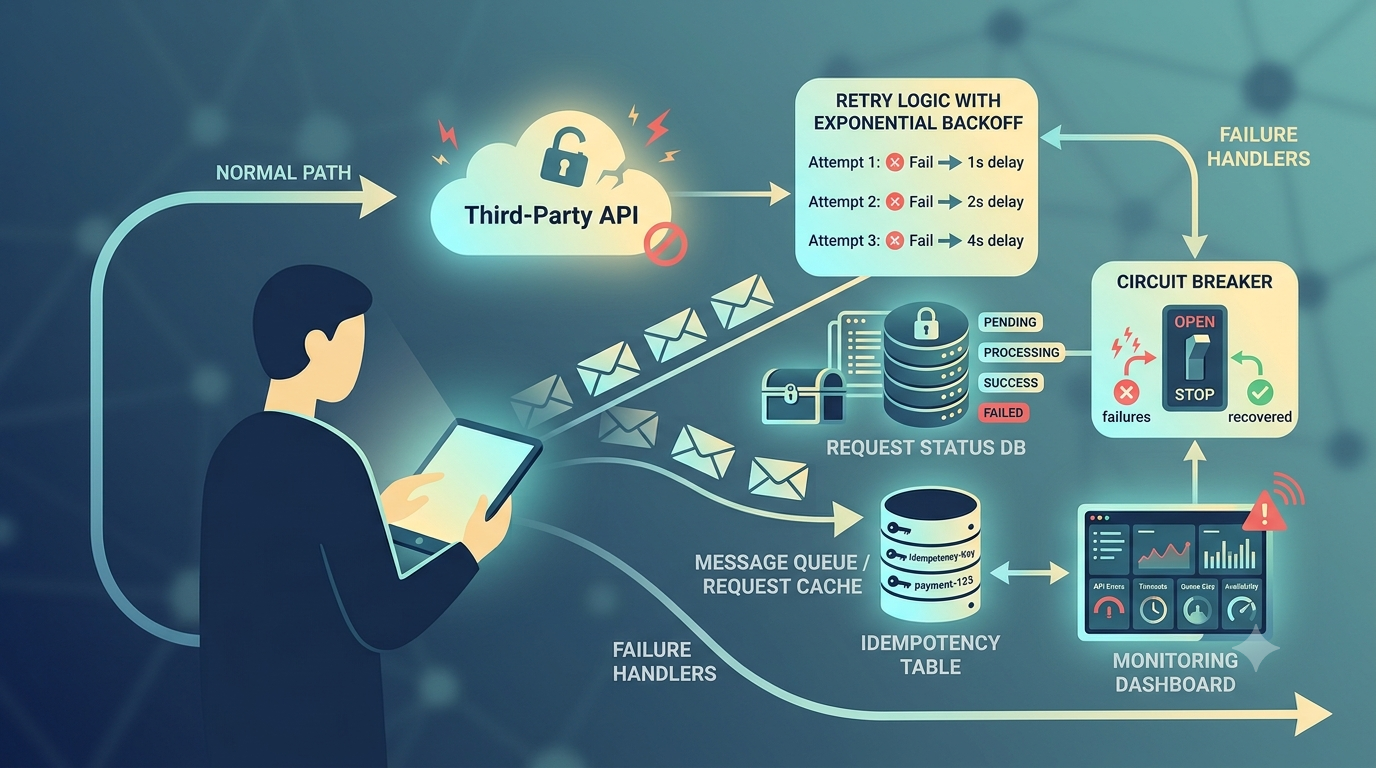
7. Handle Network Failures
Third-party services can experience:
- Timeouts
- Network failures
- Temporary downtime
- Rate limits
So we should use:
Timeouts + limited retries + exponential backoff
But retries must be implemented carefully, especially for payment operations.
We should never blindly retry a payment request without considering idempotency.
8. Log Payment Events Safely
Logging is important for debugging and auditing.
We can log events such as:
Payment initiated
Payment processing
Payment successful
Payment failed
Refund initiated
Refund completed
But we should never log sensitive payment information or secret credentials.
Logs should contain useful identifiers such as transaction IDs or order IDs instead.
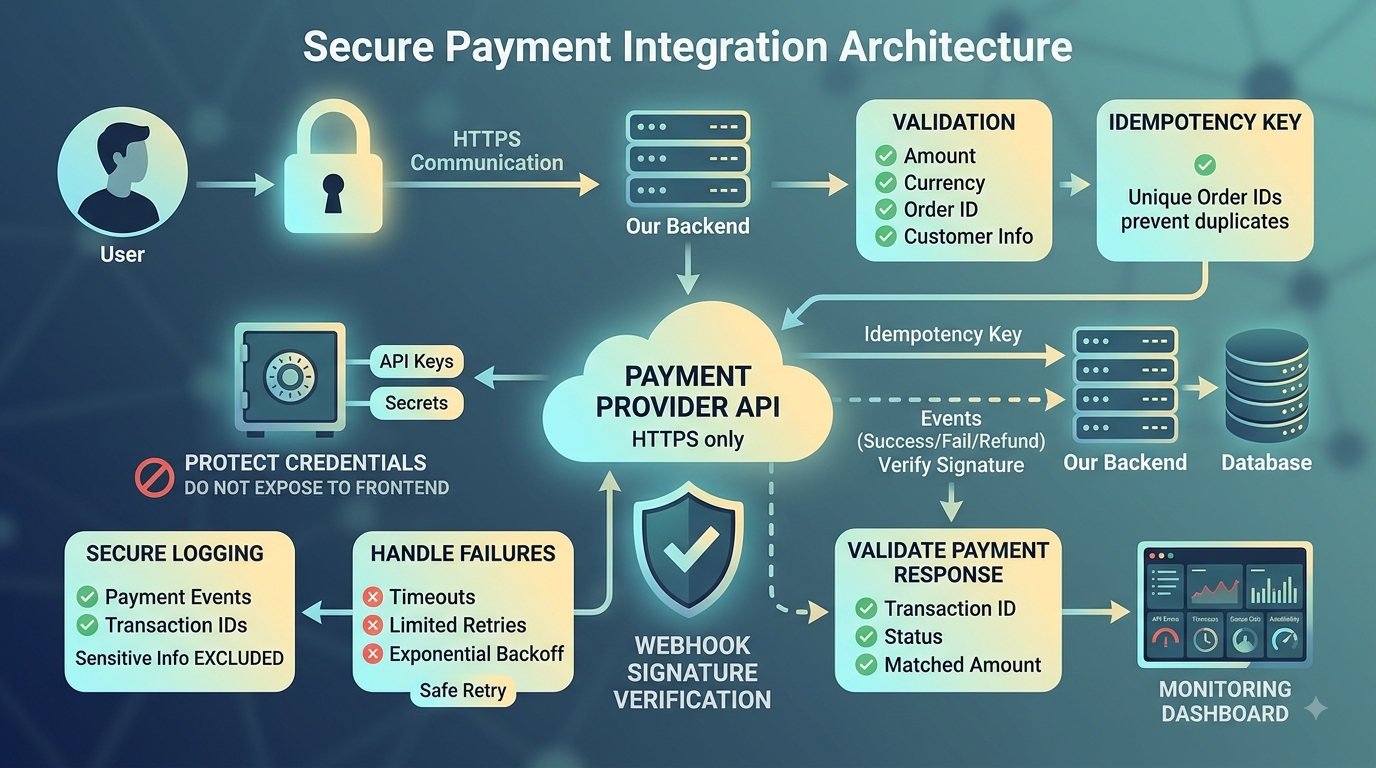
A Simple Architecture
A basic payment flow could look like this:
User
                ↓
            Frontend
                ↓
           Our Backend
                ↓
        Create Payment
                ↓
        Payment Provider
                ↓
            Webhook
                ↓
       Verify Signature
                ↓
       Update Payment Status
                ↓
            Database
This keeps the payment logic and secrets on the backend while giving us a reliable way to track the final payment status.
What I Would Focus On
When integrating a third-party payment API, my checklist would be:
✅ HTTPS only ✅ Secure API key management ✅ Never expose secrets to the frontend ✅ Backend-side validation ✅ Idempotency for payment requests ✅ Webhook signature verification ✅ Payment response validation ✅ Safe retry handling ✅ Proper payment status tracking ✅ Secure logging and monitoring
Conclusion
Payment integration isn’t simply about calling a payment API and checking whether it returned 200 OK.
It requires security, validation, reliability, and careful handling of failures.
The most important thing is to design the integration so that a network failure, duplicate request, or malicious webhook doesn’t result in an incorrect payment state or duplicate charge.
When dealing with payments, correctness and security should always come before convenience.
Happy Coding :)
메타데이터
- post_id
- 6e1f6ab9c8b8
- slug
- how-would-you-integrate-a-third-party-payment-api-securely-6e1f6ab9c8b8
- url
- https://medium.com/@gokulapriyan/how-would-you-integrate-a-third-party-payment-api-securely-6e1f6ab9c8b8
- canonical_url
- https://medium.com/@gokulapriyan/how-would-you-integrate-a-third-party-payment-api-securely-6e1f6ab9c8b8
- author_url
- https://medium.com/@gokulapriyan
- status
- ok
- fetched_at
- 2026-08-12 19:25:39