Java var (Local-Variable Type Inference)
For when you’re too lazy to write String but still want to pretend you’re working hard!
Java var
For when you’re too lazy to write
Stringbut still want to pretend you’re working hard!
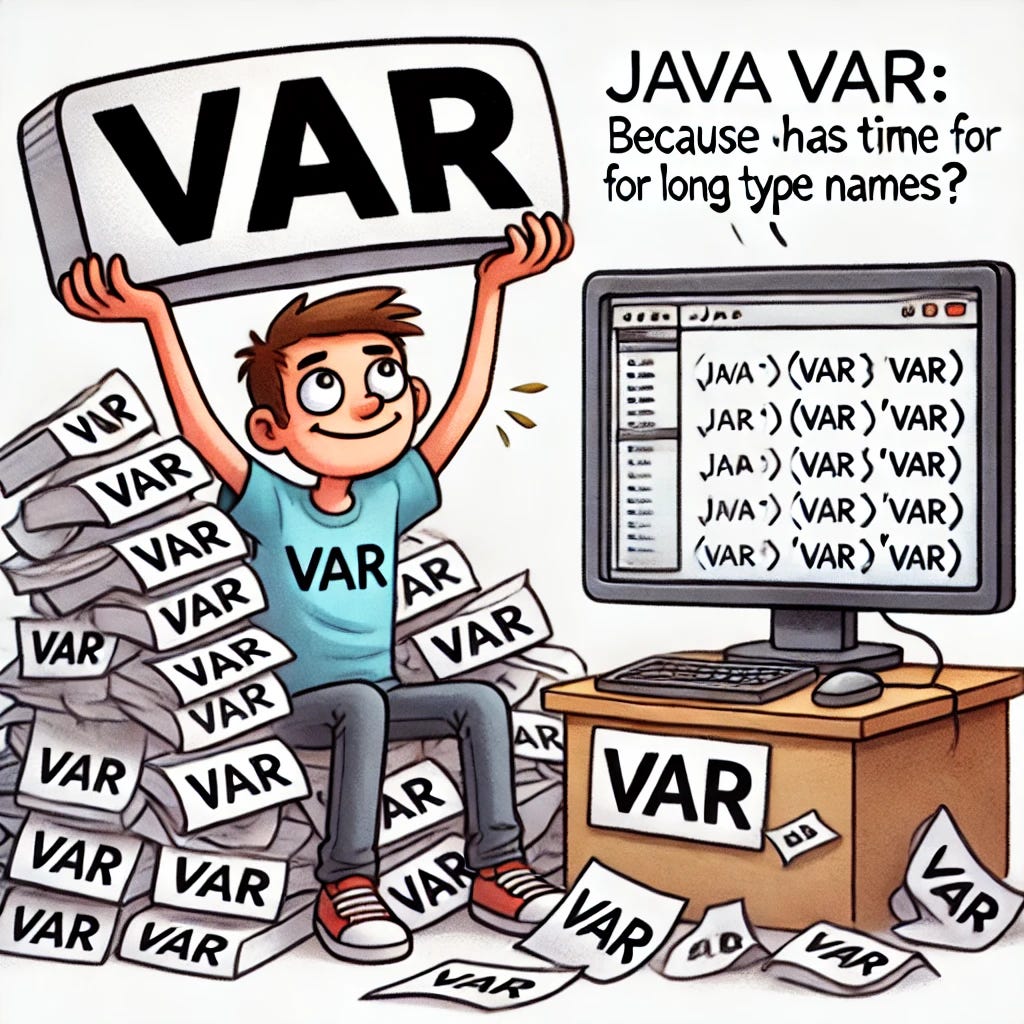
In Java, the var (Local-Variable Type Inference) is like having Java figure out the type of a variable for you, so you don’t have to write it yourself. It’s a shortcut for declaring variables without explicitly specifying their type.
Imagine going to a pizza place, and instead of telling the cashier what type of pizza you want (like cheese, pepperoni, etc.), you just say, “Give me whatever fits best,” and the cashier figures out the pizza type based on what you meant. That’s var!
How It Works:
- Before
var: You had to be specific about what type of value a variable would hold, like this:
String message = "Hello!";
int number = 10;- With
var: Java will guess the type of the variable based on the value you assign to it:
var message = "Hello!";  // Java knows it's a String
var number = 10;         // Java knows it's an int
The key thing is, Java is still strongly typed. It knows exactly what type the variable is; you just don’t need to explicitly write it. It’s not dynamic typing like in JavaScript — it just saves you from typing long type names.
Example of var:
Here’s a before-and-after example:
Without var (Old School):
String name = "John";
int age = 30;
Map<String, Integer> myMap = new HashMap<>();
With var (Modern Java):
var name = "John";               // Java knows it's a String
var age = 30;                    // Java knows it's an int
var myMap = new HashMap<String, Integer>(); // Java knows it's a Map<String, Integer>
In this example:
var namebecomes aString.var agebecomes anint.var myMapbecomes aMap<String, Integer>.
When to Use var:
- When the type is obvious: If it’s clear from the context what the type is (like
var name = "John";), usevar. - Avoid for complex types: If the type is too complicated and hard to understand without explicitly declaring it, you might want to skip
var.
If you found this blog helpful, please give it a clap 👏 and follow 🔔 for more insights and updates! Your support keeps the knowledge flowing!
메타데이터
- post_id
- 6e2233d29be3
- slug
- java-var-6e2233d29be3
- url
- https://blog.devgenius.io/java-var-6e2233d29be3
- canonical_url
- https://blog.devgenius.io/java-var-6e2233d29be3
- author_url
- https://medium.com/@mbusinesssolutions
- status
- ok
- fetched_at
- 2026-07-22 19:30:19