Why Did Buddhist Temples and Shinto Shrines Protect Christians Despite the Prohibition Edicts?
Mysterious Japan Part 3
Why Did Buddhist Temples and Shinto Shrines Protect Christians Despite the Prohibition Edicts?
Mysterious Japan Part 3
Following Toyotomi Hideyoshi’s Edict Expelling Missionaries (1587)1 and the Tokugawa shogunate’s prohibition edicts against Christianity (1612)2, persecution of Christians intensified, and even those who sheltered them were subject to severe crackdowns. And yet there are many documented cases in which Buddhist temples, Shinto shrines, and entire village communities protected hidden Christians3.
Despite the harsh persecution, why did villages, temples, and shrines choose to protect hidden Christians?
Behind the willingness of religious institutions to defy the prohibition edicts — cooperating with or quietly tolerating the presence of hidden Christians — lay an extremely pragmatic survival strategy centered on “maintaining the local community,” as well as a distinctive feature of Japanese society at the time: an ambiguous coexistence among religions.
The main reasons are as follows.
1. Collective Responsibility to Prevent the Collapse of Village Society
Villages in the Edo period operated under a system called murauke-sei4, in which the village as a whole was collectively responsible for matters such as paying the annual rice tax. This bound villagers together through strong mutual responsibility. If Christians within a village were exposed and punished, the village organization itself could collapse entirely — a matter of life and death even for non-Christians. For this reason, even though a system existed that offered a substantial reward (equivalent to roughly 35 million yen in today’s money5) for informing on Christians, in communities such as Sakitsu in Amakusa, not a single Buddhist or Shinto neighbor turned in their hidden Christian neighbors. Believers and non-believers alike prioritized their shared identity as “fellow villagers” over religious difference, protecting one another’s lives and livelihoods.
2. “Tacit Tolerance” by Temples and Officials Who Prioritized Governance and Stability
For temple priests and local officials as well, exposing Christians was not necessarily desirable.
The temples’ position: As long as hidden Christians outwardly fulfilled their duties as temple parishioners and behaved as good citizens, priests sometimes chose not to press the matter, even when they suspected the truth.
The rulers’ position: For the shogunate and local lords, forcibly exposing farmers who were otherwise obedient and exemplary members of the secular order risked destabilizing local order rather than reinforcing it. During the 1805 “Amakusa Crackdown,” a total of 5,205 people across the four villages of Ōe, Sakitsu, Imatomi, and Takahama were suspected of being Christian, with the proportion of believers reaching an estimated 50–70 percent in some villages6, yet the local magistrate’s office declined to punish them, instead classifying the matter as a mere “misunderstanding” (kokoroe-chigai). This can be read as a sign that officials sought to avoid responsibility and quietly close the matter in order to preserve order.
3. Japan’s Distinctive “Religious Ambiguity” and Coexistence
For people of the time, belonging to more than one religious tradition at once was nothing unusual.
Overlapping religious affiliations: Many people participated in the rites of their family temple while also worshipping at the village shrine and relying on prayers and divination — holding multiple religious affiliations simultaneously. Hidden Christians, too, blended into their communities by outwardly becoming temple parishioners or shrine members while appearing to practice the local faith.
Facilities used as camouflage: Karematsu Shrine (a so-called “Christian shrine”) in Sotome, Nagasaki, for example, is a site where hidden Christians used the outward form of a Shinto shrine as cover to enshrine and pray to a missionary. Such sites served simultaneously as a means of concealing one’s Christian faith and as a distinctive form of coexistence that emerged amid the blurred boundaries between religions.
4. “Dual Rites” at Funerals
Under the temple registration system (tera-uke-seido), hidden Christians were required to hold Buddhist funerals; refusing to do so risked exposure, so they had little choice but to cooperate with — or make use of — Buddhist temples. After the priest’s sutra recitation had ended, or in a separate room, they would perform a distinctive rite known as kyōkeshi (“nullifying the sutra”), intended to cancel out the effect of the Buddhist scripture, before secretly conducting a Christian funeral rite of their own. In this way they preserved their faith.
In this sense, the cooperation of religious institutions and neighboring residents was not simply an act of compassion. It reflected the wisdom and social structures of the time, developed to allow people to survive side by side with those who were different from themselves.
Major Shrines and Temples That Protected Hidden Christians
Shrines (5 Selected Sites)
1. Sakitsu Suwa Shrine (Amakusa City, Kumamoto Prefecture)
Hidden Christians here outwardly became parishioners of the shrine, secretly reciting orasho (prayers) within its grounds. During the 1805 “Amakusa Crackdown,” the shrine was designated as the place where confiscated devotional objects had to be surrendered, but the villagers were spared punishment and treated as having simply “misunderstood.”
2. Karematsu Shrine (Sotome, Kurosaki, Nagasaki Prefecture)
The best-known example of a “Christian shrine,” disguised in the outward form of a Shinto shrine during the prohibition era to enshrine the missionary known as San Giwan (missionary from Portuguese) To this day, Catholics, descendants of hidden Christians, and Buddhists jointly hold a festival here.
3. Yamagami Shrine (Kirikoshi, Goto Islands, Nagasaki Prefecture)
A shrine used by hidden Christians as a form of cover. A distinctive custom survives to this day in which a Christian blessing is offered in advance over the ceremonial food presented to the Shinto priest during festivals.
4. Okinokamishima Shrine (Nozaki Island, Ojika, Nagasaki Prefecture)
Because the entire island was considered sacred ground in Shinto tradition, hidden Christians reasoned that becoming shrine parishioners would make them less likely to be suspected, and settled there accordingly. They maintained their community while outwardly serving as shrine parishioners and even participating in Shinto rites.
5. Kojo Shrine (Iki-tsuki Island, Nagasaki Prefecture)
Cited as one of the places where hidden Christians borrowed the name “shrine” to conduct their own distinctive rites.
Buddhist Temples (5 Selected Sites)
1. Fuoken (Sakitsu, Amakusa City, Kumamoto Prefecture)
A Sōtō Zen temple where hidden Christians outwardly became parishioners. Today it issues a commemorative goshuin (temple seal) stamp together with Sakitsu Church and Sakitsu Shrine, symbolizing the “harmony of three religions.”
2. Tenpukuji (Kashiyama, Sotome, Nagasaki Prefecture)
A Sōtō Zen temple where hidden Christians in the Kurosaki district became nominal parishioners (known locally as the “temple-affiliated faction”). When Karematsu Shrine was rebuilt in 2002, the temple’s chief priest cooperated by purifying the land with rice and salt and by allowing Christian remains to be interred in the temple’s ossuary.
3. Eirinji (Okuura, Goto Islands, Nagasaki Prefecture)
Home to a statue known as the “Maria Kannon,” said to be made of white porcelain. One of the temples entrusted, through the temple registration system, with overseeing and protecting hidden Christians when the Gotō domain accepted them as settlers.
4. Shōgakuji (Amakusa City, Kumamoto Prefecture)
Associated with a cluster of Christian gravestones that testify to the history of hidden Christians, and mentioned as part of the region’s religious heritage.
5. Danna-dera (family temples) in general
Beyond any single temple, priests at family temples throughout the region generally chose not to press the issue as long as hidden Christians outwardly fulfilled their duties as parishioners — even when they suspected the truth — prioritizing the stability of the local community.
Among these shrines and temples, Karematsu Shrine stands out as a particularly emblematic case, since it continues to this day to host a joint festival involving multiple faith traditions. Let us look more closely at the background of this practice.
A Joint Buddhist–Shinto–Catholic Festival at Karematsu Shrine in Kurosaki, Sotome, Nagasaki

Photo: https://www.visionservice.io/blog/karematsu-shrine-a-hidden-christian-sanctuary-in-nagasaki
Karematsu Shrine https://sustainable.nagasaki-visit.or.jp/en/spots/94
At Karematsu Shrine in the Kurosaki district of Sotome, Nagasaki Prefecture, Buddhists, the descendants of hidden Christians who maintained their faith as shrine parishioners, and Catholics jointly hold a festival each year. The reasons behind this go far beyond a simple religious observance, resting instead on “harmony within the local community” and “respect for a shared history.”
The main reasons are as follows.
1. Gratitude and Remembrance for a Shared Leader and Ancestors
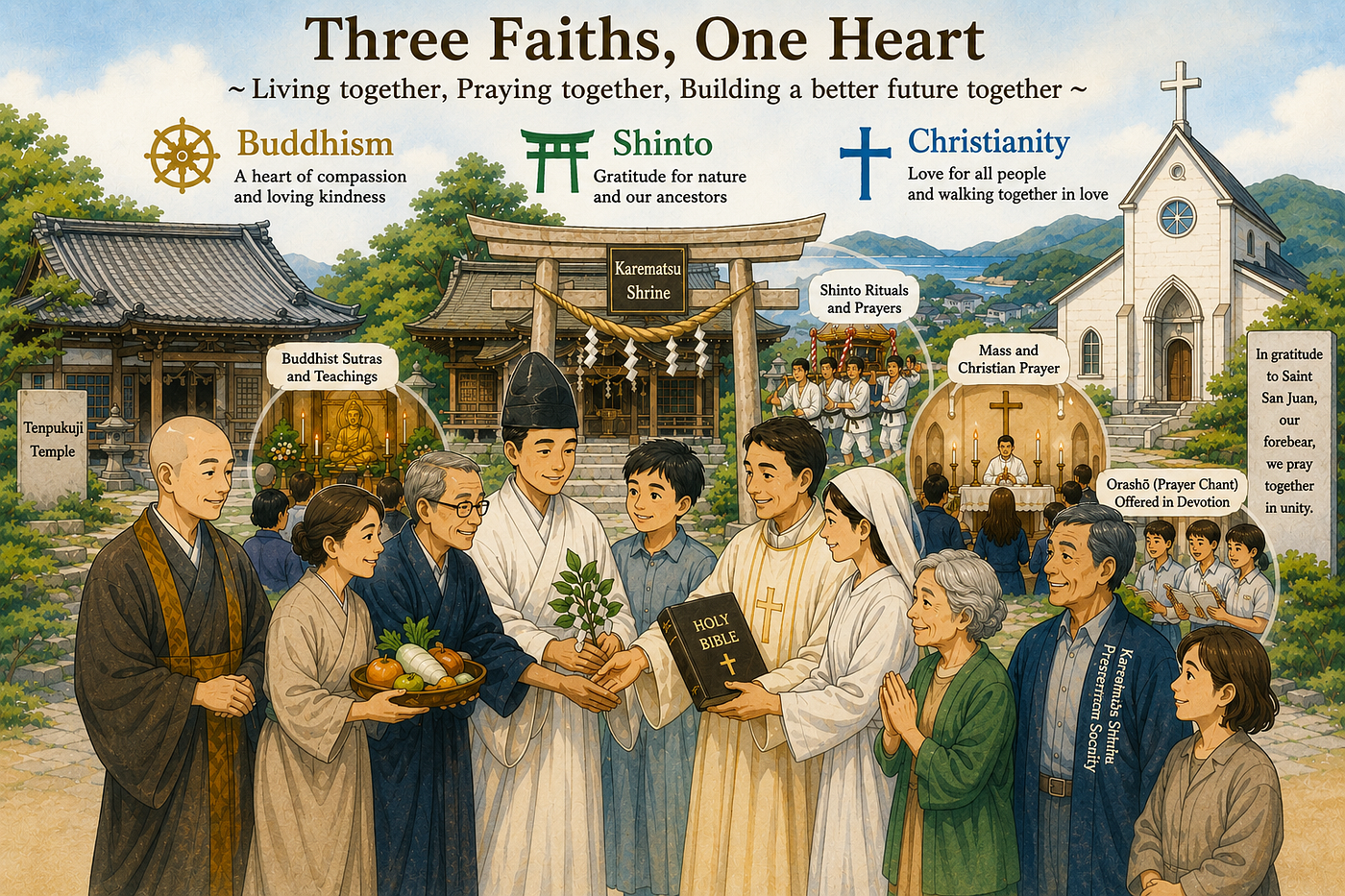
Karematsu Shrine is a “Christian shrine” dedicated to the missionary known as San Giwan (missionary from Portuguese), who guided hidden Christians in this area during the era of prohibition. Though their faiths differ, the participants in all three traditions come together to offer prayers of gratitude and remembrance for San Giwan, the shared leader who upheld the faith through harsh persecution, and for their own ancestors, who risked their lives to pass that faith down.
2. Resolving Emotional Conflicts That Persisted Since the Meiji Era
In the Sotome region, after the ban on Christianity was lifted in the Meiji era, long-standing tension and emotional friction persisted among three groups: those who returned to the Catholic Church, those who continued the distinctive faith practices handed down from the era of hidden Christianity, and those who remained affiliated with the Buddhist temple (Tenpukuji) that had served as their nominal parish during the period of prohibition. Disputes such as the Nonaka incident, centered on ownership of sacred images, reflected this friction. The direct catalyst for the joint festival came in the Jubilee Year of 2000, when the priest of the Catholic church in Kurosaki called for the various “separated brethren” to reconcile and unite, declaring that during the era of hidden Christianity, “all had once been companions guided together by San Giwan.”
3. Preserving and Maintaining a Local Heritage Site
Another major factor was the deteriorating condition of Karematsu Shrine’s main hall, built in 1938, which faced the risk of collapse. Since no single individual or organization could maintain it alone, the three groups came together to form the “Association to Protect Karematsu Shrine” and jointly raised funds to rebuild the shrine hall. Today the shrine serves as a spiritual anchor for the local community and is cherished as a cultural property of Nagasaki City.
4. A Symbol of Coexistence and Peace Beyond Religion
This festival is regarded as a symbolic event, reflecting deep reflection on the history of Christian persecution while working toward a society in which different religions can understand and coexist with one another. Through the shared meal that follows the ceremony, the festival also aims to strengthen bonds among local residents and to contribute to the peace and development of the region.
At the festival held at Karematsu Shrine, a Catholic Mass, an offering of orasho prayers by those carrying on the traditions of hidden Christianity, and an offering of food by Buddhists from the Association to Protect the shrine are all performed together as one, making it a rare example of religious harmony.
This reconciliatory festival, shared among three traditions, may reflect one facet of a Japanese communal culture that places great value on “wa” (harmony) and seeks to avoid conflict. That said, the wisdom of allowing different faiths to coexist within the same community is by no means unique to Japan; it can be found in cultures around the world. Still, the tendency to avoid foregrounding an exclusive devotion to “the one true God” and instead to prioritize communal harmony above questions of religious correctness can be seen as one characteristic feature of the Japanese religious sensibility.
Notes
-
The Edict Expelling Missionaries was issued by Toyotomi Hideyoshi on the 19th day of the 6th month of Tenshō 15 (July 24, 1587) at Hakozaki in Chikuzen Province (present-day Higashi Ward, Fukuoka City), ordering missionaries to leave the country and regulating trade with the Nanban (Iberian) merchants. (Sources: “Bateren Tsuihōrei,” Nihon Daihyakka Zensho and Sekai Daihyakka Jiten, via JapanKnowledge; Wikipedia)
-
The Tokugawa shogunate’s prohibition of Christianity began in Keichō 17 (1612) with an edict applying to the shogunate’s own directly held territories (tenryō). This was followed in Keichō 18–19 (1613–14) by a nationwide edict drafted by the monk Ishō Sūden and issued in the name of Shogun Tokugawa Hidetada, which became the shogunate’s basic law on the suppression of Christianity throughout the Edo period. (Sources: Kotobank, “Baterenoi Tsuihōbun”; Nihon Daihyakka Zensho)
-
“Hidden Christians” (senpuku kirishitan) refers to those who, during the era of prohibition (from the late 16th century until the ban was lifted in 1873), outwardly presented themselves as Buddhist or Shinto believers while secretly continuing to practice Christianity. Those who, after the ban was lifted, did not return to the Catholic Church but instead continued their distinctive syncretic practices are referred to in scholarship as kakure kirishitan (a related but distinct term, often also translated as “hidden Christians”); the two groups are treated as scholarly distinct categories. This essay uses “hidden Christians” (senpuku kirishitan) as its standard term throughout.
-
Murauke-sei was a system in the Edo period under which responsibility for matters such as paying the annual rice tax and maintaining public order was collectively assigned to the village as a whole.
-
Records indicate that the reward for informing on a missionary was 500 silver coins (gin). Using conventional conversions of the time (1 silver coin ≈ 43 monme; 1 gold ryō ≈ 60 monme of silver; 1 gold ryō ≈ 100,000 yen today), this comes to more than 35 million yen. Currency conversions from the Edo period vary depending on the method used, so this figure should be understood as an approximation. (Source: Gifu Prefectural Historical Archives, commentary on “Kirishitan Kinrei”)
-
In the 1805 (Bunka 2) “Amakusa Crackdown,” a total of 5,205 people across the four villages of Ōe, Sakitsu, Imatomi, and Takahama were suspected of being Christian. The proportion of believers is estimated at roughly 50–70 percent in Ōe, Sakitsu, and Imatomi, and confined to a single hamlet in Takahama. To avoid escalating the matter, the shogunate did not punish those implicated, instead requiring only that they step on a Christian image (fumi-e) and pledge loyalty, treating the affair as a mere “misunderstanding.” (Sources: Wikipedia, “Amakusa Kuzure”; Weblio Dictionary)
Note: The specific rites and histories described for Yamagami Shrine, Okinokamishima Shrine, Kojo Shrine, Eirinji, and Shōgakuji have not been verified against primary sources.
메타데이터
- post_id
- 6e2bcfc61b2d
- slug
- why-did-buddhist-temples-and-shinto-shrines-protect-christians-despite-the-prohibition-edicts-6e2bcfc61b2d
- url
- https://medium.com/@nekosakura7/why-did-buddhist-temples-and-shinto-shrines-protect-christians-despite-the-prohibition-edicts-6e2bcfc61b2d
- canonical_url
- https://medium.com/@nekosakura7/why-did-buddhist-temples-and-shinto-shrines-protect-christians-despite-the-prohibition-edicts-6e2bcfc61b2d
- author_url
- https://medium.com/@nekosakura7
- status
- ok
- fetched_at
- 2026-07-19 07:50:39