The Torn Wall
In this dream, I was picked up in an old brown panel van, the kind that seemed left over from another decade. It was battered but still…
The Torn Wall
In this dream, I was picked up in an old brown panel van, the kind that seemed left over from another decade. It was battered but still running, carrying me toward a house I did not recognize. I was not driving. I did not choose the route. I was simply being transported inside a vehicle that looked functional enough to continue moving, though not sound enough to inspire trust.
Outside the house stood a woman with two younger people. She introduced them as her son and daughter, but the introduction felt less personal than categorical. Their identities were presented before their characters could emerge.
The son had an ambiguous appearance. He was visibly male, yet strongly feminine, almost as though he occupied several classifications at once. The dream did not present this as threatening or improper. His ambiguity seemed symbolic: he belonged to no clear category. He appeared to hold a role that could not be immediately defined.
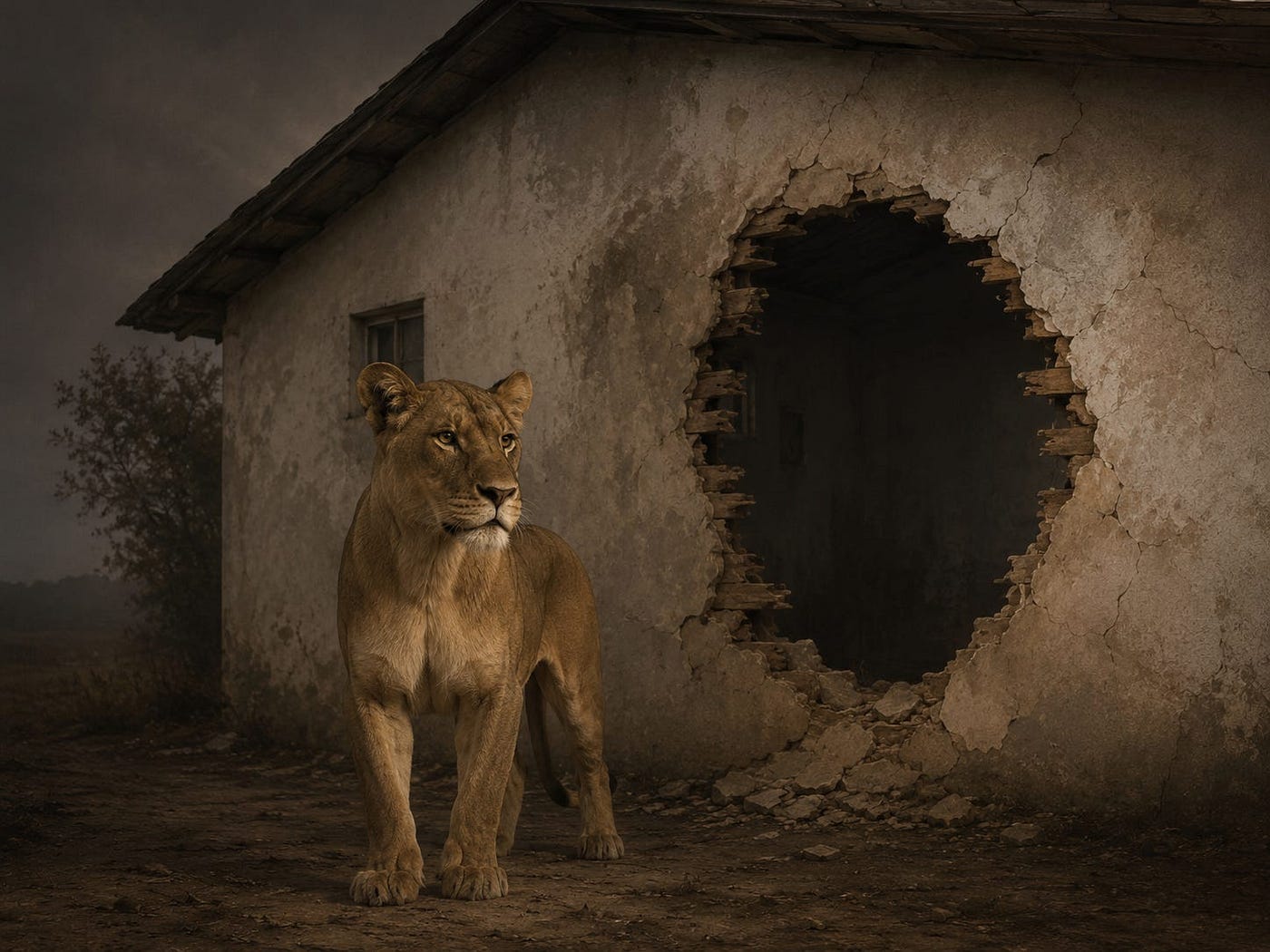
The daughter was more striking. She had the face of a lioness.
She did not seem monstrous. On the contrary, she felt like the clearest and most trustworthy presence in the dream. Her animal face carried alertness, strength, and instinctive authority. While the other figures were introduced through words and labels, she required no explanation. Her nature was visible.
The entrance to the house was not a door. There was a large tear in the wall, and I entered through it directly into a bedroom. The room was crowded with beds and occupied by several men. It was messy, temporary, and exposed. A bedroom is usually one of the most private areas of a house, yet this one could be entered through a rupture in the exterior wall.
There was no threshold, no permission, and no meaningful separation between inside and outside.
Almost immediately, the men and I moved behind a makeshift television desk and became sports commentators. The transformation was sudden. A private room became a public studio. People who had been sleeping in beds were now seated behind an imitation of institutional authority, analyzing events as though they possessed official knowledge.
The desk looked authoritative, but it was improvised.
The man beside me began talking about professional football players. He insisted that players who were plainly Black were actually white men. The statement was absurd, but he spoke with the confidence of a broadcaster. The desk gave his false claim the appearance of legitimacy.
The dream seemed to revolve around unstable identities and damaged boundaries.
The son’s role was ambiguous. The athletes were described as the opposite of what could plainly be seen. A bedroom became a television studio. Ordinary men became commentators. A broken wall became an entrance. Nothing remained securely within its proper category.
The woman outside the house may represent authority itself: the power that introduces people, defines their positions, and gives them legitimacy. She tells me who the younger figures are, and her declaration becomes the official version of reality. Yet the dream quietly questions whether such declarations can always be trusted.
The torn wall is the central image.
A door regulates entry. It marks the distinction between public and private space. It can be opened, closed, locked, or approached through accepted ritual. A tear in the wall does none of these things. It represents access without proper authorization. It is not simply an open boundary but a wounded one.
The dream house therefore appears less as a safe structure than as a place where privacy has become uncertain. The wall still exists, but it no longer performs its purpose. People may pass through the damage and behave as though the breach were normal.
The lioness-faced daughter stands apart from this confusion.
In Jungian terms, she may carry anima energy, but not in its gentle or romantic form. She represents an instinctive feminine intelligence capable of recognizing danger and defending boundaries. A lioness protects territory, offspring, and the integrity of the pride. She does not need a title, desk, or verbal declaration to establish her authority. Her power is embodied.
That may explain why she felt helpful. In a dream filled with false labels and uncertain roles, she was exactly what she appeared to be.
The psyche may have created her as a compensating figure. When boundaries become too porous in waking life, the unconscious may answer with an image of fierce protection. When authority becomes confusing or misplaced, the dream produces a form of authority that is instinctive, visible, and undeniable.
The lioness does not argue about who belongs where. She knows.
The dream does not merely criticize a damaged environment. It asks a deeper question about authority: Who has the right to enter? Who has the right to observe? Who has the right to define another person’s role?
The most dangerous form of disorder may not be open chaos. It may be the moment when improvised authority begins to resemble legitimate authority, when a broken wall is treated as a doorway, and when confident speech overrides visible truth.
Yet the dream also provides its own protective answer.
Somewhere beside the compromised house stands a lioness.
The image feels almost too precise, as if invented for effect, yet that is often the way dreams present truth: not as argument, but as form.
메타데이터
- post_id
- 6e2d31aef805
- slug
- the-torn-wall-6e2d31aef805
- url
- https://medium.com/the-liminal-threshold/the-torn-wall-6e2d31aef805
- canonical_url
- https://medium.com/the-liminal-threshold/the-torn-wall-6e2d31aef805
- author_url
- https://medium.com/@brett929is
- status
- ok
- fetched_at
- 2026-07-14 17:21:48