Part 2: Advanced Messaging Patterns in Mule 4: When VM and Anypoint MQ Work Better Together
Design scalable, resilient, and high-performance integrations using the right messaging patterns.
Part 2: Advanced Messaging Patterns in Mule 4: When VM and Anypoint MQ Work Better Together
Design scalable, resilient, and high-performance integrations using the right messaging patterns.
Introduction
In my previous article, “Design Smarter Integrations: VM vs Anypoint MQ Queues in Mule 4,” we explored the fundamental differences between MuleSoft’s VM connector and Anypoint MQ. The key takeaway was simple:
- VM is ideal for asynchronous communication within the same Mule application.
- Anypoint MQ is designed for reliable messaging between distributed applications and services.
However, real-world enterprise integrations rarely rely on just one messaging technology. Modern architectures often combine both to achieve better scalability, resilience, and maintainability.
In this article, we’ll go beyond feature comparisons and explore practical messaging patterns that can help you design production-ready Mule applications.
Why Messaging Patterns Matter
As integration landscapes grow, applications face challenges such as:
- Processing long-running operations asynchronously
- Handling unpredictable traffic spikes
- Isolating failures
- Scaling independently
- Improving application responsiveness
Choosing the right messaging pattern isn’t just about performance — it’s about designing systems that remain reliable as they evolve.
Design Pattern 1: Asynchronous Processing Within a Mule Application Using VM
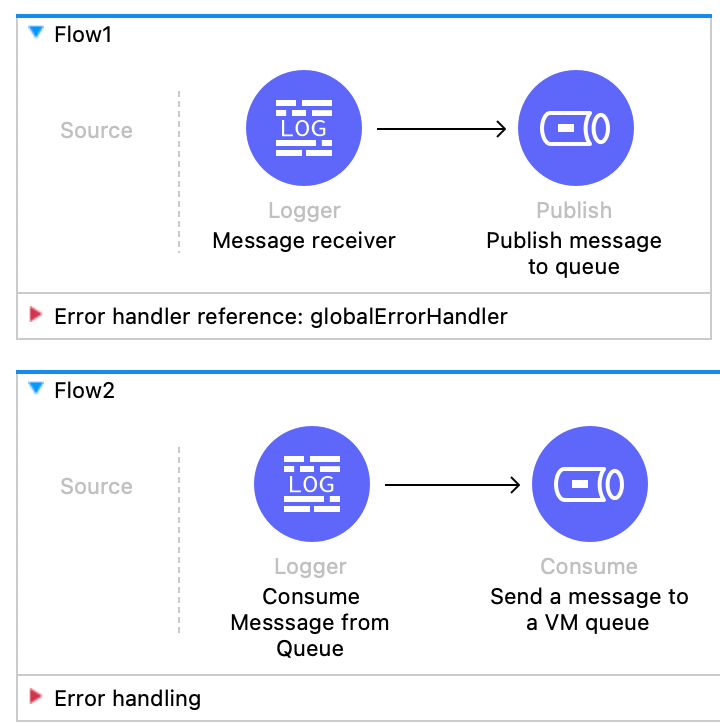
One of the most common uses of the VM connector is to decouple processing stages inside the same Mule application.
Example Pattern:

The VM queue sits between the two flows and is the async boundary.
Its two modes:
- Transient (in-memory, fast, lost on restart) and
2. Persistent (survives restarts, backed by disk).
For production, persistent queues are essential for any message you can’t afford to lose.
Concurrency is controlled by the VM Listener’s consumer count — you can spin up multiple concurrent consumers to parallelize processing without changing any flow logic.
Error isolation is a major benefit: a crash in the processor flow never propagates back to the receiver flow or the original HTTP client. The caller already got their 202.
Use VM when all producers and consumers are part of the same Mule runtime.
Design Pattern 2: Reliable Communication Between Applications Using Anypoint MQ

When multiple Mule applications or external services need to communicate asynchronously, Anypoint MQ becomes the preferred solution.
Each consumer processes messages independently, making the architecture more scalable and fault tolerant.
Benefits
- Durable message storage
- Independent deployments
- Loose coupling
- Cloud-native scalability
- Retry support
Even if one consumer is temporarily unavailable, messages remain safely stored until processing resumes.
Design Pattern 3: The Hybrid Architecture (VM + Anypoint MQ)
In enterprise projects, using VM and MQ together often provides the best balance of performance and reliability.

Design — MQ + VM — Combined
The rule: VM inside, AMQ between.
Within Application A, each stage (Validate → Transform) hands off via VM queue so slow steps don’t stall the HTTP listener. Once the message is ready, MQ Publish hands it to the cloud broker. Application B’s MQ Subscriber wakes up, processes through its own internal VM queue, writes to the database, and ACKs — confirming the message is safe to delete.
The caller receives a 202 Accepted response immediately. Everything after that is asynchronous, reliable, and fully decoupled across both apps.
Design Pattern 4: Handling Traffic Spikes with Message Buffering
Consider an e-commerce platform that receives 20,000 orders during a high-traffic festive flash sale.
Without a messaging layer:
- APIs slow down
- Timeouts increase
- Requests fail
- Databases become overloaded
With Anypoint MQ:

Handling large transactions
Pattern 5: Building Reliable Retry Mechanisms
External systems occasionally fail due to temporary issues such as:
- Network interruptions
- Service downtime
- API rate limits
Instead of immediately failing the request, a retry strategy can improve reliability.

Error handling and retry pattern with a Dead Letter Queue
Best Practices
- Limit retry attempts
- Send failed messages to a Dead Letter Queue (DLQ)
- Alert support teams when DLQ messages accumulate
Pattern 6: Scaling Consumers Horizontally
One of the biggest advantages of Anypoint MQ is its ability to distribute work across multiple consumers.

Scaling Consumers Horizontally
Instead of one application processing every message, multiple workers share the load.
Benefits include:
- Higher throughput
- Improved availability
- Better fault tolerance
- Easier horizontal scaling
Performance Considerations

Performance Considerations
Conclusion
Messaging is more than just moving data from one point to another — it’s about designing systems that remain responsive, resilient, and scalable under real-world conditions.
VM and Anypoint MQ aren’t competing technologies; they complement each other. VM delivers exceptional performance for asynchronous processing within a Mule application, while Anypoint MQ provides the durability and decoupling needed for distributed architectures. By understanding where each fits and combining them thoughtfully, you can build integration solutions that are easier to maintain, scale, and operate in production.
메타데이터
- post_id
- 6e33fcb5c9d8
- slug
- part-2-advanced-messaging-patterns-in-mule-4-when-vm-and-anypoint-mq-work-better-together-6e33fcb5c9d8
- url
- https://medium.com/another-integration-blog/part-2-advanced-messaging-patterns-in-mule-4-when-vm-and-anypoint-mq-work-better-together-6e33fcb5c9d8
- canonical_url
- https://medium.com/another-integration-blog/part-2-advanced-messaging-patterns-in-mule-4-when-vm-and-anypoint-mq-work-better-together-6e33fcb5c9d8
- author_url
- https://medium.com/@stutitank06
- status
- ok
- fetched_at
- 2026-07-17 04:06:05