Custom Telehealth Platform vs.
Executive Summary
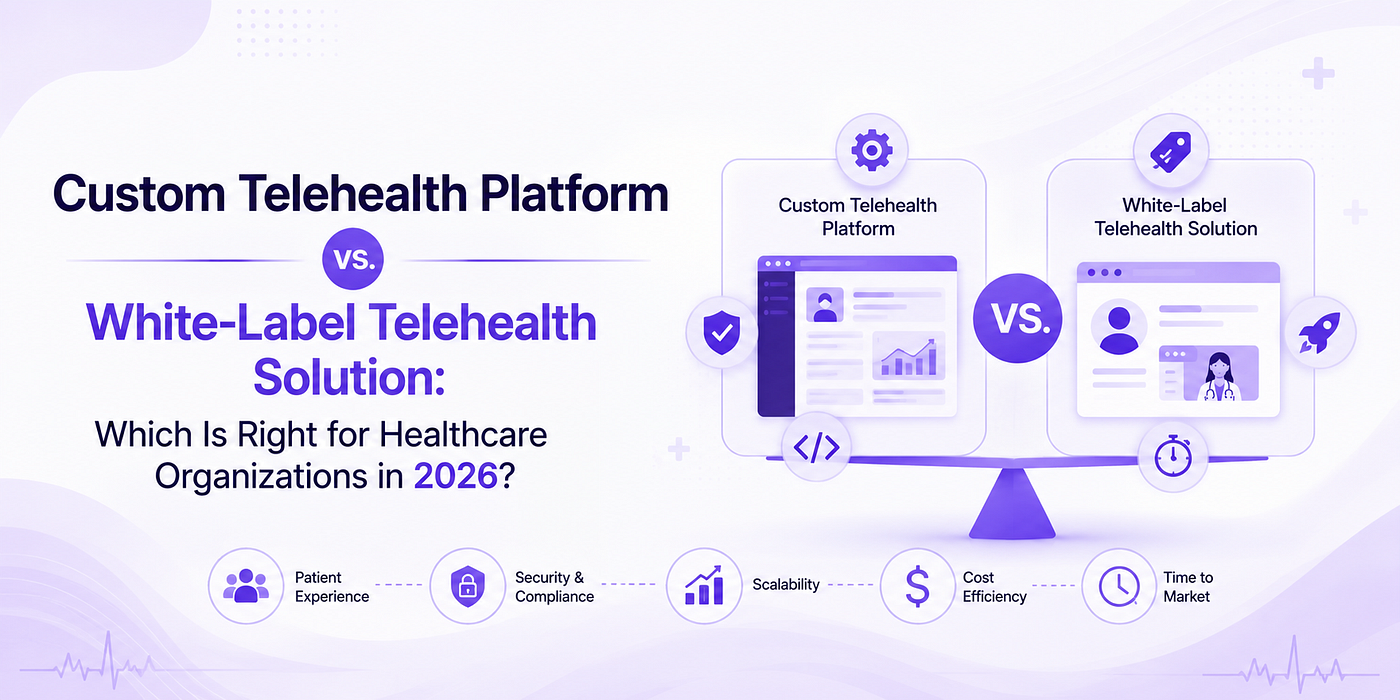
Custom Telehealth Platform vs. White-Label Telehealth Solution: Which Is Right for Healthcare Organizations in 2026?
Executive Summary
As virtual healthcare becomes a strategic priority for hospitals, clinics, and healthcare networks, organizations face a critical decision: Should they build a custom telehealth platform or adopt a white-label solution?
White-label platforms offer rapid deployment and lower upfront investment, while custom development delivers greater flexibility, ownership, and long-term scalability. The right choice depends on your clinical workflows, integration requirements, budget, compliance strategy, and growth plans.
This guide explores both approaches, compares their long-term costs, and explains the technical infrastructure required to deliver secure and reliable telehealth services.
Understanding the Two Approaches
What Is a White-Label Telehealth Platform?
A white-label telehealth solution is a ready-made virtual care platform developed and maintained by a third-party vendor. Healthcare organizations can customize branding elements such as logos, colors, and domain names while relying on the provider’s infrastructure and feature set.
Key Benefits
- Faster implementation (typically within weeks)
- Lower initial investment
- Managed hosting and maintenance
- Regular updates from the vendor
- Reduced technical complexity
Potential Limitations
- Limited customization options
- Dependence on vendor roadmaps
- Ongoing licensing costs
- Restricted access to backend systems and data
- Challenges supporting specialized clinical workflows
What Is Custom Telehealth Platform Development?
Custom telehealth development involves designing and building a proprietary virtual healthcare solution tailored to an organization’s exact operational and clinical requirements.
Healthcare providers own the application, source code, infrastructure, and data architecture.
Key Advantages
- Complete control over user experience
- Deep integration with healthcare systems
- Ownership of intellectual property
- Greater scalability for large organizations
- Ability to create specialized workflows and features
Considerations
- Higher upfront development costs
- Longer implementation timelines
- Ongoing maintenance responsibilities
- Requirement for dedicated technical resources
When Does a White-Label Solution Make Sense?
White-label platforms are often the best option when:
- Telehealth services need to launch quickly
- Budget constraints limit development investment
- Virtual care programs are still being validated
- Internal engineering resources are unavailable
- Standard workflows satisfy operational requirements
Many healthcare organizations begin with a white-label platform to evaluate adoption before investing in custom infrastructure.
Signs You’ve Outgrown Your White-Label Platform
As telehealth usage expands, organizations often encounter limitations that impact growth.
Rising Licensing Expenses
Per-provider or per-consultation fees may be manageable initially, but costs can increase significantly as the organization scales.
Workflow Restrictions
Clinical teams may require custom routing, advanced patient journeys, or integration with connected medical devices that existing platforms cannot support.
Integration Challenges
Many platforms offer basic integrations but struggle to accommodate complex interoperability requirements across multiple healthcare systems.
Data Accessibility Concerns
Organizations seeking advanced analytics, AI initiatives, or population health insights often need unrestricted access to operational and clinical data.
The Emerging Hybrid Model
Many healthcare enterprises are moving toward a hybrid strategy that combines the strengths of both approaches.
In this model:
- Organizations leverage existing communication APIs or video infrastructure.
- Internal development teams build customized patient and clinician experiences.
- Core workflows remain fully controlled by the healthcare provider.
This approach enables faster deployment while preserving flexibility for future innovation.
Benefits of a Hybrid Architecture
- Reduced development complexity
- Faster time-to-market
- Greater customization
- Easier scalability
- Lower long-term vendor dependency
Telehealth Infrastructure: The Technology Behind Virtual Care
Regardless of deployment strategy, every telehealth platform relies on a real-time communications stack.
WebRTC
WebRTC enables secure audio and video communication directly through web browsers and mobile applications without requiring additional software installations.
Benefits
- Low latency
- Cross-platform compatibility
- Secure encrypted communication
- Real-time media transmission
Signaling Layer
Before a video consultation begins, devices must establish a connection.
Common signaling technologies include:
- SIP (Session Initiation Protocol)
- WebSockets
- Proprietary signaling services
These components manage:
- Session initiation
- Call routing
- Connection negotiation
- Session termination
Media Servers
As telehealth sessions become more complex, cloud-based media servers help manage multiple participants and optimize bandwidth usage.
Common architectures include:
SFU (Selective Forwarding Unit)
- Efficient resource utilization
- Ideal for multi-party video consultations
- Better scalability
MCU (Multipoint Control Unit)
- Centralized media processing
- Simplified endpoint requirements
- Higher server resource consumption
Enterprise Telehealth Implementation Roadmap
1. Establish Compliance and Security Controls
Organizations should evaluate:
- HIPAA compliance requirements
- Business Associate Agreements (BAAs)
- Data encryption standards
- Identity and access management policies
- Single Sign-On (SSO) integration
2. Design Healthcare System Integrations
Modern telehealth platforms should support:
- Electronic Health Records (EHRs)
- SMART on FHIR integrations
- HL7 interoperability
- Scheduling systems
- Billing platforms
3. Build for Scalability
Healthcare organizations must prepare for sudden increases in demand.
Recommended practices include:
- Auto-scaling infrastructure
- Cloud-native architecture
- Load balancing
- Distributed media services
4. Implement Communication Failover
Reliable patient communication requires contingency planning.
Examples include:
- PSTN fallback
- SIP trunking
- Audio-only failover modes
- Network resilience mechanisms
5. Enable Monitoring and Observability
Performance monitoring should include:
- Network latency
- Packet loss
- Video quality metrics
- Infrastructure utilization
- System health dashboards
6. Validate Device and Network Compatibility
Healthcare environments often include:
- Legacy hardware
- Thin-client workstations
- Restricted networks
- Managed endpoints
Comprehensive testing helps ensure consistent user experiences across all environments.
EHR Integration: Basic Connectivity vs. Deep Interoperability
Many telehealth vendors advertise EHR integration, but the depth of integration varies significantly.
Standard Integration
Typically includes:
- Patient information retrieval
- Appointment synchronization
- PDF summary uploads
Advanced FHIR-Based Integration
Supports:
- Real-time data exchange
- Embedded telehealth workflows
- Structured clinical documentation
- Automated chart updates
- Improved provider productivity
Organizations seeking seamless clinician experiences often require advanced interoperability capabilities.
Compliance Responsibility: Who Owns the Risk?
A common misconception is that purchasing a compliant telehealth solution transfers regulatory responsibility to the vendor.
In reality, healthcare organizations remain accountable for protecting patient information and ensuring compliance with applicable regulations.
With White-Label Platforms
Vendors manage portions of the infrastructure and security controls, but organizations remain responsible for:
- User access management
- Internal security policies
- Workforce compliance
- Operational governance
With Custom Platforms
Organizations assume greater responsibility but gain complete visibility and control over:
- Infrastructure
- Data handling
- Audit logging
- Security architecture
- Compliance processes
Final Verdict
The choice between custom development and a white-label telehealth platform is ultimately a business decision rather than a purely technical one.
Choose White-Label If:
- Speed is your highest priority.
- Budget is limited.
- You need a proven solution quickly.
- Telehealth is still being evaluated as a service offering.
Choose Custom Development If:
- Telehealth is a long-term strategic initiative.
- Deep EHR integration is required.
- Specialized clinical workflows are essential.
- Long-term scalability and ownership matter.
Consider a Hybrid Approach If:
- You want faster deployment without sacrificing flexibility.
- You need control over workflows while leveraging existing communication infrastructure.
- You plan to evolve toward full platform ownership over time.
For many enterprise healthcare organizations in 2026, the hybrid model delivers the most practical balance between speed, customization, and long-term value.
메타데이터
- post_id
- 6e42aa08e6db
- slug
- custom-telehealth-platform-vs-6e42aa08e6db
- url
- https://medium.com/@ecosmob.technology/custom-telehealth-platform-vs-6e42aa08e6db
- canonical_url
- https://medium.com/@ecosmob.technology/custom-telehealth-platform-vs-6e42aa08e6db
- author_url
- https://medium.com/@ecosmob.technology
- status
- ok
- fetched_at
- 2026-08-07 03:07:56