No more alibis: why generative AI can’t hide behind Section 230 any longer
A German court’s preliminary ruling that Google’s AI Overviews made false statements is more than just another chapter in the long-running…
No more alibis: why generative AI can’t hide behind Section 230 any longer
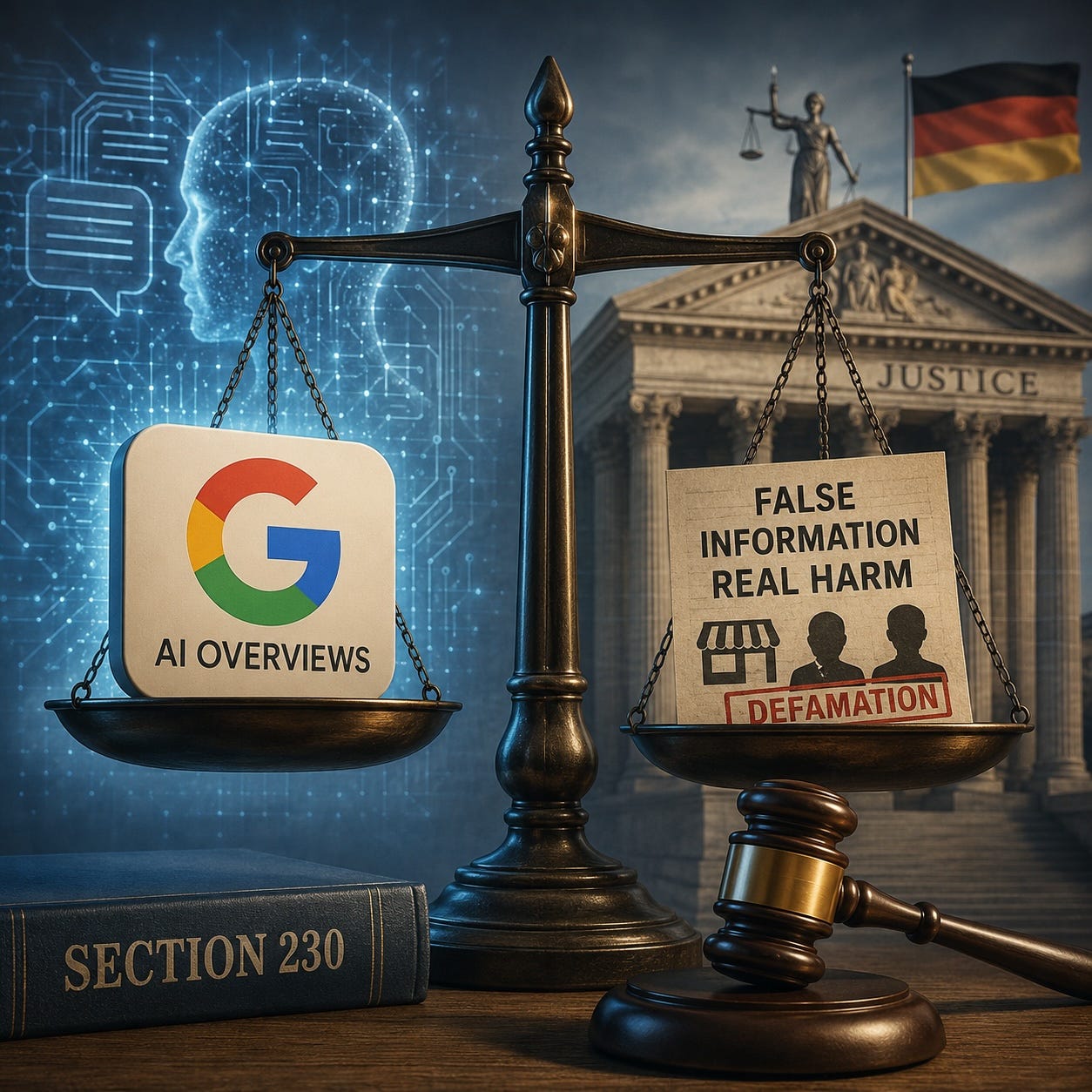
A German court’s preliminary ruling that Google’s AI Overviews made false statements is more than just another chapter in the long-running saga pitting Brussels, EU member states’ justice systems and Sillicon Valley.
And while Big Tech might play the victim card and interpret it as a typical overreaction, it’s something much more important: a Munich court has said, in essence, that when a company uses AI, it can’t hide behind the excuse that it was “just organizing information.”
The case is especially interesting because it does not revolve around copyright, abuse of dominant position, or remuneration, although all these issues are obviously running in the background. Two German companies sued Google because its AI Overviews associated them with scams. The problem is that the sources linked by Google didn’t say that. AI had mixed, inferred, synthesized, and drawn all the wrong conclusions. And the court understood that those claims were not third-party content: they were Google content.
That distinction is crucial. For decades, search engines have been treated as intermediaries. A search engine crawls, indexes, sorts, and links. It can make mistakes, prioritize badly, direct the user to junk, but in principle all it is doing is giving directions. Generative AI is different. We are no longer dealing with a results page that refers to others. We are dealing with a system that reads, combines, summarizes and presents an answer with the appearance of authority; in the name of the company that deploys it.
Google tried to defend itself with an argument that, in reality, reveals the magnitude of the problem: users could check the links. But if the user has to verify every sentence of an AI-generated response, what is the purpose of the response? The feature is sold precisely as a simplification, as a way to save time and avoid clicks. If it works, it replaces the traditional search process. If it is wrong, it cannot hide behind an invitation to continue investigating. A company that sells convenience cannot take refuge in the fact that the user should have fact checked every word when something goes wrong.
There are much wider ramifications here than Google’s reputation. This is a wake-up call for all AI companies producing claims about people, companies, products, doctors, teachers, journalists, politicians, or competitors. For years we have accepted with surprising docility that platforms were responsible for almost nothing: neither for what their algorithms recommended, nor for what they amplified, nor for the economic or reputational consequences of their automated decisions. Generative AI breaks that implicit pact. When the algorithm no longer just classifies other people’s content, but creates a new claim, the old alibi of the middleman begins to crumble.
In the United States, a clash with Section 230 of the Communications Decency Act is inevitable. That rule, considered by many to be fundamental to the development of the internet, states that an interactive service provider should not be treated as a publisher of information provided by another content provider. Its historical logic was reasonable: to protect platforms from impossible liabilities for every piece of content posted by third parties. But the uncomfortable question is obvious: what happens when the information is no longer provided by “another”, but by a model trained, fine-tuned, deployed, optimized and monetized by the company itself?
American jurisprudence has yet to resolved this dilemma. In Gonzalez v. Google, the Supreme Court avoided ruling on the actual scope of Section 230 as it relates to recommendation algorithms. But generative AI raises a much less comfortable question than algorithmic recommendation: we are not just talking about selecting what a user sees, but about fabricating an answer that did not exist before. As an analysis by the American Bar Association pointed out, these systems are becoming less and less like neutral intermediaries and more and more like authors who synthesize, interpret and generate their own content.
This is the nub of the question. If I make a false accusation, they have to answer for it. The same applies to any type of media. If a company uses AI to make a false accusation and place it in the most visible part of the most used search engine in the world, are we really going to accept that no one is responsible? The injured party must accept this because “the model was wrong”? That idea is only defensible if we continue to treat AI as a kind of natural phenomenon, like rain or wind, and not as what it really is: a product designed, controlled and commercially exploited by companies.
The debate also intersects with the question of value extraction. European media and publishers have called AI Overviews out for stealing traffic, visibility, and revenue from them. The Independent Publishers’ Alliance has filed an anti-trust complaint with the European Commission arguing that publishers cannot exclude their content from AI responses without also disappearing from Google Search. In Italy, publishers have described the feature as a traffic killer. In response, the European Commission is investigating the scenario called “Google Zero”, in which Google uses third-party content to respond within Google, keeping all traffic internal.
The ruling introduces a deeper dimension than competition or compensation. It’s not just about whether Google abuses its dominant position. It’s about whether a company can turn the internet into raw material, distill it using opaque algorithms, sell distillation as an authoritative response, and at the same time deny liability when that response destroys reputations, alters consumption decisions, or damages businesses.
The answer should be obvious. Responsibility cannot evaporate in technical architecture. If the system is designed by Google, deployed by Google, optimized by Google, integrated into Google Search and monetized by Google, then its errors are not simple accidents of the information ecosystem: they are product failures, editorial failures or both at the same time. And that completely changes the debate.
AI does not need impunity to innovate; it needs the right incentives. If AI companies know that they will not have to answer for their mistakes, they will deploy systems that are increasingly aggressive, opaque and cheap to maintain. If they know that they will be liable for the damages caused by their fabricated claims, they will invest in verification, traceability, correction mechanisms, limits of use and risk assessment. Exactly what any responsible industry that makes potentially harmful products has to do.
The German ruling is preliminary, yes. Google will appeal, qualify, minimize and repeat that the vast majority of the answers are correct. But that’s not the point. The point is that the old internet contract, based on platforms that claimed not to be responsible because they only hosted or linked to third-party content, no longer fits with systems that generate their own language on an industrial scale. AI is not a link. It is not a list. It is not a neutral window on the world. It is a machine for producing affirmations. And whoever sets that machine in motion must answer for what its AI says.
For too long, Big Tech has enjoyed an extraordinary asymmetry: it captures value when its algorithms work but avoids responsibility when they fail. The Munich court’s decision aims to end this asymmetry. And that’s why it’s important. Not because it is European. Not because it’s against Google. But because it begins to ask the question that will define the next decade: when AI speaks, who is really speaking?
And the answer, much as it makes Silicon Valley uncomfortable, cannot be “nobody”.
(En español, aquí)
메타데이터
- post_id
- 6e43dde2c766
- slug
- no-more-alibis-why-generative-ai-cant-hide-behind-section-230-any-longer-6e43dde2c766
- url
- https://medium.com/enrique-dans/no-more-alibis-why-generative-ai-cant-hide-behind-section-230-any-longer-6e43dde2c766
- canonical_url
- https://medium.com/enrique-dans/no-more-alibis-why-generative-ai-cant-hide-behind-section-230-any-longer-6e43dde2c766
- author_url
- https://medium.com/@edans
- status
- ok
- fetched_at
- 2026-06-17 18:03:35