What Does “Dual Variable of a Constraint” Really Mean?
If you have worked with optimization, machine learning, or economics, you have probably encountered phrases like:
What Does “Dual Variable of a Constraint” Really Mean?
If you have worked with optimization, machine learning, or economics, you have probably encountered phrases like:
“the dual variable associated with the constraint” “we update the dual variable to enforce feasibility”
At first, this terminology feels abstract and detached from intuition. What exactly is a dual variable? Why does every constraint seem to have one? And more importantly — why should we care?
This article explains the meaning of the dual variable of a constraint step by step, starting from intuition, moving to mathematics, and ending with practical interpretations in machine learning and large-scale systems.
Optimization Is About Decisions and Limits
Every optimization problem has two essential components:
- Decision variables — the choices you can control
- Constraints — the limits those choices must respect
A standard constrained optimization problem looks like this:
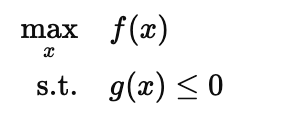
Here:
- x is the primal variable, representing your decisions
- g(x)≤0 is a constraint, restricting what decisions are allowed
This formulation is called the primal problem. It focuses on finding the best decision under fixed limits.
But optimization theory offers a second, equally powerful perspective — one that focuses not on decisions, but on the constraints themselves. This is where dual variables enter the picture.
The Central Idea: Constraints Have Prices
The most intuitive way to understand a dual variable of a constraint is this:
It measures how much the optimal objective would improve if the constraint were relaxed slightly.
In other words, the dual variable answers a sensitivity question:
- Is this constraint actually limiting us?
- If so, how costly is it?
Because of this interpretation, dual variables are often called:
- Lagrange multipliers
- Shadow prices
- Constraint prices
They quantify the importance of a constraint at the optimum.
How Dual Variables Appear: The Lagrangian
Dual variables arise naturally when we form the Lagrangian:

Here:
- x remains the primal decision variable
- λ is the dual variable associated with the constraint g(x)≤0
The role of λ is to penalize constraint violations. A larger value means violating the constraint is expensive; a smaller value means the constraint is relatively unimportant.
For inequality constraints, dual variables satisfy: λ≥0
This ensures that violating the constraint never improves the objective artificially.
Binding vs. Non-Binding Constraints
At the optimal solution, each constraint falls into one of two categories:
Binding constraints
- The constraint is tight and actively limits the solution
- Relaxing it would improve the objective
- Dual variable is strictly positive
Non-binding constraints
- The constraint is loose and does not affect the solution
- Relaxing it has no effect
- Dual variable equals zero
This relationship is captured formally by complementary slackness, but intuitively it says:
If a constraint is not restricting you, it has no price.
Dual Variables as Shadow Prices
The economic interpretation of dual variables makes their meaning especially clear.
Consider a budget-constrained optimization problem:Total spend≤B
The dual variable associated with this constraint represents:
How much additional value you gain from one extra unit of budget.
If the dual variable is:
- Large → budget is scarce and highly valuable
- Zero → budget is not the bottleneck
This is why dual variables are often called shadow prices: they reveal the hidden value of constrained resources.
Why Dual Variables Matter in Machine Learning
Dual variables are not just theoretical constructs — they play a central role in many ML models and systems.
Support Vector Machines (SVMs)
In SVMs:
- Each training point corresponds to a margin constraint
- The dual variable determines whether a point becomes a support vector
Points with zero dual variables do not affect the decision boundary, while points with positive dual variables define it.
Constrained Learning Problems
In modern ML, models are often trained under constraints:
- Fairness constraints
- Budget constraints
- Risk or safety constraints
Dual variables act as adaptive tradeoff parameters, automatically balancing objective performance against constraint satisfaction. Updating dual variables is equivalent to learning how strictly constraints should be enforced.
The Dual Perspective: Pricing Instead of Enforcing
The primal problem asks:
What decisions maximize my objective under fixed constraints?
The dual problem asks instead:
What prices on constraints make the system optimal and stable?
From this perspective:
- Primal variables respond to prices
- Dual variables adjust to enforce feasibility
This viewpoint is especially powerful in large-scale systems, where explicitly enforcing constraints is difficult but adjusting prices is efficient.
One-Sentence Takeaway
The dual variable of a constraint is the variable that measures the marginal value of relaxing that constraint, often interpreted as its shadow price.
Once you start seeing dual variables as prices rather than symbols, constrained optimization becomes not only clearer — but deeply intuitive.
메타데이터
- post_id
- 6e49ecfc5f00
- slug
- what-does-dual-variable-of-a-constraint-really-mean-6e49ecfc5f00
- url
- https://medium.com/@VectorWorksAcademy/what-does-dual-variable-of-a-constraint-really-mean-6e49ecfc5f00
- canonical_url
- https://medium.com/@VectorWorksAcademy/what-does-dual-variable-of-a-constraint-really-mean-6e49ecfc5f00
- author_url
- https://medium.com/@VectorWorksAcademy
- status
- ok
- fetched_at
- 2026-06-09 15:37:30