KSE weekly digest of foreign companies Self-sanctions in RF, 1st edition
Prepared by the KSE Institute team and KSE members of the Board of Directors; 09–15.05.2022
KSE weekly digest of foreign companies Self-sanctions in RF, 1st edition
Prepared by the KSE Institute team and KSE members of the Board of Directors; 09–15.05.2022
Disclaimer: At the beginning of the Russian invasion of Ukraine KSE Institute launched an analytical project, which was named “SelfSanctions”, aimed to collect data on foreign companies operating in the Russian market and limiting or terminating their activities. Examination of data was conducted jointly with specialists from the Ministry of Economy, the Ministry of Foreign Affairs and the Ministry of Digital Transformation of Ukraine. The database contains a lot of information, we collect daily statistics on changes in the status of foreign companies operating/operated in the Russian market and limiting or terminating their activities. Also, we created the Telegram bot https://t.me/exit_ru_bot for tracking/monitoring of news on priority foreign companies (coverage 1, 2, 3 or 7 days of monitoring). Also, we do regular analysis of changes in share prices and capitalization of parent groups of companies that have or have had business in Russia.
KSE database is partly based on the Yale’s School of Management database, epravda.com.ua and other open sources. Data is verified and KSE status is assigned. Data on stocks is taken from Google and Yahoo Finance. At the same time, the KSE database is more complete and comprehensive and contains 40 percent more information than most other similar databases, as it also includes data on number of staff, revenue, capital and other financial indicators, the latest updates and changes in statuses, links to used sources, and daily updates from the telegram-bot etc.
KSE DATABASE SNAPSHOT
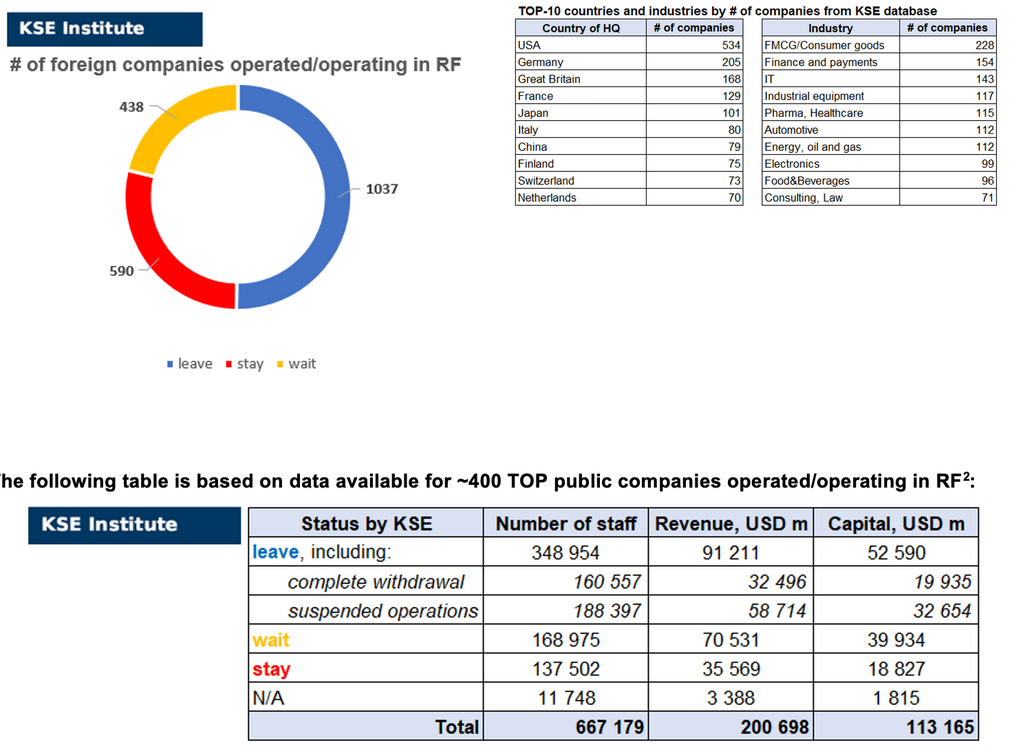
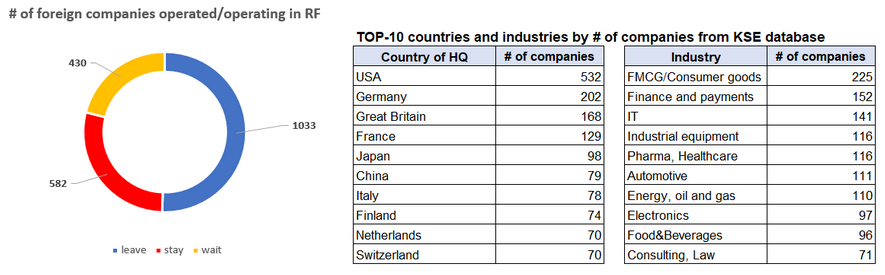
Number of the companies that continue Russian operations (KSE’s status “stay”) — 580
Number of the companies that have reduced current operations and hold off new Investments (KSE’s status “wait”) — 422
Number of the companies that have curtailed Russian operations (KSE’s status “leave”) — 1 017
As of May 13, we have identified about 2,000 companies and organizations and analyzed their position on the Russian market. About half of them are public, for ~ 400 public groups of companies, we also identified (where it was possible) their operating business in Russia (the presence of a controlling stake in a legal entity), which allowed us to calculate the value of capital invested in the country (about $113 billion), local revenue (about $200 billion), as well as staff (almost 0.7 million people). 1,439 foreign companies from 70 countries and 55 industries have reduced, suspended or ceased operations in Russia.
As can be seen from the tables below, As of May 13th, companies that declared a complete withdrawal from Russia had $27.2bn in revenues and $13.8bn in capital; companies that suspended their operations on the Russian market had yearly revenue of $66.2bn and $35.4bn in capital. TOP-10 companies-the largest taxpayers ~ $13,7bn of taxes annually — haven’t completely withdrawn yet, although suspended or scaled back.
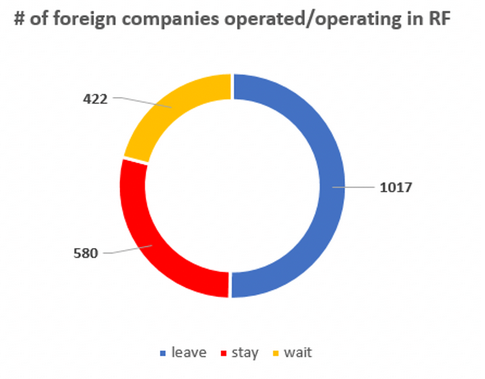


If since the beginning of the Russian invasion of Ukraine, the percentage of companies that closed operations in Russia has risen sharply by mid-March, in the last month the ratio of those who leave or stay is virtually unchanged. But during this time we see an increase in the share of those companies that remain in the Russian market. This is mainly due to the expansion of the KSE database with so-called “secondary” companies.

The actions of companies by sector (based on the KSE database, with at least 50 companies representing the industry and with at least 40 companies per country) are shown in the graphs above.
Impact on stock prices/capitalization of companies’ HQ

WEEKLY FOCUS. BANKING SECTOR
Foreign banks’ opinions are divided on whether to exit business in Russia or not. Out of the three largest foreign banks in Russia, only one has entirely left the Russian market, and two are considering selling the business, but this is just talking so far.
As of April 1st, there were 331 banks in Russia. State-owned banks dominate the banking system. The three largest of them- Sberbank, VTB, and Gazprombank- account for 55% of all assets.
Twenty-six out of one hundred largest banks are foreign, while the share of foreign capital in the banking system is almost 11%. The list of 13 systemically important banks includes three foreign:
- • UniCredit Bank,
- • Rosbank (Societe Generale),
- • Raiffeisenbank (RBI).

In addition, Citibank, Home Credit, OTP Bank and ING Bank are also among the top 50.
Investment banks were the first to announce their withdrawal from the Russian market. From March 10th to 15th , Goldman Sachs, J.P. Morgan, Deutsche Bank, Commerzbank and Citi announced winding down their operations. Moreover, Deutsche bank changed its opinion overnight when the exit of investment banks began. Credit Agricole ceased operations in Russia as well.
However, many subsidiaries of foreign banks serve their international clients and continue to stay in the market despite their small presence and absence of active business with Russian clients. Intesa Sanpaolo, Sumitomo Mitsui Banking Corp., HSBC, ING, and SEB have stopped doing new business with Russian companies but are not leaving the market.
The most pressing question is the exit of the three foreign banks with the largest assets. Societe Generale was the first to announce its withdrawal, signing an agreement to sell Rosbank to Vladimir Potanin’s Interros on April 11th. Meanwhile, Raiffeisenbank and UniCredit Bank remain in the Russian market. In early May, RBI said it was assessing all strategic options for the future of Raiffeisenbank Russia, up to and including a carefully managed exit. On May 11th UniCredit was reported negotiating the sale of Russia’s “daughter”, but no further steps have been taken.
As for the remaining 50 foreign banks, OTP Bank does not provide financing to its bank in Russia and reduces corporate lending. Home Credit reduced assets and tried to sell its Russian subsidiary before the military aggression. Still, after the war had started, the company did not make any statements regarding its business in Russia.
More details on a daily basis:
**KSE Telegram bot on news monitoring @exit_ru_bot**
**Twitter of SelfSanctions project**
¹- KSE status “leave” — Companies that have published on the company’s official website (or their release has appeared in a foreign publication such as FT, NYT, etc.) that are completely shutting down in Russia or companies that have officially announced that they are temporarily reducing operations in Russia — KSE status “wait” — Companies that have published on the company’s official website (or their release has appeared in a foreign publication such as FT, NYT, etc.) that they are reducing only part of their business operations by continuing to work on other operations or companies that have reported delaying future investment / development / marketing , while continuing their core business — KSE status “stay” — Companies that ignore exit / downsizing requirements in Russia, as well as companies that have officially stated that they remain in Russia or news of their exit have not been found
메타데이터
- post_id
- 6e673d010bb
- slug
- impact-of-foreign-companies-self-sanctioning-on-rf-economy-6e673d010bb
- url
- https://medium.com/@aonopriienko/impact-of-foreign-companies-self-sanctioning-on-rf-economy-6e673d010bb
- canonical_url
- https://medium.com/@aonopriienko/impact-of-foreign-companies-self-sanctioning-on-rf-economy-6e673d010bb
- author_url
- https://medium.com/@aonopriienko
- status
- ok
- fetched_at
- 2026-07-21 16:30:38