How U.S. High Schools Can Scale Guidance Without More Staff
How U.S. high schools can scale student guidance and counselling support using automation, AI copilots, and smarter systems without…
How U.S. High Schools Can Scale Guidance Without More Staff
How U.S. high schools can scale student guidance and counselling support using automation, AI copilots, and smarter systems without increasing staff.
Across the United States, high schools are being asked to deliver more student guidance, academic, social‑emotional, college, and career support on essentially the same staffing levels. Budgets are tight, counsellor positions are hard to fill, and yet expectations for college and career readiness continue to rise.
That leaves U.S. high schools with a core challenge: How do we scale student guidance without hiring more staff?
The answer is not “work harder.” It’s to redesign systems, use technology as a copilot, and protect precious human time for high‑impact student interactions.
The Capacity Problem in U.S. High Schools
In many American high schools, guidance is constrained less by talent and more by structure. Counsellors, advisors, and support staff are:
- Answering the same questions hundreds of times per term
- Manually tracking data that already lives in other systems
- Juggling scheduling, crisis response, testing, and paperwork alongside college and career planning
When every process is ad hoc and person‑dependent, adding another student feels like adding another brick to an already overloaded backpack. To truly scale student guidance, U.S. high schools need systems, not heroics.
1. Systemise Guidance Before You Try to Scale It
In other sectors, organisations are told: “Document it before you scale it.” The same applies to school counselling and student support.
For a U.S. high school, that means:
- Mapping the student journey from 9th grade through graduation, including key milestones (course planning, testing, college/career checkpoints)
- Defining standard workflows for things like: requesting schedule changes, exploring college options, or responding to early warning signs
- Creating shared templates for emails, parent letters, slide decks, and checklists so staff aren’t reinventing every resource
When guidance processes are documented and shared, more adults in the building, including teachers, advisory leaders, and college and career staff , can reinforce the same steps. That instantly increases your effective guidance capacity without adding a single FTE.
2. Automate Routine Tasks So Humans Can Focus on Students
A huge chunk of “guidance time” is actually logistics time. If your staff are spending hours:
- Sending manual reminders about course request deadlines.
- Chasing signatures and forms.
- Copy‑pasting the same answers into email after email.
…then you’re burning capacity on tasks that software can handle much better.
Concrete moves for U.S. high schools:
- Set up automated email or SMS reminders for recurring milestones: course selection windows, SAT/ACT dates, FAFSA priority deadlines, and college application cutoffs.
- Use online forms that feed directly into a spreadsheet or SIS view, instead of paper that must be keyed in later.
- Build short FAQ pages or “start here” guides so common questions get answered before they hit a counsellor’s inbox.
Every repetitive task you automate returns minutes or hours back to your team, time that can be reinvested in real student conversations.
3. Treat AI as a Copilot for School Counsellors
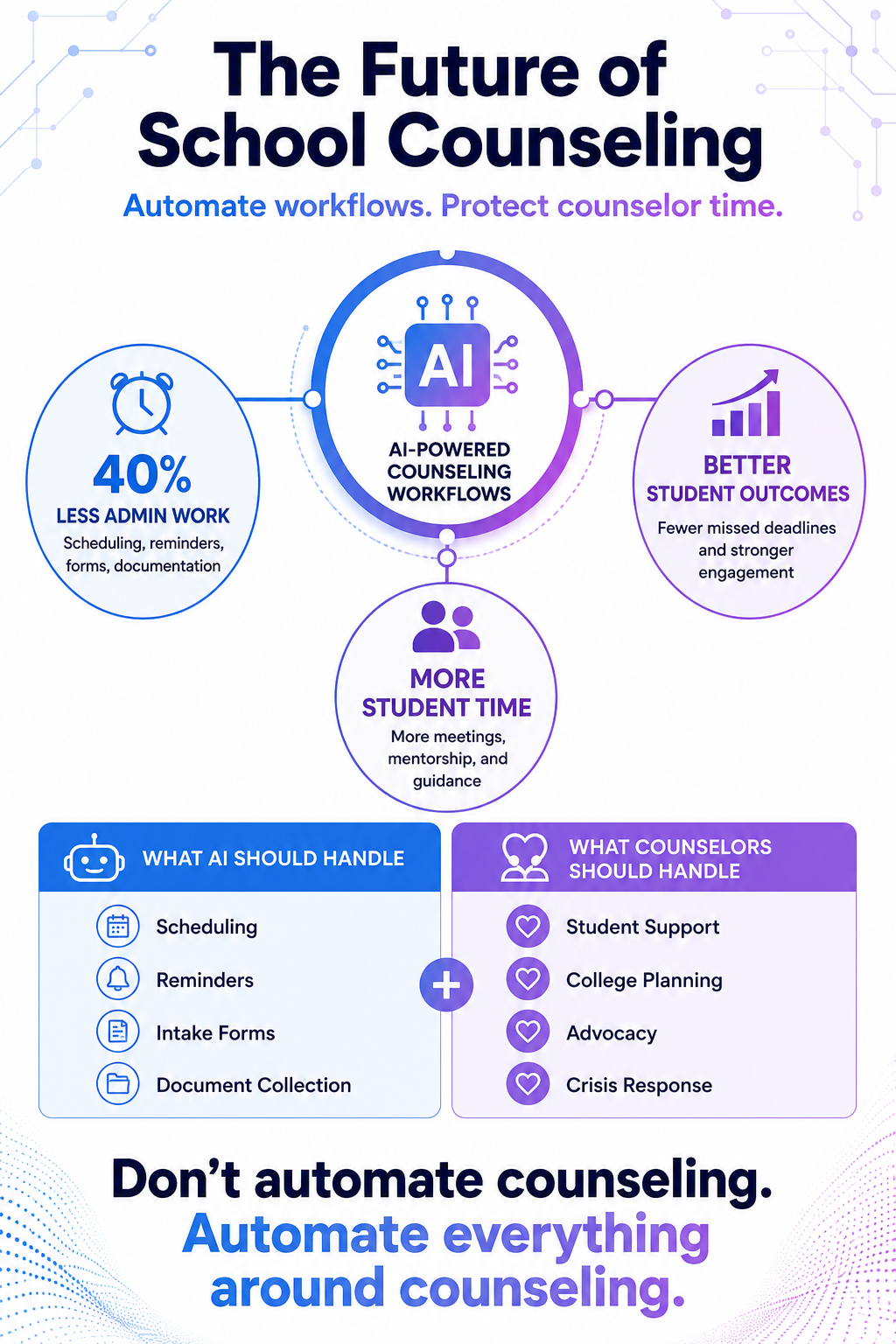
AI is beginning to act as a copilot for school counsellors in U.S. high schools, not a replacement, but a force multiplier.
Used wisely, AI can:
- Draft first‑pass emails, letters, and planning documents that counsellors then review and refine.
- Help students explore college options or career paths through structured prompts and guided tools.
- Power chat‑based assistants that answer basic “what, when, where” questions 24/7, so human staff handle the “why” and “what now”.
Think of it this way: if a chatbot can answer 50% of your routine questions about deadlines, requirements, or terminology, counsellors suddenly have far more time for high‑impact 1:1 or small‑group sessions.
Thus, it is clear that AI handles information and structure, whereas humans handle judgment, nuance, and relationships.
4. Protect Human Time for High‑Impact Guidance
Scaling guidance without more staff requires ruthless prioritization of human effort.
In U.S. high schools, high‑impact guidance work typically includes:
- Meeting with students to build realistic, values‑aligned college and career plans.
- Working through essays, financial aid scenarios, and “should I/shouldn’t I” decisions.
- Coordinating with teachers, families, and community partners for students who are off‑track or in crisis.
Lower‑impact activities — such as formatting documents, duplicating information that already exists online, or answering the same question over and over — should be pushed to systems, templates, and tools wherever possible.
Ask one hard question:
“Does this task truly require a counselor’s expertise, or could a template, video, or tool handle 80% of it?”
If the answer is “tool,” then redesign the workflow so human time is reserved for the final 20% that actually changes a student’s trajectory.
5. Build a Tiered Guidance Model: Self‑Serve → Group → 1:1
Many U.S. districts already use tiered frameworks for academics and behaviour, and guidance can also adopt the same logic.
A scalable guidance model might look like:
Tier 1: Self‑Serve Guidance
- Clear, student‑friendly pages on your website explaining graduation requirements, college terminology, financial aid basics, and key dates.
- On‑demand videos or short modules that students and families can watch anytime.
- AI‑augmented tools that let students explore options independently
Tier 2: Group Guidance
- Grade‑level assemblies or advisory lessons on course planning, college search, and financial aid.
- Themed workshops (for example: “FAFSA Night,” “First‑Gen College Planning,” “Building a College List That Fits You”).
Tier 3: Targeted 1:1 Support
- Individual meetings for students with complex needs, conflicting information, or major decisions.
- Follow‑up sessions triggered by data signals (attendance, grades, behaviour, or missed milestones).
This tiered structure helps ensure every student gets baseline guidance, while limited 1:1 time is reserved for those who most need it.
6. Use Strategic Partnerships Instead of Only Adding Staff
U.S. high schools don’t have to do everything alone. When budgets are tight, strategic partnerships can expand guidance without permanent hiring.
Options include:
- Collaborating with local colleges, workforce boards, and community organisations for workshops, mentoring, and dual‑enrollment or career‑pathway exposure.
- Partnering with college access nonprofits or virtual advising services during peak seasons (fall application months, FAFSA launch).
- Inviting alumni and local professionals to support career panels, resume reviews, or mock interviews.
Rather than one school trying to build every program in‑house, districts can leverage community assets to widen the net of guidance available to students.
7. Measure What Matters: Outcomes, Not Just Activity
To truly “scale” student guidance in U.S. high schools, leaders need to track the right metrics. Busy isn’t the same as effective.
Useful indicators include:
- Percentage of students with a documented postsecondary plan by the end of 11th or early 12th grade.
- On‑time completion rates for key milestones: course requests, college applications, FAFSA, state grants, scholarship submissions.
- Utilisation data for self‑serve resources and group sessions (views, attendance, click‑throughs).
- Time‑use snapshots showing how counsellor hours are split among admin, group activities, and 1:1 student work.
These metrics help you see whether your “scale student guidance” strategy is working, and where to refine systems, tools, or partnerships.
The Path Forward for U.S. High Schools
Scaling guidance without hiring more staff is not about asking already overworked counsellors to carry more weight. It’s about changing the design of the work:
- Systemise repeatable guidance processes.
- Automate what doesn’t require human judgment.
- Use AI as a copilot to handle routine information.
- Protect human time for high‑impact, relationship‑driven support.
- Build tiered guidance so every student receives some level of help.
- Leverage partnerships to bring in targeted expertise.
Done well, this approach lets U.S. high schools expand their guidance capacity even in a flat or constrained staffing environment and helps more students graduate with clear, realistic, and hopeful plans for what comes next.
Refrences:
Here’s an example APA‑style reference list you can attach to the end of your Medium post. Since I can’t look up exact publication details right now, treat these as templates and adjust years, URLs, and titles to match the specific sources you actually use.
References
American School Counselor Association. (2024). The school counselor and student-to-school-counselor ratios. American School Counselor Association.
American School Counselor Association. (2025). School counselors matter: The state of the profession in U.S. K–12 schools. American School Counselor Association.
CalMatters. (2025). More California students get AI chatbots in place of school counselors. CalMatters.
Keystone Knowledge. (2024). Scale up your school operations for the 2024–25 school year. Keystone Knowledge.
Keep Indiana Learning. (2024). Artificial intelligence in the world of school counseling. Keep Indiana Learning.
Panorama Education. (2025). How district leaders scale MTSS across schools. Panorama Education.
Student Success Journal. (2025). Practical strategies to support students in large courses. Student Success Journal.
Understood.org. (2019). 5 common techniques for helping struggling students. Understood.
Uprooted Academy. (2026). How schools can reduce counselor overload (without hiring more staff). Uprooted Academy.
What’s one guidance process you could systemise or automate this year so your team spends more time talking with students and less time chasing logistics?
메타데이터
- post_id
- 6e7fc2da623f
- slug
- how-u-s-high-schools-can-scale-guidance-without-more-staff-6e7fc2da623f
- url
- https://medium.com/@collegefindoutreach/how-u-s-high-schools-can-scale-guidance-without-more-staff-6e7fc2da623f
- canonical_url
- https://medium.com/@collegefindoutreach/how-u-s-high-schools-can-scale-guidance-without-more-staff-6e7fc2da623f
- author_url
- https://medium.com/@collegefindoutreach
- status
- ok
- fetched_at
- 2026-06-09 15:37:30