Panspermia, Octopuses, and Comets 1/6
The origin of life on Earth is unknown. In the scientific field, two theories try to explain the mystery: Abiogenesis, preferred by most…
Panspermia, Octopuses, and Comets 1/6
The origin of life on Earth is unknown. In the scientific field, two theories try to explain the mystery: Abiogenesis, preferred by most scientists, and panspermia, defended by a small but fierce circle of scholars. This article aims to explain what panspermia is and what are the reasons given by its supporters

The protagonists of this story
In 1979, the Italian publishing house Mondadori issued “La Nuvola della Vita” by Fred Hoyle and Chandra Wickramasinghe, a book that I avidly read because it promised answers to the great cosmological questions that, then as now, were at the center of my interests. It was the Italian translation of a book published the year before by the British publishing house Dent, titled “Life Cloud. The origin of life in the Universe.” That book was the official manifesto of panspermia, the theory on the cosmic origin of life supported by the two authors.

F. Hoyle, C. Wickramasinghe, “La nuvola della vita. L’origine della vita nell’Universo“, Mondadori 1979
Hoyle and Wickramasinghe’s book came back to my mind some time ago as I was reading one of the latest studies on panspermia, published in August 2018 in the journal Progress in Biophysics and Molecular Biology. The article, entitled “Cause of Cambrian Explosion — Terrestrial or Cosmic?”, is a general compendium on the panspermia hypothesis, updated with some of the most recent scientific results, including those relating to the analysis of the Polonnaruwa meteorite, which fell into the island of Sri Lanka at the end of 2012. Among the many authors of the article, there isn’t Fred Hoyle, who died in 2001. There is, instead, his disciple and colleague Chandra Wickramasinghe, that with Hoyle entered into a scientific partnership that lasted about forty years.

Fred Hoyle
Fred Hoyle, born in England in 1915, was the author of the first two scientific papers on the nucleosynthesis of elements heavier than helium, i.e., the process which, inside the stars, at temperatures of many millions of degrees, leads to the formation of elements such as iron, starting from other lighter ones. The extraordinarily modern idea that Hoyle presented in those articles, of concentric shells formed by elements gradually heavier as one approaches the stellar core, is still the reference paradigm for nucleosynthesis in supernova explosions.
Hoyle’s name is inextricably linked to the Big Bang theory. In fact, the expression “Big Bang” was proposed for the first time by Hoyle himself during a BBC radio broadcast in 1949. But, ironically, he used the term sarcastically since he was an ardent supporter of a cosmological model antagonistic to that of the Big Bang, the steady-state theory. Hoyle was one of the authors of this cosmological model, based on the idea that the matter that fills the universe results from continuous creation.

Chandra Wickramasinghe
Chandra Wickramasinghe, born in 1939 in Colombo, the capital of Sri Lanka, is a mathematician, astronomer, and astrobiologist. After a period of study in Cambridge under the supervision of Fred Hoyle, he was a long-time professor of applied mathematics and astronomy at the University College of Cardiff. He is the author of dozens of books, many dedicated to popularizing the panspermia hypothesis, and over 350 scientific articles, 75 of which were published in Nature.
It must be pointed out that science is not done with names, however authoritative, but with proofs. However, since neither abiogenesis, the most popular theory on the origin of life among scientists, nor panspermia are supported by decisive evidence, it is interesting to analyze the ideas and circumstantial evidence underlying the panspermia hypothesis. So, we can try to understand why renowned scientists like Hoyle and Wickramasinghe have embraced with unwavering conviction a theory that most of their colleagues have always considered little more than curiosity.
This article is dedicated to delineating the little-known theoretical framework that supports the panspermia hypothesis, a picture full of bizarre ideas and controversial theses, but which is inspired as a whole by a surprisingly deep and powerful cosmic vision rich in charm and beauty.
An outrageously small probability
**Abiogenesis*, the theory with the greatest consensus today, holds that life was born here on Earth from inorganic* materials at the end of a slow assembly process driven by chance, which most likely occurred in hydrothermal vents, submerged fissures of volcanic origin scattered on the seabed, through which high-temperature water flows, enriched with sulfur, iron and other minerals.

A hydrothermal vent on the ocean floor. The one visible in this image is a black smoker, a type of hydrothermal vent that emits water at very high temperatures, which emerges from the depths of the Earth, producing large plumes with a sulfurous appearance. In structures like these, according to the theory of abiogenesis, life first appeared on Earth
The radical criticism of Hoyle and Wickramasinghe (hereafter H and W) concerning the theory of abiogenesis is that life is too complex a phenomenon for one to seriously think that it developed on Earth by trial and error, starting from inorganic matter.
In “Evolution from Space” of 1981, they harshly criticized the theory at the time most in vogue, that of the so-called “**primordial soup**,” which had received formidable impetus following the famous experiment carried out in the 1950s by Stanley Miller and Harold Urey, two scientists who had recreated in the laboratory what was thought to be the conditions of the early Earth. By subjecting a “soup” containing hydrogen, methane, water, and ammonia to electric shocks for a week, Miller and Urey discovered that numerous amino acids, the basic components of proteins and the chemistry of life, had spontaneously formed.
But amino acids are only precursors of life, not life themselves. The criticism of H and W pointed to the extreme improbability that, starting from amino acids, essential macromolecules to life processes such as enzymes could have formed on the primordial Earth proceeding by purely random attempts.
Enzymes are long protein strands that act as catalysts. They accelerate or delay the chemical reactions that allow the metabolism of living cells. (People lacking the lactase enzyme, for example, cannot digest lactose, the sugar in milk.) H and W calculated that the probabilities that a perfectly functioning enzyme can be assembled randomly by trial and error with the right amino acid sequence and the correct spatial shape, are no more than 1 in 10²⁰, i.e., 1 in 100 billion billions.
Then, H and W went on to consider the probabilities in relation to the total number of existing enzymes:
By itself, this small probability could be faced, because one must contemplate not just a single shot at obtaining the enzyme, but a very large number of trials such as are supposed to have occurred in an organic soup early in the history of the Earth. The trouble is that there are about two thousand enzymes, and the chance of obtaining them all in a random trial is only one part in (10²⁰)²⁰⁰⁰ = 10⁴⁰⁰⁰⁰, an outrageously small probability that could not be faced even if the whole universe consisted of organic soup. [F. Hoyle, N.C. Wickramasinghe, “Evolution from Space. A theory of cosmic creationism”, 1981]
A single chance against a total of unfavorable combinations represented by 1 followed by 40,000 zeros is really too little, especially if we consider the short time — in geological terms — that the random shuffling of the “ingredients” of life had available at the beginning of Earth’s history to pass from pure inorganic matter to living organisms capable of reproducing.
In the original abiogenesis hypothesis, dating back to the formulations of Haldane and Oparin, the incubation time of life in the hot “soup” of the primordial seas was a few hundred million years, a time much longer than is not admissible today, based on the latest findings.
In fact, until just three decades ago, the oldest documented traces of microbial life were fossil cyanobacteria dating back to 3.5 billion years ago. Since the formation of a stable Earth’s crust dates back to about 4.3 billion years ago, there remained an interval of 800 million years available to chance and natural events to discover the right formula to trigger life in the seas of the archaic Earth.
But discoveries that have taken place in recent years have dramatically reduced this time window. A study by Matthew S. Dodd and other authors, published in March 2017 in Nature, describes the discovery of possible fossil microorganisms dating back to between 3.770 and 4.280 million years ago, found in sedimentary rocks from an ancient hydrothermal vent in Canada, in a place in Quebec called Nuvvuagittuq. Similarly, a study by Elizabeth A. Bell and other authors, published in 2015, states the probable biological origin of some graphite inclusions found in a 4.1 billion-year-old zircon found in Jack Hills, Western Australia.

Credit: Matthew Dodd — Hematite microtubules, discovered in Nuvvuagittuq, Canada. They are probably the oldest fossil record of life on Earth
Therefore, it seems that life began very early on Earth, in the middle of **Hadean**, the oldest of the geological eras, between 4.6 and 4 billion years ago.
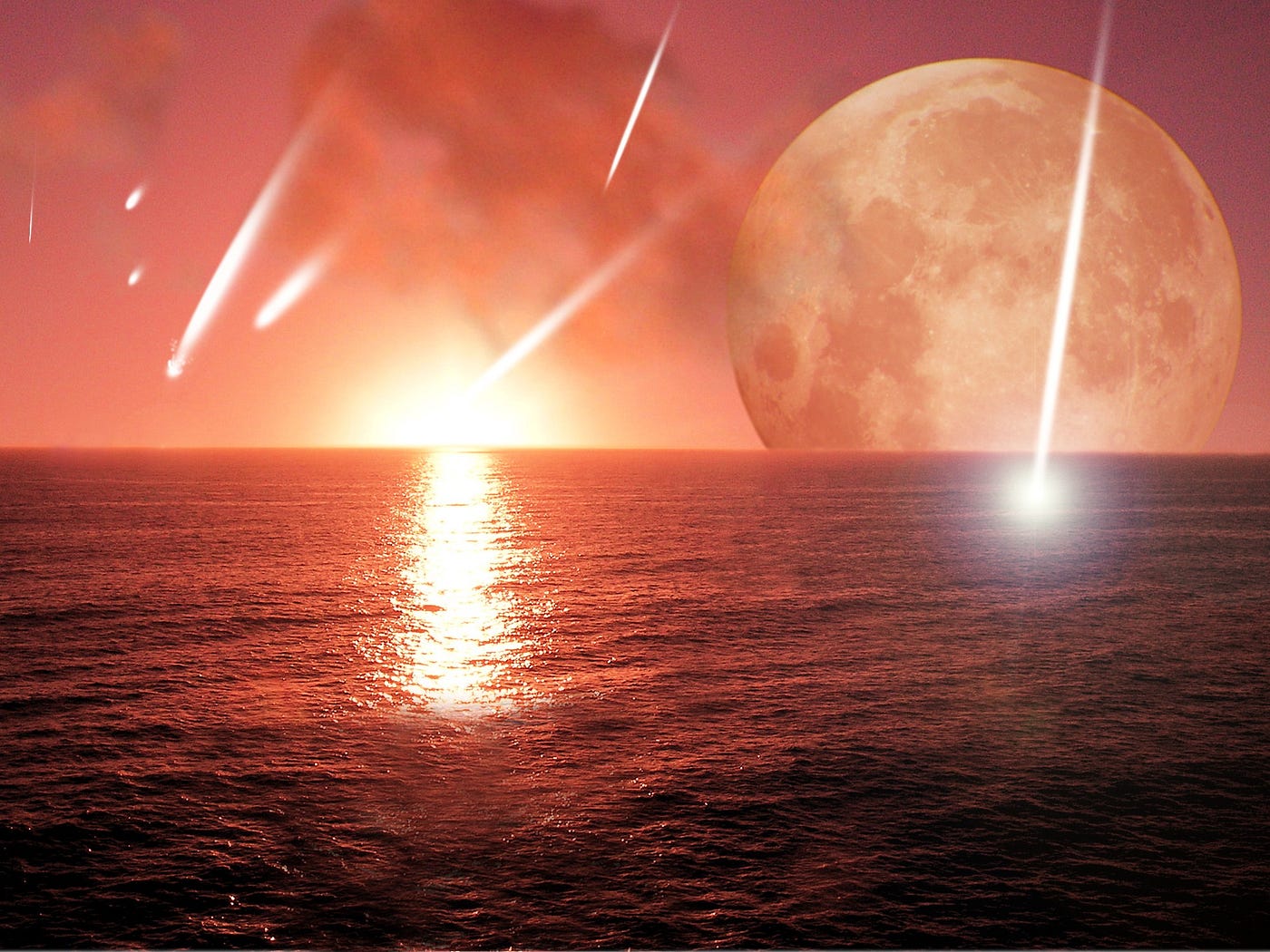
The planet itself consolidated its crust during the Hadean, an era that saw the most hellish and violent series of catastrophic events that Earth has ever experienced — not just the giant impact with the planetoid Theia, from which the Moon was born, but also a subsequent bombardment of comets and asteroids, lasting millions of years, caused by the probable orbital displacement of Jupiter and other outer planets of the solar system. The scars of that bombing are still visible today: Huge impact craters on Mars and the Moon, whose surfaces are not able to periodically regenerate like that of the Earth, aided by tectonic movements and the erosion of water and the atmosphere.
Chandra Wickramasinghe and the other authors of the cited study (whose lead author is the Australian immunologist Edward J. Steele) believe it is extremely unlikely that life could have arisen spontaneously on Earth, starting from inorganic matter, over the course of a very violent and highly unstable geologic era like the Hadean:
Rather we think it more reasonable to suggest that the particular evidence of microbial life in the Canadian rocks was delivered by cometary bolides, only to be instantly destroyed or carbonised on impact. The conditions that would most likely to have prevailed near the impact-riddled Earth’s surface 4.1 — 4.23 billion years ago were too hot even for simple organic molecules to survive let alone evolve into living complexity. This leaves panspermia as the most plausible valid option for the origin of terrestrial life; the first microbes were most likely delivered to the planet along with impacting comets and meteorites. [E.J. Steele et al., “Cause of Cambrian Explosion — Terrestrial or Cosmic?” (2018)]
So panspermia, unlike abiogenesis, supports the extraterrestrial origin of life:
In our considered view the totality of the multifactorial data and critical analyses assembled by Fred Hoyle, Chandra Wickramasinghe and their many colleagues leads to the bare minimum yet plausible scientific conclusion that life was seeded here on Earth by life-bearing comets as soon as conditions on Earth allowed it to flourish (at or just before 4.1 Billion years ago); and living organisms such as space-resistant and space-hardy bacteria, viruses, more complex eukaryotic cells and organisms (e.g. Tardigrades), perhaps even fertilised ova and plant seeds, may have been continuously delivered ever since to Earth helping to drive further the progress of terrestrial biological evolution. This process, since the time of Lord Kelvin (1871) and Svante Arrhenius (1908) has the scientific name “Panspermia”. [E.J. Steele et al., “Cause of Cambrian Explosion — Terrestrial or Cosmic?” (2018)]
Read the other parts of this story
메타데이터
- post_id
- 6eacfeec42cd
- slug
- panspermia-octopuses-and-comets-1-6-6eacfeec42cd
- url
- https://medium.com/amazing-science/panspermia-octopuses-and-comets-1-6-6eacfeec42cd
- canonical_url
- https://medium.com/amazing-science/panspermia-octopuses-and-comets-1-6-6eacfeec42cd
- author_url
- https://medium.com/@md64
- status
- ok
- fetched_at
- 2026-06-09 18:16:15