From Idea to Impact: What Winning Gold at the National AI Awards Taught Me About Research
Lessons from COGNI, our AI-Integrated Hand Function Recovery System with Smart Glove and Mobile Application For Stroke Rehabilitation
From Idea to Impact: What Winning Gold at the National AI Awards Taught Me About Research
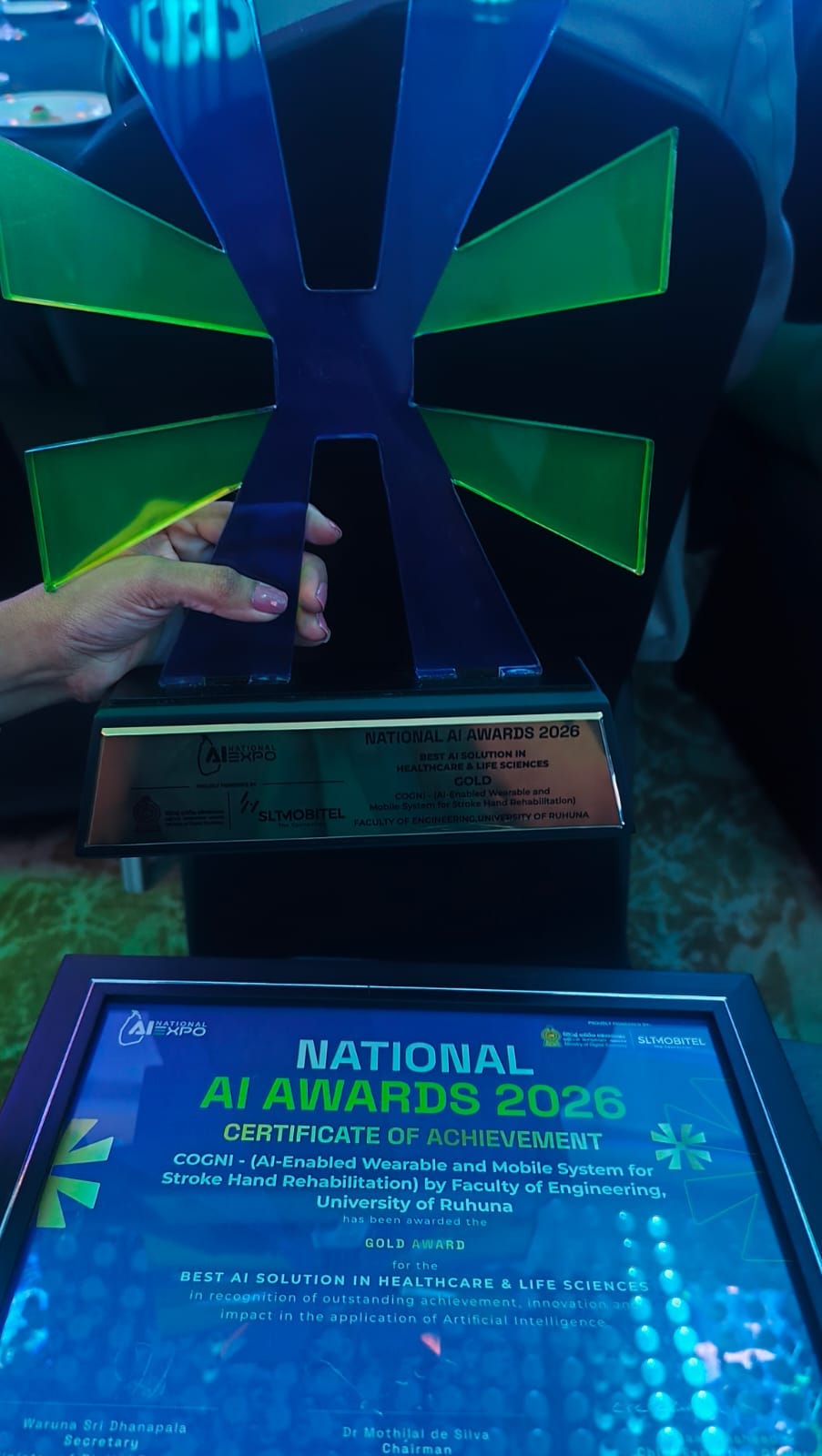


award ceremony
Lessons from COGNI, our AI-Integrated Hand Function Recovery System with Smart Glove and Mobile Application For Stroke Rehabilitation
The trophy was not the most valuable thing we brought home. The most valuable thing was a lesson about where good research actually begins.
Our team from the Faculty of Engineering, University of Ruhuna, recently received the Gold Award at the National AI Awards 2026 in the Best AI Solution in Healthcare and Life Sciences category. We competed alongside solutions from established companies and healthcare organizations across Sri Lanka. It was also the second competition our project has won.
The project is COGNI, an AI-enabled wearable and mobile system for stroke hand rehabilitation. It brings together a mobile app, interactive rehabilitation games, real-time hand tracking, a wearable smart glove, and a web platform where doctors and therapists can follow each patient’s progress.
*https://youtu.be/zESbbsmdx2k?si=jFYUBAwhXNydICvW*

system
But this article is not really about the award. It is about what the journey taught me as an engineer who wants to do research that matters. If you are a student, an early-career researcher, or someone with a head full of ideas, I hope some of this saves you a few wrong turns.
Lesson 1: Fall in love with the problem, not the idea
Most of us start the same way. We see a new technology, a smart glove, a clever AI model, and we ask, “What can I build with this?” That question feels exciting. It is also the fastest way to build something nobody needs.
The question that changed our project was different: “What is actually going wrong for stroke survivors, and why?”
Stroke often leaves people with weakened hand function. Recovery depends on repetitive, consistent exercise over long periods. Yet therapy sessions are limited, home exercises are boring and easy to skip, and therapists often cannot see what happens between visits. None of these is a technology problem. They are human problems: motivation, access, and visibility.
Once we understood that, every feature had to earn its place. The games exist because motivation is a real barrier. The glove and hand tracking exist because therapists need objective data, not guesses. The web platform exists because doctors need to see progress between sessions. The idea came last. The problem came first.
Lesson 2: A well-defined problem statement is half the solution
Before writing a single line of code, we went back to the literature. We read about stroke rehabilitation methods, existing rehabilitation devices, serious games in therapy, and sensor-based hand assessment. We also listened to the people closest to the problem: clinicians and therapists.
The literature review did three things for us:
- It showed us what already works, so we did not reinvent it.
- It showed us where existing solutions fall short, such as cost, accessibility, or lack of engagement.
- It gave us a language to describe the gap precisely.
That precision matters. “Stroke patients need better rehab” is a wish. A real problem statement names who is affected, what exactly is going wrong, why current approaches fail, and how we will know if we have improved things. When our problem statement became sharp, our design decisions became easier, our evaluation became measurable, and our presentations to judges became far more convincing.
If I could give one piece of advice to a new researcher, it would be this: spend more time on your problem statement than feels comfortable. Rewrite it until a stranger could read it and understand why it matters.
Lesson 3: The best solution is not the most impressive one
With a clear problem, we had many possible solutions. Vision-only tracking, sensor-only gloves, standalone games, clinic-only systems. Each had strengths. Each had trade-offs.
We learned to judge options against the problem, not against how impressive they looked. The questions we kept asking were simple:
- Does it solve the problem we defined, or a problem we invented?
- Can patients actually use it at home, without a technician?
- Is it affordable and practical in a Sri Lankan healthcare context?
- Does it give clinicians data they can trust and act on?
- Can we test and validate it properly?
The optimum solution is the one that balances effectiveness, usability, cost, and feasibility. Sometimes that means choosing the simpler sensor, the lighter model, or the less flashy feature. That is not a compromise. That is good engineering, and good research.
Lesson 4: Research only matters when it reaches people
A paper or a prototype is not the finish line. Impact is. For us, impact meant asking how COGNI could change a real patient’s week: more exercise done at home, more motivation to continue, and earlier, better-informed decisions from their therapist.
Thinking about impact also changed how we tested. As a Quality Assurance Engineer, I have learned that a system is only as good as its reliability in real conditions. In healthcare, that standard is even higher. A tracking error is not just a bug; it can mislead a clinical decision. So we tested not only whether features worked, but whether they worked for the people who would actually use them, including older patients with limited hand strength.
Real impact comes from that combination: a real problem, solid evidence, a well-chosen solution, and careful validation. Remove any one of them and the work stays a demo.


sessions with real patients
What comes next
If I compress everything into one line, it is this: start with the problem, research it deeply, define it sharply, choose the solution wisely, and measure your success by real impact.
None of this happened alone. Thank you to my teammates, including Taneesha Iyenshi, Hashith Sithuruwan and Malith Aberuwan, for the late nights and the shared belief. Thank you to our supervisors, Dr. Kushan Sudheera, Dr. Noeline W. Prins-Horton, and Prof. Kithsiri Pathirana, for guiding us with patience and honesty. And thank you to the University of Ruhuna, our families, and everyone who supported us.
This milestone makes me even more committed to research at the intersection of AI, healthcare, and assistive technology. I am especially interested in rehabilitation technology, wearable systems, and the rigorous testing and validation of medical AI.
If you are a researcher, clinician, or engineer working in these areas, I would love to connect. Whether it is a collaboration, a research opportunity, or simply a conversation about building technology that genuinely helps people, my inbox is open.
Keep learning, keep building, keep experimenting.
— Monilka Rajapaksha
메타데이터
- post_id
- 6ebba315b988
- slug
- from-idea-to-impact-what-winning-gold-at-the-national-ai-awards-taught-me-about-research-6ebba315b988
- url
- https://medium.com/@monilkarajapaksha/from-idea-to-impact-what-winning-gold-at-the-national-ai-awards-taught-me-about-research-6ebba315b988
- canonical_url
- https://medium.com/@monilkarajapaksha/from-idea-to-impact-what-winning-gold-at-the-national-ai-awards-taught-me-about-research-6ebba315b988
- author_url
- https://medium.com/@monilkarajapaksha
- status
- ok
- fetched_at
- 2026-10-03 09:38:59