Media and Society; What Was Said, What I Heard and What It Meant
By JemiNem
Media and Society; What Was Said, What I Heard and What It Meant
By Inebriated Oracle
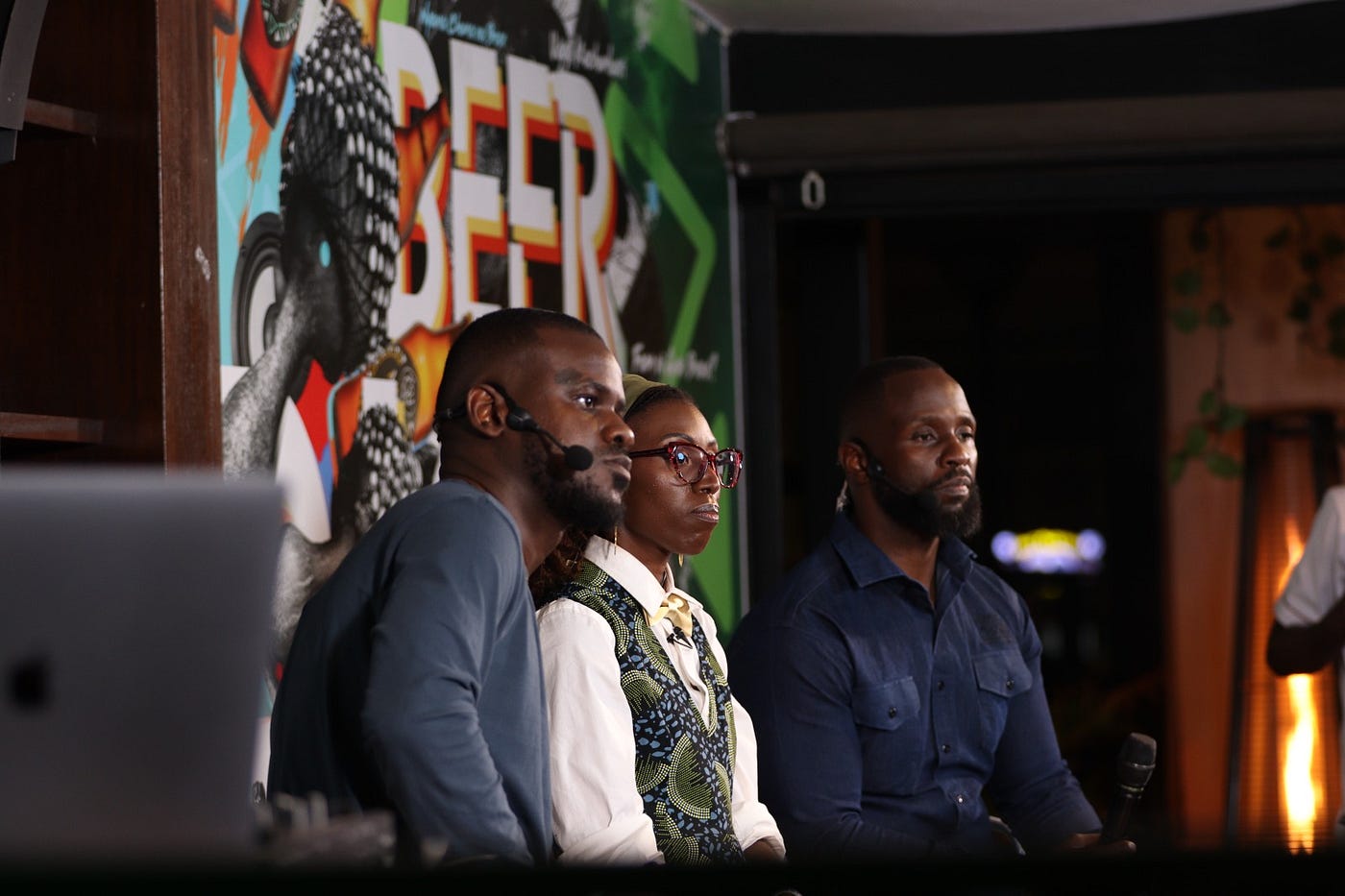
On a packed night at Drunken Lectures, John-Allan Namu, Justin Wandia and Tom Mukhwana from the podcast “The Big Picture Big Topic” hosted an insightful discussion on the profound impact of journalism and narratives on societies, particularly in Kenya. The lecture delved into the historical evolution of media, the subtle yet powerful influence of language, the ongoing battle against misinformation and the evolving role of journalists in a rapidly changing digital landscape. Here’s how the lecture unfolded:
The Crucial Role of Language and Narrative
Language shapes how we see the world, how we process information or how we relate to others. It plays a major role in how we calculate, reason or imagine possibilities. Growing up in a postcolonial society, we’ve witnessed how colonialism didn’t just strip cultures of land and identity it also disrupted communication at its core. English was presented as the language of intelligence, refinement or “superior thought,” while Kiswahili and other local languages were pushed aside, framed as languages for the uneducated or the ordinary masses, how the naskia lakini siwezi ongea brigade (I’m part of it) came to be.
This deeply rooted perception has lingered. Speaking English still often equates to power or competence, even when local languages can express the same depth and complexity. That’s why moments like the launch of KTN Leo in the early 2000s were so important. For the first time in mainstream media, the idea that Kiswahili could carry the weight of national news, analysis or public discourse gained traction. It was a turning point; proof that ideas don’t lose their weight just because they’re spoken in a local tongue.
We saw the same impact with investigative shows like Jicho Pevu. It brought complex, sophisticated stories to us in Kiswahili, capturing not just our attention, but our emotions. The contrast with English programs like Inside Story was clear: English often speaks to logic, but Kiswahili speaks to the heart. That emotional connection is powerful — it draws people in and makes them care. You feel Jicho Pevu. You nod at Inside Story. It’s no wonder vernacular stations hold such influence.
We’ve also seen how language becomes a tool of resistance. During the Finance Bill protests, Muchiri Mike’s initiative to translate the bill’s summary into multiple local languages wasn’t just an act of civic education, it was rebellion. For once, people weren’t being told what to do or how to vote; they were reading, analyzing: deciding for themselves. It reminded us that language isn’t just a method of communication. It’s a method of empowerment.
Narratives matter. The stories we choose to tell and the languages we use to tell them, shape our culture. When we center local voices and local languages, we’re not just talking, we’re building new futures. The narratives we reinforce today become the cultural norms of tomorrow.
Journalism’s True North For a long time, we were told journalism is about balance — giving equal space to both sides. But when one side holds all the power and the other is simply trying to survive, that balance becomes a lie. Journalism isn’t about standing equidistant from truth and power. It’s about standing with the people.
Tough calls have to be made. Sometimes that means refusing to give airtime to government officials who only come to spin the same narratives. We have seen what happens when the media gives them the mic: they flood the airwaves with distraction, deflection and denial. There is no value in “grilling” someone who’s only there to repeat rehearsed lines. That is not journalism. That’s just noise.
When the media fails to center the voices of ordinary people — people like us — it fails to resonate. We don’t see ourselves. We don’t hear our struggles. We tune out. Journalism must be rigorous, not neutral.
“Equality and representation on camera and newspaper is not equality of voice” - John-Allan Namu.
Just because two voices are aired doesn’t mean they are equal in weight, context, or consequence. We saw this clearly in the coverage of the Gaza conflict when genocidal acts are presented alongside political justifications as if both deserve the same airtime, that’s not balance. That’s complicity. The same applies to the Gen Z protests here at home. If the voices of young people risking their lives in the streets are simply paired with statements from officials blaming them for chaos, we miss the truth. We flatten the story. We rob it of meaning.
True journalism digs deeper. It looks beyond statements to lived realities. It questions systems, not just soundbites. When we talk about “representation,” we’re not asking for equal airtime. We’re asking for context, for care, and for truth. Because that’s the only kind of journalism that builds anything real.
Combating Misinformation and the Rise of AI Propaganda We’re living in a time where misinformation spreads faster than facts. It’s not just influencers or fake accounts. Even official government pages can post things that are completely untrue. That’s why fact-checking has become non-negotiable. We can’t afford to just guess anymore or run with assumptions. That’s how we lose credibility.
Still, it’s not all doom. We’ve seen how powerful citizens can be when they come together. Remember when Kenyans used open-source intelligence to identify the police officer who shot Boniface Mwangi? That was people power in action. The right voices were amplified; there was accountability.
But misinformation is more dangerous than ever. We’ve had government officials sharing deepfakes, pushing false foreign policy positions, shaping narratives that put actual lives at risk. It’s not enough to block accounts or flag content. We have to fight misinformation with better information. That means writing explainers for our parents, breaking down memes or giving context — not just for those spreading lies, but for those receiving them.
AI propaganda has taken the danger to a whole new level. Older generations may struggle to spot the difference. But we’re not immune either. We know it’s propaganda and yet, like cult recruits, we still find ourselves nodding along. Why? Propaganda is not just a regime tactic; it’s also a psychological tool. Repetition works. Familiarity builds trust. The lie told often enough becomes comfortable. Because propaganda doesn’t appeal to our logic. It goes for the limbic system, the animal brain. It flatters, frightens and confirms what we want to believe.
“Facts are boring, but they bear repeating.” — Justine Wandia
And they must be repeated. Kindly. Again, and again. Especially to hostile crowds, when you correct a lie too forcefully, you’re not just confronting falsehood — you’re shaking someone’s sense of self. That’s why misinformation is hard to uproot: it’s tied to identity. We can’t wait for the law to catch up. It’s up to us to flag deepfakes, correct false narratives, to help others see through the fog. Because when we don’t, we risk being manipulated into silence.
Headlines, Framing; the Journalist’s Dilemma Headlines are powerful. They stick. Consider the difference between: • Activists demonstrate at Central Police Station, and • Protesters storm Central Police Station. Same event. Completely different emotion.
Words are never neutral. They frame what matters. And in a digital age where a misleading headline can make or break a story’s reach, Tom offered a difficult truth: “If a title hurts the truth, all the backlash should be cancelled in general and shut down to the home.” Basically, we can’t afford to sell lies just to survive.
And yet, many journalists are doing just that. We also can’t ignore the pressure journalists face. Shrinking newsrooms, collapsing ad revenue, the rise of social media has made survival a daily hustle. Sometimes clickbait feels like the only way to keep the lights on. But there’s a line. Some things are not worth the clicks.
The Cost of Inconvenient Truths It’s not easy telling the truth when no one wants to hear it. After the June 25th protests in 2024, stories of a massacre in Githurai flooded the timeline. But when Africa Uncensored investigated, the evidence didn’t match the claims. That didn’t win them any popularity. People accused them of being anti-Gen Z, of protecting the state. But the facts are the facts. Our duty is to history, not hashtags.
A year later, during the 2025 protests, people came better prepared. With cameras. With receipts. That shift — from belief-based outrage to evidence-backed truth — was powerful. It showed us how narratives can change. But only if we’re brave enough to speak the truth, even when it’s unpopular. We’ve seen how powerful narratives can become reality. With weighty stories of the 2007–2008 post-election violence it wasn’t just the violence — we know the numbers, we’ve seen the images — but the layered machinery that helped make it possible. Propaganda, fear-mongering, selective language use and an astonishing silence (or compliance) from the very institutions meant to inform and protect us.
Take the phrase “Uthamaki ni witu, thamaki ni ciao,” which loosely translates to “the kingdom is ours, the fish are theirs.” At first glance, it’s a tribalistic slogan, one of many. But to stop there is to miss the point. This was a tool used during the election period, circulating among communities to create an emotional and divisive narrative. It was part of a larger story being told — a coded message that reinforced political identity and fueled suspicion. What made it dangerous was not the phrase itself, but how it was repeated, echoed and left unchallenged by media houses. The phrase became one of many that, once embedded in conversation, contributed to tensions that eventually snowballed into post-election violence. Its misuse and spread were not just divisive, they were catalytic. A tactic we have seen employed in African states time and time again.
It’s important that facts on the ground speak louder than the rumors in the air. Shatter glass houses when they shelter falsehoods, no matter how popular the narrative or how disruptive the truth may be. After all, the one who holds the pen decides which story gets told.
Standing with Independent African Journalism African media is under threat. Censorship, funding struggles, global narratives drowning out local ones — these are everyday battles. We saw it when African Stream was shut down for being “too sympathetic” to Russia. Whether or not you agree with its content, it was an African voice trying to tell our story.
Africa Uncensored’s model is one of balance — earning through commercial work and relying on donor support. But that doesn’t mean compromise. With that model comes turning down funding that comes with strings attached. Because the integrity of the story matters more than the survival of the newsroom.
What African journalists need now is solidarity. Share their work. Subscribe. Support however you can. Because if journalists fall, the burden falls on you — and carrying the truth alone is a much heavier load than having someone tow the line ahead of you.
Journalism is not just about reporting. It’s about drawing the map for others to follow. When the map is distorted, people go down the wrong road. And when that happens, the whole society loses its way. Truth isn’t easy. But the cost of not telling it is far greater.
메타데이터
- post_id
- 6ec69bf5f23a
- slug
- media-and-society-what-was-said-what-i-heard-and-what-it-meant-6ec69bf5f23a
- url
- https://medium.com/@inebriatedoracle/media-and-society-what-was-said-what-i-heard-and-what-it-meant-6ec69bf5f23a
- canonical_url
- https://medium.com/@inebriatedoracle/media-and-society-what-was-said-what-i-heard-and-what-it-meant-6ec69bf5f23a
- author_url
- https://medium.com/@inebriatedoracle
- status
- ok
- fetched_at
- 2026-06-27 18:20:27


