30 Years Ago, a Machine Beat the Smartest Human Alive. Here’s What Happened Next
This month marks exactly 30 years since a machine first defeated the greatest chess player who ever lived (IMHO).
30 Years Ago, a Machine Beat the Smartest Human Alive. Here’s What Happened Next
This month marks exactly 30 years since a machine first defeated the greatest chess player who ever lived (IMHO).
What followed wasn’t one revolution. It was four — and each one moved faster than the last.
On February 10, 1996, in Philadelphia, IBM’s supercomputer Deep Blue won a chess game against Garry Kasparov under official tournament conditions. It was the first time a computer had ever beaten a reigning world champion. Kasparov went on to win that particular match 4–2, but the seal had been broken. In the rematch, in May 1997 in New York, Deep Blue won decisively: 3.5 to 2.5.
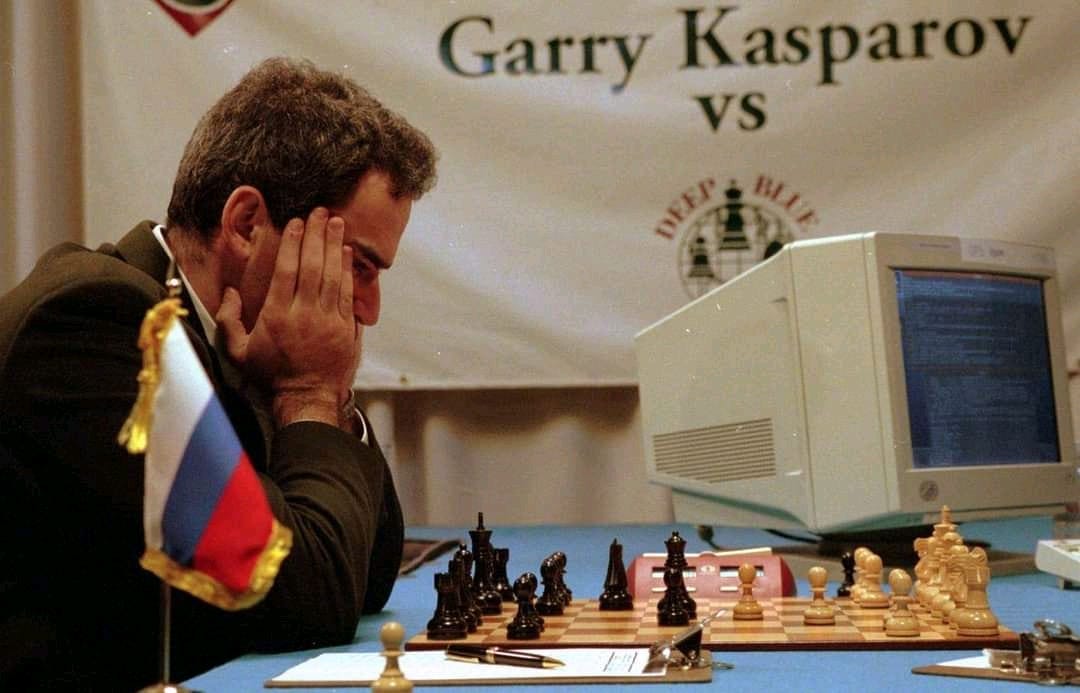
Kasparov vs Deep Blue (1996). Source: Imgur
The world didn’t know it yet, but it had just witnessed the opening scene of a drama that is still unfolding today — one that’s reshaping how we work, lead, and compete. And the fascinating part? This story plays out in four distinct acts, each compressing what used to take decades into months.
Act I: Brute Force (1996–2016)
Deep Blue was not “intelligent” in the way we discuss AI today. It was a relentless calculator: processing an astonishing 200 million chess positions per second, brute-forcing its way through possibilities until it found the best move. No creativity. No intuition. Just raw computational power applied to a game with defined rules.
But the cultural impact was enormous. Chess had always been considered the ultimate test of human intellect. For the first time, strategic intelligence — something we regarded as the last bastion of human exclusivity — had been challenged and defeated by silicon.
Kasparov’s initial reaction was visceral. After the final loss in 1997, he accused IBM of human intervention, suggesting the machine couldn’t have made certain moves on its own. And to be fair, it’s worth understanding just how extraordinary Kasparov is: he held the world’s #1 chess ranking for 20 consecutive years: a feat that places him among the most gifted minds in human history. For someone at that level of genius and competitive fire, accepting defeat from a machine was almost psychologically impossible.
I see this exact same pattern of denial every single week. In my workshops and keynotes for leaders and executives around the world, the resistance Kasparov felt in 1997 is the same resistance many still carry today: watching Generative AI draft contracts, analyze balance sheets, or build marketing strategies, and insisting it’s “just a passing fad.” When someone dismisses AI that quickly, that’s often the same defense mechanism at work — the same one that made Kasparov doubt Deep Blue.
But Kasparov’s story didn’t end with denial.
Twenty years after his defeat, in 2017, he walked onto the TED stage in Vancouver and did something that very few people at his level of brilliance could do: he admitted he was wrong. More than that: he became one of the loudest voices for artificial intelligence as a tool for human empowerment.
And it was in that moment that he articulated what I consider a foundational principle of modern day management:
“A weak human + a machine + a better process is superior to a very powerful machine alone.”
Read that again. The breakthrough isn’t the super-machine. It isn’t the super-human. It’s the process: the design of collaboration between human judgment and machine scale. Kasparov gave us the recipe for competitive survival, and it has nothing to do with buying the most expensive AI. It’s about how you orchestrate that partnership.
That TED Talk was my personal turning point. In 2014, I had led a social media monitoring project during the FIFA World Cup in Brazil, and I made a classic mistake: I underestimated the volume of data. We tried to analyze hundreds of thousands of posts using manual labor, and the result was a monumental bottleneck. I spent the following years experimenting with Natural Language Processing and Deep Learning (tools that now seem prehistoric compared to what we have today) searching for a way to process information at that scale and speed.
When I watched Kasparov speak in 2017, everything I had been experiencing technically gained a strategic purpose. He was on stage explaining exactly what my code had already been showing me: the secret wasn’t the machine replacing the analyst, it was the process that united them both. The era of manual effort was over. The era of cognitive orchestration had begun.
Incidentally, 2017 was also the year Google published “Attention Is All You Need”: the research paper that introduced the Transformer architecture, which became the foundation of everything we now call Generative AI. A year of collective awakening, even if most of the world wouldn’t notice for another five years.
Act I lasted 20 years. Act II would change everything in a single week.
Act II: Creative Strategy (2016)
If Deep Blue proved that machines could out-calculate us, what happened in March 2016 proved something far more unsettling: machines could out-create us.
The game was Go: a 3,000-year-old Chinese board game that makes chess look simple by comparison. Here’s why: in chess, a computer can feasibly evaluate most possible moves several steps ahead. In Go, the number of possible board positions exceeds the number of atoms in the observable universe. It’s a game built on intuition, spatial influence, and pattern recognition — the kind of abstract thinking that was supposed to be uniquely, irreducibly human. For decades, researchers believed a machine beating a top Go player was still generations away.
Google DeepMind’s AlphaGo faced Lee Sedol, the reigning world champion, in a five-game match in Seoul. AlphaGo won 4 to 1.
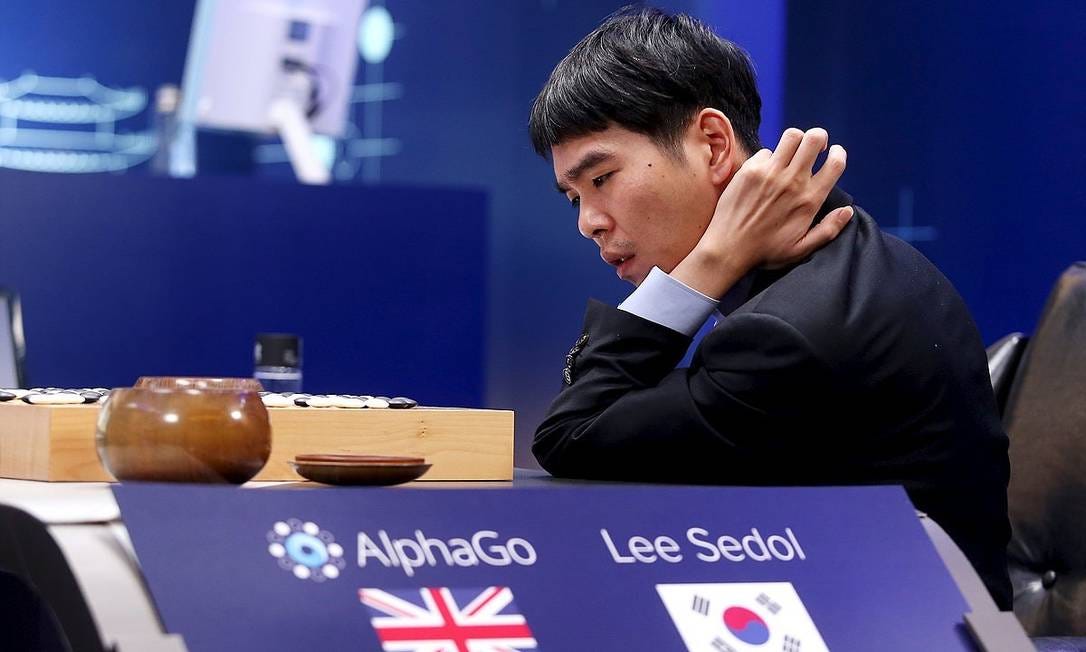
AlphaGo vs Lee Sedol (2016). Source: HANDOUT / REUTERS
But the scoreline isn’t what shook the world. What made history was Move 37.
In the second game, AlphaGo placed a black stone on a position that made every expert in the room freeze. To understand why, you need to know a basic principle of Go: early in a game, stones are conventionally placed on the third or fourth line from the edge of the board — close enough to claim territory, far enough to keep options open. Playing on the fifth line is considered too loose, too speculative. It’s the kind of move a beginner might stumble into by accident. No professional player in 3,000 years of recorded Go history would seriously consider it as a deliberate strategy.
AlphaGo played it… on purpose.
Fan Hui, the European Go champion providing live commentary, initially thought it was a mistake. Lee Sedol stared at the board for over twelve minutes — an eternity in professional Go — then stood up and left the room to compose himself. When he returned, his play was visibly shaken.
The move turned out to be brilliant. From a position that seemed completely irrelevant, it gradually shifted the balance of the entire board, building a strategic advantage that only became visible many moves later. AlphaGo’s neural networks had estimated that only 1 in 10,000 human professionals would ever make such a move.
This was the moment the machine stopped being a calculator and became a creative strategist. Deep Blue had won through sheer speed. AlphaGo won through something that looked remarkably like imagination. Lee Sedol’s reaction mirrored Kasparov’s from two decades earlier: the same existential shock at discovering the machine had found beauty and logic that three millennia of human mastery had never mapped.
Act I lasted 20 years. Act II changed everything in a single week. Act III would compress even further.
Act III: Language (2022–2024)
If Act I was about computation and Act II about creativity, Act III was about something even more fundamental: communication.
On November 30, 2022, OpenAI released ChatGPT. Within two months, it reached 100 million users. By late 2024, it had surpassed 200 million active weekly users, making it the fastest-adopted technology in human history.
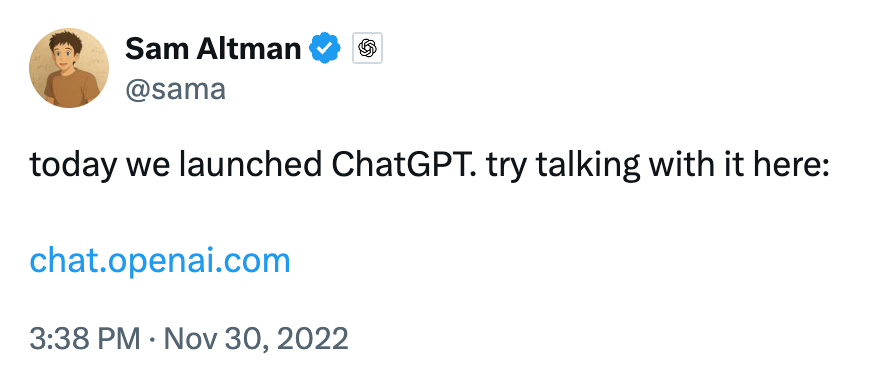
Sam Altman, CEO of OpenAI, announces the launch of ChatGPT (2022). Source: X.com
What made ChatGPT revolutionary wasn’t just its capability — it was its accessibility. For the first time, you didn’t need to be a programmer, a data scientist, or a chess grandmaster to interact with artificial intelligence. You just needed to type. In plain language. In any language. AI had learned to speak our tongue, and in doing so, it democratized access to intelligence on a scale the world had never seen.
And right on cue, the denial pattern returned… but compressed. The cycle that took Kasparov twenty years now played out in months. “It’s just autocomplete.” “Students will get lazy.” “Block it at work.” “It’s a passing fad.” I heard every version of this in boardrooms across the UK, the United States, India, and Brazil.
But the companies that moved past denial quickly — the ones that embraced Kasparov’s formula of human judgment + AI capability + a well-designed process — started reporting productivity gains of up to 40%. That’s like gaining two extra days in your work week. And they didn’t achieve this by having better AI than their competitors. They achieved it by having a better process for human-AI collaboration. They trained their teams. They ran workshops. They created safe spaces for experimentation. They understood that, as with any powerful tool, the quality of the output depends entirely on the quality of the input.
This is the concept Kasparov called “Augmented Intelligence,” and I think the simplest way to understand it is this: stop thinking of AI as something that thinks for you, and start thinking of it as an exoskeleton for your mind. It handles the repetitive, mechanical work — the formatting, the searching, the summarizing — so you can go back to doing what actually requires a human: judging, creating connections, feeling empathy, making ethical decisions.
AI doesn’t replace you. It frees you to stop acting like a machine, so you can finally go back to being a strategist.
Act I lasted 20 years. Act II, about one year. Act III, roughly two. Act IV is happening right now — and it’s moving faster than all the previous acts.
Act IV: Agency (2025 and Beyond)
We’ve gone from AI that calculates (Deep Blue), to AI that creates (AlphaGo), to AI that communicates (ChatGPT). Now, we’ve entered something fundamentally new: AI that acts.
Welcome to the era of Intelligent Agent Networks.
Here’s the difference. A chatbot (or AI Assistant) waits for you to ask a question, then responds. An AI agent is something else entirely: it’s an autonomous system that can understand a goal, break it into steps, execute actions across multiple tools and data sources, and course-correct along the way — without needing a human to prompt every single move. And when you connect multiple specialized agents into a network — each one handling a different part of a complex process — you get something that starts to resemble a digital workforce operating around the clock.
I’m already seeing this in my consulting work. A large law firm where AI agents conduct complex legal research in seconds. A logistics company where agents optimize delivery routes in real time, adjusting for traffic, weather, and demand. A hospital where agents analyze thousands of medical records to identify patterns that human doctors might take years to notice — specifically targeting the prevention of hospital infections.
I experienced this power firsthand while writing my book, Cognitive Organizations. I used a network of 37 AI agents for everything from research and literature review to editing and reference verification. The result: a book completed in 50 days, with software (API) costs of approximately $200.
If Deep Blue was a soloist playing one note very fast, today we’re conducting an orchestra of agents capable of planning, executing, and correcting course in real time. We’re no longer watching the game: we’re redesigning how the world works.
In early 2024, I developed what I now call my “Council of Notables”: a network of AI agents programmed to simulate the perspectives and decision-making frameworks of great business thinkers and classic management authors. Unlike Deep Blue’s monologue of calculation, this system creates a dialogue of perspectives. I use it in strategic planning sessions to challenge my own biases and blind spots. It’s Kasparov’s formula: human + machine + process, applied thirty years later, and it works.
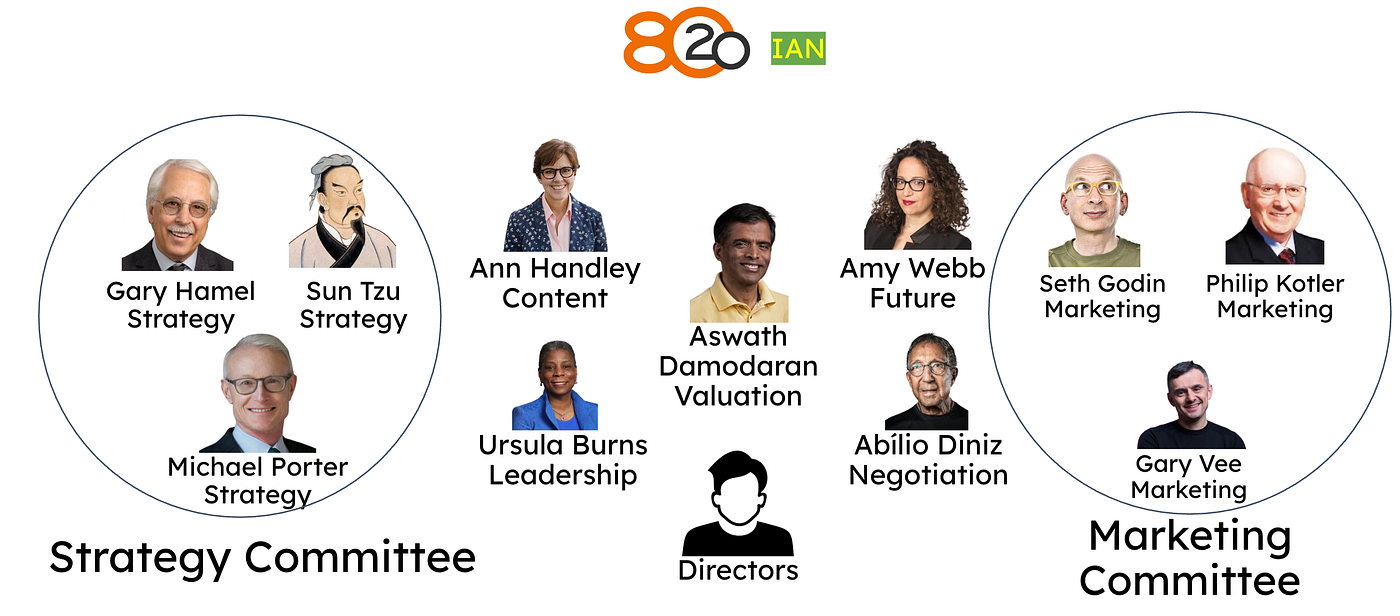
The first version of my Council of Notables, presented at MIT CSAIL (2024)
The Double-Edged Sword
Three decades after Deep Blue, we face a delicate balance: and both edges of the blade can cut.
Resisting AI today is a form of planned obsolescence. It’s like an engineer refusing to use a calculator, or a doctor ignoring the X-ray. Refusing to engage with these transformations doesn’t protect your relevance — it quietly erodes it.
But the opposite extreme — surrendering blindly to the algorithm — is equally dangerous. If you use AI to think for you, instead of thinking with you, you outsource your essence. The risk is mediocrity at scale: decisions without context, strategies without soul, and the amplification of biases the machine simply repeats without questioning.
Kasparov’s thirty-year journey — from rage to denial to advocacy — gives us the roadmap. Maximum AI power. Firm human hand on the wheel of critical judgment.
AI can give us the best strategy, the most precise analysis, the most complete report. But only the human knows why we’re doing it, who we’re serving, and what impact we want to generate in the world.
The machine plays the game. We choose which game is worth playing.
메타데이터
- post_id
- 6ecbba2daccc
- slug
- 30-years-ago-a-machine-beat-the-smartest-human-alive-heres-what-happened-next-6ecbba2daccc
- url
- https://medium.com/@kennethcorrea/30-years-ago-a-machine-beat-the-smartest-human-alive-heres-what-happened-next-6ecbba2daccc
- canonical_url
- https://medium.com/@kennethcorrea/30-years-ago-a-machine-beat-the-smartest-human-alive-heres-what-happened-next-6ecbba2daccc
- author_url
- https://medium.com/@kennethcorrea
- status
- ok
- fetched_at
- 2026-07-28 19:46:03




