Edgar Allan Poe Taught Me to Listen to the Dark, Rather than Fear it.
What happened when I stepped inside the House of Poe.
Edgar Allan Poe Taught Me to Listen to the Dark, Rather than Fear it.
What happened when I stepped inside the House of Poe.
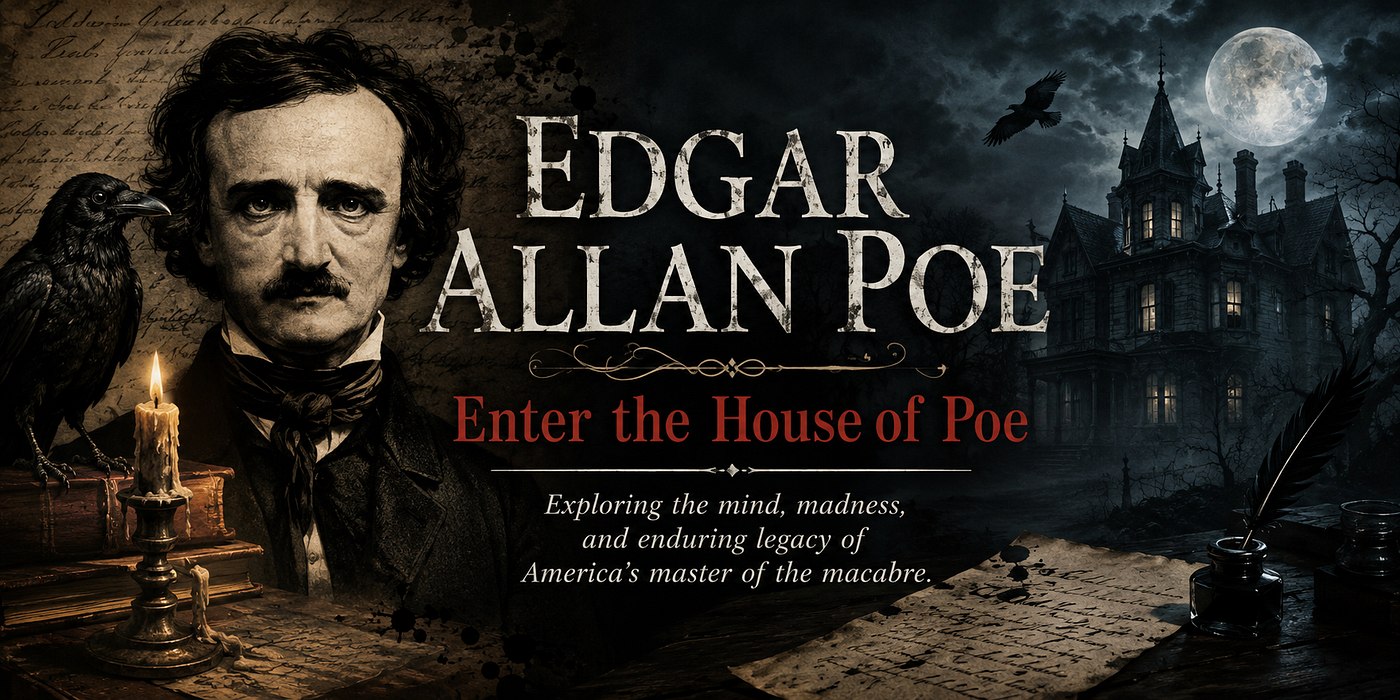
Chat gpt image
There are writers you admire. There are writers you study. And then there are writers who quietly move into your imagination and never really leave.
For me, Edgar Allan Poe was one of those writers. The first time I read him, I expected ghosts, ravens, and gloomy old houses. That’s the reputation, after all. Instead, I found something far more unsettling. I found myself.
Not literally, thankfully. I wasn’t hiding under floorboards listening for a telltale heartbeat. But I recognized something in the way Poe wrote about fear — not as something lurking outside the window, but as something growing quietly inside the mind.
That realization changed the way I read. Eventually, it changed the way I write.
Walking Through the House of Poe
Reading Poe feels like walking into an old Victorian house where someone forgot to open the curtains. You instinctively lower your voice. The floorboards creak. The wallpaper seems to watch you. Every hallway promises that something dreadful has happened here — even if you can’t quite prove it.
Poe never seemed interested in comforting his readers. He wanted us to linger in uncertainty. He wanted us to question what was real and what was imagined. More importantly, he wanted us to realize that those two things are often separated by a very thin line.
That’s what keeps his stories alive almost two centuries later. His monsters weren’t vampires or werewolves. His monsters were guilt. Obsession. Memory. Regret.
Those creatures never go out of style.
The Scariest Place Is the Human Mind
As I’ve grown older — and hopefully a little wiser — I’ve come to believe that Poe understood something many writers still overlook. The greatest horror isn’t what jumps out of the closet. It’s the story we tell ourselves after the door closes.
Fear doesn’t usually arrive screaming. It whispers. It sounds reasonable. It explains why we shouldn’t trust someone. Why we’ll probably fail. Why that mistake from twenty years ago still defines us.
The mind can become its own haunted house. Poe knew that long before psychology gave it a name. His narrators don’t simply go mad. They convince themselves they’re perfectly rational while slowly building the prison they’ll eventually inhabit.
That’s terrifying because we’ve all done some version of it. Maybe not with hidden bodies beneath the floorboards. But with old regrets. Old grief. Old stories about who we think we are.
He Wasn’t Writing About Death
People often describe Poe as obsessed with death. I don’t think that’s quite true. I think he was fascinated by what grief does to people who refuse to let it move.
His characters cling. They replay memories. They become consumed by one idea until every other possibility disappears.
- Love becomes possession.
- Curiosity becomes compulsion.
- Justice becomes revenge.
- One thought becomes the entire universe.
As a writer, I’ve found that fascinating.
Not because I want to write depressing stories — but because every memorable character is obsessed with something.
- The detective obsessed with truth.
- The lover obsessed with someone they cannot have.
- The villain obsessed with proving they’re right.
Poe understood that obsession creates momentum. Characters don’t drift through stories. They chase something. Even when it destroys them.
The Lesson That Changed My Writing
For years I assumed writers simply poured emotion onto the page. Write what you feel. Write from the heart. Write your pain.
Then I began studying Poe more carefully. That’s when I realized he wasn’t dumping emotions onto paper. He was engineering them. Every repeated word. Every image. Every sound. Every sentence rhythm. Everything served a purpose.
The darkness wasn’t accidental. It was designed.
That may be the greatest lesson Poe ever taught me. Emotion without structure is therapy. Emotion shaped with intention becomes literature. There’s a world of difference.
The Atmosphere Is the Story
One thing I continually return to in Poe’s work is atmosphere. His settings aren’t backgrounds. They’re accomplices.
- The house participates.
- The storm participates.
- The silence participates.
- Even the furniture seems to have opinions.
As someone who writes paranormal suspense, I think about that constantly. Readers remember places that feel alive. A hallway should feel like it’s listening. A staircase should hesitate. A forgotten hotel should carry secrets long before anyone finds the body.
Poe taught me that atmosphere isn’t decoration. It’s another character.
Why He Still Matters
Nearly two hundred years later, Edgar Allan Poe continues to influence mystery writers, horror writers, thriller writers, and anyone interested in exploring the strange architecture of the human mind. His stories remind me that fear isn’t always loud.
Sometimes it’s quiet enough to sound like common sense. Sometimes it’s memory. Sometimes it’s guilt. Sometimes it’s simply one thought repeated often enough that it becomes truth.
Those are the shadows worth writing about.
Stepping Back Into the Light
Every time I return to Poe, I discover something different. Not because his stories change. Because I do. That’s the mark of timeless literature. It keeps revealing new rooms inside the same old house.
If you’ve never ventured very far beyond The Raven or The Tell-Tale Heart, I encourage you to wander deeper. Step quietly. Listen carefully. Mind the heartbeat beneath the floor.
You may discover, as I did, that the most fascinating mysteries were never hiding in the darkness. They were waiting patiently inside your own imagination all along.

AI capture of author and cat
Thank you for reading my story! If you found this interesting or useful, please clap and click the REPOST icon to help others find it.
Like to read suspense fiction? Click here for a free short story: www.sherrybriscoe.com, or you can get the full book here: CHANNELING EDGAR ALLAN POE From obsession to atmosphere: a gothic guide for modern writers inspired by Edgar Allan Poe. Write stories that breathe, whisper, and haunt. https://a.co/d/0hmfwwZo
Your friend, fellow writer, and lover of all things supernatural,
Sherry Briscoe
Reader, Writer, Wordsmith Advisor — writing and marketing tips for indie authors, and occasional words of inspiration.
메타데이터
- post_id
- 6ee19fd79655
- slug
- edgar-allan-poe-taught-me-to-listen-to-the-dark-rather-than-fear-it-6ee19fd79655
- url
- https://medium.com/tales-of-terror-paranormal-and-the-strange/edgar-allan-poe-taught-me-to-listen-to-the-dark-rather-than-fear-it-6ee19fd79655
- canonical_url
- https://medium.com/tales-of-terror-paranormal-and-the-strange/edgar-allan-poe-taught-me-to-listen-to-the-dark-rather-than-fear-it-6ee19fd79655
- author_url
- https://medium.com/@sherryabriscoe
- status
- ok
- fetched_at
- 2026-07-09 00:50:33