DGFT License vs IEC Code: Major Differences registraton DGFT License vs IEC Code: Key Differences…
The Directorate General of Foreign Trade (DGFT) regulates the international trade ecosystem in India with respect to imports and exports…
DGFT License vs IEC Code: Major Differences registraton DGFT License vs IEC Code: Key Differences Every Importer and Exporter Should Know in 2026
The Directorate General of Foreign Trade (DGFT) regulates the international trade ecosystem in India with respect to imports and exports under the Foreign Trade Policy. When entering the global market, businesses are obligated to comply with two critical documents: the Import Export Code (IEC) and the DGFT Licence.
Many entrepreneurs believe that the **IEC **and DGFT Licence refer to the same instrument. However, these two documents serve different purposes and are required under different circumstances. Understanding the difference between these two documents will assist you in ensuring compliance and that your international trading operations run smoothly.
DGFT REGISTRATION
What is an Import Export Code
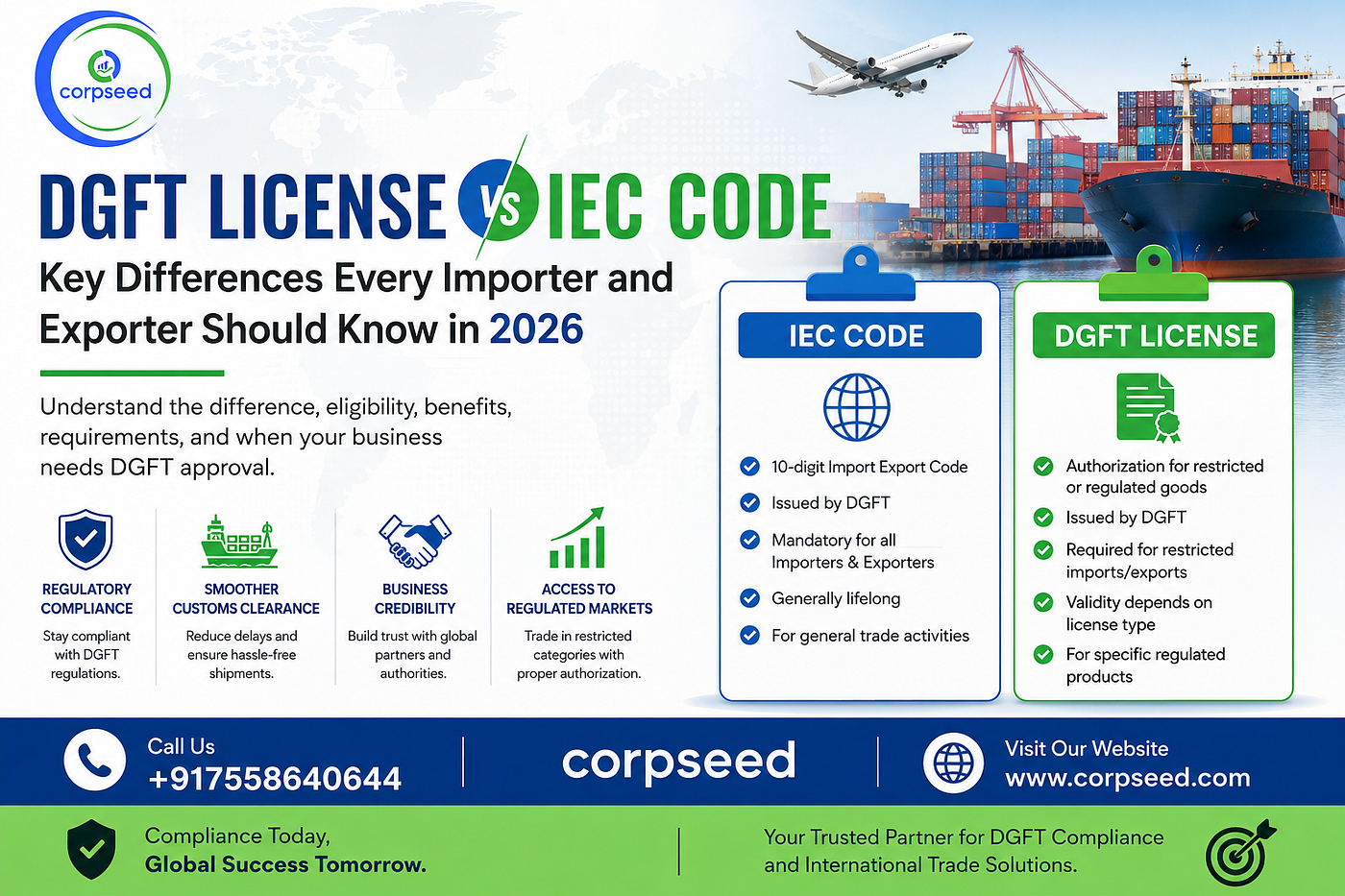
An Importer-Exporter Code (IEC) is a unique (10) ten-digit identification number issued by the Directorate General of Foreign Trade. All businesses importing goods and services to India, or exporting goods and services from India must have an IEC.
Without an IEC, businesses cannot do the following: • Import goods to India. • Export goods from India. • Receive foreign currency payments for their exports. • Clear shipments through customs.
The IEC is also the first step for a business wishing to participate in international trade.
What is a DGFT License
The DGFT License is a unique permit that can legally allow an importer or exporter to bring in or send out restricted items (or products) include regulated (not forbidden) or sensitive (dangerous) items. Therefore, The Import Export Code (IEC) allows you to conduct business internationally, but you are required to get extra permission from DGFT before importing or exporting specific categories of product reasons indicated below:
Type of Goods
A. Certain Chemical Products B. Defense-Related Products C. Hazardous Material D. Restricted Technologies E. Certain Types of Agricultural Goods
With the use of a DGFT License all of these transactions must comply with national and international law and regulate whether your legal traded “goods” will be done in accordance with both the laws of your country and those of the country to which you wish to export or use.
DGFT License vs IEC Code: Major Differences

When is IEC Alone Sufficient
Businesses engaged in the international trade of “free” goods under India’s import/export law would generally find that an IEC is adequate.
Typical goods that would fall within this definition would include:
A. Garments B. Consumer goods C. General industrial goods, and D. Non-restricted machinery; as well as handicrafts.
Therefore, under these circumstances, businesses may export/import goods with the Indian Government (via DGFT) without requiring additional DGFT authorization.
When is a DGFT License Required
A DGFT license is required when products are in the categories established as restricted by the government.
Examples of how businesses may need to obtain DGFT approvals:
- Restricted Imports
- Restricted Exports
- Strategic Products
- Environmentally Sensitive Goods
- Industrial Material (Specialty)
Importers and exporters must verify product classifications carefully before commencing international transactions.
Benefits of Obtaining DGFT Authorization
Regulatory Compliance
The DGFT permits companies to comply with India’s laws governing foreign trade.
Decreased Customs Delays
If your business or product is properly licensed, there are typically fewer delays due to the administrative verification process of customs.
More Credible Business Partners
Businesses that have a valid license will typically receive more trust from their business partners and government regulatory agencies than unlicensed businesses.
Access to Regulated Markets
Some products will only be able to be traded after obtaining DGFT approval to trade (import or export).
Common Mistakes Businesses Make
Delays are a problem for many companies because of:
- Assuming that IEC is only needed.
- Being incorrect about the classification of their products.
- Ignoring DGFT notifications.
- Incorrect documentation submission.
- Applying for licenses after planning to ship.
A well-planned compliance strategy can help prevent costly disruptions.
How to Determine Whether Your Product Requires a DGFT License
Businesses should review:
-
Current Foreign Trade Policy provisions
-
ITC (HS) classifications
-
DGFT notifications
4 .Product-specific restrictions
Consulting trade compliance experts can simplify the process and reduce the risk of non-compliance.
Also Read: https://www.corpseed.com/service/dgft-license-for-restricted-import-export
Future of DGFT Compliance in India
As a result of increased digitization and modernization of trade initiatives, DGFT processes will be more streamlined going forward. This means that businesses will benefit from greater transparency, quicker processing times and improved online compliance systems over the next few years.
To maintain a continuous flow of business and promote sustainable growth, companies engaged in international trade must continue to stay abreast of the changing DGFT rules and regulations.
Conclusion
In India’s global trade ecosystem both the IEC & DGFT Licences are critical components. The IEC is the primary form of registration for exporting and importing products internationally, while the DGFT Licence is an additional form of authorisation for shipping certain types of restricted/controlled products globally.
By understanding how these licenses differ, organisations can ensure that they are in compliance with trading regulations, thus avoiding customs problems and facilitating expedient international trade.
Related Resource: For businesses dealing with restricted imports or exports, understanding the requirements of a **DGFT Export Import License** can help ensure smooth regulatory compliance and trade operations.
Get your DGFT Certificate quickly with expert assistance from Corpseed. Simplify your import-export registration process and stay compliant with DGFT requirements. Call Corpseed at +91–7558–640–644 and start your DGFT registration online today.
메타데이터
- post_id
- 6ef3a31faad1
- slug
- dgft-license-vs-iec-code-major-differencesgistratondgft-license-vs-iec-code-key-differences-every-6ef3a31faad1
- url
- https://medium.com/@manish.arya_24628/dgft-license-vs-iec-code-major-differencesgistratondgft-license-vs-iec-code-key-differences-every-6ef3a31faad1
- canonical_url
- https://medium.com/@manish.arya_24628/dgft-license-vs-iec-code-major-differencesgistratondgft-license-vs-iec-code-key-differences-every-6ef3a31faad1
- author_url
- https://medium.com/@manish.arya_24628
- status
- ok
- fetched_at
- 2026-06-23 17:05:31