The First Night of a Blackout: Which Appliances Drain a Home Battery Faster Than Expected?
The first night of an outage is usually when people learn the hard way that their battery math was wrong. I found this out during a 2023…
The First Night of a Blackout: Which Appliances Drain a Home Battery Faster Than Expected?
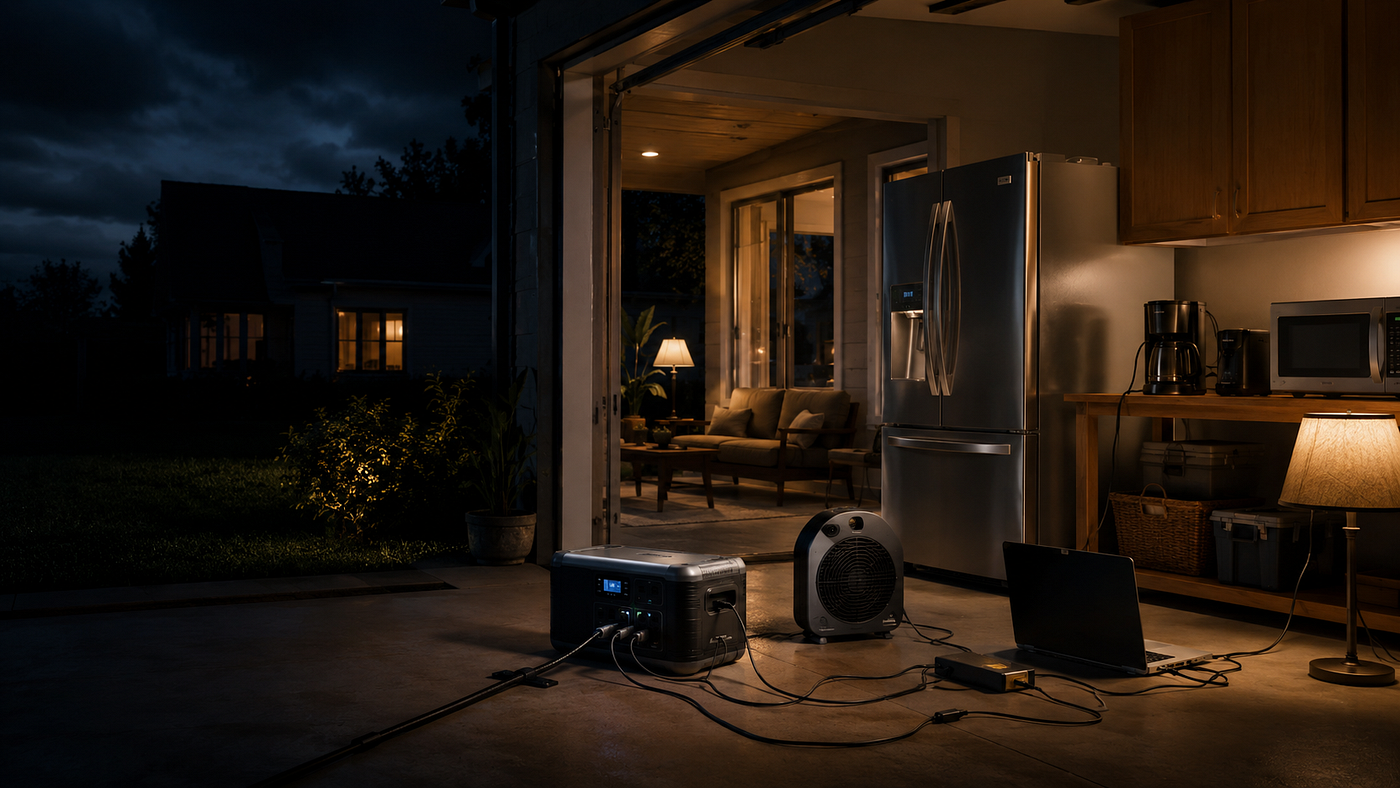
The first night of an outage is usually when people learn the hard way that their battery math was wrong. I found this out during a 2023 outage when my fridge alone ate through more of my battery’s capacity overnight than I expected, and I hadn’t even turned on anything else power hungry yet. It wasn’t the running wattage that got me. It was the startup surge every time the compressor kicked back on.
If you’re planning your first night of home backup power, here’s what actually drains a battery faster than the label on the appliance would suggest.
Running Watts vs Starting Watts: The Number Most People Miss
Almost every appliance lists a running wattage, how much power it uses once it’s already on and operating steadily. Fewer people check the starting wattage (also called surge or inrush wattage), which is the short burst of extra power many motor-driven appliances need the instant they switch on. This surge can be two to three times higher than the running wattage, and it happens every single time the appliance cycles on, not just once.
This matters because your solar generator or home battery has a continuous output rating and often a separate, higher surge rating. If an appliance’s starting wattage exceeds what your unit can briefly supply, it can trip the unit’s overload protection, even if the appliance’s running wattage looked perfectly fine on paper.
Appliances That Surprise People Most
ApplianceTypical running wattsTypical starting surge wattsRefrigerator100 to 250800 to 1,200Sump pump800 to 1,0001,300 to 2,200Window AC unit500 to 1,2001,500 to 2,500Well pump1,000 to 2,0002,000 to 4,000Space heater1,200 to 1,500Roughly the same, resistive load, no significant surgeMicrowave600 to 1,200Roughly the same, minimal surge
Note that these are general industry ranges, and your specific appliance’s nameplate rating (usually on a sticker on the back or bottom of the unit) is always the number to trust over general estimates.
The pattern worth noticing: motor-driven appliances (fridges, pumps, AC units) have the biggest gap between running and starting watts. Purely resistive appliances (space heaters, toasters, most microwaves) draw fairly steady power without a major surge.
Why the Fridge Specifically Catches People Off Guard
A refrigerator doesn’t run continuously, it cycles on and off throughout the day to maintain temperature, and the compressor draws its surge wattage every single time it kicks back on, not just once at the start of the outage. Over a full night, that’s potentially dozens of surge events, each pulling a brief spike well above the appliance’s steady running wattage. This is exactly what caught me off guard during my 2023 outage. I’d budgeted battery capacity based on the fridge’s running wattage listed on the Energy Guide label, not accounting for how often the compressor cycle would repeat overnight, or the surge each cycle required.
What I Actually Changed After That First Night
After that outage, I stopped sizing my backup power around running wattage alone. Before buying or upgrading any backup unit now, I check three things:
- The unit’s surge wattage rating, not just continuous output. A unit rated for 2,000 watts continuous might only handle a 3,000 watt surge briefly. If your fridge and sump pump could theoretically surge at the same moment, add their surge numbers together and compare against that rating.
- How many motor driven appliances I actually need running at once, since each one adds its own surge event, and those can stack if multiple appliances cycle on simultaneously.
- The manufacturer’s actual surge handling spec, not just marketing claims. Cheaper units are more likely to advertise a high continuous wattage number while glossing over how they handle surge loads, which is exactly the gap that trips people up on their first real outage.
This is really the bigger lesson from that whole experience: buying a solar generator based on the biggest advertised wattage number, without checking how it actually handles appliance startup surges, is how people end up with a unit that shuts off unexpectedly during the exact moment they need it most.
One brand I looked into that publishes clear surge wattage specs alongside continuous output, rather than just leading with a headline capacity number, is Nature’s Generator. Whichever unit you choose, check the surge rating against your specific appliances before you assume it’ll handle your first night without issues.
Frequently Asked Questions
Why did my battery drop faster than expected even though I wasn’t running much? This is usually the fridge compressor cycling repeatedly overnight, each cycle pulling a brief surge well above its steady running wattage. It’s one of the most common reasons people underestimate overnight battery drain.
How do I find my appliance’s actual surge wattage? Check the manufacturer’s spec sheet or manual, since the sticker on the appliance itself usually only lists running wattage. For appliances with a compressor or motor (fridges, pumps, AC units), assume the surge could be two to three times the running wattage unless the manufacturer states otherwise.
Should I unplug my fridge overnight to save battery during an outage? Generally not recommended, since food safety depends on maintaining consistent temperature. Instead, size your battery and continuous output rating around the fridge’s actual surge requirements rather than removing it from your power plan.
Does this surge issue apply to solar generators specifically, or all backup power sources? It applies to any battery-based system with a continuous and surge output rating, which includes solar generators and home battery systems. It generally doesn’t apply the same way to traditional gas generators, which are often sized with more surge headroom by design, though checking the specific unit’s spec sheet is still worth doing. Our comparison of solar and gas generators for extended outages covers this difference in more detail.
Final Thoughts
The first night of a blackout is where theoretical battery math meets real appliance behavior, and the gap between the two usually comes down to startup surge, not running wattage. Check your appliances’ actual surge requirements against your unit’s surge rating before you’re relying on it in the dark, not after your battery drops faster than the spec sheet suggested it would.
메타데이터
- post_id
- 6f01b4d032f2
- slug
- the-first-night-of-a-blackout-which-appliances-drain-a-home-battery-faster-than-expected-6f01b4d032f2
- url
- https://medium.com/@iamstephmontana/the-first-night-of-a-blackout-which-appliances-drain-a-home-battery-faster-than-expected-6f01b4d032f2
- canonical_url
- https://medium.com/@iamstephmontana/the-first-night-of-a-blackout-which-appliances-drain-a-home-battery-faster-than-expected-6f01b4d032f2
- author_url
- https://medium.com/@iamstephmontana
- status
- ok
- fetched_at
- 2026-07-17 08:37:47