How Childhood Trauma Slowly Becomes Your Identity
How unspoken wounds rewrite your mind, your heart, and your life
How Childhood Trauma Slowly Becomes Your Identity
How unspoken wounds rewrite your mind, your heart, and your life
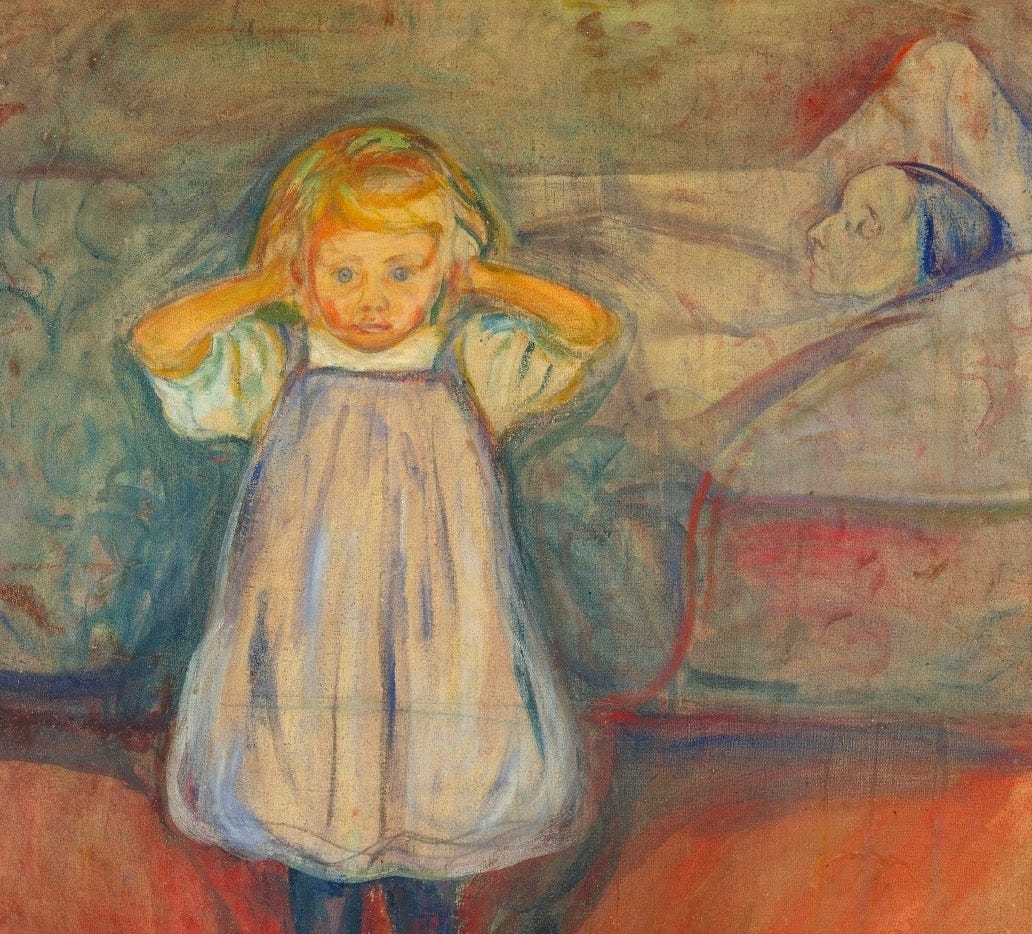
The Child and Death | By Edvard Munch — The Athenaeum: pic
There is a child in the room who does not cry out loud.
She has already learned that sound can be dangerous. Those footsteps can carry storms. That love can arrive with a hand that trembles between warmth and harm.
So she folds herself inward, small as a secret, and teaches her voice to disappear before it is ever heard.
This is how it begins. Not with a single wound, but with a quiet education.
In that house, nothing is named as it truly is.
Fear wears the costume of discipline. Loneliness is called independence. Silence is mistaken for peace. The child grows inside this confusion like a plant reaching toward a sun that never quite arrives.
She does not know that something is wrong. She believes this is simply how the world breathes.
And then there is a moment.....
It is never loud enough for others to notice. A door closes too hard. A word lands too sharply. A gaze turns away when it should have stayed. In that instant, something fragile inside her mind bends and does not return to its original shape.
She learns that safety is uncertain. That love must be earned. That her own feelings are too much or not enough.
She learns to survive.
She becomes careful.
She becomes watchful.
She studies faces the way others study books, searching for signs of danger in the smallest changes.
She grows kind in a way that exhausts her, giving more than she owns, hoping it will buy her a place where she can finally rest. Or she becomes distant, wrapping herself in a cool armor that keeps both harm and tenderness away.
This is how a personality is built from fractures.
Years pass.
The child becomes an adult.
Her body stretches into time, but her fears remain small and ancient.
A simple silence feels like abandonment. A raised voice echoes like a storm from years ago.
She reacts before she understands why. Her heart runs ahead of her reason, carrying memories that have no language.
She tells herself this is who she is.
She says she is anxious.
She says she is difficult.
She says she cannot love properly.
Cannot trust fully.
Cannot breathe easily in rooms that others find ordinary.
She does not see the invisible thread that ties her present to a past she was never allowed to question.
This is the quiet cruelty of childhood trauma. It hides itself so well that it becomes her identity.
It follows her into love, where closeness feels like a fragile illusion. It follows her into success, where joy feels like a borrowed coat that does not belong to her. It follows her into solitude, where even peace feels unfamiliar, as if calm itself is a kind of danger.
And still, within her, the child remains.
Not gone.
Not healed.
Only hidden in plain sight.
She waits in the pauses between thoughts. In the hesitation before speaking. In the reflex of shrinking, apologizing, and disappearing. She waits to be seen without consequence. To feel without correction. To exist without the quiet fear that something will turn.
The shape of her life was drawn before she understood what shape meant.
But to see it, truly see it, is a kind of awakening. A quiet refusal to remain unnamed.
The past does not loosen easily, but recognition begins to soften its edges.
To name the silence is to disturb it. To feel the wound is to prove it is real. And perhaps, slowly, with a care that trembles but does not break, she may begin to draw again.
Not perfectly.
Not completely.
But enough to make space for a self that was never allowed to fully arrive.

“The author of this article, Sadman Sakib Ayon.”
Visit Sadman Sakib Ayon’s main Medium profile to explore more stories: https://sadmansakibayon1.medium.com
메타데이터
- post_id
- 6f09fbf28b4a
- slug
- how-childhood-trauma-slowly-becomes-your-identity-6f09fbf28b4a
- url
- https://medium.com/reflections-and-realities/how-childhood-trauma-slowly-becomes-your-identity-6f09fbf28b4a
- canonical_url
- https://medium.com/reflections-and-realities/how-childhood-trauma-slowly-becomes-your-identity-6f09fbf28b4a
- author_url
- https://medium.com/@lostinbangladesh
- status
- ok
- fetched_at
- 2026-07-17 06:05:59